

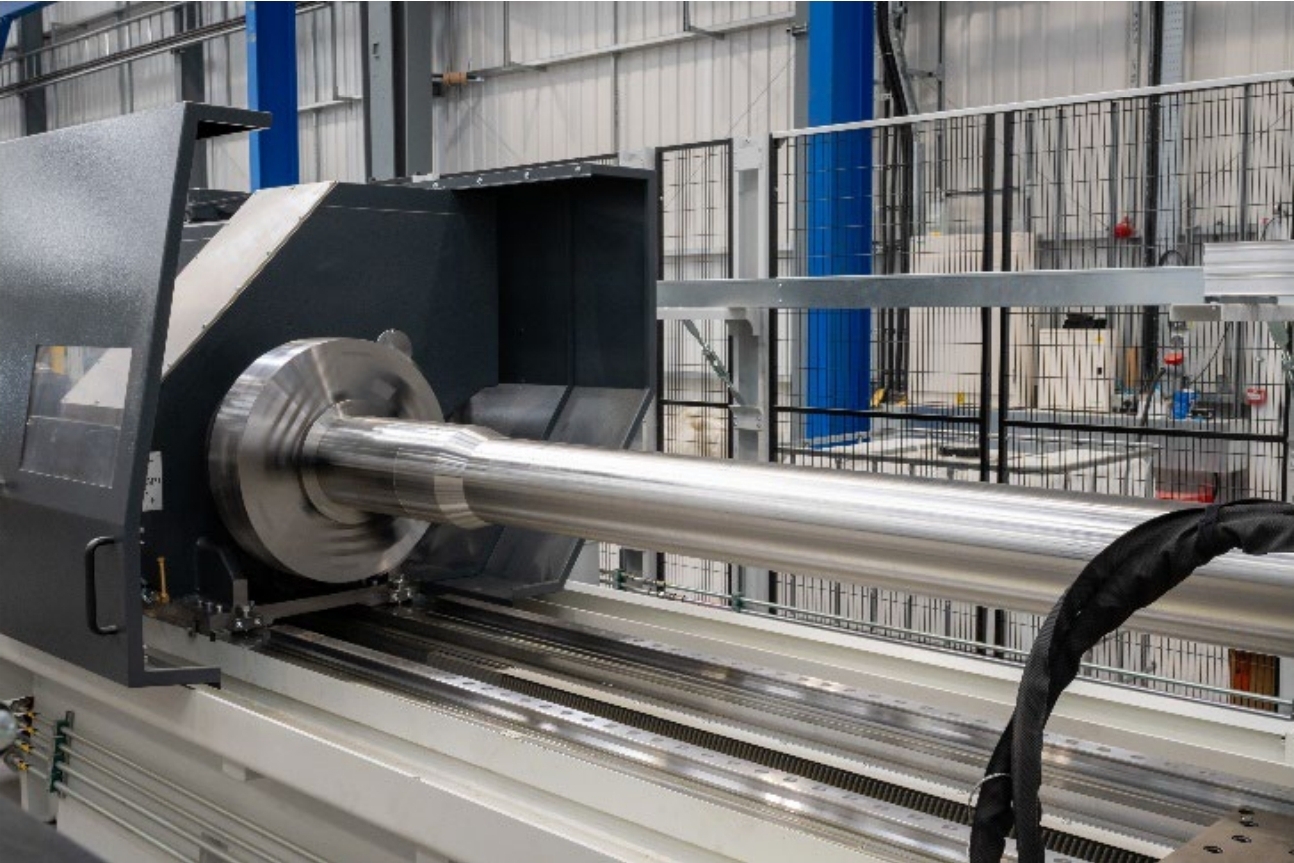
Rheinmetall has officially opened its UK Gun Hall at Telford in the presence of Wes Streeting, the Secretary of State for Defence, marking the return of independent production of large-calibre weapons to Britain, according to the company.
The facility will manufacture 120mm and 155mm weapon systems, including those supporting Challenger 3 and future artillery platforms. It offers 11,500 square metres of production space and at peak capacity can produce up to 245 barrels a year across both calibres, along with more than fifty breeches annually.
Wes Streeting said: “Britain is back in the business of making the weapons that our Armed Forces need to defend the nation against our adversaries. From an empty site to full production in eight months, this is rapid reindustrialisation in action. One hundred skilled jobs in world-class manufacturing and the return of large-calibre weapon production to UK soil for the first time in twenty years – this is what defence as an engine for growth looks like.”
Rheinmetall turned an empty facility into an operational manufacturing capability in eight months, installing and commissioning advanced manufacturing equipment and transferring specialist expertise to the British workforce. Production of breeches and breech blocks began in May and barrel production followed in June.
Armin Papperger, chief executive of Rheinmetall AG, who hosted the opening ceremony alongside Streeting, said: “Today’s opening is an important milestone for Rheinmetall and for the United Kingdom. In a remarkably short period of time, we have turned our commitment into a sovereign manufacturing capability that will strengthen Britain’s defence industrial base for decades to come. The UK has been a long-standing and valued partner for Rheinmetall, and today we are building on an already strong relationship. We are committed to investing in the UK for the long term, expanding our industrial footprint and working together to deliver the capabilities needed for the future. By combining Rheinmetall’s expertise with British skills, innovation and manufacturing, we are strengthening the UK’s sovereign industrial capacity, supporting the Armed Forces and contributing to the security of NATO and Europe.”
Rebecca Richards, managing director of Rheinmetall UK, said: “The official opening of our UK Gun Hall is a landmark moment for Rheinmetall UK and for Britain’s defence industrial base. In just eight months, we transformed an empty facility into an operational manufacturing capability by investing in British people, British skills and British industry. From the outset, we have listened to what the UK needs and focused on delivering sovereign capability at pace. By transferring specialist knowledge from Germany and developing a highly skilled British workforce here in Telford, we are creating skilled jobs, supporting British businesses and building the industrial capacity needed to equip our Armed Forces while investing in the long-term prosperity of the UK.”
The Gun Hall is expected to support more than a hundred highly skilled people as production develops. Rheinmetall currently employs around 685 people in Telford, thirty-five of them at the Gun Hall, and the facility forms part of more than £200 million the company has invested across its British operations over the past five years.
British employees undertook training and knowledge transfer at Rheinmetall’s production facility at Unterlüß in Germany, gaining expertise in precision manufacturing, quality assurance and specialist weapon production before bringing it back to Telford. The company has also recruited specialist skills from across the Telford region.
Rheinmetall said it intends to introduce British steel from Sheffield Forgemasters into production. This publication has reported on the wider work to rebuild Britain’s ability to manufacture large calibre guns and on the point at which the first British-made artillery barrels headed to Ukraine.
The company described the Gun Hall as a concrete example of the industrial partnership between the United Kingdom and Germany established under the Trinity House Agreement. The investment complements Rheinmetall UK’s work on the Boxer Mechanised Infantry Vehicle and the Challenger 3 programme, both of which are built at Telford by Rheinmetall BAE Systems Land.
Ministers confirmed in Parliament this month that there is no current requirement to procure new 105mm barrels for the L118 Light Gun, and consequently no plans to restore domestic production of that calibre.









Excellent news. It is incredible that we allowed this capability to disappear and that all our new warships will be armed with foreign made guns.
We need to ensure that project Grayburn delivers a sovereign small arms manufacturing capacity.
Yes, agree 100% 👍
It is interesting that they are not planning to restart 105mm barrel manufacturing… that puts a finite life on the 105mm systems. Although it’s fair to say you can fire a lot of shots through a 105mm barrel before it needs replacing…
Could they make much of a profit making no more than 245 barrels per year?; the capital investment in tooling and machinery must have been very expensive.