

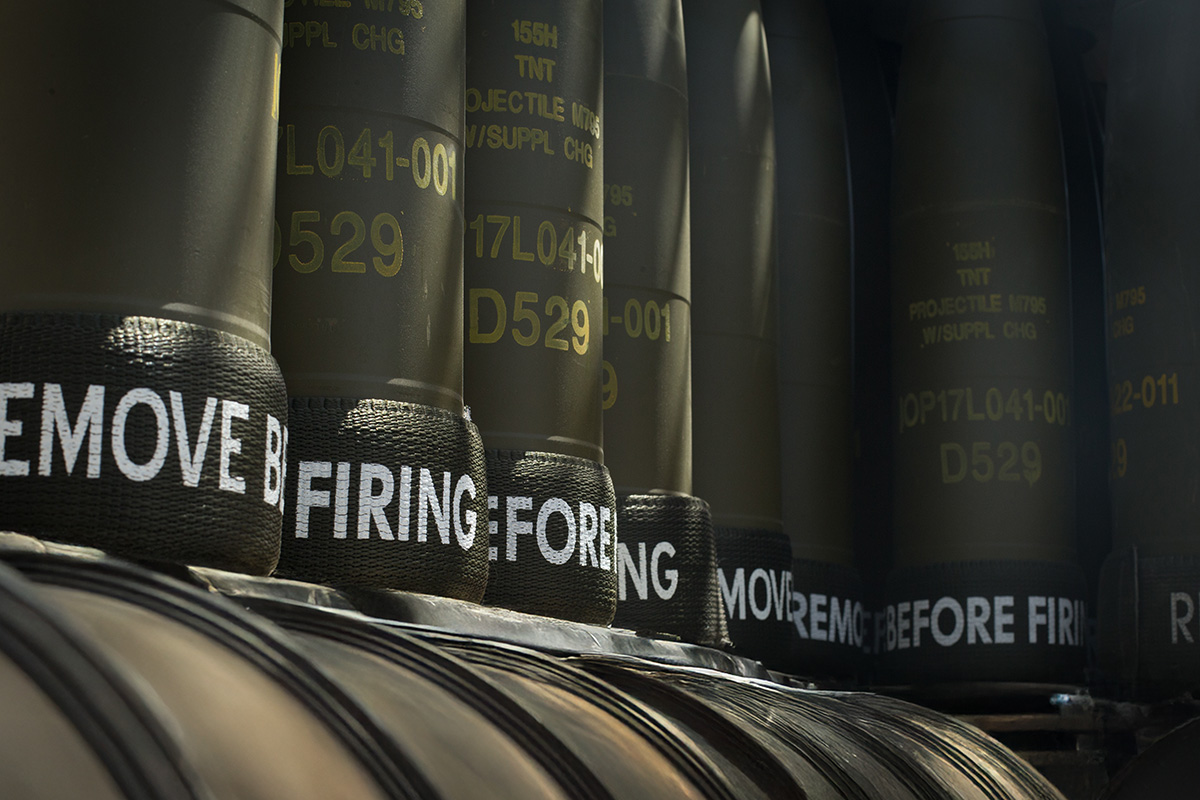
Britain must be able to manufacture critical defence components at home in sufficient quantities, increase production and replenish stockpiles when threats increase, and sustain its armed forces through a prolonged conflict, according to the Defence Secretary.
Wes Streeting was speaking at the official opening of the UK Gun Hall at Telford, the Rheinmetall facility that returns large-calibre weapon production to Britain.
He said: “But those armaments do not get produced by waving a magic wand. Nor in the event that this country finds itself in a war fighting state, can that capability and capacity in industry be conjured up.”
He said: “To make sure we can deter and, if necessary, defeat, our adversaries, Britain must have the capacity to manufacture critical defence components at home and in sufficient quantities. We must have the capacity to increase production and replenish stockpiles when threats increase. We must have robust supply chains to back them up, and we must have the wider industrial resilience to sustain our armed forces through prolonged conflict.”
On the balance between technology and mass, Streeting said: “Despite the advent of drones and data of AI and autonomy, it is not enough to simply out-innovate those who would wish us harm, though we must. We must also outproduce them too, because advantage increasingly belongs to those who can manufacture at scale and field capability fastest.”
He referred to remarks made at the event by the Chief of the General Staff, saying: “As the Chief of the General Staff just said, we are making daily discoveries about the changing nature of the conflict in Ukraine. Yet, as was also pointed out, for all of the technological advances we’re seeing on the battlefield, what you might call more traditional weaponry still has its place in modern warfare.”
On the facility itself, Streeting said: “And so what we’re opening the doors to here is more than a manufacturing plant. We’re opening the doors to something much greater and much more ambitious. And that is readiness and resilience. For the first time in decades, artillery gun barrels will be produced in Britain. They will be made using British steel from Forgemasters. As we’ve heard, their production will create one hundred jobs here and hundreds more across the supply chain right across the country.”
He added: “Gun Hall will also support the next generation of equipment for the British Army, helping to deliver the firepower that will make us warfighting ready by 2030.”
The Telford facility will manufacture 120mm and 155mm weapon systems, including those supporting Challenger 3 and future artillery platforms, with a peak capacity of up to 245 barrels a year across both calibres and more than fifty breeches annually. Rheinmetall turned an empty building into an operational manufacturing capability in eight months, with breech production beginning in May and barrel production in June.
Streeting also set out the case for combining domestic production with allied integration, saying: “And this factory is a reminder that stronger domestic industries and deeper allied integration are not contradictory. Done right, each strengthens the other.”
He said: “The defining test is not where every single component of a piece of kit or equipment was made. It is whether our combined industrial base can give our armed forces what they need, when they need it, because an alliance that can mobilise its armies must also be able to mobilise its industries.”
The Defence Committee reported this week that general munition stocks are among the capabilities European NATO members lack in sufficient numbers, and that the unglamorous enablers of warfighting capacity including logistics networks and ammunition stockpiles have withered through decades of underinvestment across the alliance.
Ministers confirmed in Parliament this month that there is no current requirement to procure new 105mm barrels for the L118 Light Gun, and consequently no plans to restore domestic production of that calibre. This publication has reported on the wider effort to rebuild Britain’s ability to manufacture large calibre guns.








Agreed. Focus needs to be placed on the means of rapid production prior to actual production.
Let’s hope it is not too little too late. One site producing 245 barrels a year will not be enough to sustain any long term conflict and is of course vulnerable. Modern “stuff” is so hard to make at speed and large volume unless we are highly motivated. The Ukrainians have shown the way but let’s try and get it under way before war is declared and perhaps we will deter that great humanitarian …..sorry psychopath from any more military adventures. Putin too might think twice if we get our ducks in a row but QUICKLY for God sake.