

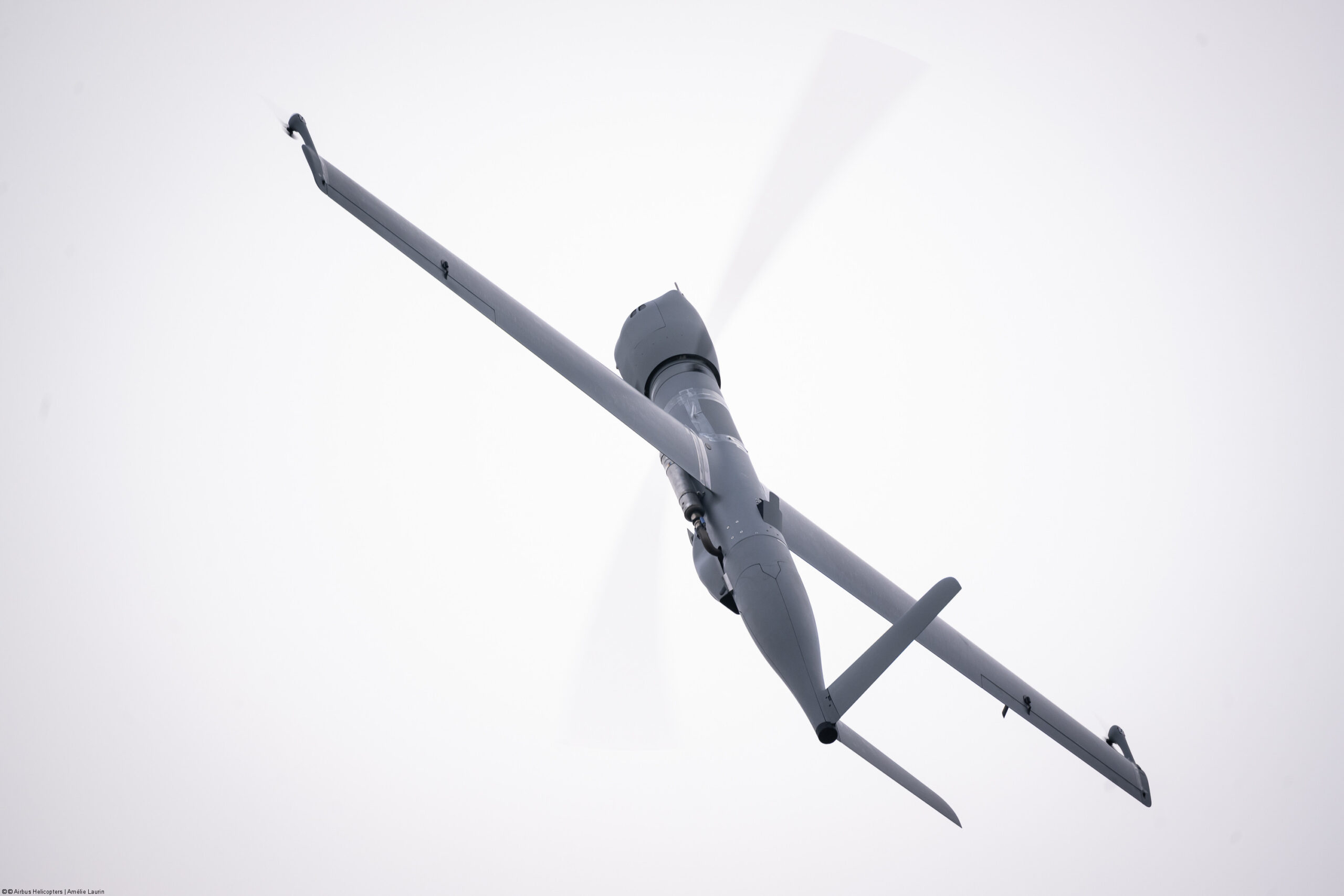
The Airbus U030 Flexrotor has begun maritime surveillance operations in the Baltic Sea on behalf of the European Maritime Safety Agency, marking the tactical uncrewed system’s first operational deployment in Europe, according to Airbus.
The deployment began in July covering Estonia, Latvia and Finland, and supports national authorities with maritime surveillance. It follows a €30 million framework contract awarded to Airbus Helicopters in December 2025 to provide remotely piloted aircraft systems services for multipurpose maritime surveillance across the European Union, with Extensee as sub-contracted operator.
Operations started after a series of test flights to validate technical and regulatory milestones ahead of entry into service, and to support the handover to Extensee.
Victor Gerin-Roze, Head of Uncrewed Aerial Systems at Airbus Helicopters, said: “We are pleased to see the U030 Flexrotor begin operational service under the EMSA framework, marking its first operational deployment in Europe and supporting the critical mission of enhancing maritime surveillance.”
He added: “The start of operations in the Baltics demonstrates its ability to operate effectively in diverse maritime theatres while supporting critical coast guard functions. Through this contract, we contribute to protecting Europe and strengthening its sovereignty, and we take pride in this commitment.”
The service provides operational intelligence gathered through electro-optical, infrared and radar payloads, streamed in real time to the EMSA remotely piloted aircraft data centre. Airbus says this allows participating national authorities to follow missions live and integrate the information into their operational workflows.
According to the company, the system supports coast guard functions including search and rescue, fisheries control, environmental monitoring and the detection of illicit maritime activity. Airbus Helicopters manages and coordinates the operations under the EMSA framework, allowing deployment across multiple simultaneous operations in participating countries, with the aircraft themselves flown by Extensee.
The U030 Flexrotor is a vertical take-off and landing system with a maximum launch weight of 25kg and an endurance in excess of 12 hours in standard configurations. It conducts autonomous launch and recovery from land or sea within an area of 3.7 by 3.7 metres, a footprint small enough to allow operation from vessels without flight decks.
The Baltic has become a focus of surveillance activity following a series of incidents involving damage to undersea cables and pipelines, and concerns over the movement of sanctioned oil tankers through the region. NATO launched Baltic Sentry in January 2025 to increase monitoring of critical undersea infrastructure, drawing on frigates, patrol aircraft and uncrewed systems from allied nations.
The Flexrotor was developed by the American company Aerovel, founded by Tad McGeer, who had earlier pioneered the Insitu ScanEagle. Airbus acquired Aerovel in 2024 and has since redesignated the system under the U030 name as part of a wider renaming of its uncrewed range to align with its helicopter and fixed-wing product naming.


What sensors can this thing be equipped with. 12 hour endurance and such small take off /landing requirement seems useful, altough max weight of 25kg would indicate only a camera which would be of limited use over wide areas.
Steve,
The U030 can carry 8 kilograms of sensors (modules) it can accommodate over 100 types of modular payloads and interchangeable sensor configurations depending on the mission profile, it typically deploys a combination of the following major sensor suites and systems on a single flight within its weight limit.
Electro-Optical / Infrared (EO/IR) Cameras – High-resolution optical, Mid-Wave Infrared (MWIR), and Long-Wave Infrared (LWIR) cameras mounted on digital turrets for real-time daytime or thermal imaging, tracking, and mapping.
Radar Payloads – Compact maritime and surface surveillance radar systems.
Signals Intelligence and Electronic Intelligence (SIGINT / ELINT) – Specialised equipment to detect, locate, and track electronic emissions and communications.
Automatic Identification System (AIS) – For maritime vessel tracking and coastal monitoring.
Wide-Area Search and Environmental Sensors – Including specialised options like methane detectors or custom atmospheric/scientific sensors.
Communications Relays / Data Link Payloads – Configurable nodes (such as Wi-Fi hotspots or tactical relay modules) to extend communication footprints.
The airframe is designed with three dedicated physical payload positions.
one ahead of or above the rotor, plus individual ventral and dorsal mounting locations. Each station provides standard mechanical, power, and data connections secured with simple fasteners, allowing operators to rapidly reconfigure the aircraft using basic tools.
Individual sensors and modular payloads designed for the Airbus U030 Flexrotor vary in mass depending on their specific type and function, though they must all operate within the platform’s overall eight-kilogram payload ceiling.
Standard electro-optical and infrared gimbals, which form the core of daily intelligence and surveillance operations, typically range from 0.75 kilograms to roughly three kilograms. These compact optical turrets balance high-resolution thermal and daylight imaging with low power consumption to preserve the aircraft’s extended endurance.
Heavier specialised equipment, such as miniaturised maritime search radars or dedicated electronic intelligence systems, occupy a larger portion of the mass budget and can approach the upper limits of what the modular bay accommodates. Meanwhile, lightweight auxiliary hardware like Automatic Identification System transponders, communications nodes, or environmental sensors generally weigh under a single kilogram, allowing operators to pair them alongside a primary optical package without exceeding structural thresholds.