

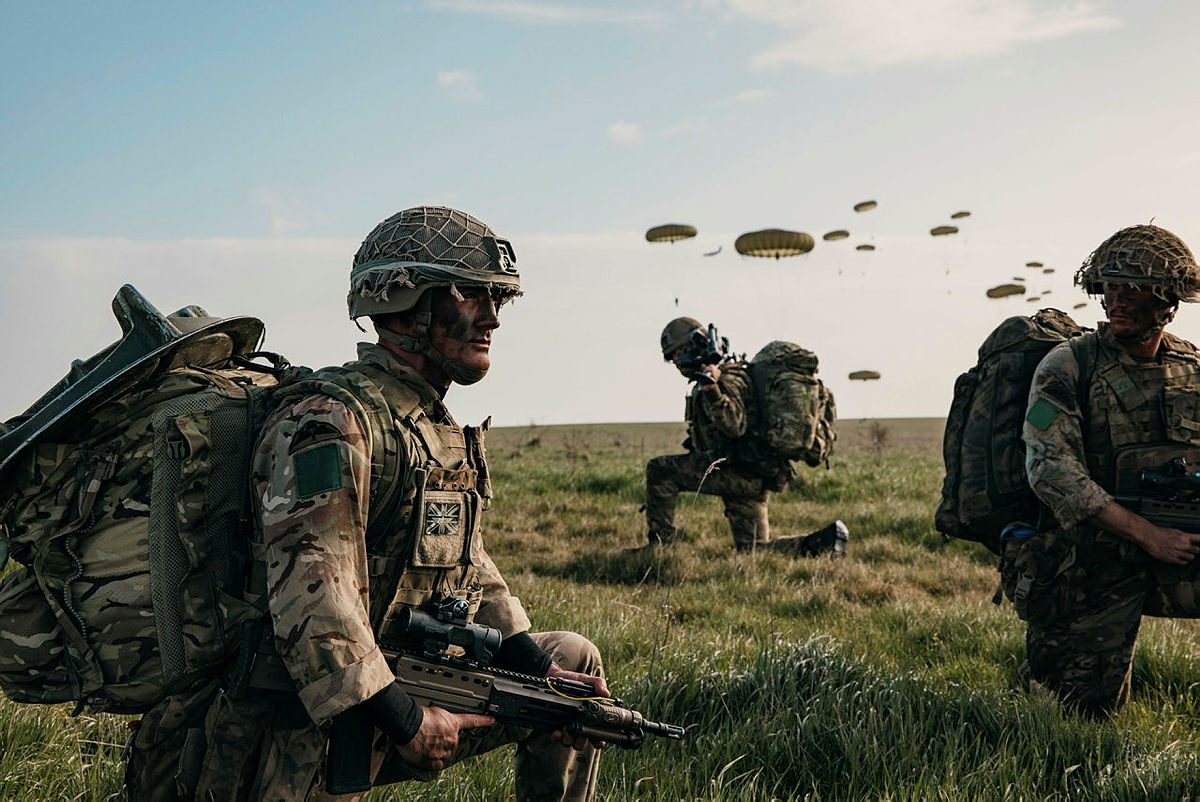
Around seven hundred paratroopers have been dropped onto a German drop zone from four Atlas C1 transports across multiple waves, bringing back battlegroup-level airborne insertion using the aircraft for the first time, according to the Royal Air Force.
Exercise Rhino Titan brought together the RAF Air Mobility Force and 16 Air Assault Brigade Combat Team as a Joint Airborne Task Force, with British, French and German troops taking part. Airborne operations have long been part of British military capability, and the difference here lies in the scale and in soldiers travelling with their stores in the same aircraft.
Squadron Leader Luke, a flight commander on 30 Squadron and the airborne mission commander, said: “Rhino Titan demonstrates the return of large-scale airborne insertion as a capability. The Atlas allows us to deploy combat forces further, faster and more efficiently than previous generations of aircraft, giving Defence the ability to project force rapidly wherever it is required.”
Stores previously needed aircraft of their own, so carrying personnel and equipment together generates more combat power from the same number of airframes, and lets troops become operational almost immediately on landing. Paratroopers board carrying parachute equipment, weapons, communications systems and bergen loads of up to fifty kilograms, with air loadmasters and parachute jump instructors supervising the process before departure.
Squadron Leader Nick, officer commanding the Parachute Training Squadron at RAF Brize Norton, said: “By the time soldiers board the aircraft, a significant amount of planning and preparation has already taken place. Parachute Jump Instructors will have delivered specialist ground training, while detailed planning between aircrew, dispatchers and ground forces coordinates every aspect of the mission.”
He added: “It takes RAF aircrew, engineers, Air Loadmasters, Parachute Jump Instructors and support personnel working alongside the Army to deliver that capability safely and effectively.”
Getting to this point took eighteen months of increased activity between Brize Norton, Weston-on-the-Green and Salisbury Plain, progressing from basic parachuting serials through formation flying and simulated mass drops to integrated delivery of personnel and stores. Aircraft, crews and instructors had to be dedicated to that training while global operational commitments continued.
Squadron Leader Luke said: “The harder we train in exercises, the easier it is to deliver the capability when it’s needed.”
Pathfinders went in ahead of the main force to validate the drop zone and provide reconnaissance and surveillance before the larger force arrived. The RAF said the exercise builds on work done with NATO allies through activities such as Exercise Falcon Leap, where Atlas operators and other tactical airlift nations develop common tactics and procedures, and that dropping troops by parachute lets forces deploy beyond established infrastructure.
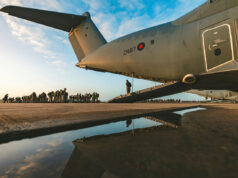
The A400M Atlas entered RAF service in 2014 and operates from Brize Norton with 24, 30, 70 and 206 Squadrons. The type will also be fitted for firefighting under the package the government announced last week, which is to give Britain an aerial firefighting capability permanently based in the United Kingdom for the first time.









“24, 30, 70 and 206 Squadrons”, all ’12’ operational aircraft??
3 per squadron?🤔🤔