

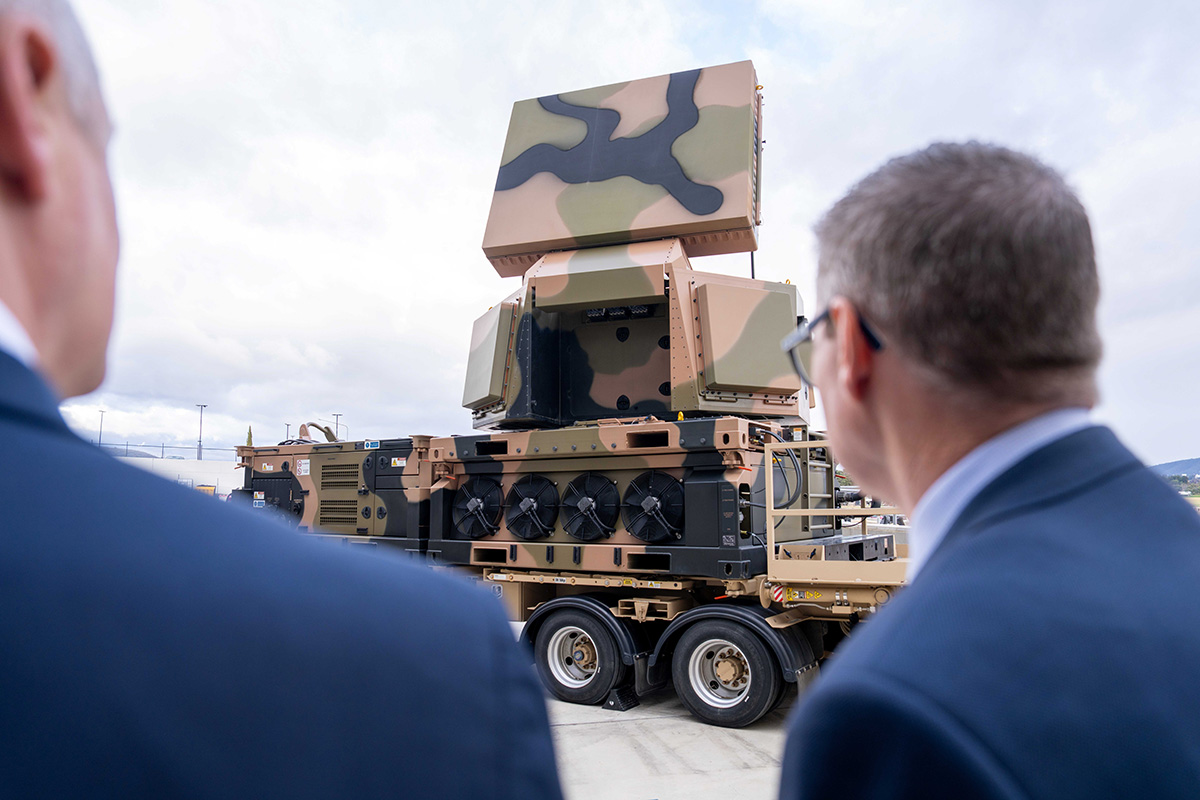
Britain has signed a statement of intent to potentially adopt Australian CEA radar technology for its frontline forces, with QinetiQ handling integration, testing, and assurance of the capability across the UK defence enterprise, the company stated.
The four-way agreement involves QinetiQ, the Ministry of Defence, the Australian Department of Defence and Canberra-based CEA Technologies. It was signed at the CEA factory in Canberra, with Luke Pollard, the UK Minister for Defence Readiness and Industry, and Pat Conroy, the Australian Minister for Defence Industry, both present.
The signing follows commitments made at the Australia-UK Ministerial Consultations in June, where the two governments announced they would explore joint development and production of an active electronically scanned array radar capability.
Mr Pollard said: “Today, we are deepening our industrial cooperation with Australia on cutting-edge radar technologies. By bringing QinetiQ’s expertise together with CEA’s world-class radar technology, we can strengthen the warfighting readiness of both our nations while backing jobs and growth on both sides of the world.”
Steve Wadey, group chief executive of QinetiQ, said: “QinetiQ’s unique expertise positions us as a strategic and trusted partner to the UK Ministry of Defence and its allies. Current conflicts remind us of the importance of air defences, which are increasingly under pressure, and QinetiQ is proud to play a key role in bringing this vital technology to the UK.”
Alan Clements, chief executive of CEA Technologies, said: “Today’s signing is an important milestone for CEA and the Australian and UK defence industries. It reflects the confidence both governments have in CEA’s world-leading radar technology and the important role industry partnerships play in strengthening sovereign capability.”
The parties describe the document as a framework for continued co-operation while future opportunities are explored, which stops short of any order.
CEA Technologies is unusual in the radar world in being a mid-sized Australian company whose products have displaced those of much larger firms. Its CEAFAR phased array family is fitted to the Royal Australian Navy’s Anzac-class frigates, where the radar replaced the original set during the anti-ship missile defence upgrade and produced a marked improvement in performance, and variants have been selected for the Hunter-class frigates and for Australian land-based air defence.
Active electronically scanned array radars steer their beam electronically rather than by rotating a dish, using a face made up of many small transmit and receive modules. That allows a single set to track many targets at once, switch between search and engagement tasks in an instant, and continue working with reduced performance if individual modules fail, which a mechanically scanned radar cannot do.
What the UK might use it for has not been stated. Britain has an acknowledged shortfall in ground-based air defence, with the Army fielding Sky Sabre in small numbers, and the war in Ukraine has pushed the question of layered protection for airfields, ports and infrastructure up the agenda across NATO. The Strategic Defence Review of 2025 committed to strengthening air and missile defence without settling on the sensors that would underpin it.
QinetiQ employs around 7,500 people and holds the Long Term Partnering Agreement covering the Ministry of Defence’s test and evaluation ranges, work that gives it the trials infrastructure any new radar would need to pass through before entering British service.












Interesting, I remember reading about us looking into this years ago.
Yes we continually look into things. I note even now it says ‘ … while future opportunities are explored, which stops short of any order.’ That said and escaping the cynicism for a while, there is a distinct likelihood that some sort of order will come from this eventually, whatever form that takes and when, will rely on further successful cooperation agreements directly with uk companies I presume.
When I saw the title, I thought it was going to be JORN.
Me too!
TBH France and Italy are in the process of their mid life upgrades for the 4 Horizon class AAW Destroyers and that includes adding Grand Kronos AESA S & X band radar panels to enhance their ABM capability.
So would it make sense for us to go down a similar route but using the Australian CEA products instead of Leonardo ? One thing is for sure the time is well past when we really need to get serious about U.K. land and sea missile defences and make our minds up about committing some real money to actually buying something.
Honestly if the U.K Air Defence was powered by the sheer volume of MOD / HMT / Politicians hot winded blather we would be the best defended country on earth.
Unfortunately that early idea went out the window with the French “Top Secret” hot air balloon mounted blunderbuss project of 1808 although it did have a 100% kill rate.
Yeah but what is the point if we have no interceptors capable of shooting down ballistic missiles and we need land based air defense. Not just for the army. But I am not expert but I thought we don’t even have missile batteries to shoot at anything.
So long SAMPSON
Perhaps use could be made of CEAFAR in a longer range GBAD system? The alternatives are SAMP/T off the shelf or SAAB’s Giraffe 4a or 8a long range radar sets if we wanted to create our own system with longer range than Sky Sabre.
CEA are really bad at naming their products, which makes them quite hard to keep track of. There’s a system called MMPAR which has a large rotating panel and four smaller fixed ones, but there was also one called GBMMR which had six fixed panels folding out from a container footprint.
CEFAR is EOL, they have moved onto CEFAR 2, while we wont ever know its around the same capability as the SPY-6 and has full aegis baseline 8 capability including virtual aegis
I believe this was 1 or 2 radars recently tested with a live SM-2 shot last month. If derringer could be made to carry SM-6 or maybe intergrated with Typhoon so sort of alternate GBAD
Thanks. I used CEAFAR to refer to all of CEA’s radar set, which I probably shouldn’t.
The Aussies are quietly building a decent defence industry
Something else we should be spending the f35 money on.
Are we not capable of building this type of gear now?
If we keep buying foreign systems, we will lose what capabilities we have. With BAE, Leonardo UK and Hensoldt UK(Kelvin Hughes) all large companies capable of turning out AESA radars, and the UK buying Thales NL, Saab, Lockheed Martin and now looking at CEA, I wonder is it just that UK companies are too specialised or is something else going on?
There have been plenty of international partnerships in the past, but this does feel odd.
I’ve no idea, be good if someone can shed some light on it.
Hi Jonathan, When you expand it to land vehicles, small arms, etc etc etc the fact is we historically build things that are tailored to our own requirements with very little thought given to exports. That translates into virtually everything is too expensive due to short production runs and we end up buying fewer than we need.
That was fine 50 years ago but now it seems that it’s only when we work in collaboration with foreign partners and forced to consider their needs we then nail it. It also helps keep our Political Masters in line as they don’t mind scrapping a U.K project but not a foreign partnership one.
Bottom line is our procurement system still acts like its arming “The British Empire” and exports are either a given certainty or we just don’t care as long as it keeps MOD and the Military Hierarchy in cushy project work.
As for this radar it may just a replacement for the 1850 and add on to Sampson so not really an issue, and to be honest when Australia has bunged us £2.8 billion to invest in U.K. industry it would be a bit Bloody rude not to buy something back.
Yes, BAES have been doing work on the next gen AESA to replace Sampson. Like a lot of newer ASEA radars available today, the Next Generation Radar Demonstrator (NGRD), is based on a modular and scalable format, meaning you can build the array to suit the cost/requirements. This is a clean-sheet S-band Gallium Nitride (GaN) solid-state design, which can be used for maritime and land based systems. They are using this architecture in the Artisan Next Generation radar, which they’re hoping will be a future upgrade path for the T26 etc. From the images I’ve seen, it can be used in either fixed panel, or fitted to a mechanically rotating assembly.
The CEA radar started off as a very small operation, led by an ex-RAN engineer. It is also very good, where some say it’s the best S-band AESA array currently available. Which I’m sure has a lot of bias behind it, As the SPY-6 and 7 are no slouches, as is Saab’s Giraffe 8A and I’m sure Leonardo will claim the same for their Kronos family of radars.
However, Australia saw that CEA had a winner on their hands and Nationalised the Company. I’m not sure where CEA fits in the MOD planning, especially when BAES is actively pursuing its own next gen AESA?
Is this not one of the effects of AUKUS.
We are supposed to be making the most of our partner’s products whilst obviously they make the most of ours.
If they have decent kit then great.
BAE is already suppose to be working on something similar so it’s hard to see a use for this.
It’s for land based radar most likely, CEA have a radar that meets the requirements for SERPENS but also can be used for GBAD.
To be fair so do Thales and SAAB.
Both of those currently are providers to UK GBAD and SAAB have just set up a factory for G1X and I believe GAMB on the south coast.
Maybe them and BAE Cowes are about to find out that politically AUKUS has to be seen as a two way street?
The two way street is that Australia gets nuclear submarines and we get paid to build them 🙂
There’s no point in abandoning our own, adequately capable, efforts to shift to a non-sovereign option.
It’s a bit more than just paying us to build them, it’s them paying us to invest £Billions up front to invest in our capability to build them for ourselves as well as them.
And that all means we can afford more SSNS for ourselves due to the bulk buy bonus.
That’s way less easy to quip though, which counts against it.
We won’t be getting an eighth attack submarine much before 2050. We don’t have to rush to reciprocate.
No sea based, navy outlook did a good article on it.
This specific agreement is most likely related to land based applications. There’s no timeframe in which we buy a new off the shelf naval radar in the next few years, but SERPENS and GBAD are both big outstanding requirements. At the time of the previous agreements CEA hadn’t really got going for land based and so everyone assumed it was naval they were talking about.
That’s kind of where you’re wrong. CEAFAR is adaptable by design to multiple different applications. If there’s a unique requirement you have, you can simply tailor the panels.
BAE is way off in producing an equivalent technology.
Down here we’ve heard that you have a Wallaby loose somewhere in Devon, now you’ll be able to see it.
I hear he signed for the Exeter Chiefs. You’ll be able to see him more often when the season gets underway.