

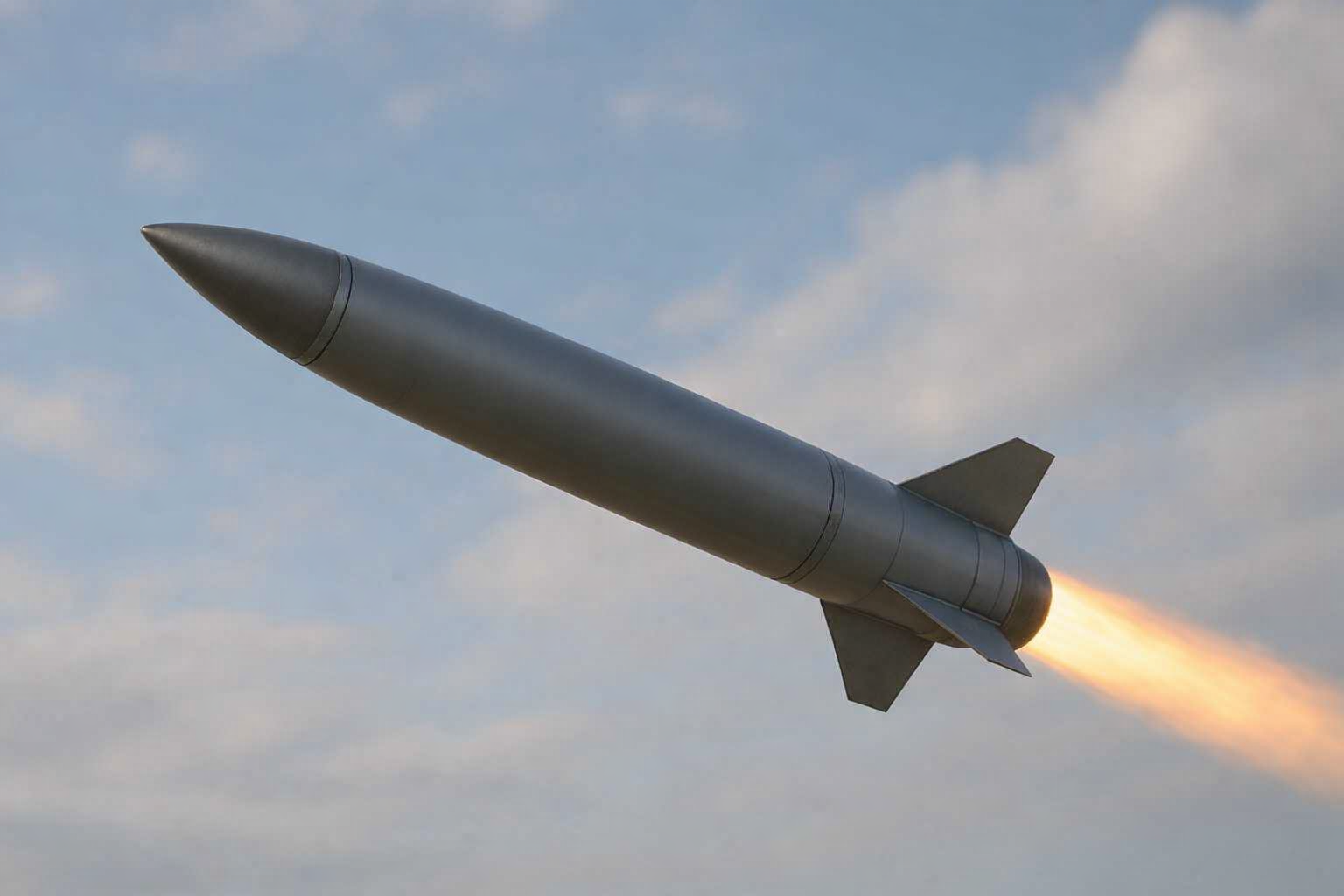
The Ministry of Defence has set out new details on its Nightfall deep-strike missile programme for Ukraine, confirming development contracts will be awarded this spring, with production expected to begin in late 2027.
In written answers to Parliament, Defence Minister Luke Pollard said the MOD is moving toward awarding multiple development contracts as part of a rapid competition process, with a strong emphasis on UK industrial involvement.
Responding to questions on domestic manufacturing, Pollard said “the Department aims to maximise the UK industrial content of these development contract(s)”, though he added that exact proportions cannot yet be confirmed.
According to the answers, the deadline for industry proposals is 9 February 2026, with three teams expected to each receive a £9 million development contract in March. Each team will be required to “design, develop and deliver their first three missiles within 12 months for test firings.”
Following successful testing, the MOD plans to move quickly into production. Pollard told MPs that “we plan to place a 2-year production contract, with the first deliveries of Nightfall to Ukraine to start in late 2027.” Output is expected to increase rapidly, with production “ramp[ing] up to a rate of at least 10 missiles per month.”
The minister confirmed that this late-2027 delivery window also represents the effective in-service date for the new capability, stating that “we envision the first deliveries of Nightfall to Ukraine to start in late 2027.”
The Nightfall programme was announced earlier this month as a UK-led effort to provide Ukraine with a domestically developed deep-strike ballistic missile, intended to support long-range precision fires against high-value targets. The structure of the programme, with parallel industry teams and early test firings, reflects lessons drawn from recent accelerated procurement efforts linked to the war in Ukraine.









It’s immensely impressive that the UK has developed a tactical ballistic missile in just a coupe of yers even though it’s has no experience in developing such weapons.
We should take note and apply this to a UK MMRB program and SLBM. This shows the technology of ballistic missiles is pretty easy to do. It is 1960’s tech and nations like Iran and North Korea can do it so it should be pretty straight forward for us.
MRBM*
Well we can build most things if we wanted. We just don’t. Sure we don’t need to rely on the Americans for our Trident nuclear deterrent but it’s just easier. But is it smart that is the question. I hope this leads to more sovereign capabilities.
We still have the ability to knock things up out of nowhere when needed, Ukraine has really proved that. Terrahawk AAA based on the RNs DS30 mount with an off the shelf optical sensor and radar, ASRAAM based mobile SAM using old rails off of decommissioned Harriers, Tornadoes and Hawks, Flamingo cruise missile may have been heavily supported by us if ykyk and a ballistic missile from scratch in just a few years.
Everything we are involved in gives up experience and expands the skill set of our industry. People here get grouchy because they cant look past the numbers game but all of this will eventually pay off for us.
You guys are right the last decade or so has transformed technologies of this nature to be near off the shelf, literally in some cases indeed. A New Zealand Company (originally) is now on the fringe of being one of the most influential space launch outfits in the World, a Spanish company is making great if more conservative strides too, another New Zealand company and a Canadian Company are well placed to push single stage to orbit capabilities, lots of US companies are making good progress with very innovative concepts from nowhere like Stoke Space, all this is increasingly no longer even cutting edge technology, Tempest is probably far more complex a programme. If we want to do this we could, we did it from nothing in the 60s on a shoestring, till we gave the capability up, the talent is there to do projects of this nature now, it’s a matter of choice and like this project not aiming too high initially, just been more convenient to rely on the US. Those days may be numbered however.
Slight correction, we built the Blue Streak ICBM in the 50s, cancelled it in the 60s and used it to launch a satellite called Prospero, which is still up there beeping away. Black Arrow.
It was combined with French and Italian stages to create Europa, which was retired and we all became ESA and built Ariane. The French built that one though (boooooo)
But we’ve always been and still are at the cutting edge of missile and motor design. Make a SAM back down again and presto, ballistic missiles.
And we’re masters of motors too, Ramjet in Bloodhound and Sea Dart, air breathing throttleable Ramjets, solid fuel, we could even dust off Black Arrow’s HTP motor.
And of course there was supposed to be SABRE 😢😭
And of course there’s fluid dynamics, we’re second to none at that too, these missiles will be built and tested in SIM long before they get printed.
And technically all missiles are ballistic, ours just hit the target while still in the air.
That’s hard, hitting the grind is EASY, you practically can’t miss 😂
Well that part is all avionics, multi sensor guidance using GPS, INS, TERCOM for cruise and IR.
We have native industry for all that and we’re very good at it too.
Plus, that 99 year contract with Ukraine isn’t for giggles and headlines, they are the premier ballistic missile nation in the west.
This is why I hate the “we don’t build nuffink” doomers.
Two second Google and a bit of pride is all it takes to dispel that.
Because we still have a lot to be proud of.
Somebody queue the Elgar, please. 🇬🇧🥲
Problem is, all of our current generation of large missiles like ASTER have their rocket motors built in France or Italy. That ability to build large solid rockets is what the UK lost and what Nightfall will hopefully get us back.
This is utterly hilarious.
Are you people completely thick?
We haven’t even been able to successfully launch the American ICBMs from our nuclear submarines in three separate tests over 9 years and you seriously think that we can develop an IRBM in less than 24 months?
Yes, absolutely!
Beyond the Ukraine war, I believe this will mean the UK is the only western manufacturer of tactical and short range ballistic missiles.. and from there we could easily move to long range ballistic missiles.. not a bad sovereign capability to have.. I bet there is actually going to be a widening market for tactical and short range systems.. I could imagine Poland and the Baltic states snapping our arms off for a range of cheap plentiful accurate ballistic missiles in the 600-2000km range band.. it the a great conventional strategic deterrent for them.. I could see Japan, Korea, Taiwan and a host of Middle Eastern countries wanting some as well..turkey Germany… so many possibilities for customers.. because one thing the Russian Ukraine war has shown is not having conventional strategic deterrent and weapons is a none starter and ballistic missiles are still the hardest to counter…
Hi Jonathan I really don’t think either South Korea or Japan will be knocking our door down to but and U.K ballistic missiles, they have their own and busily developing others. South Korea has developed their own SLBM with a 500km range and they are in service with at least 3 of their KSS III Batch 1 AIP Submarines (6 K-VLS per boat), Batch 2 will have 10. As for Japan they are busy developing their own Hypersonic BM’s.
I had not clicked the South Korean BM program to be honest
They have a bright idea and it’s to counter N Korea and their Nucs by blitzing them and the C2 on the ground before they can launch. The trick is having excellent targeting intelligence and faster response times, given their mastery of electronics I wouldn’t bet against S Korea pulling it off.
Been have a bit of research around their ballistic and cruise missile conventional strategic deterrence.. it’s quite a thing.. you don’t really need sub strategic nuclear deterrence systems… when you have a conventional ballistic missile with an 17,000lb warhead.. it’s a bit mind blowing… apparently they use it as a short range ballistic missile to hit NK sites with 17,000ib warheads but if you but a modest 1000kg warhead on it it would actually be an IRBM…
South Korea already have their own Ballistic missile and it’s pretty good
It’s Countries like this we should be trying to collaborate with beyond this programme, perhaps even earlier than that, or part of.
Yes, we both have similar requirements and needs. Both have expertise. They’re already approaching Europe with some of their equipment such as tanks for Poland
Nightfall sounds very 007
Pay attention 007, it looks like the naughy chaps at -QUANTUM- SPECTRE are at it again. Something called Project Nightfall.
Intelligence says it’s some kind of nanoswarm they’ll launch into the Stratosphere, where it’ll spread out , blocking out the sun over the entire world.
If anybody wants food, they’re going to need sunlight and will have to pay SPECTRE for the privilege.
Your easy in is the usual, gullible daughter of Blofeld and head of the Chinese tongs, her name is Kèlì Xiè, she switched to her mother’s name after the divorce and subsequent war.
Here’s her file and photo.
Bond: “Boobies”
PAY ATTENTION 007.
Aw, there’s no markdown for strike though on QUANTUM… ☹️
😂
What are the chances of being Mk.41 capable. Going off ballistic missiles with similar capability it should be able to fit in the stripe length module and with the price requirement of 800,000 for each missile that makes it cheaper than the Stratus so could be a cheap method of having offensive firepower in our ships. Not to mention being a ballistic missile makes it more difficult to intercept than a cruise missile for interceptors (easier for radar to detect)
It’s going to be MFOM compatible, MLRS Family of Missiles. So two in every pod for M270 and HIMARS
Mk41 should be a doddle
Simply splendid news.Knocking out ten a month aswell, that really would be impressive.A small glimpse of light at the end of the tunnel maybe?
Splendid. Stratus is looking very nice but most of the price estimates I’ve seen for it place it at about 2 million and missile. Stratus LO will definitely still be a better missile than this for shooting ships and deep strikes with its stealth but depth of stockpiles should be good due to the relatively cheap price and sometimes you just need to hit something quickly.
It is a poor state of affairs when we are all terribly impressed when something happens. We are so programmed to expect procurement failure.
All procurement should work at this pace.
How do you design a ballistic missile for £9M?
Simply not realistic.
So much is off the shelf now it is very possible to a degree I’m sure, plus there’s the risk against benefit analysis. it’s what happens thereafter or when you start going for cutting edge that ups the costs.
I am not sure where you shop?
A ballistic missile is a body, control surfaces, avionics and attached sensors and solid fueled motor.
We already build all of those things natively.
The reason why places like America fail at every attempt, it’s trying to reinvent the wheel every single time
Whereas we are the masters of just grabbing what we need and bolting it together.
At the end of the day, it’s a precision built guided rocket and we’ve been building those for 70 years.
How many big missies has the UK built in the last 50 years? Where does the UK manufacture large solid motors?
In what respect does America fail at every attempt (I assume you refer to ballistic missiles)?
I think there is more to Ballistic missile design than ‘just grabbing what we need and bolting it together’.
1) Bloodhound, Sea Dart
2) Roxel
3) Cost, requirements, scope creep, their projects always get cancelled which is why they’re decades behind us.
4) That’s Nice Dear.
1) Neither of those are ‘large’.
2) Roxel do not make large solid motors E.g. >1 m diameter and several meters long.
3) The Americans have spent lots agreed. No one can do a BM design for £9M. To suggest they are decades behind is balderdash.
4) I was quoting you.
10 rounds a month (300Kg warhead or thereabouts) will certainly make a difference, not.
If you listened to Zelensky’s speech yesterday it’s exactly the capability that he was crying out for, well longer range ideally but then that’s all part of the upgrade path.
Equally you need to look at the bigger picture how many Storm Shadows can they use each month, how many of their own missiles? To be truly successful you use a combination of capabilities to truly breech the defences, the Russians use a very large number of basic drones and a far smaller numbers of various missiles in their attacks. Flexibility and variation is key.
Just wish the UK wouldn’t be publicisng all this stuff with such precise details. Speak less, do more than and deliver earlier than. And have some for the UK!
Nightfall AND Brakestop AND FP-1 AND FP-5
And that’s if we don’t subcontract across the continent.
We could build them but the hundreds a month if we committed to the bit.
They’ve practically crippled Russia with Putt-Putt drones and angry Mavics, adding hundreds of serious boom will be, certainly cathartic and probably devastating.
A 30kg warhead knocks something off line for a few months.
500kg deletes it.
A single Lancaster carried 3 to 6 thousand kg, Agreed unguided, and they operated in their hundreds, night after night.
Lets put things in perspective please.
The common sense thing to do would be to build up a stock of our own as well. Won’t happen though. Our own version will take 20 years and multiple billions of pounds to get into service.
End of 2027 is 2 years away before production. I would guess the war will be over by yhen . If the kit is mostly off the shelf why not be setting targets for 6 months to 1 year . Its all just painfully slow with no guarantee of anything in 2 years time
Those with more knowledge of missiles, than I, seem once to be crowing, but I have two questions. 10 a month really ? Why not a 100 ?Yes we produce great stuff both military and commercially you only have to see the film of Russians trying to counter storm shadow,but we are crap at producing an economic success. Secondly, the 3 tests, do it in Ukraine, if they hit the target you don’t have any questions and not a lot to lose.
100 a month wouldn’t be long term, it would build a stock then as ever capability lost when politicians close them down.
If we assume the Ukr frontline will soon freeze in a “peace” they need deterrence long term. A ceasefire may place restrictions on range of weapons Ukr can possess though they will resist that.
30 a month over 3 years gives them a 1000 plus missiles to pre empt any new Russian build up and push their SAM systems back.
3 years gives us time to reorganise as well in case a rearmed Ru knocks at the door.
A modest line allows upgrade.
Hmm…intriguing development. Purely idle personal speculation, but could this also serve as the genesis for an eventual UK rail/road mobile, land-based component of a nuke triad? 🤔 Dreadnought programme underway, including development of Astrea warheads and updated Trident II SLBMs, SSN-A, reportedly to be equipped w/ Virginia VPM, in design and presumed eventual access/acquisition of SLCM-N, F-35A acquisition announced, w/ access to B61-12 prepositioned inventory, and additionally, possible UK developed nuke CM variant (and the assumption that GCAP/Tempest will be dual capable/certified). All options could eventually result in a significant, independent UK inventory by the late 2030s-early 2040s. Timely, as the last arms control treaty, New START, lapses on 5 Feb 26. On the other hand, it could all be mere coincidence…🤔😉
Hi Mate, I would say at present there is no appetite for expanding in to a full nuclear triad, with the current set of politicians we have. However, things may change if your President has a change of mind with supporting NATO’s B61 tac nuke option. But then if he does that, there will be more European Countries looking at how to solve that problem. Especially if their delivery platform was the F35A. As adding more weapons to the backlog of F35 weapons integration can’t/won’t be completed in time to maintain the deterrence. So a plan B will be needed. Which could be a surface launched ballistic missile with optional payload configurations, i.e. singular or multiple nuclear armed re-entry vehicles or via an air launch weapon.
But then the question is are these buckets of sunshine deployed by NATO only for tactical use, or do they also include behind the lines interdiction? As that will dictate not only the weapon but perhaps also the launch platform. There are two options, being either air launched or surface launched. For air launched, eNATO would need a weapon that can replace the B61, but used from either non-US platforms or from the F35, but cloned to look like a B61, so the aircraft’s mission system thinks it’s a B61. A surface launched nuclear armed version of something like ATACMS would also be suitable. That could be fired from M270 type launchers.
However, if used for interdiction, then the weapon will have to at least match the strike range of a F35A, you’d be looking at least up to 500km and more if tanker support is provided. Which is in the short range ballistic missile (SRBM) category much like the Iskander-M. But would also include medium range ballistic missile for targets over 500km away. Therefore, means having the ability to lob payloads up in to low earth orbit. This means that the payload delivery vehicle will need to be able to operate in low earth orbit. Plus the re-entry vehicles will need the appropriate heat shield to cope with re-entry. Whilst remaining aerodynamically stable and not deviating from the target path. Getting objects into space is the easy bit. Making sure that the returning vehicle doesn’t burn up and can stay on target is the hard part.
Mentioning GCAP, does make for an interesting discussion if used as a nuclear delivery platform. Everybody knows that this aircraft is going to be bigger than Typhoon. The unrefuelled long range requirement and internal weapons bay clearly infers this. It would be a highly capable platform for delivering a STRATUS LO/RS cruise missile or two at targets. But the long range and low observability would equally make it a great platform for delivering a nuclear armed cruise missile. That’s not to say, like the Mig-31 it could be used to launch an air launched ballistic missile like the Kinzhal.
If there is the political will and required need, there are definitely a number of options that could be used instead of the B61, the Nightfall ballistic missile being one of them.
There was a written answer yesterday that said Nightfall would be contributing to UK expertise in ‘propulsion systems, materials and precision guidance’ so they may be anticipating the issue of building our own reentry vehicles.
Perhaps GCAP could carry the BMs externally? The Israelis have their Lora but the diameter is too big for anything to fit externally. If GCAP’s payload is as large as they are hinting then it could carry some pretty chunky missiles a long distance.
Davey,
Appreciate your thoughtful response. Given recent history, not certain anyone can accurately predict geopolitical landscape over an extended period. It may be prudent for ENATO to plan for a continuum of degrees of US withdrawal from ENATO affairs in the foreseeable future. Particularly relevant in nuclear arena, post 6 Feb 26. UK committed to continuing CASD mission w/ Dreadnought Class SSBNs equipped w/ Trident II D5LE2 SLBMs (Astrea warheads (A21/Mk7 aeroshell)). This will be a technologically state-of-the-art deterrent, but also be a relatively modest capability. One SSBN on station, w/ a current, officially acknowledged, maximum loadout of 40 warheads may not deter Mad Vlad and the Orcs. Perhaps of more consequence, a solo SSBN represents at least a theoretical single point failure of deterrent capability. Prudently, the UK plans for RAF to acquire at least 12 dual capable F-35As, and will have access to the prepositioned NATO B61-12 stockpile. This may prove adequate for the near term-to-intermediate future, but reasonably convinced MoD/RAF long term plan would be GCAP/Tempest, equipped w/ sovereign nuke weap system(s). There is also the possibility that SSN-A could/would be equipped w/ SLCM-N, essentially a stealthy evolution of TLAM-N, during the 2040s. Reasonably certain UK could also design, develop and deploy a rail and/or road mobile ICBM and/or IRBM during the same timeframe, if deemed necessary. The basic technology was demonstrated w/ Pershing 2 deployment 40+ yrs. ago. Presume the French will also update/expand the force de frappe during this period. The ultimate bottom line: ENATO may require the deployment of additional warheads, if forced to confront the CRINKs alone. Of course, this presupposes adequate defence funding becoming available. 🤔
To be brutally honest, I think China is a bigger problem for the US than Russia is currently. It will take years of rebuilding for Russia to be able to compete not only economically but also militarily. The rest of NATO should be able to contain the Bear. But personally I think you are right in that the UK and the rest of NATO should consider an alternative (Plan B) to the B61, in case support is dropped or frozen.
France are in a reasonable position here, but historically they won’t share/sell nuclear weapons to anyone. However, their ASMP-A which is soon to be replaced by the ASN4G, would still be an effective weapon with a UK designed warhead fitted. Would they sell the missile minus the warhead? Otherwise, we would have to look at something like a nuclear option for Storm Shadow or possibly STRATUS-LO as an urgent requirement. Again it would be for a Typhoon option followed by GCAP. Getting either fitted to the F35A would take too long, unless Lockheed Martin were willing to open the mission system code etc. I’d say an aircraft carried nuclear armed cruise missile would be the easiest to design and manufacture over a ballistic missile.
There are pros and cons with a surface launched mobile nuclear missile. Being able to move it to anywhere in the Country will make it significantly harder to target. However, where ever each weapon goes, it will need significant force protection to screen it from both the great unwashed, but also any espionage/sabotage targeting.
As things are going with the amount of silence and double spin coming from the Government, our armed forces will be lucky to get a fresh batch of toilet rolls.
I really hope this experience in developing our own ballistic missiles goes, down the line, towards us designing and building our own SLBMs to replace Trident in time, to make our nuclear capability completely, 100% sovereign.
The less we need to rely on the US, the better.