

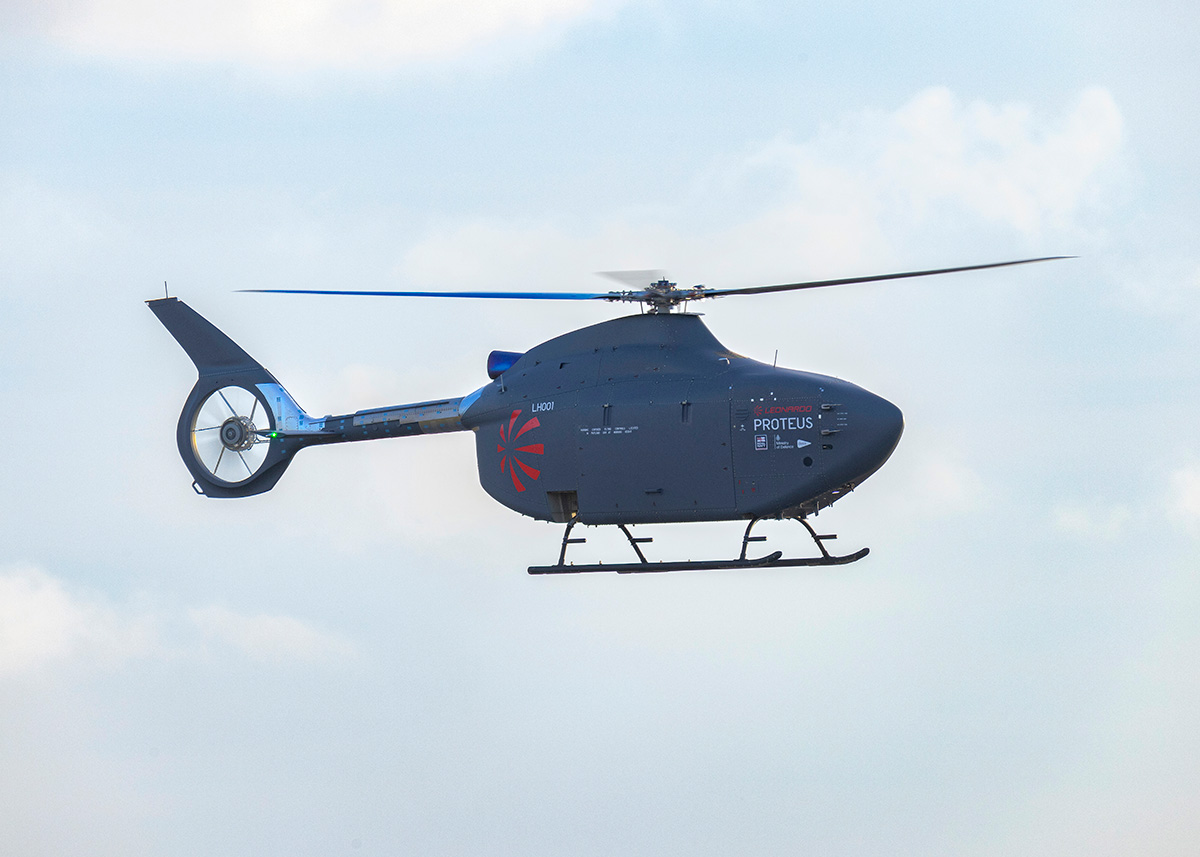
The UK’s first full-size autonomous helicopter has flown for the first time in Cornwall, marking a major milestone in Royal Navy plans for a hybrid fleet and the Atlantic Bastion concept set out in the Strategic Defence Review.
British aviation history was made this week as Proteus, the UK’s first truly autonomous full-size helicopter, completed its maiden flight from Predannack airfield on the Lizard Peninsula.
Designed and manufactured in Yeovil by Leonardo, the helicopter is being developed for the Royal Navy as a technology demonstrator under a £60 million programme aimed at integrating uncrewed aircraft alongside crewed platforms in future naval air wings. The flight followed weeks of ground-running trials at Leonardo’s Yeovil site, where the aircraft’s engines, sensors and autonomous systems were tested before it took to the air. During the sortie, Proteus operated its own flight controls without a human pilot onboard, while being closely monitored by test pilots on the ground for safety.
Proteus is intended to demonstrate how large autonomous helicopters could support a future hybrid navy, conducting tasks such as maritime patrol and anti-submarine warfare while freeing up crewed aircraft for other missions. The concept aligns closely with the Atlantic Bastion strategy, which focuses on securing the North Atlantic through a networked mix of ships, submarines, crewed aircraft and uncrewed systems. Unlike smaller drones already in Royal Navy service, Proteus represents a “step change” in size and capability. With a payload of more than one tonne, the helicopter is designed to operate in challenging maritime conditions, including high sea states and strong winds, carrying sensors or mission equipment without placing aircrew at risk.
Luke Pollard, Minister for Defence Readiness and Industry, said the flight underlined the value of British defence innovation.
“This maiden flight is a proud moment for British innovation. Designed and built in Yeovil, Proteus supports skilled UK jobs while helping deliver the hybrid navy outlined in our Strategic Defence Review. Autonomous systems like this will be vital in protecting our seas without putting personnel in harm’s way.”
Commodore Steve Bolton, Royal Navy Deputy Director Aviation Future Programmes, described the event as a key moment for naval aviation.
“The successful first flight of Proteus is a significant step in delivering the Royal Navy’s maritime aviation transformation vision and demonstrates our commitment to investing in autonomy as part of a hybrid air wing.”
Leonardo said the programme supports around 100 highly skilled jobs in the UK and places Britain among a small number of nations developing full-size autonomous rotary-wing aircraft.
Nigel Colman, Managing Director Helicopters UK at Leonardo, said:
“Proteus represents a step-change in how maritime aviation can deliver persistence, adaptability and reach, conducting the dull, dirty and dangerous missions in challenging environments without putting human operators at risk.”
Further flight testing is expected as the Royal Navy and Leonardo continue to explore how autonomous helicopters could be integrated into future maritime operations and NATO defence planning.






Mazeltov!
British? I thought Leonardo was Italian, having taken over Westlands.
Does HMG have a golden share, like with other companies?
No, the Italian government does. The UK government has the National Security and Investment Act, 2021, and the threat of nationalisation.
No It was a merger between Augusta and Wastlands.
Is Boston Dynamics an American company or a South Korean Company?
Haven’t the foggiest!
Google says “is an American engineering and robotics design company founded in 1992 as a spin-off from the Massachusetts Institute of Technology.”
I’d never heard of them, are they good?
Calm doooooon Daniele, no one has insulted your bloodline. Who knows who owns anything anymore, it’s about where they’re built, in which factories and with whose hands.
I think the best we can hope for these days mate, is that the design is held by the UK entity- so at least we get additional future licencing royalties into the UK PLC and potentially physical exports from a UK production line.
Beyond that, building out the design team here in the UK so that they’re producing original designs and have a value that may be worth spinning off into a UK company again is probably the only route towards a truly sovereign capability again…
Protector drones out of Waddington fly by us occasionally and there is something irrationally disturbing about it I don’t know why. Not as scary as watching the Yank Ospreys fly past though, they just seem to defy aerodynamics.
Good to see the Lysander Road Toy Shop is busy 😁
(It’s OK, I know a few of the boys there from a while back)
I’m struggling to see the value add of these. No question that cheap drones have revolutionised warfare, but big expensive ones I am less clear on.
Ok you save the need for a crew, who can be sat back in blighty but still need all the repair and maintaince crew on the ship. Plus sat comms can be jammed resulting in a unusable vehicle.
I assume some weight and space saving from the lack of the crew but how much of that is going to then be lost by adding a powerful computer to do the flying.
What troubles me is the possibility of, come conflict, all one sides drones are succesfully hacked , strike their own forces & then return to the enemies vessels or do a suicide attack.
Weight saving from no crew can benefit in greater range than the manned system, with or without more fuel.
That has to happen sooner or later. I wouldn’t be surprised if it hasn’t already happend in Ukraine on a smaller scale.
It has already happened.
Pilots are real really expensive and a nightmare to train.
Small helicopter drones like this could allow you to put AWAC and ASW capabilities on every ship of the fleet quite cheaply so even OPV’s can now be significantly more useful.
Depends on weight. A radar that can see beyond the horizon and therefore exceed that of the ship would need to be of a certain size and weight. No idea what that is though.
Pilots are expensive for sure, but so are engineers to repair and service them. Plus it’s normally the upfront costs that is the biggest issue and I assume these helicopters are not going to be cheap.
I thought it was well known that drones are for the 3 D’s: dull, dirty, or dangerous, work.
Proteus is aimed at the dull: flying double digit hour sorties to perform ISR.
The size of the drone is immaterial.
Is it realistically going to have double digit hour flight time once equipped with sensors of some form and flying in ocean winds?
If it can then yeah I see the value add, but I doubt it.
The plane it’s based on before adding all the automation has a max flight time of 5 hours, which I assume is over land with minimal winds and load.
Proteus is a research/development vehicle. It will input into a future production helicopter.
I know, just feels like they are approaching drones from the high end platinum coated approach, rather than from a objective need and capability approach
Realistically nothing this size will be useful over land but will allow for much larger operations over the sea.
I think the armchair admirals underestimate the weight saving by going fully unmanned. Not just losing seats and pilots, all safety features relating to crew are gone, no safety crash zones are needed, remove most of the backup systems etc. Even build it out of cheap materials, let every time it crash / get shot down be a write off. Don’t over spec them, each will have a different role fit (radar, sono stores etc.) and they can work together. And suddenly you’re looking at getting 20 maybe 25 for the price of a wildcat.
I like the theory, I bet in practice it will cost around the same as a manned helicopter, if not more. We will see.
Server racks are very small for what they do. I imagine the computers on board this helicopter weigh less than a single crew member would and takes up a fraction of the space.
What that enables you to do is fill up all of the volume and structural weight that was dedicated to keeping the crew warm, comfortable and free to do their jobs to a combination of fuel, payload and redundant Comms systems.
So as an example the Merlins have c.10h endurance but this vastly smaller drone helicopter is supposed to have more than that with a decent payload too. A manned helicopter the same size would be useless.
We will see, the US has been playing around with these for years and so far hasnt’ been impressed enough to place any orders.
The US thought that their Firescouts would be doing ISR ashore or in close proximity to suspicious vessels, where helicopters are particularly vulnerable. They were also remotely operated rather than actually autonomous.
Proteus is larger, designed for ASW rather than ISR and has the advantage of autonomy to avoid jamming issues.
I think we also have to take into consideration where progress will take us through development and research. Judging the future based purely on the first instance of a test platform is self defeating, after all a Spitfire Mk 1 was half the wight and 100mph slower compared to late Mk Spitfires developed within 5 years or so. You have to start somewhere even if as with the Spitfire it was hardly ideal initially. It’s about being good enough with the potential to progress substantially, but only developmental testing will really give you even initial useful data and experience upon which to make realistic predictions upon which to base future commitments. Or we can just wait, let others do all the work and just buy whatever is produced. Don’t find that idea encouraging in present circumstances.
Did the firescout ever come out of trials? Only a handful were ever ordered which would indicate not fully.
Well, the MQ-8C Firescout is a fleet of 38 and operates off the LCS as an ISR and targeting platform, although it can use APKWS too, which is a very rough equivalent of our Martlet. That is based upon the Bell 407, but with an endurance of 15 hours with a simple load. I don’t know what the endurance of a manned Bell 407 is, but I doubt it’s 15 hours. It should follow that Proteus would get better endurance than a similarly sized helo, with a simple payload for either spotting and providing targeting data to the frigate, or even directly engaging.
Alternative, but similarly sized packages could include sonobuoys, and possibly depth charges, or even a single lightweight torpedo. None of these are massively heavy, or consume a lot of power in the way a surface or air search radar would. I don’t think they are the intended payload.
I think the point of Proteus is to supplement the manned helicopter, to provide constant air coverage- or closer to it. It may not have the full capabilities of a Wildcat or Merlin, but if it can deliver some of the effect it’s an infinite improvement over nothing if the manned helicopter is on deck.
Wow a helicopter that flys itself, truly the British drone programme is breaking new ground 😂
We were so far ahead 15 years ago and now this.
No doubt the autonomous software is an improvement but this is hardly ambitious.
Don’t think we were so far ahead compared to some others just playing a good competitive game. Shame mind I agree that we seem to have discarded opportunities in this sector as in so many that have great promise but risk and cost hold us back, leaving others to exploit it leaving us to buy the technology in when it later becomes vital.
One hopes and prays this is a British success story. Though im sure UK government eill screw it up sooner or llater and we will end up purchasing a small from the US or Europe.
Nothing British about this sadly. 100 per cent Leonardo owned.
Industry likes to put big british flags on stuff in the hope it will increase the chance of getting a load of extra case, just look at boxer.