

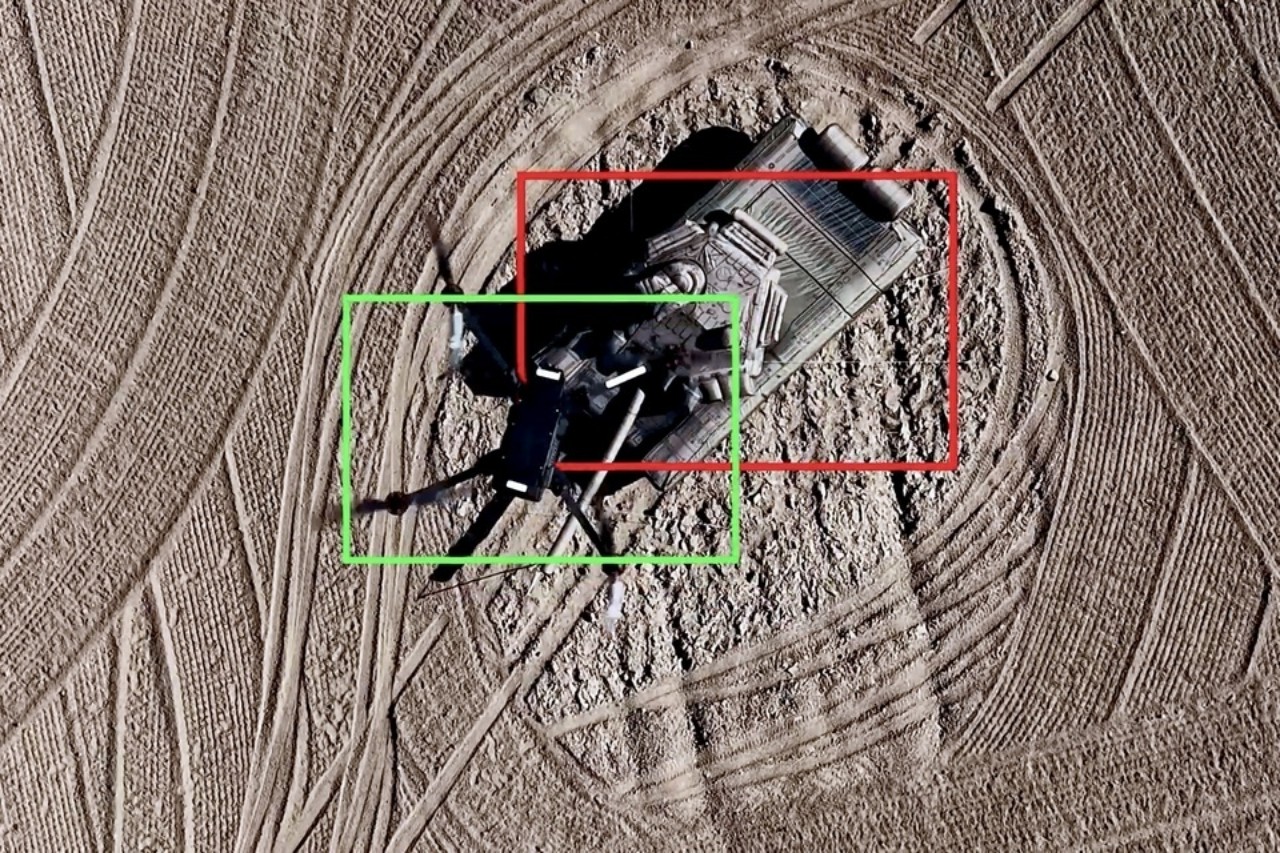
The British Army has put an eight-aircraft drone swarm through battlefield trials, testing technology that allows groups of uncrewed systems to be commanded collectively during realistic military tasks, according to the Defence Science and Technology Laboratory.
The work forms the first phase of the Software Defined Swarms Concept Demonstrator, developed by Dstl with Army Headquarters and industry and building on activity conducted under AUKUS Pillar 2.
Two industry-led approaches were tested in realistic operational environments. One was developed by BlueBear, a Saab company, while the second came from the Disruptor Group, a consortium of British companies led by Applied Intuition.
The trials allowed soldiers to assess how the systems handled representative battlefield tasks, with the Army particularly interested in roles such as intelligence, surveillance and reconnaissance for forward-deployed forces.
At the centre of the work is what the Army describes as true swarming, where groups of robots are commanded collaboratively rather than simply flying several individually controlled drones in the same area.
Brigadier Kieran Sheldon, Head Military Capability Plans at Army Headquarters, said: “The partnership with Dstl to develop swarming technology has been hugely energising for all involved. Dstl has enabled, with industry, the Army to conduct extensive in field trials since May.”
He added: “The technology for true swarms, groups of robots that are commanded as collaborative groups, has significant potential and due to the work of Dstl and the industry teams, the Army is more informed and empowered to seize it.”
The Army has already completed eight weeks of experimentation using the Swarm Capability Test Bed, which consists of eight uncrewed aerial vehicles.
The system is now in the hands of British Army operators, with the Experimentation and Trials Group carrying out live flying and further trials planned through 2026 and 2027.
Dstl said the demonstrator uses open architectures so that the system can be adapted as new technologies emerge rather than being tied permanently to a single type of drone or control system.
The same underlying approach could also be applied beyond the air domain, including to uncrewed ground vehicles and uncrewed surface vessels.
The project brings together more than a decade of Dstl work in artificial intelligence, autonomy and swarming technology into a test bed that soldiers can now use directly in the field.
Richard, Dstl’s Land Systems Programme Manager, said: “The team has demonstrated what true partnership can achieve, uniting technical excellence, operational insight, and strategic coherence to drive forward a capability that will fundamentally reshape future military advantage.”
The Army sees swarming systems as one route to increasing battlefield mass without relying entirely on expensive crewed platforms, using lower-cost autonomous systems that can work together to produce a coordinated effect.
Sheldon said: “This offers the opportunity to really accelerate the Army’s adoption of uncrewed, autonomous and swarming systems to increase fighting power through lower cost attritable and consumable systems that provide coordinated effect.”
The work also reflects lessons from Ukraine, where the rapid evolution of drones, autonomous systems and electronic warfare has placed a premium on technologies that can be adapted quickly as threats change.






Seems like such a waste of time developing drones under AUKUS pillar II when America is shutting down drone programs in favour of Testosterone treatments and back to basics approach to fighting wars.
It’s upsetting to see such a once mighty fighting force and a bulwark of democracy being wrecked by a Fox News host and a president obsessed with shiny parades, battleships and making the rockets pointier.
Pathetic. Grow up child.
Just a thought: as AI development races ahead, is there a possibility that these systems will monitor and defend in an economical fashion that could ultimately reduce the number of counter systems? I can envisage a battlefront quickly becoming a stalemate as a result of opposing AI systems counteracting each other like a professional chess match. The drone has done exactly that in the Ukraine war with or without AI.
It’s already happening, drones using pattern recognition algorithms to target not just vehicles but other drones.
Radars are expensive but digital cameras are ridiculously cheap. Any sensor that can use them can be scaled up exponentially.
That being said it’s not really AI vs AI. None of these technologies are actually AI, rather what we called big data a few years ago before Sam Altman and Elon Musk started scamming all the idiots in the world.
Whatever the nomenclature, these advanced electronic systems are still in their infancy in historical terms and one wonders just how quickly the battlefield could become stale using them. It appears only multiple systems operating in random patterns can actually keep warfronts active. It’s obvious the lack of meaningful air cover has led to stalemate on some battlefronts in Ukraine, keeping MBTs from being used in their traditional manner.
“The drone has done exactly that in the Ukraine war with or without AI”
Au contraire, recent developments show that drones incorporated into all arms attacks have been successful in regaining significant territory lost to Russia.
A good point.
Ajax is looking rather pointless.
I’d not go that far. I think that there are armoured recc vehicles in service with Army’s around the world still. If so, unless they’re discarding them, which I don’t think they are, then there’s a role.
Events and tech might have overtaken it in it’s forward deep recc role, such has been the time it’s taken to develop but there must be usefulness in the asset yet.
It has good ISTAR systems, armour, and gun. Use them.
It was a bit tongue in cheek.
At some point having eyes forward will be necessary for when drones are countered, we will be in an enviable place then. (A bit more tongue in cheek).
I think we’ve mentioned this before. Ajax can carry an additional bod in the back. Perhaps this person could be used as a organic drone operator. Where the drone is launched and recovered to the vehicle. Whether that’s flown from a box attachment fitted to the rear, or the operator has to get out of the vehicle to set up the drone. But by giving Ajax its own organic drone, it gives the vehicle a beyond line of sight capability. Or where the drone clears the area ahead of the vehicle for the vehicle to then move up to.
Agreed, I was thinking this the other day- a crate launcher on the back and an operator or two in the smaller crew compartment. Mixed complement of ISR and one way effectors, and you’ve got yourself what the Army have always claimed Ajax to be- a top-tier reconnaissance vehicle that can hit hard when required.
With the right Comms, you could even have them calling up additional drones from a Boxer/Patria module, or other vehicle sat a bit further back.
Hi Daniele, agreed on Ajax here.
Apparently, some of the more recent Ukrainian advances have been supported once again by armour. There are very few details, and they’re often delayed, because they’re taking OPSEC very seriously (quite right too). But it seems they’ve been making use of adverse weather windows and EW to bring mixed MBT and IFV groups up to the contact line to support infantry in hard assaults to kick out the Russians. They then pull back under cover from their own fire, artillery, and drones once the weather has cleared up.
It means they can move a lot of infantry quickly and safely, to take advantage of the window, and the heavy armour means that losses are light if they hit mines or the weather clears unexpectedly and/or the Russians have fibre optic FPVs in the air. Plus, the firepower provides support to the infantry in the attack- as intended.
You just wouldn’t get all those benefits from light vehicles, so heavy/mechanised armour is still absolutely valid. Admittedly, Ajax isn’t strictly an IFV- but I think the point still stands.