

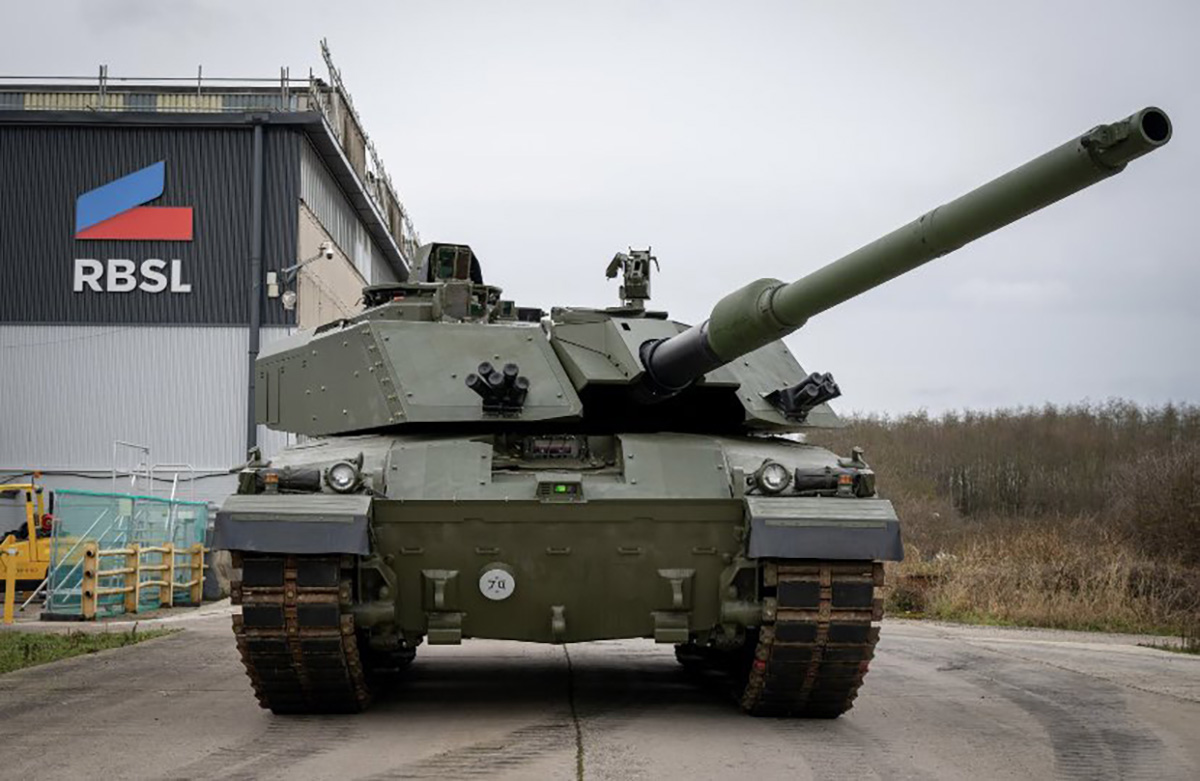
The Ministry of Defence has confirmed that manufacturing of the Challenger 3 main battle tank will not begin on a fixed timetable, but only once performance trials have been successfully completed.
In written answers to Conservative MP Ben Obese-Jecty, defence minister Luke Pollard said the programme is “currently undergoing demonstration phase trials to prove the performance of the tanks.” He added that manufacturing will begin once performance is validated, “rather than being tied to a specific deadline.”
The demonstration phase involves a limited number of vehicles being used to validate design, integration and performance against requirements. As of late 2025, only eight Challenger 2 hulls have been allocated to Rheinmetall BAE Systems Land for design, build and testing activity, with series conversion yet to begin.
The response clarifies that Challenger 3 remains firmly in this demonstration phase, with the transition to manufacturing dependent on technical outcomes rather than calendar milestones. Pollard said the project team will continue to reassess progress, stating that “the timeline [will be reviewed] regularly to ensure alignment with delivery milestones, operational needs, and emerging technical risks.”
By avoiding a fixed start date for production, the department is signalling a cautious, risk-managed approach intended to reduce the likelihood of downstream delays or capability shortfalls. While earlier planning assumptions pointed to Challenger 3 entering service later in the decade, the latest parliamentary answers underline that progress will be driven by trial results rather than pre-set dates.
Challenger 3
Challenger 3 is a British fourth-generation main battle tank developed for the British Army through the conversion of existing Challenger 2 vehicles. Produced by Rheinmetall BAE Systems Land with 148 tanks planned for delivery by 2030. The programme represents the most substantial upgrade to the UK’s armoured capability in decades, featuring a new turret, improved hull, modular armour, and provision for an active protection system.
The origins of Challenger 3 lie in long-running efforts to extend the service life of Challenger 2. Initial work began in 2005 under the Capability Sustainment Programme, but funding delays and management issues slowed progress. In 2014, the programme was reorganised as the Challenger 2 Life Extension Programme, leading to competing proposals from BAE Systems and Rheinmetall. Following the merger of their UK land operations into RBSL in 2019, Rheinmetall’s more ambitious design effectively became the sole viable option short of replacing the fleet with a foreign tank.
The defining technical change in Challenger 3 is the adoption of the 120 mm Rheinmetall L55A1 smoothbore gun, replacing the rifled gun used on earlier British tanks. This brings ammunition commonality with NATO allies such as Germany, alongside a new kinetic energy round developed jointly for Challenger 3 and Leopard 2. Other upgrades include advanced sights with third-generation thermal imaging, improved fire control systems, enhanced electronic architecture, and mobility improvements such as upgraded hydrogas suspension and transmission components








Would still prefer to see 186 Challenger 3 in the British Army.
I think everyone would.
John H, that number would equip three Type 58 regiments (Daniele tells us that the third armd regt, KRH, stays in role) with just 12 left over to be spilt between the Trg Org (both REME and RAC), the Repair Pool and the Attrition Reserve. That’s a tad tight!
There was a reason we ordered a mere 386 MBTs in the early 90s for the post-Cold War army.
Yes, but fantasy fleets have to be based on economic reality. Plus available hulls & industrial capacity.
148 upgrade units and 148 new builds. Sorted. Amazon.com, press buy.
What will they be supported by after Warrior is retired in 2027? Without armoured infantry we can’t deploy the few tanks we have. It’s a giant mess.
Exactly, 148 will be “too many” with no IFVs, next to no artillery, very few transporters, and various other unglamourous supporting arms down to bare bones. The Army needs to face facts and aim to have 2 fully supported brigades deployable by 2030, there’s no way we’ll be able to deploy a well balanced division, let alone 2 as some deluded people are suggesting we aim for.
By ‘deluded people’, you are no doubt referring to the authors of the 2025 SDR?
‘Recommendations:
41. The Army must modernise the two divisions and the Corps HQ that it provides to NATO as one of the Alliance’s two Strategic Reserves Corps (SRC). The SRC should be led by the Corps HQ (Allied Rapid Reaction Corps) and enabled by, and command, Corps-level capability. The first division should comprise a fully deployable Headquarters, three manoeuvre brigades with armoured and mechanised capabilities, support brigade, and associated enablers. Planning should include the integration of the Royal Marines Commando Force into the SRC when appropriate’
That is not a ‘delusion’. It is a NATO commitment, of which we are in breach, just as we are also in breach of the security assurances that we gave to Ukraine in 1994 and our obligations, as a U.N. Security Council permanent member, to uphold UN principles, leading on threats to peace, recommending peaceful settlements, and supporting enforcement measures.
It’ll be Boxer. Tanks don’t *have* to be supported by armoured Infantry, they *have* to be supported by some form of Infantry. Armoured is ideal, failing that Mechanised, failing that motorised, and failing that light role. On Telic 1 a lot of the Infantry the Tanks worked with was light role (16 AA and 3 Cmdo, since 16AA had been deployed instead of a Mechanised Brigade).
Forgive my ignorance, but do we not need IFVs to support CR3 if we are to provide the so called heavy 3rd division to NATO? 1st Div is meant to be the lighter mechanised force.
If Boxer is to fill the hole Warrior is leaving, we need a lot more of them with far heavier armament than has been announced. I am no expert so happy to be corrected.
Hi Rob.
It’s the difference between the optimal solution and a solution. Tanks working alongside Infantry mounted on an IFV is the best solution because that means you get 120mm fires from the tank, the eyes of infantry bringing MG’s, Rifles, ASM’s, and Drones to bear, and the IFV supporting with 30mm and ATGM’s.
If you drop the IFV, and replace it with an APC, you loose the 30mm and the ATGM’s have to be used dismounted, but you can still provide a heavy formation (for a lot of the British Army’s history in fact 432/Cheiftain or 432/Challenger did a very similar ConOp to Challenger/Boxer).
Rob, I am sure you saw the MoD press statement in March 2021, that WCSP was canned, WR would soldier on unmodified and would be retired from mid-2020s and that Boxer MIV would instead be issued to the infantry of the armoured brigades in 3rd Div , (rather than to the Mech Inf in 1st Div).
A horrendous and crazy decision to replace an IFV with a MIV (APC), but its been known about for over 4.5 years.
Despite talk of a number of ARES possibly being converted into IFVs, I have never seen this as an officially funded project. Rachel has no money for IFVs. Maybe when Defence gets to 2.5% or more it (or some other IFV project) could be teed up as a Project.
Its all ridiculous. WCSP issues were fast becoming resolved and the project was very cheap (relatively). Could you imagine the Navy being told they could not have frigates anymore and had to use Patrol Boats for frigate duties instead?
Sounds about right. Not buying enough tanks because there’s no Warrior replacement is plain daft. Use Boxers until an IFV solution is found.
So Challenger sometime if it works; Ajax dodgy and no warriors. It’s not only Ajax that makes people sick. Two pretend brigades of nothing in how many years.
Bring on putin!!
Run over him more like, if we can find something to use!
Preparing for announcing the predictable delay…
So being generous based on in-service date of all 148 by 2030, they have 6 years for the whole programme. Hope someone has reviewed the Project Plan and looked at long-lead items etc, as if they started in January, it works out at approx 1 of the production line every two weeks.
When is the new barrel plant in Sheffield due to open? I imagine they will have to start boring barrels for CH3 and 155RCH from day one.
Looking at Forgemaster info on the web, i think its due to start production in 2028
I wouldn’t bet on the 155RCH coming along actually any time soon .
Germans have ordered 84 with delivery between 27-29,also 54 going to Ukraine.
trouble is apart from adding a BV have we started to modify the specifications for them I wonder
Finney, you mean CR3. CH was the abbreviation for Chieftain. I am fairly sure Rheinmetall is building the 120mm smoothbore gun in Germany.
Mark F, In 2005, the MOD created the Capability Sustainment Programme (CSP) to extend the service life of Challenger 2 into the mid-2030s and upgrade its mobility, lethality and survivability. By 2014, the CSP had been replaced by the CR2 Life Extension Programme (LEP) which shared a similar scope of replacing obsolete components and extending the tank’s service life from 2025 to 2035. I worked for Rheinmetall on CR2 LEP way back in 2016.
Contract Award with RBSL was signed, valued at £800 million, on 7 May 2021.
Thus, things did not start this January!
Graham, I was referring to the time to convert all the tanks, as in work on the production line, rather than all the R&D, test and evaluation etc. According to the article, only 8 CR2’s have been handed over to RBSL conversion, meaning that 140 need to be handed over, stripped, upgraded and rebuilt between Jan 26 and end of 2030
Begn? I thought it had begun ages ago!
SO! what are we actually saying here? Not only GD & LM failing on vehicle contracts. Rheinmetall too? every project placed to foreign companies has failed dismally.
Panther (disaster), Ajax, WCSP, Boxer, C3 how do people in DE&S, Army remain in position? Over £25 Billion spent without fielding a new fleet? Archer excluded?
Panther was only a disaster because they didn’t factor in all the additional kit MOD wanted to install. This effected bslance and CofG. I believe thst once they upgraded the suspension that it became a perfectly acceptable vehicle. Well excluding that fact they had all been abandoned in the Ashchurch hangers, and MOD had gone fulltilt on Foxhound
Panther had poor reliability, hence all low miles and the extra weight made it wallow off road, inboard brakes overheated, ballistic windows prone to fogging up. The bottom armour had to be removed to grease props, no access panels. fuel tank leaks. Mods to stop aux belts snapping etc. radiator and condenser protected by flimsy plastic grill. There were better protected vehicles for less money, seems like favour for chum Berlusconi
There also was an issue with the way the kit was placed on the inside, it meant that you could only exit the vehicle by the same way you’d entered it. So if you where in the left hand seat, and had a contact left, congratulations you’d be getting out the left hand door. (At least that’s what I was told, never actually worked on Panther).
To be fair I think there were a few sincere in Industry for the lucky few….
Sinecure!
It seems sensible to me?
Certainly better than (ahem) the other programme, where we started production before finding out if they worked or not.
I know. 🙄
This is utter cobblers!
For what its worth I believe that given the current problems/inability to project manage any of the home grown AFV’s we would be better off mothballing all current programs and buy from our European Nato partners and by jumping on their orders we would get them a lot cheaper and have a reliable access to spear parts as well as a common logistical support for ammunition and communications. We need to fill the void left in our armoured divisions ASAP and as cheaply as possible and the current MoD procurement system dose not cut it as there are to many mouths to feed.
Curious to ask what AFV programs we could jump on and get preferable terms and quick delivery?
The Pole’s and the Germans for a start are increasing the numbers of AFV’s, I’m pretty sure they would welcome more orders as it would bring down their costs as well.
The poles are going Korean with their MBT,obviously Leo for Germany,which would you pick and why?
We are getting with CR3 a modern MBT (not enough)for the insane price of £5m a pop. By the time any contract has been agreed with anybody else,trails etc are done CR3 on the timescale indicated will be in service! Rhienmettal have also said they can build more if ordered.
I would go with the Germans myself, as for the C3 we “might” see a few by 2030 but at just 148 proposed it is going to be an expletive reconditioned C2. I would put all the C2’s in reserve and go for a fleet of Leopard 2’s for the same money we are proposing to spend on C3’s we could get at least 200 L2’s along with a common logistical support along side the German army.
The C2’s and L2’s are giving a good account of them selves in Ukraine and even the L1’s seem to be out lasting the T72 and 80’s but what the UK needs is Armour now not in 5 to 10 years (if it is actually delivered). As for the Ajax I hope in the very near future it can get sorted but looking at its history there is a very big question mark. So we need to claw back as much money as we can from AD and invest in an “off the self” product that is currently in production.
Sorry mate but how you going to get 200 Leo 2A8 at €32-€35m each compared to CR3 cost of £5m?
As for CR3 being a regenerated CR2 what do you think leopards are?they are all just the next generation of the same tank!
The C3 are going to cost a lot more that £5m that’s if we ever get them.
£800m fixed contract dividend by 148,£5.4m per tank👍
That £800m buys you 23 Leo 2!
Jacko, as you well know, there has been no fixed budget contract that the MoD has signed that has come any where near the signed contract, Ajax, T31, PIP for T45’s just to name the one’s that come to mind straight away all have been vastly over the agreed price.
With C3 we will be getting a revamped C2 in (if we are lucky) 5 to 10 years.
This project is going to cost the tax payer a lot more than £800mil and the British Army will still be found wanting with just 148 units proposed (at the moment) that if they can find 148 C2’s in good enough condition to revamp. I am all for British industry first but the flash to bang in the MoD’s procurement is far to long as it has too many mouths to feed and the Army, RN and the RAF needs Kit now not in 5 to 10 years if they are lucky.
You really should do some research about CR3,it’s hardly a revamped 2, a completely new turret kind of turns that on its head! Even IF the budget ( fixed) rose it still would not be the approx £7b that your fantasy fleet of 200 Leos would cost!Ajax despite its problems is NOT over the fixed price which again a quick question on Google will confirm!
All the facts and figures are readily available to find but hay ho if you want to continue your narrative carry on.
Perhaps Santa can bring you some Leo’s tomorrow have a good one cherio.
300 at least are needed.
I sometimes wonder what would have happened if the Government+MoD of the day had decided in 1938 that although there were looming threats to world peace, somehow there would be a period of 5-10 years grace before we really needed the extra kit + trained manpower?
Just watching the “The World at War” documentary about the Battle of France (1940)
Amazing to think that the B.E.F left all its Tanks, Artillery and trucks and other heavy equipment behind at Dunkirk.
In June 1940 Britain had nothing. Yet we managed to carry on rebuild, and fight in Africa.
Anybody think that this inability to kit out our forces by the mod and wonderful politicians might be planned?
How could anyone be that incompetent and short sighted.
Could it be foreign States playing the long game. Infiltrating the corridors of power. Making sure we don’t have the kit or numbers of trained service personnel to use them.
We are undobtedly heavily infiktrated. Our enemies are doing everythinf they can to lobby behind the scenes , bribe officials and encourage apathy from social media, lobbying the welfare state using political groups and cancel culture etc . And its all working
I’m not sure the welfare state is the issue here.. the Uk was strong across the Cold War with a welfare state.. a fair society that cares for the sick and elderly is a strong nation, a society that educates its children is a strong society.. a society with good public health and a healthcare system is a strong society.. infact most of the structures we have were created to make our nation stronger at fighting wars.. the NHS and public health were specifically created around the need to have a healthy productive population.
Our biggest issues are
1) a demographic one.. go back to the hight of our power the average age of death was about 45-50 when we helped win the Cold War it was in the 60s now it’s in the 80s.. but as our life expectancy has grown our healthy life expectancy has not grown in the same.. so we have a huge population of old frail people.. and the simple truth is they cost an utter fortune.. the NHS will spend about 20 time more on the average person in their 80s compared to the average person in their 20-50s.
2) loss of social cohesion.. this is down to many things. but for a large part of the younger population basic things like affordable housing, steady jobs and reasonable priced food no longer exist.. I lived in a world where I was guaranteed a job and even working in a shop I could buy my first home… the new generation cannot even get steady jobs in tescos… and to buy your first home you need a salary of at least £30,000 a year.
Welp seems that doomer-ism has gotten it’s claws into CR3 here as well. The eminently sensible idea to do the project right and run trials through to completion before commiting to full scale production shouldn’t be controversial, and it’s definitely not a “problem.”
Hi Dern, Merry Christmas!, I don’t disagree, bizarre that this was not expected from the off though? Having been a project manager I would expect these items to shown on project plan/Gantt chart/Key project milestones as well. Otherwise its all meaningless!
Can you blame anyone for being a “doomer” when it comes to UK defence? Perhaps the situation isn’t as bad as we fear (although I strongly suspect it is), but what actual, positive news do we have these days? Anything progressive or actually in progress seems to relate to foreign militaries. I also suspect the UKDJ reports on this so frequently because there is little news on the British defence industry.
I agree that being slow and steady with the new Challengers seems like a good idea, especially given Britain’s catastrophic history of splashing cash on white elephants, but is it being drip-fed to save money/due to lack of interest, rather than to ensure it’s done right?
Also, is anything we’ve learned from Ukraine going into Challenger 3? Western tanks seem to be too heavy, complicated and expensive, and too limited in numbers. But we seem to be doubling down on all those factors with C3.
I absolutely can blame people for being doomers, and your comment here is a case in point. An eminently sensible decision to tie the delivery date to trials rather than an arbitrary contractual date has everyone turning into moaning myrtles, as is the want on this site.
“Western tanks seem to heavy complicated and expensive” what makes you say that other than “I just have vibes.”
You’re free to have your own opinion of course but you can’t expect others to find blind optimism when there is virtually nothing positive coming out of our defence news. You might argue that reviews and discussions by the powers that be are a win. Until physical action is taken, they’re serving up nothing but greek salad, and that’s not something I am going to get excited about.
As for the tanks, it sounds like you didn’t read the news reports coming out of Ukraine at the time Western tanks first went into action, and you probably didn’t keep track of what was actually happening over there. As far as I recall, as it’s been a while, they were mostly knocked out or captured with Ukrainian personnel being quoted that they lack manoeuvrability and survivability, and were struggling in their terrain.
Oh boy, and this is why I asked.
I paid very close attention when “western” tanks went into action, and what was actually happening. I for example remember that Challenger and Leopard went into action during the Tokmak offensive, when green Ukranian troops where sent straight into the most heavily defended part of the line without fire superiority, surprise, or air support.
They where not “mostly knocked out.” There where a few photos widely publicised by Russian sources of a Ukranian column that got caught by Russian Artillery and Helicopters, and the fact you seem to have swallowed that explains where your encouraging negativity comes from.
Western Tanks have had superior survivability to Russian designs, both in terms of weathering actual hits, and the crews ability to survive a tank being knocked out and fighting again, notably the lack of western tanks turret tossing. Terrain in Ukraine is difficult, for all tanks, and wheeled vehicles, so again, another non-starter (this is why there is a fighting season in Ukraine, when the conditions allow for armour to move, and part of why the Russian advance on Kyiv in the first months of the war ground to a halt.
So yeah, sounds like you didn’t pay attention to any detail and just where fed some narratives you swallowed hook line and sinker.
I’m not expecting blind optimism. I’m pointing out that people like you will turn a neutral, or even good story, like this into doomerism, because you have a hard on for the armed forces failing btw.
Yeah, but from our perspective, you’re putting too positive a spin on things. You’re getting breadcrumbs and thinking they’re gold nuggets.
Excessive positivity is toxic, just as excessive negativity is.
Not sure why people are moaning about a plan to only begin production when the design is actually proven to work..seems a sensible idea to me, manybe if they had done that with Ajax the army would not be 5.5 billion down a busted vehicle.
Indeed. We have a lot of problems but some programs, like CR3, are doing well and running as planned. Not every MOD project is a disaster.
They’re moaning because the Treasury has been, and is, drip feeding the project with cash therefore ensuring its slow pace from the start.
To be fair we don’t really know that Grinch, to me it seems to be coming along ok we have actually got the test vehicles out doing their thing.. I would much rather they get it right than spaff the budget on a gold plated vomit box.
Very generous of Putin to wait for the UK to catch up with procurement and get ready for war.
The question I want answered is: what do the powers that be think is going to happen in the world over the next 10 years? If they’re happily convinced Britain will have no need to either go to war, or project power/influence, or defend itself from attack, then we can breathe a sigh of relief.
Provided, of course, they have irrefutable evidence of this. I suspect they don’t. Maybe this is why Mystic Meg isn’t on telly any more – the government are paying her to predict the future of this country.
One more thing I’m worried about is our worthless prime minister. Apparently, a couple of years ago, Rishi Sunak’s eyes glazed over whenever anyone mentioned defence of the realm; Starmer isn’t just listless and useless like Sunak, he is actively counter-productive whenever he casts his evil guff cloud over a topic. This is a conspiracy theory but it seems to me like he is actively weakening the UK. Not letting it crumble, not showing disinterest, but actively shrinking it.
What trails etc are we doing that Rhienmettal have not already done on the eight prototypes they have had since at least 2024? It’s a proven hull,suspension and engine,the gunnery and turret trails will already have been done at Rhienmettals expense,does ADTU really need to do years of the same stuff already done ?
As was pointed out above, the £800mill is just the start, there are too many “ifs” in the equation so we are better off going for a proven product off the shelf. Just because it says so on Google dose not make it true, as some one has to upload the information onto Google to start with so what are they getting out of the deal.
There are plenty of references to this contract,of course Google is not the oracle just the quickest way if you can’t be bothered to do some actual research👍Ajax despite the problems is still within budget as it is fixed and GD have to sort those problems !what makes you think the CR 3 contract would be any different? As I pointed out the cost of 200 Leo A8 is approx £7b just for the tanks you can add on supply,service and a whole new logistics chain cost on top that!
Ajax is way over the original budget then if you include the cost of the 1st inquiry and now we have a 2nd inquiry and the Ajax program is still far from delivery (if ever it will be delivered) GD have no money left so it will be the good old UK tax payer who will/is being asked to foot the bill and the same will be true for the C3. We are already in bed with the Germans so why not expand the program to get as much kit out of them as possible that way both Germany and the UK will drive down the cost/item and with a common logistical rout the cost for spear parts will be a lot less as well and more available.
There is a cancer in the MoD Procurement system and until that is cut out we will be better off allowing the Army, Navy and Airforce to by the kit they need directly from existing production lines.