

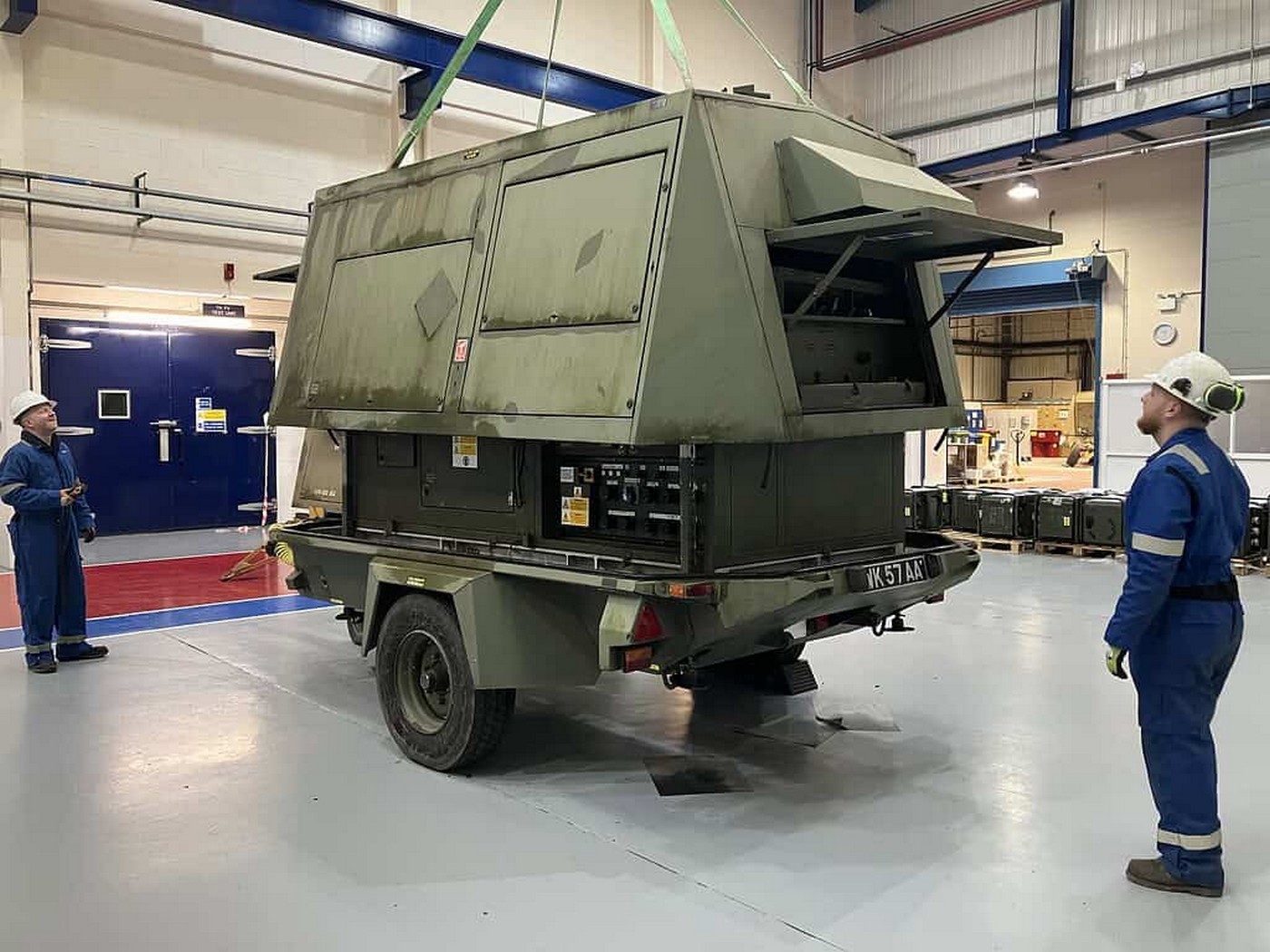
Babcock has been awarded a contract to provide in-service support for the British Army’s Field Electrical Power Supplies (FEPS) generators under a deal worth up to GBP 36 million over eight years.
The contract will see the company deliver maintenance, repair and overhaul services for the Army’s deployable power generation systems, which provide electricity for communications equipment, lighting and other critical infrastructure during operations and training exercises.
FEPS generators are used across the British Army to supply reliable electrical power to tactical communications networks and support facilities in environments where fixed infrastructure is unavailable. Under the agreement, Babcock will take responsibility for the full lifecycle support of the generator fleet, including asset management aimed at improving availability and reliability during deployments.
The company said the work will be delivered from three locations across the UK and will create around 20 new jobs requiring engineering and technical expertise. Babcock already acts as a strategic support partner to the British Army, providing maintenance and asset management services for a range of vehicle fleets and equipment.
Through the new contract, the company will apply its existing asset management framework to the FEPS fleet to ensure generators remain operational and ready for rapid deployment when required.
Kate Robinson, Managing Director of Through Life Equipment Support at Babcock, said the agreement strengthens the company’s role in supporting frontline capabilities.
“This contract supporting FEPS enables the British Army to operate and ensure that they have the power they need, when and where they need it,” she said. “This new agreement strengthens our relationship with our customer and demonstrates Babcock’s integrated approach to complex asset management, powering our Armed Forces on the frontline.”










Well, this article certainly goes back to the basic needs…Electricity 👀
Generators of all sizes, down to the very popular fundraiser ECOFLOW ones, providing such an important capability
Trench candles are great, but having some proper power means you can have decent lights, recharge drone batteries, laptops, and mobile phones whilst sat in the bunker, tents, etc
Good to see reinvestment
I have not seen the details of course, but £36 million over eight years to provide MRO above and beyond that provided by REME and RE personnel sounds a lot, particularly when many generators might not get that much use in a typical year.
Back in the day, Spec Repair was done a lot ie Specified Repair, ie only when a particular piece of equipment required MRO which was beyond the capability of uniformed maintenance manpower would it be backloaded by Contracts Branch REME to a contractor. Contractors raised a periodic invoice itemising what they had fixed in, say, a calendar month, and it was settled. Now we want to pay contractors £millions per year almost as an insurance policy. I doubt the MRO actually done by the contractor will amount to £36m by value.
These things must be getting old. I remember it being a decent system. Why not replace them though? Generators are commonplace. Many worksite generators are perfectly good and not tied to the trailer. Pretty sure they can be made in the UK.
They are being replaced, that’s what this contract is about. The Army is looking to replace its gennys in 2030, until then Babcock is paid to ensure the generators actually work when needed, rather than just being paid for individual repairs. This shifts the risk of equipment failure to the contractor. By securing up to eight years of support, the MoD avoids the risk of having a dead fleet in 2030 if the next-generation Manoeuvre Power technologies, like hybrid vehicle power aren’t ready.
While the Field Electrical Power Supplies (FEPS) fleet has an estimated Out-of-Service Date of September 2030, the contract is designed as a 5-year core term with optional extensions.
The core term from 2026 to 2031 is the initial five year contract and covers the full maintenance and support of the 840 generators through to their planned retirement date.
The contract includes optional extensions; 3 x 1-year options to extend the service up to a maximum of eight years (years 2031 through to 2034). These years serve three primary purposes. If the successor Manoeuvre Power (Man-P) programme or vehicle electrification trials face technical delays, the Army can keep the existing FEPS fleet operational beyond 2030 to avoid a power capability gap.
It also allows for phased decommissioning … a gradual draw down of the fleet as new equipment is introduced, ensuring units are not left without power while waiting for their new gear.
Electric drives (vehicles) provid several mission-critical benefits over traditional mechanical drives, including –
‘Silent watch’ and move, the vehicle’s ability to operate all its electronic combat systems; thermal sights, radio suites, radar, and electronic jammer, for extended periods without running the main engine.
Without the engine running, eliminates acoustic noise and significantly reducing the thermal signature that makes them visible to infrared sensors.
Electric motors provide instant torque, allowing maximum torque immediately from a standstill, this allows for faster acceleration and better ‘escape boost’ in emergency situations compared to diesel engines.
Exportable power, the vehicle effectively becomes a mobile power station. The massive battery and generator can be tapped to power field hospitals, command centers, or tactical microgrids, often replacing the need for standalone FEPS generators.
Because power is moved via cables rather than a rigid drive shaft, designers utilise the inherent design flexibility to relocate components to improve blast protection or create more internal space for troops and equipment, providing.
We all know about regenerative braking; like F1 cars … commercial EVs and military electric drives can recover energy during braking to recharge the onboard batteries.
The British Army’s planned transition from traditional diesel generators to a modernised power network is a calculated move to trade raw fuel capacity for tactical stealth and logistical efficiency. While the Babcock contract ensures the ageing fleet of hundreds of generators remains operational through their 2030/35 retirement date, the real focus is on the Manoeuvre Power programme and the rollout of hybrid-electric drive vehicles. By using these vehicles as mobile power stations and integrating them into tactical microgrids, the Army can replace noisy, high-signature machinery with silent, high-torque alternatives that are harder for an enemy to detect.
British-led innovations like the Solus Power Kratos battery units further this goal by providing ruggedised, portable energy in a familiar form factor, allowing troops to maintain critical communications and drone operations without the constant tether of a fuel convoy. Although the shift toward a more electronic battlefield introduces new considerations regarding EMP weapons … ‘E-bombs’ through electromagnetic hardening, the military is already addressing this through rigorous shielding standards and distributed power architectures designed to survive modern electronic warfare. The modern diesel is also vulnerable, most modern British Army diesel vehicles produced since the mid-to-late 1990s rely on electronic engine control units … ECU’s and a major EMP event would likely ‘fry’ these computers, rendering a modern diesel truck just as inoperable as an electric one. However, High-voltage electric drive systems are often inherently better shielded than standard petrol or diesel cars because they generate their own internal electromagnetic fields and must be designed to contain them.
It represents a fundamental shift in how the Army will generate and consume energy on the front line, moving away from isolated mechanical units toward a smart, networked ecosystem that prioritise survivability and rapid deployment.
Thanks very much. A lot of great information there. But it doesn’t seem like the army is close to transitioning to a hybrid drive fleet. Boxer, Ajax or even the proposed LMPs seem to be traditional diesel. Hopefully the next gen generators will be a success. Surely they can’t mess up buying generators.
You’re right that the Boxer and Ajax fleets today are built around traditional diesel engines, but the UK Army’s transition to electric isn’t an all-or-nothing it’s a phased shift toward Hybrid Electric Drive … HED. The Boxer is Hybrid-Ready, the initial batches delivered and being built in Telford use the Rolls-Royce MTU diesel engine, however, the vehicle is designed with a drive module and mission module split.
Through the TD6 programme the MoD has conducted trials using hybrid-drive Boxers, and because the drive system is self-contained in the module, the Army can potentially swap diesel drive modules for hybrid or electric ones later in the vehicle’s 30-year life cycle without redesigning the whole fleet. For now, diesel provides the range and reliability needed for immediate deployment, but the electrical architecture is already ‘over-specced’ to handle high-power tech like directed-energy weapons or active protection systems.
Ajax is in a different beast. We all know that its development has been cursed by mechanical issues, particularly; vibration and noise, and these ongoing issues have kept the focus on fixing its traditional powertrain rather than innovating it.
Ajax currently uses an MTU 8V 199 diesel engine, however, Ajax is a heavy, tracked reconnaissance vehicle, pure electric tech isn’t ready to move 40 plus tonnes of steel through deep mud for days at a time.
An Ajax engine weighs approx 1,300 kg.
Transmission weighs roughly 900 kg – 1,000 kg.
Add cooling systems, starter motors, and heavy drive shafts.
– Total mechanical heart weight – roughly 2,300 kg
To transition Ajax to a series hybrid, like the trials seen on the Boxer, the weight distribution shifts. You lose the heavy transmission and drive shafts, but you gain high-density batteries.
Two high-torque electric motors, one for each track weigh roughly 400 kg each, 800 kg total.
Small diesel generator engine as a ‘range extender’ to charge the batteries, around 600 kg.
Battery pack, to move a 40-tonne Ajax with any meaningful range, you need a battery bank weighing at least 1,500/2,500 kg.
– Total Electric Heart Weight – roughly 3,000/4,000 kg.
The great thing is … while the electric system is technically 500/1,000 kg heavier, it offers a massive design advantage in packaging the drive elements. In the mechanical Ajax, the engine and transmission must be physically connected by a straight line of steel shafts. In an electric Ajax, you can put the batteries in the floor and the generator in the corner, lowering the centre of gravity, making the vehicle more stable and harder to flip, even if it is slightly heavier overall.
Why this matters for Ajax specifically, Ajax has struggled with vibration and noise issues caused by the massive mechanical resonance of its engine and gearbox hitting the steel hull. An electric drive removes the mechanical connection between the engine and the tracks, which would/could/ maybe, theoretically solve the vibration problem entirely.
Maintaining ‘silent watch’ for days without restarting the primary engine is achieved through a sophisticated combination of ultra-high-density storage, smart power management, and supplemental energy harvesting. The British Army’s approach to electrification, is an integrated system specifically designed to avoid the thermal and acoustic ‘beacon’ created by a traditional idling diesel engine.
Modern hybrids like the Boxer HED have moved away from traditional lead-acid batteries, which fail after only a few hours of heavy sensor use, in favour of Lithium-Ion or Lithium Iron Phosphate banks like the the Xcelion 6T system. These provide roughly double the energy in the same footprint and can sustain a vehicle’s hotel load including; radios, thermal sights, and cooling for extended periods, some trials demonstrated a full silent watch of up to 96 hours while consuming only a fraction of the total battery capacity.
The endurance is further extended by ‘smart duty cycles’ where the power management system is programmed to prioritise mission critical electronics. If battery levels drop below a certain threshold, the vehicle can perform a tactical recharge, involving a quick, high-intensity engine burst of roughly 20 minutes to dump massive amounts of charge back into the batteries, thus, providing several more hours of total silence far more efficiently than constant idling.
For truly long-duration missions, the Army utilises supplemental kits such as flexible, camouflage-coated solar mats to trickle charge the banks during daylight, alongside virtually silent methanol fuel cells. methanol fuel cells emit almost no heat and act as secondary range extenders for the electronics, ensuring the main drive batteries remain fully charged for an immediate silent creep departure.
On a larger scale, the transition toward tactical microgrids allows a group of vehicles to be networked together to share resources. This collective energy approach means that if one vehicle has a higher solar intake or a larger battery reserve, it can share its power with the rest of the unit using power export cables, ensuring that no single vehicle is forced to start its engine and inadvertently give away the unit’s hidden position.
It’s an evolving scenario, that needs time (paradox problem) and evaluation to get right, the technology is moving very fast.
Search google for the British Army’s Approach to Battlefield Electrification – “british-army-approach-to-battlefield-electrification”.
Search google for the RUSI article – “Achieving Military Advantage for the British Army Through Energy Transition”
Alvin Toffler’s concept of ‘Future Shock’, the psychological disorientation caused by too much change in too short a time is the perfect example for the current explosion in battery technology. In 2026, the British Army is navigating a super-industrial shift where energy density is finally catching up to digital ambitions, creating a genuine tactical shock for traditional military planning. The speed of this transition has effectively ended the traditional twenty-year technology cycle; systems integrated into vehicles like the Ajax or Boxer can now become technologically dated before their first deployment.
To counter this, the Army is moving toward modular battery architectures with open slots that allow 2026-era Lithium-Ion packs to be swapped for 2028-era solid-state packs in a weekend, rather than waiting for a decade-long refit.
We are currently at a ‘Tofflerian’ tipping point with solid-state batteries, which were showcased at CES 2026 by firms like Donut Lab and ESOX Group with energy densities reaching 400 Wh/kg! For the Army, this removes the thermal runaway risks associated with liquid electrolytes, allowing batteries to be used as structural components or even woven into a soldier’s body armour, effectively turning the person or the machine into a literal jerry can of electricity. This shift is epitomised by the Kratos battery technology from Solus Power (UK), a ruggedised, portable unit that allows a squad to ‘prosumerise’ energy by harvesting it from solar mats or vehicle drives to power drones and jammers independently of a central fuel line.
Toffler famously noted that the illiterate of the twenty-first century would be those who cannot learn, unlearn, and relearn, and logistics officers are currently having to unlearn the idea that fuel is measured solely in gallons, they must now relearn that fuel is a data-driven commodity, using AI systems like the ASGARD digital network to predict energy needs and manage power at the tactical edge.
The true ‘Future Shock’ for the MoD is not just that this technology exists, but that the rate of improvement is now faster than the bureaucracy’s ability to write the manuals for it, forcing a total reinvention of how the British Army sustains itself in the field.
Read “Future Shock” 1970 by Alvin Toffler. Toffler got many things right, some things wrong; but his gist that technology was on “exponential acceleration” bender was correct.
We might need to revisit some of the aspects that many said he got wrong; that the Future Shock would lead to a total psychological collapse and widespread physical illness across society. While we certainly see modern ‘burnout’ and digital fatigue, humans have proven surprisingly adaptable, we haven’t collapsed; we have simply normalised the chaos by being glued to and hypnotised by our smartphones. ; )
There are genuine concerns about how we’re going to keep the Field Electrical Power Supplies (FEPS) operational under the current support arrangements. If Babcock has taken on the generator support contracts, it’s vital that they put a solid plan in place to ensure parts and maintenance are readily available, especially in situations where sourcing parts is already a challenge. Right now, we’re really struggling to get even a single part because there’s no proper contract in place for FEPS spares. This isn’t just frustrating, it’s a serious issue that could impact our ability to keep these generators running when they’re needed most.