

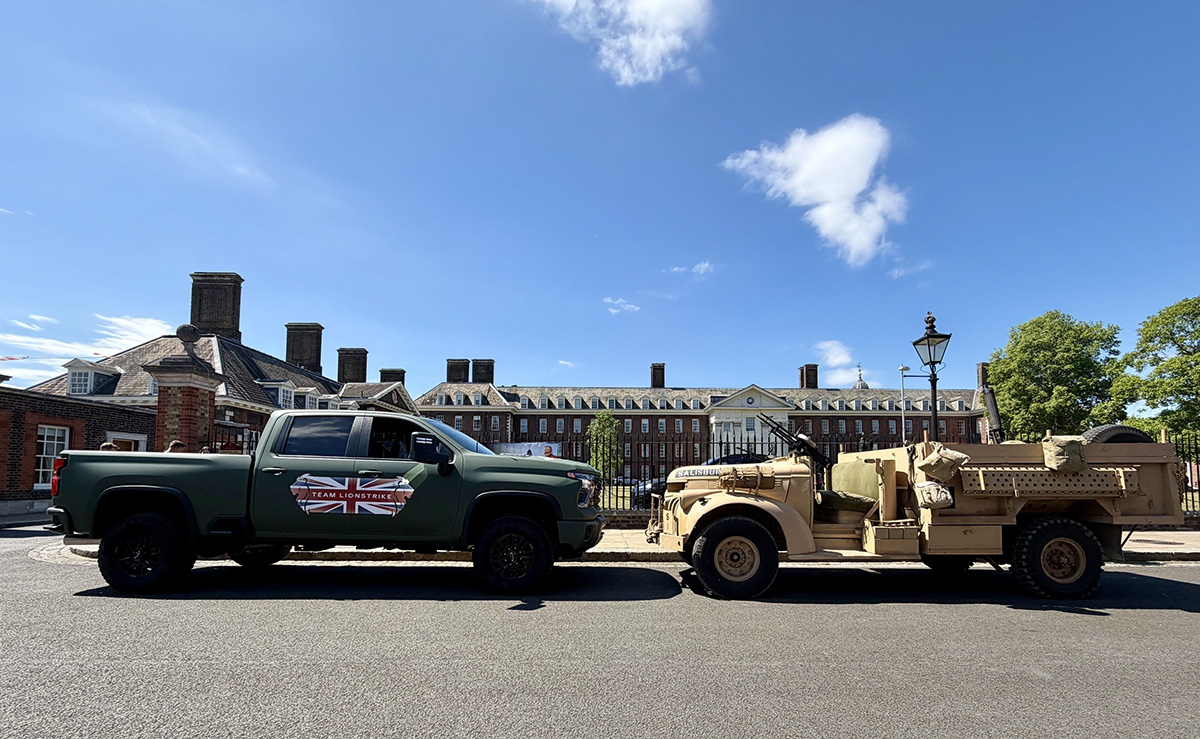
Team LionStrike, the consortium of GM Defence, BAE Systems, and NP Aerospace bidding for the British Army’s Land Mobility Programme, has added the Chevrolet Silverado HD to its proposal, unveiling the vehicle at an event at the Royal Hospital Chelsea.
The Silverado HD is powered by a 6.6-litre Duramax turbodiesel V8 producing 1,322 Nm of torque. In the 2500HD configuration it offers up to 9,997 kg of towing capacity and 1,860 kg of payload, while the 3500HD single rear wheel variant pushes towing to close to 10,000 kg with a payload exceeding two metric tonnes.
The load bed measures up to 2.1 by 1.9 metres, enabling transportation of NATO-standard pallets. According to the consortium, the cab offers sufficient internal space for troops to operate equipment while the vehicle is in motion.
The Silverado HD joins two other platforms already included in Team LionStrike’s proposal: the Infantry Squad Vehicle, a light air-transportable troop carrier derived from the Chevrolet Colorado that has been selected by both the U.S. and Canadian armed forces, and the Chevrolet Silverado LD, a lighter variant fitted with a 3.0-litre Duramax turbodiesel producing 671 Nm of torque with up to 6,804 kg of towing capacity.
Gilbert Nelson, Vice President of International Sales and Marketing at GM Defence, said the team’s approach was designed to deliver capability to British soldiers quickly and at lower cost than bespoke alternatives.
“Team LionStrike’s approach — leveraging the depth, experience and highly-skilled UK-based workforce of BAE Systems and NP Aerospace to modify, integrate, homologate, and support vehicles built in North America by GM — is the fastest, lowest-cost path to put modern vehicles into the hands of British soldiers. Our foundation is commercial, off-the-shelf technology with a proven track record of quality, durability, and capability that can be OEM-adapted to meet emerging requirements. That’s how we will rapidly enhance the operational readiness of the British Armed Forces and reduce the cost and complexity of equipping, training, and deploying troops.”
The Land Mobility Programme is the British Army’s effort to replace and modernise its fleet of light utility and tactical vehicles, a category that encompasses a wide range of roles from troop movement and logistics to command and liaison tasks. The programme has attracted several competing bids from different consortia and is one of the more significant vehicle procurement efforts currently underway in UK defence.
Team LionStrike’s pitch leans heavily on the commercial off-the-shelf nature of its platforms, arguing that proven civilian technology adapted for military use offers advantages in cost, reliability, support infrastructure, and speed of delivery over purpose-built military vehicles. That argument has gained traction in several allied nations, with the ISV’s adoption by the U.S. and Canadian armies cited as evidence of the approach’s viability.








Yea, General Motors seems a good idea 🙄
Anyone know if the chaps from Munro in Scotland have thrown their car into the running? Even if it were a “light” utility vehicle in the UK.
I’ve gained $17,240 only within four weeks by comfortably working part-time from home. Immediately when I had lost my last business, I was very troubled and thankfully I’ve located this project now in this way I’m in a position to receive thousand USD directly from home. Each individual certainly can do this easy work & make more greenbacks online by visiting
following website—.,.,.,.,.—>>> JobatHome1.Com
No, hell no!
I’m surprised that with the American involvement, they didn’t call it ‘Team Lionstrike Eagle Claw Hammer Patriot Team America’
Said in a Jeremy Clarkson voice. lol
You missed out the word freedom, they love that in thier childish op names.
Some pics of the vehicle would have been nice.
But do we really want 5,000 US-made trucks? I thought we were trying to reduce our dependency on the USA.
May be that there isn’t a better COTS solution, as JLT’s Defender derivative may not quite hit the military spec and Ineos has shot itself in the foot moving manufacture to France.
I’d sort of hoped that Supacat might have come up with a contender, it’s not a big leap from a Coyote to a Landy TUM replacement.
Toyota/Babcock Landcruiser
Cripes, I thought JLR stopped making the Defender a couple of years ago?
….meaning the robust off-roader not the ‘fashion statement’ soft-roader type.
No, No! This may be visually a tough vehicle, but there are much stronger offerings than this US product. A Toyota-based design is a better long-term prospect if the MOD goes for an off-the-shelf SUV. The US Army might use these, but they change their vehicle fleets faster than the UK. What is required is a bespoke rugged design with at least ten years of active service, not a civilian product tarted up to look ‘military’. We’ve done that with an Italian SUV. Supercat should be encouraged with government backing to build a plant that can produce a volume of vehicle-encapsulating qualities and expertise seen in their bedrock Jackal range. It may be an expensive option, but over a protracted period, it could save a considerable amount of money.
What are we expecting of this vehicle,is it just non fighting transport? Then go with cheap civilian based 4×4. Even a ford transit 4×4 equivalent. Cheap and big production line already in place. Until anti drone ability is proven fancy stuff is staying well back from front line.
Whatever is chosen, going for an off-the-shelf one does have advantages but won’t last and will end up being replaced before time. Strong, rugged and long-lasting should be the rule when buying these vehicles and protect the taxpayer from short-termism.
Ford Ranger?
Ford Ranger is effectively the interim solution alongside the Mitsubishi Barbarian.
True!
We should not be buying American
2 tonne payload would be useful & a 10 tonne towing capacity. Then its down to physical size & if left hand drive is an issue. The Duramax engine is a solid power unit. Also has a chassis which is always better for bolting on payload additions. But please god not a JLT Defender they are a pile of junk, terrible build quality, the last Land Rover was bad enough.
As the Australian’s say ‘If you want to go out in the bush take a Land Rover, if you want to come home take a Toyota’
I don’t think JLR Defender is even in the running.
Luke, the latest Defender looks like a Range Rover, no doubt expensive, luxurious and only a soft-roader.
Exactly Graham.
Anything but American, we must wean ourselves off this addiction and mistaken belief that the colonials produce quality others cannot, their civilian cars and trucks have been crap for decades but politically it is just not acceptable to trade with those lickspittle turncoats.
..up to 2.1 by 1.9 metres load area…do they not have a tape measure? It’s either 2.1 by 1.9 or it isn’t.
BUYING “up to” 148 tanks or something is a different matter of course. Then the phrase needs to be altered to ” nowhere near”.
AA
Its time to examine a link up with nato countries like norway, sweden ,germany they produce some rugged reiable gear we have to standardise its no good every nato country having their own vehicles they can be built in the purchasing countries factories providing jobs and skills
Whatever is chosen, going for an off-the-shelf one does have advantages but won’t last and will end up being replaced before time. Strong, rugged and long-lasting should be the rule when buying these vehicles and protect the taxpayer from short-termism.