

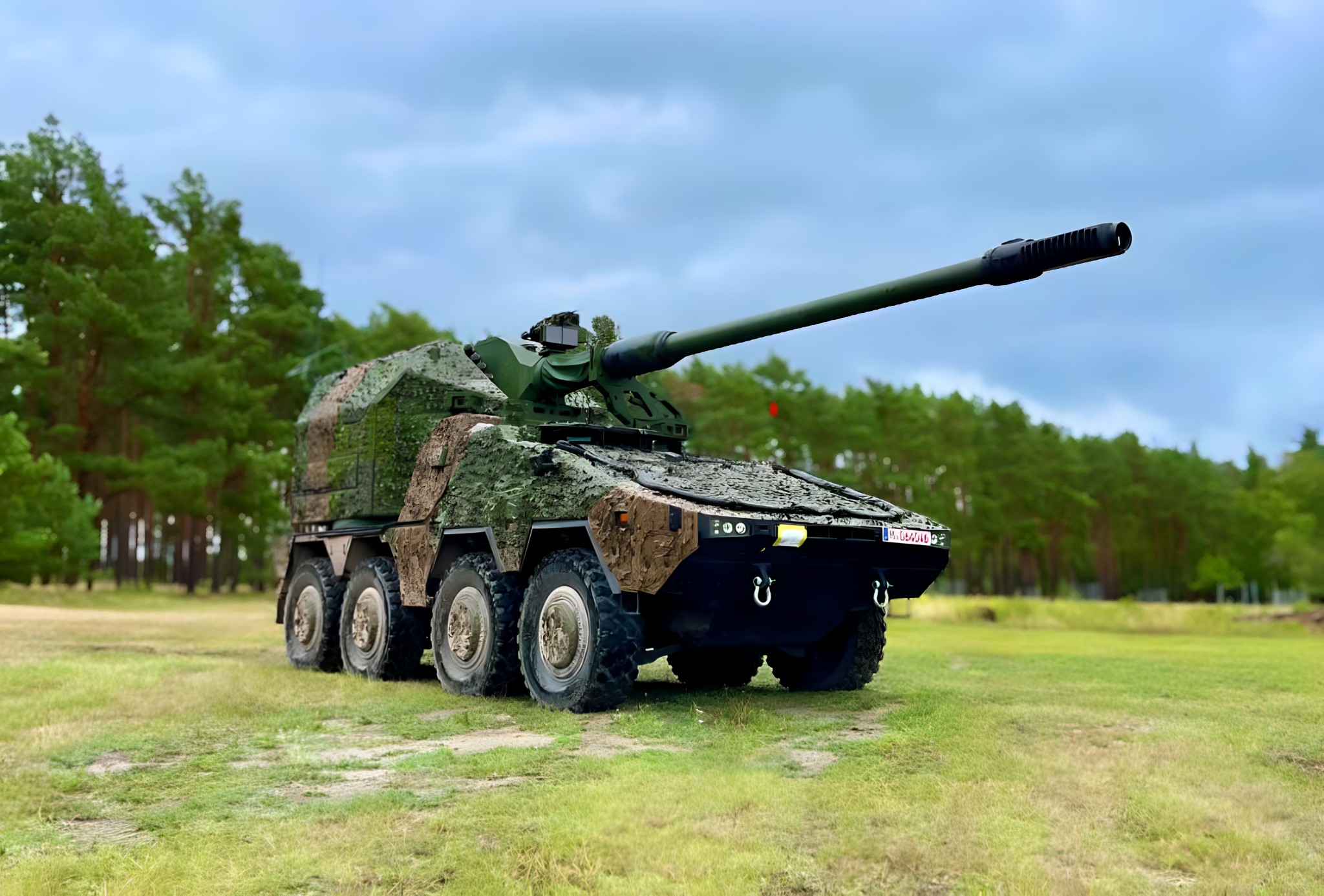
The government has confirmed that the British Army’s Remote Controlled Howitzer 155 programme will deliver a Minimum Deployable Capability within this decade, with the full programme expected to cost more than £3 billion across its service life.
Minister of State for Defence Luke Pollard provided the details in response to written questions from Mark Francois MP, the Conservative member for Rayleigh and Wickford, tabled on 26 May. Pollard confirmed that “in line with the Integrated Procurement Model, the UK’s Remote Controlled Howitzer 155 programme will deliver a Minimum Deployable Capability within this decade,” defining that capability as “a Royal Artillery Battery equipped with RCH155 platforms, having completed the necessary specialist training,” with “an appropriate peacetime safety case to enable training on UK ranges, preparing the sub-unit for potential operational deployment.”
The acquisition cost for the programme is estimated to exceed £1 billion, comprising a £53 million Long Lead Item contract let in March 2025, a £52 million Early Capability Demonstrator contract awarded in December 2025, and the series production contract announced on 13 May 2026. The whole life cost of procuring and supporting a fleet of 72 systems is expected to exceed £3 billion over a projected 25-year service life.
The RCH155 is a wheeled self-propelled howitzer developed by Rheinmetall, mounted on a Boxer armoured vehicle platform. It is capable of firing standard 155mm NATO artillery rounds at ranges of up to 40 kilometres and can execute autonomous loading, laying and firing sequences without crew exposure. The system has seen operational use in Ukraine, and its selection by the UK follows a broader European trend toward wheeled, highly mobile artillery platforms that reduce logistical burden compared to tracked predecessors.
The British Army’s acquisition of 72 systems is a significant recapitalisation of its long-range fires capability, replacing the AS90 self-propelled howitzer, a tracked system that had been in service before mostly being transferred to Ukraine.








Any chance of a tracked ‘Fires’ system in the future? My current hobbyhorse is autonomous armour. Anything from MBTs to small logistic transporters. Artillery must also be on the list, and a senior UK defence minister has told a conference that drones are the new and essential tool on the battlefront. Many thousands of drones will be required, and no nation can afford to be lax on this issue. Possibly, in the days when war is measured in dead forces, we may be counting in drone loss. Placing personnel in direct danger is expensive on so many fronts, both in lives and in the loss of months and years of training. Germany is experiencing some resistance to conscription, and I guess that will be a modern reaction across NATO. Robotics, drones and AI are the way forward whether we like it or not, and the vision of a future when a drone can deliver your post could also drop an explosive on your house! Sadly, warfare could be a much more local hazard for us all and bring the battlefront to our front doors.
Tracked Fires system is MLRS, which is expanding in launchers, recovery vehicles, and units, with 39 RA to stand up shortly, if it hasn’t already done so.
So no 155mm on tracks then? There is turmoil in the MOD, I guess, at the moment, as the DIP slips further away and how to proceed with the Army’s modernisation. I would not be surprised if there is a significant shift to anti-drone-mounted systems on MBTs and APCs and how to handle the snail’s pace of Boxer production and the stumbling Ajax 2 programme. Sadly, further exacerbation must be quickly selecting an IVF and FV432 replacement in short order. All this as remote systems appear to be challenging crewed armour in the future; hence, my recommendation the UK begins development of a remote 30-40 tonne MBT and recaptures a market it once dominated.
“So no 155mm on tracks then?”
Considering there are only 3 regular Regiments in the RA that could make use of them, given the current Army ORBAT roles, no.
The RCH155 purchase covers that.
Thanks DM.
in fairness – this could happen if we buy the boxer tracked drive module at some point.
It is one of the key selling points of the system and could be done if we wanted it
so not impossible – but unlikely I would suggest (never say never though)
I’ve gained $17,240 only within four weeks by comfortably working part-time from home. Immediately when I had lost my last business, I was very troubled and thankfully I’ve located this project now in this way I’m in a position to receive thousand USD directly from home. Each individual certainly can do this easy work & make more greenbacks online by visiting
following website—.,.,.,.,.—>>> JobatHome1.Com
432 replacement is already known its boxer in the armoured brigades and patria in the rest by and large.babcock are waiting for the order to start on patria but as usual no decision yet🙄
Thanks Jacko, as for Patria 6×6 I understand Babcock will manufacture in the UK, and awaiting the DIP plan no doubt.
Babcock will manufacture in the UK *if* the Uk gov decides they want a similar system and then downselects to Patria.
Aren’t Patria supposed to replace the protected patrol vehicles like Mastiff etc? We are in the program after all and there was talk of a requirement of at least 2000 vehs. Or was it just talk as usual?
It’s not “just talk” it’s more like people adding 2+2+2 and getting 8.
1) There is a MOD program to replace patrol vehicles, and when it comes it will be a large order, through it’s Land Mobility Program (LMP), which is subdivied into the LMV (Land Mobility Vehicle) aka Range Rover Replacement, Light Protected Mobility vehicle (LPM) and the Heavy Protected Mobility Vehicle (HPM).
2) Babcock and Patria signed an agreement that if the UK deciedes it wants CAVS Babcock will make it under licensce in the UK. (This was misreported and a lot of people though it was the UK government signing an agreement with Patria). And are pitching it hard to be the HPM vehicle.
3) The UK joined CAVS in September 25. Given the above there seems to have been a lot of reporting that CAVS was selected for HPM, but so far it seems the only thing that is certain is that Stormer will be replaced with CAVS.
I wouldn’t be surprised if CAVS did end up getting expanded to be the full on HPM replacement, but AFAIK the decision hasn’t been taken yet.
👍
Boxer and RCH155 comes in a tracked variant but no one has shown much interest in it. When fighting in Europe then wheeled platforms are potentially much more useful than tracked.
Hmmm … wonder whether a thorough evaluation of the relative performance of AS-90 vs. RCH155 in combat conditions, has been conducted by the Ukrainians? 🤔 Not absolutely certain that the Orcs (and the rest of the CRINKs) will strictly adhere to the Marquis’ rules of Land Warfare, and only utilize the road network. (How damnably un-British of them!) 🤔😉
Based on what Ukraine has learnt,Poland is going all in for Tracked SPG only – they are not interested in Wheeled.
They don’t need to self reply far to be fair!
Tracked means lots of HET which we lack, deploying a tracked Bde from SPTA to Eastern Europe vs a wheeled or mixed wheeled tracked one requires fewer logistics I belive.
Bloody phone. Self “reply” of course is self Deploy.
PT,
Thanks for the reply. 😊👍
Jim, interestingly, some comments I’ve read suggested there is a role in the British Army for a tracked howitzer; hence, the trials using the Korean offering. With the rapid drone development dominating planners’ minds, a fast shot and scoot (Archer & RCH155) is probably the best choice, though the Ukrainian forces speak very highly of the CH90.
Jim, You wrote: “When fighting in Europe then wheeled platforms are potentially much more useful than tracked”.
I wonder then why so much equipment that we produced to fight in Europe in forward areas was tracked, from the early tanks in WW1 to the present day? I was a ‘BAOR warrior’ (serving in Germany four times) – the ‘tip of the spear’ was tracked.
I suppose the point was most of BAOR was already deployed where it was intended to fight. IIRC most of the re-inforcing stuff from UKLF was wheeled(?).
Now we’re talking about shipping the British Army across Belgium, Germany and a large chunk of Poland at speed?
Phil, certainly strategic mobility is a factor when specifying the Requirement for a new equipment but just as important if not more so, is the tactical mobility on arrival in the battlespace – it remains to be seen how good the tactical mobility of any and all Boxer-based vehicles is compared to tracked vehicles, especially in deep glutinous mud and snow
An armoured division, such as 3 (UK) Div essentially is, has many tracked vehicles requiring HET lift at times ie over a very long distance on roads. I doubt that making the SP artillery wheeled rather than tracked will ease this aspect of logistics greatly.
Maurice, the programme to replace the AS-90 was called the Mobile Fires Platform (MFP) programme. On 27 January 2020, MoD released the Key User Requirements (KUR) for its MFP programme to procure a new 155 mm self-propelled artillery system. Industry across the world was invited to first express interest and later to formally bid. Numerous contenders were in the running – I recall it was the German PzH2000, Korean K9 Thunder, Archer, Boxer RCH-155, and possibly the French CAESAR. The MoD then moved very slowly!
On 24 April 2024 our PM, the acknowledged artillery expert, Rishi Sunak and Chancellor Scholz announced UK/GE collaboration on the Remote-Controlled Howitzer 155mm (RCH 155) 52 calibre Wheeled Artillery Systems. This torpedoed the customary army plan to competitively evaulate contenders. Sunak chose Boxer RCH-155 to replace AS-90 – the army didn’t.
As always, Graham, interesting data, thanks. Apparently, there is some concern that the preorder trials of RCH155 are being curtailed to ensure a faster ISD. In light of Ajax, there is some concern we may be walking into a similar dilemma with this hasty decision. The only difference with RCH155 is it will be a shared problem if it turns out to be a lemon.
Hi Maurice, fortunately the Bundeswehr conducted trials on RCH-155 some years ago, starting in early Feb 2023, and I hope that any lessons learned will have been addressed.
Also, Ukraine ordered 54 of these (their first RCH 155 was delivered on January 13, 2025) and they will also generate comments from experience gained under combat conditions.
We do need to do our own trials of course but well-run abbreviated trials may suffice in the light of the above.
My view is that we should have bought a mix of wheeled and tracked SPGs for 1st and 3rd divisions respectively.
Graham, if there were any gremlins, they would have surfaced before now. So, let’s get them into service as soon as practicable.
Interesting side note:
1st German/Dutch Corps is apparently taking over command of the Northern Baltics from NATO MNCNE (Multi-National Corps North East).
The Batlics apparently now will be 1 DE/NL Corps commanding 1st Estonian Division (2nd Estonian Brigade and 1st Estonian Brigade inc. the Britsh Battlegroup) and Multinational Division North (Multinational Brigade Latvia, Latvian Mechanised Brigade and 1st Danish Brigade), and MNCNE in the South Commanding the Lithuanian Division and Multinational Division North East (German 45th Panzer Brigade and a rotational Brigade from the Polish 16th Mechanised Division).
I wonder if we will see any German or Dutch units subordinate to the Corps in the near future.
Good evening Daniele.. Now l know we have gone through this a zillion times, but how many MLRS do you think there will be in each regiment and per battery if the total number finishes on the current 61 and not the final 76 that had been mentioned.
Hi John!
Blimey….I don’t know! I can only guess based on existing Batteries and what I’ve read.
Starting with the existing,
I understand the Regiments have 2 Fire Batteries each, 8 launchers each, so 16 per Regiment.
Deep Fires programme talked of 8 Batteries.
That was guessed at by some as expansion of the 2 existing Regs by a Battery each, so 6, plus the 2 in 101 RA, the Reserve.
It looks like now with the announcement of 39 RA forming that it might remain 2 Batteries each, for the 8 in 4 Regiments total.
That would make 64, with the remainder trials, training, spares, maintenance, whatever.
Maybe if the final 15 are not confirmed they might only have 6 per Battery? I don’t know if that’s feasible. Would make 48 across the Regiments.
I know formations reduce on the quiet, remove a Battery here and there, and the Regiment remains, whose really going to notice? Politicians operate like that all the time, as do the Army playing their shell games.
Thanks for the return info: l hope they do go for the full 76.. Appreciate the details, Daniele.. Have a good evening.
Hi Daniele, I do wonder if we might reduce the number of launchers to a battery- based upon Ukraine. See if this makes sense: The munitions they’re firing are becoming more effective and longer-ranged, so less requirement to mass fires. At the same time, enemy surveillance of the battlefield- even deep behind the lines where you might expect M270s to be operating- is getting much better due to drones. So a battery of 8 launchers, even when they’re dispersed a bit, might be too much of a mass of men, materiel and logistics to easily hide. So switching to 6 per battery, with a greater number of batteries spread wider, might make sense?
Morning Joe.
Yes, I follow the logic there. This info is still unavailable to me, 8, 6, both fit into the overall total.
Another thought, I’m starting to piece together the OWE distribution, a long standing question of mine. Apparently, 26RA has a OWE Troop. Maybe it’ll also be a question of personnel per Regiment, some now needed to operate the OWE Catapults and not operate and support MLRS?
Unless said Regiments have simply had an uplift in personnel? I do not know.
Good question.
To me, they’re different capabilities- so should be managed by an uplift rather than a spread of personnel. But I’m not going to bet on that yet..!
I had a look into it briefly, and our battlegroup in Estonia apparently has the same capabilities as Ukraine in terms of Recce/Deep Strike (look up Project hedgehog from May last year, and some of the reporting about it from July onwards). I assume that to mean that we’ve got surveillance drones wired into a connected battlefield managements system, from which targets can be assigned to both conventional artillery and OWEs/drones (the ones they were stated as using in the exercise have a range of 150 miles and a 20 kg warhead, so we’re not just talking about frontline effects).
To me, the OWE capability is pushing out the range of our indirect fires- and seem to be available at Battlegroup level if they’re saying our Estonian forces have them. Unless they’re divisional, and handed down on an as-needed basis?
But, either way, looks like we have 155 mm tubes out to ~40 km, GMLRS out to 75+ km (depending on type), and then OWEs out to 200+ kms. I guess the question is, would your average RA regiment be staffed appropriately and positioned properly to be able to process and then prosecute all the targets that lay in their area of responsibility, from 30 km out to 200? Strikes me that might be a bit much to ask, without meaning to disrespect the capabilities of those command troops. It may be that we end up with two types of RA regiment: Some dealing with the more “traditional” targets and ranges, and some dealing with the outer layer- to keep prioritisation and kill loop simple and short. But that would change your distribution of OWE completely.
Not sure if I’m managing to clearly explain my thoughts, let me know if it’s rambling mess..!
Your rambling is as good as mine, Joe.
We can only guess, not being Army types who know how these things work.
Setting the world or any other subject to rights over a pint is one of my favourite pass times- so rambling comes with that package!
Indeed, we shall have to watch from our armchairs
Mmm we don’t even know with any certainty that it actually works as advertised yet🤔
I can tell you with minimal certainty that it doesn’t work as advertised yet. It did at one point but prolly not no-more.
The vehicle will [almost certainly] have to be ‘updated’ to fit the new supply chains.
Existing supply chains for the vehicle are known to be broken.
FWIW I find it interesting that Luke Pollard is not only saying he wants the artillery – but he wants it WITHIN “this decade”.
The more projects these defence companies have on the go at once, the slower they get things done generally speaking.
With potential adoption of an automation portfolio. This particular defence company has lots to focus on and that includes fixing the [broken] supply chains for the RCH 155 I guess.
There is limited throughput unfortunately; so certain projects have to get priority over others.
RCH 155 is B grade priority and there are projects that are higher up on the agenda. Companies can only work as quick as is practical… Those are the realities unfortunately. I don’t think the government will be able to pin a timeframe to the project without a formal contractual agreement in place. For that there needs to be enough carrot to enable the fixed deadlines.
Government can always pay to fast-track certain aspects of procurement, but this requires additional financial incentive and like I say, a contract. Without a formal obligation and relative finance it will ultimately be left to the defence contractors digression regarding the timeframes + delivery.
.
👍
So that’s £41,000,000 per Unit.
Gawd knows what we will pay for the Land Rover Replacements !
procurement is £13 million each. That’s compared to Ajax that’s £10 million.
Both are probably the most technically capable vehicles in their class in the world. CH3 upgrade is £5.5 million a peace.
I don’t begrudge spending top dollar on fighting platforms. It’s when we try and replicate the cheap as chips CVR(T) family and stick ambulances, repair trucks and command posts on to £10 million armoured reconnaissance vehicles that I have a problem.
Well you’re going to have recovery and C2 versions of Boxer and Ajax, that’s fine, for their individual fleets.
My issue is, which I think you’ve included, using such expensive vehicles for roles a cheaper type could do, which enables more assets at lower cost.
Serpens and Boxer Bridgelayer are two that spring to mind, where’s a flatbed truck can carry a radar and where existing Bridgelayers have greater capability than the proposed expensive replacement.
Oh dear here we go again BVLB is supposed to be coming in 2029 to replace Titan,so we replace a vehicle that does not need extensive preparation of the ground to get to its launching site with a 14m span compared to 26m for Titan🙄
What on earth is going on in Chatham to even begin to make sense of this bollocks🤬(not to mention that Titan is supposed to be having an MLU)
That’s the bollox!
As a Sapper, I knew you’d have an opinion on this!
It’s beyond belief mate! Having seen/ been on many M2/AVLB crossing the amount of preparation sometimes just to get wheeled vehicles to the site and across is not easy! If your bridging veh can’t get there before said prep then the world truly has gone mad🤬
Here speaks the voice of experience.
Any politicians reading this? Take note.
Though M2/M3 itself is wheeled, i assume given it’s flexibility it negates the wheeled aspect, can enter the water at a point of ones choosing and not at a mudbath requiring matting before thousands of vehicles cross?
👍
Just checked and Leguan type bridges unlike the ones we use now cannot be laid together to widen the gap to be bridged so we will be at 14m and anything over that will require the likes of MGB etc! Unbelievable loss of capability!
Bit confused here! Are you saying the CVRT family were not a roaring success because they were,no modules are planed for Ajax they are all going on Boxer aren’t they,so do you want to clear up what you wrote?
Don’t bother just read your post properly👍
Yup. But It’s amazing just how expensive these are, especially using the whole life figure.
comparatively speaking, Land rovers were cheap as chips back in the day, I’ll bet their replacements won’t be so affordable even given the essential tech and protection upgrades not available back then.
Still, at least the Shareholders will gain I suppose.
Be cheaper to bring Wombats back than this stuff. And it could be towed by a Landy….
It costs so much, because pretty much …
It’s the boxer base, costing ~£6.3 million _plus_ the turret etc.
A M777 howitzer 155mm costs roughly £3 million.
Add some glue to that and you are not far off £12 million ppu.
Really govt is paying for these two articles of defence combined into one.
And in a package that actually works and supposedly within a deadline.
CH3 was cheap because it was based off of cannibalised tech, production [of the hulls at least] is not very scalable with C3, unlike Boxer or RCH 155.
I wont hold my breath 🤣. Something is bound to go pear shaped…
This decade ! lol in WW2, you got things ready in 90 days. Yes I know the counter arguments but still, this decade !
Up to a point, Lord Copper!
How long did it take to get a UK tank that was on an equal footing to the Panther and Tiger, how long to get a decent dual-purpose gun for RN Destroyers, for example?
Wheels – deployable by road – get stuck in mud
Tracks – not deployable by road – show me the mud!
If you want off road deployability – it has to be tracks
So then why not a sensible mix of both tracked and wheeled? Horses for courses. Hope they’re keeping the Archers for ready masse.
Bring back the Halftracks !
Exactly. On this subject I still recall someone pointing out that GSFG in the Cold War happily had a mix of tracked and wheeled types.