

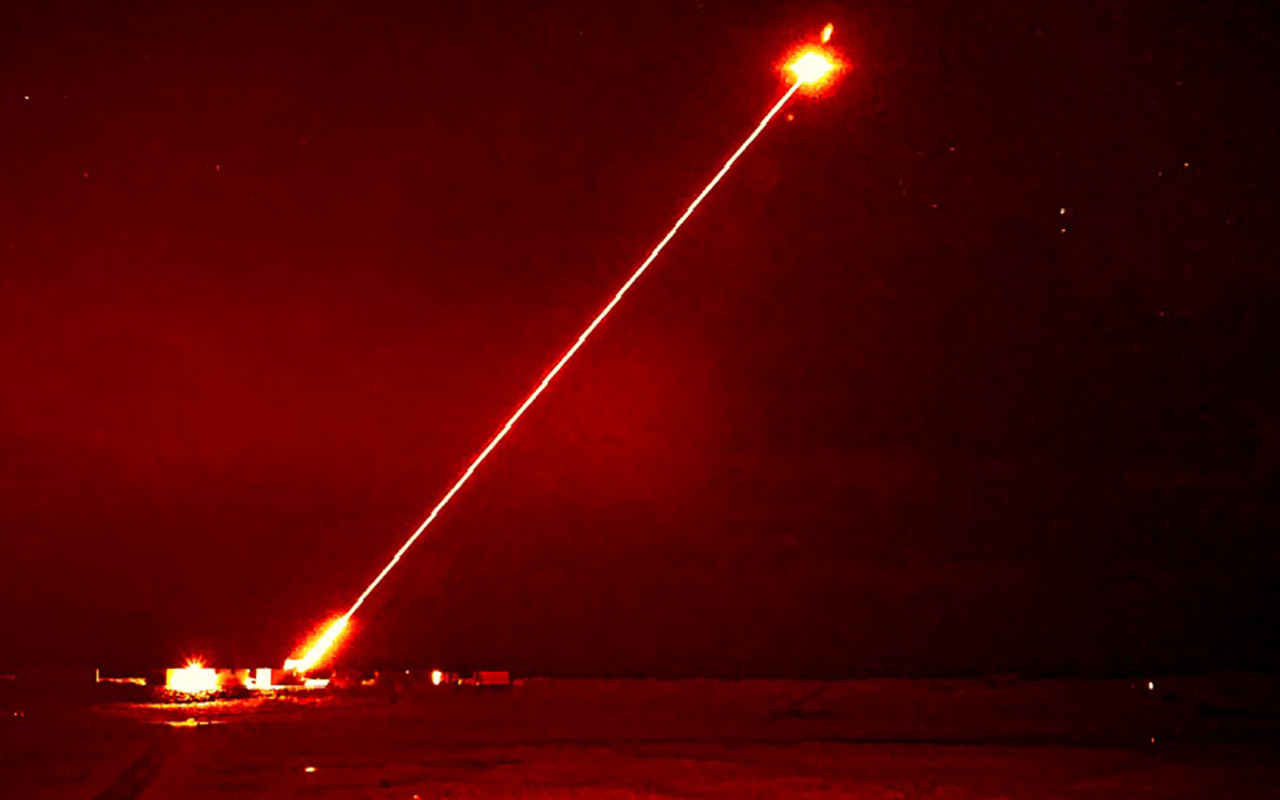
QinetiQ is investing £20 million to accelerate the development and production of laser directed energy weapon technology, the company stated.
The company said the company-funded investment would expand both its product portfolio and production capability to support future laser weapon programmes in the UK and allied markets. It will increase development and production capacity at QinetiQ’s sites in Farnborough and Malvern.
At the Farnborough International Airshow, QinetiQ unveiled HELENA, a new brand name for its coherent beam combination high energy laser source products. According to the company, these laser sources are the critical component of any laser directed energy weapon system, which can be used to defend against drones and other advanced threats.
QinetiQ said it has more than 25 years’ experience in developing the technology and remains a member of the UK’s DragonFire consortium alongside MBDA and Leonardo, which is due to deliver laser weapon systems onto Royal Navy ships from 2027.
According to the company, laser directed energy weapons offer a low cost per shot and a near-infinite magazine depth, complementing existing air defences and helping in particular to counter the low-cost drones seen widely in modern conflicts.
Steve Wadey, Group CEO of QinetiQ, was quoted in the press release as saying: “Directed Energy Weapons are quickly moving from development to deployment to change the game in battlefield economics against the drone threat, and QinetiQ has been at the forefront of this technology for two decades.”
He added: “The investment announced today demonstrates our commitment to accelerating both the development and manufacture of sovereign laser technology, ensuring we can meet the growing demand from the UK and our international allies and provide them with the operational advantage on the battlefield.”
QinetiQ said its existing laser weapon activity directly supports 150 jobs.












I suspect military grade lasers may also be something that finds itself front and centre in Andy Burnhams military industrialisation strategy, the UK appears to be at the forefront of this technology which has massive export potential and it seems likely the US will have limits on who and what they are willing to share.
If the UK develops a ballistic missile defence capability then there is a real chance we could offer a comprehensive air defence system like Iorn Dome / Iorn beam with CAMM provided Short and Medium range interceptors and lasers providing point intercept.
Dear Mr Putinbot,
Effective ballistic defence systems require, and will continue to require, a lot more than CAMM & a laser.
PS the UK is playing catch up in laser development. The British efforts need a mighty kick up the backside which will cost a lot more than 20 million.
This bromance is getting creepy now. Do you need room service. 🤭
The 20 millions are for QinetiQ own plans to sells it’s laser source to other buyers as a separate component, potentially exporting it, a laser source is only one component of a laser weapon system, this move is not related Dragonfire
Correct, a full DEW system needs a lot of moving parts, George, like Leonardo’s beam director and MBDA’s command tech. But it’s not completely detached from DragonFire. QinetiQ actually provides the core high-power coherent beam-combining laser source for the DragonFire program.
Upgrading their own labs and testing facilities with this £20m is all about maturing that specific sovereign laser tech so they can meet the MoD’s tight 2027 timeline for the Type 45s. Though you’re definitely right that having a top-tier, upgraded test facility also positions them brilliantly to package and export that laser source component to other allied programs down the line. It’s a win-win really.
Thanks for the clarifications, eventually QinetiQ is the only “really” British company in this strategic project, the others are of foreign origin, it’s very important to keep sovereign capabilities
You’ve hit on a critical point there, George. Protecting true sovereign capability is an absolute minefield for the MoD these days.
While MBDA UK and Leonardo UK employ thousands of British engineers at places like Stevenage and Edinburgh, at the corporate board level, the profits and intellectual property ultimate answer to Paris, Rome, and pan-European shareholders. That is exactly why QinetiQ’s position in the project is so vital. Keeping the core laser source technology entirely under a purely British corporate umbrella ensures London retains complete operational freedom of action and export control over the most sensitive part of the weapon.
It’s a delicate balancing act—leveraging multinational scale for the heavy engineering, while keeping the strategic crown jewels strictly domestic.
When I worked for QinetiQ it was indeed an R&D company, but the article does state, ‘It will increase development and production capacity at QinetiQ’s sites in Farnborough and Malvern’, and later quotes the CEO as saying, “accelerating both the development and manufacture”.
It seems that QinetiQ UK has indeed moved into the manufacturing business, something I was told they wouldn’t or couldn’t do..! How things have changed.
Cheers CR
That is a fascinating bit of insider context, ChariotRider, and it really highlights how much the defence landscape has shifted. The luxury of just being an R&D house is gone when the threat matrix moves this fast.
For a long time, the UK was great at inventing world-class tech but terrible at industrialising it. If QinetiQ is actively breaking its old rules to build actual production capacity in Farnborough and Malvern, it shows they realise that securing the supply chain is just as critical as the science itself. It is a massive step forward for sovereign manufacturing.
Bit uncalled for with the name-calling there, Grinch. Jim didn’t say CAMM and a laser would stop an ICBM; he was clearly talking about a tactical, layered point-defence shield like Iron Dome, which handles cruise missiles, rockets, and drones. Also, saying the UK is playing catch-up on lasers is just flat-out wrong. The DragonFire trials proved the UK is right at the cutting edge, especially with our pinpoint tracking and beam-combining tech. You’re also misinterpreting the £20m figure—that isn’t the entire R&D budget for the weapon. That’s purely QinetiQ investing in their own private testing facilities to fast-track the integration onto Royal Navy ships. It’s an infrastructure upgrade, not the whole program budget. The tech itself is in a very strong place.
Countries that have lasers on deployed warships: America, China, Japan.
Countries that have sent trials lasers to sea: France & Germany.
Countries that have done neither: the UK and everyone else.
Did your keyboard freeze, Grinch? You’ve literally copy-pasted the exact same oversimplified list from earlier in the thread.
Since you brought up “Physics,” let’s actually talk about it. The physics of Directed Energy Weapons dictate that a low-power, 15kW to 30kW laser bolted to a deck for a quick sea trial—like the ones on your list—is structurally incapable of burning through a hardened anti-ship missile casing. Those are essentially glorified optical dazzlers for close-in commercial drones.
The physics that actually matter involve coherent beam combination, which is exactly what the UK is doing by combining multiple fibre laser beams into a single, high-power coherent strike vector. That is why the MoD is spending hundreds of millions on DragonFire to ensure that when it integrates onto a Type 26 or Type 45, it has the megawatt-level tracking and thermal management to kill real front-line threats, not just provide a photo-op.
Repeating a copy-pasted list won’t change the procurement data or the engineering reality. The UK is building a weapon, not a public relations exercise.
You’re dribbling
…—…