

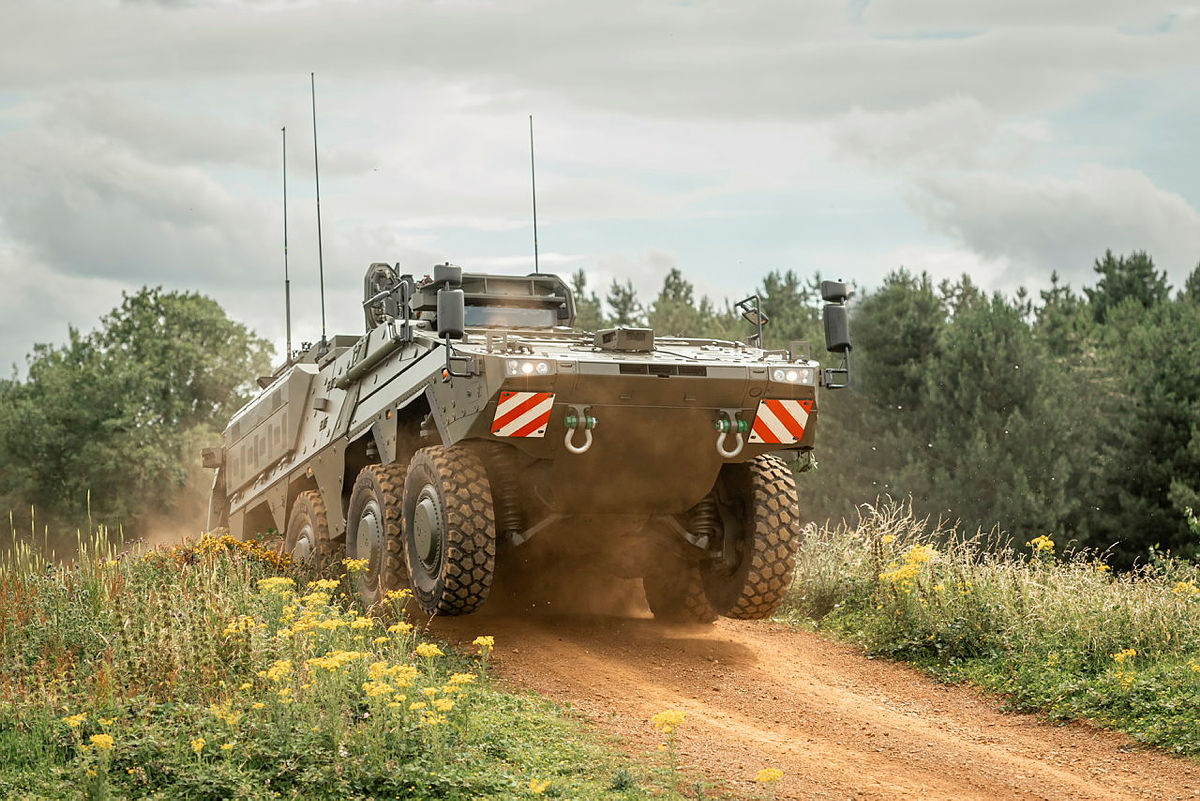
The Army will procure a Heavy Wheeled Recovery Vehicle to recover Boxer in the field, the order remains at 623 vehicles with more than five hundred being built in Britain, and seventy two Boxer RCH artillery vehicles are being bought, according to an answer given in Parliament.
Ben Obese-Jecty, the Conservative member for Huntingdon, asked how Boxer will be repaired in the field given that no repair and recovery variant has been ordered.
Luke Pollard MP said: “Boxer is a world-class vehicle that will boost our soldiers in a variety of military missions and scenarios across the globe. As I said in Parliament on 19 October 2026, the programme is hugely successful, delivering important capability and national benefit.
“The Army will absolutely have the ability to recover and support Boxer vehicles on the battlefield, such as through the Boxer support variants and the wider force, including the Heavy Wheeled Recovery Vehicle which we will procure.
“There has been no change to our order of 623 Boxer vehicles, of which over 500 are being built here in the UK, and we are buying 72 Boxer RCH Artillery vehicles.
“The work in Telford, Stockport and plenty of other locations across the country is backing more than 1,000 British jobs.”
The commitment to buy the recovery vehicle firms up an answer given the day before, in which Pollard said the Flensburger Fahrzeugbau Gesellschaft armoured recovery module had been assessed for the role and rejected, the department concluding that a generic heavy wheeled recovery vehicle would offer greater utility and affordability across the force. He also set out that Boxers currently recover one another peer to peer, backed where needed by the Support Vehicle (Recovery) and the Challenger Armoured Repair and Recovery Vehicle.
The RCH 155 is the wheeled self-propelled gun built on the Boxer drive module, pairing the artillery turret developed by Krauss-Maffei Wegmann with the vehicle already in British service. Seventy two of them will replace the AS90 in the close support artillery role.
All 623 Mechanised Infantry Vehicle Boxers are being delivered to a common build standard, and ministers confirmed last week that a planned third batch is no longer being pursued through the Boxer programme, a decision that cannot be tied to a single date because it was taken as part of the work on the Defence Investment Plan.






Sounds like the Boxer version was rejected and we will get some extra vehicles. I hope I am understanding correctly.
But, with the way politicians and especially Ministers mince and play with words I’d like to hear it specifically. For example I would like to hear we are getting 623 Boxers AND ON TOP OF THAT 72 Artillery boxers. The way things are, those Artillery could be included in the 623. I would love to be corrected but I have never seen clarification that the 72 are a separate and additional buy.
Finally some common sense, someone in the MoD or treasury has told the army to sort its shit out and forget using £7 million armoured vehicles as tow trucks, we need high end vehicles like boxer and Ajax to fight, not do basic utility roles than can be easily done by vehicles that are ten times cheaper.
Hopefully we can now see a massive order for Patria 6X6 to do many of these more mundane tasks.
Exactly.
Jim, a company fitter section REME from the LAD provides forward-based repair and recovery support to a rifle company. They are generally moving a tactical bound behind the F Echelon combat vehicles, until they have to go even further forward to undertake a task. The REME variant or variants have the same protection and mobility as the vehicle being supported, for what I thought were obvious reasons. For recovery the REME vehicle must weigh the same or more than any Boxer variant requiring recovery.
You rather horrify me by considering that Repair and Recovery are mundane tasks – do you have military experience? Take a Boxer company with 12 vehicles in the 3 platoons and 2 more in Coy HQ. In a morning they drive through Rasputitsa-style mud and a platoon of 4 Boxers bog in. Then in the afternoon 2 Boxers experience a mechanical or electrical breakdown. So 6 Boxers out of 12 combat APCs are out of action in a single day. The Company is Combat ineffective without repair and recovery.
What REME vehicles are ten times cheaper (I would say ‘one tenth the price’)? The Repair variant must have the same mobility and protection as Boxer and its crane must be able to lift a Boxer engine; any similar version at second line REME must also be able to carry a spare Boxer engine. The Recovery vehicle supporting Boxer must have the same protection as Boxer and ideally have better mobility to avoid getting bogged in itself… and be the same or heavier weight to the heaviest Boxer variant requiring support.
Given that we will probably now replace the planned REME Boxer variant that would do both repair and recovery with two vehicles…a repair vehicle and a recovery vehicle those 2 vehicles must cost less than the originally planned single REME Boxer variant.
BTW, the heaviest Boxer might weigh 37-39 tonnes and more if it has TES kit. The Patria AMV recovery variant typically has a combat weight of 32 tonnes; it could not recover Boxer. The gross vehicle weight (GVW) of the MAN SV recovery vehicle is 32 tonnes (and has the added disasdvantage of being unarmoured) so it could not recover Boxer. The FV513 Warrior Recovery Vehicle has a combat weight of approximately 25.5 tonnes so it could not recover Warrior. Hence the need for a new Heavy Recovery Vehicle, unless we buy more CRARRVs just for the Boxer battalions!
They will have quite a few Atlas & Apollo and I’ve read that a heavier SVR is already being looked at e.g. MAN HX 10×10
Sonik, some 38 Atlas recovery variants have been ordered and 50 Apollo repair variants, both of which are of course tracked. I am glad that you think that is quite a few – it is just enough to support the Ajax family.
If some are to be siphoned off to support 4 x Boxer battalions, that will be 16 of each (one per Boxer rifle company fitter section and 1 at LAD Main), so the numbers to support the Ajax family come down to 22 Atlas and 34 Apollo….not enough!
I too have heard about the MAN HX 10×10 behemoth being considered for the recovery role in a Boxer battalion (and perhaps its Rotator crane would cover the Boxer repair role?). Hopefully the MAN has the same mobility of the Boxers that it would support. It looks like an ‘armoured version’ is available weighing 43.8 tonnes. It does not look a lot of fun to cam up when parked up, given its massive dimesnions (3.5m x2.5m x11.6m) !
As you say there’s armour upgrades for the MAN HX 10×10 ( and the option of a weapon station) . But how big and heavy is it going to be ? Maybe this ?
Rheinmetall MAN Military Vehicles showcases HX10x10 Heavy Repair & Recovery Vehicle at DSEI 2025
Highly mobile system for complex repair and recovery operations
Available in armoured and unarmoured versions
Visit us at our DSEI stand S9-110
This is something I have mentioned before, when they were chinning off the Ajax variants, some commentators (one in particular) got very lucid and reckoned a MAN truck could do the recovery with the Ajax units! Like much of the Army the CSS is wafer thin and in some areas non-existent. A good example is our CSS jump in with us, the REME section, RLC etc etc…..there’s not so much of a FEBA in todays asymmetric warfare mate. Spot on post.
In the end the boxer is profoundly expensive due to its modular nature so it’s likely they have decided they could procure a well protected recovery vehicle for less money.
Cost is obviously the main reason, but it’s also MOD avoiding bespoke engineering due to Ajax. The FFG Boxer R&R was trialed and it’s not up to the job. They prefer to buy a different MOTS that works (even if it’s not optimal) over the project risk of re-engineering the Boxer R&R variant.
The order for 623 Boxers was placed some time back. There is no indication that it might be cut, which would incur considerable penaly costs.
Now the order for the 72 Boxer RCH has been placed snd manufacture is underway. Agsin, there is no indication that it might be cut, which would again incur condiderable penalty charges.
I think we can confidently look forward to both being delivered, so 695 equipments total, plus a future batch of.some COTS recovery vehicles
.
Frankly it looks like cost cutting to reduce the expensive variants and get the base hulls as locked in to the total number so cant reduce the total order.
This new recovery vehicle will just be pushed back and delayed and then a u turn when they cant avoid the capability gap anymore and have to get the boxer variant anyway.
Without lots of variants we dont get the shared parts and maintenance and economy of scale that made boxer attractive otherwise its a very expensive apc, and we still dont have warrior replacement or half a dozen other vehicles that boxer variants could of filled.
Bit confused a out the so called ‘ Boxer support vehicle where necessary ‘ what on earth is that ? I thought that the whole point of this decision was that the whole fleet aside of course from RCH155 would-be built to the same standard and pretty much identical in every way . This article specifically stated that the 623 Mechanised Infantry Vehicles are being delivered to a common build standard – does this include the RWS?
Your right they all basically share the same hull and front and have different modules go on the back so they are probably locked in to the total number of boxer ordered and have cut expensive variants to save cash short term and kick the can down the road for the roles those variants would of done.
I wonder if they are looking at purchasing the RMMV 10×10 Recovery Vehicle, perhaps the same as supplied to the ADF, but that has a “Miller” top-hamper, rather than an “EKA” one, which has been the Army’s preferred supplier for the last two variants of Heavy Wheeled Recovery. 1st the 6×6 Foden EKA, and then the current MAN 8×8
If the MOD do go with the 10×10, it will share commonality with the Dry Support Bridge (made by WFEL), that is being purchased under Project TYRO
I’ve read somewhere that 10×10 MAN SVR is being considered. I’d say it’s pretty likely to be selected given lower cost (than a proper armoured vehicle) and commonality the wider HX fleet.
Mark F, that recovery vehicle sounds lovely! So long as this 10×10 has the same protection as Boxer, equal or better mobility, a strong enough winch and weighs as much or more than the heaviest Boxer requiring recovery, say about 40 tonnes or so?. How many of those boxes are ticked for the 10×10?
Secondly we need a repair vehicle to support Boxer…with the same protection and mobility as Boxer and with a crane that can lift a Boxer engine. Those held at second line and doing E&MA changes also needs the ability to carry a spare Boxer engine. What is the army going to supply to do that job?
Thirdly the vehicle to provide Boxer recovery and the vehicle to provide Boxer repair must, as a pair, cost less than the Bover REME variant originally envisaged, which would do both functions.
Good to see today that we now have a Chancellor who can fund defence properly……..oh no sorry he didn’t. Only last week Streeting said Healey would plug the £4.6 billion gap at the budget. The bullshit is getting beyond boring now, just put GCSE Russian into the curriculum and save a fortune.
Apparently he has plugged the gap (articles on BBC News and Navy Lookout) but the £15b total is spread over (including the now found £4.7b) is spread over a number of years.
The remaining problem is the the need to get up to 3% of GDP and 3.5% thereafter. The former has been put off until the next spending review next year but I have been unable to find a date for that. One report seemed to suggest March but another said Autumn..!
Getting to 3% going to be a much bigger challenge than finding the extra 4.7b as that is supposed to be reached by 2030, which seems unlikely if though it is desperately needed right about now!
Cheers CR
CR, unfortunately the real funding gap was £28bn, which I consider was an underestimate anyway, as it did not include the army’s equipment aspirations in the far term.
Agreed Graham,
However, the government did agree to the 15b and increase to 3% by 2030. So I was judging them on whether they would stick to their stated plan.
I would say that 3% followed by 3.5% at least represents some kind of real increase in defence spending and I cannot remember when that last happened, but it is no where near enough. I don’t think that even 4% wouldn’t be enough given the awful state our forces have been allowed to sink to. Defence spending was 4.6% of GDP when I was a lad (and that was a long time ago now 🙂 ) and they were cutting back then as well.
We are horribly vulnerable, but frankly even if we could magic up a significant increase in spending now industry would not be able to meet the sudden increase in demand and I doubt the military could get the recruits through the door either..!
As for the Army’s equipment aspirations all I can say is that they had better not screw up so completely as they did / have with Ajax. That program should be scrapped frankly as the problems are so fundamental to the hull structures it will be very very difficult solve properly. Hopefully the Army has learnt a lesson or two, otherwise I can see more money being spaffed up the wall. I believe the cost so far is around the £5b mark, i.e. the entire original budget and no vehicle is fit for frontline use as far as I am aware.
Of course, very few if any MoD major projects could be held up as examples of best practice, although things do seem to be moving more quickly when SME are involved…
There is hope, but even my optimism is being sorely tested now. If some sort of war hits us within the next 1000 days (993 days now and counting) we had better hope it isn’t a full on kinetic conflict or we are going to get seriously hurt. My biggest concern is that the state of the RN, our maritime flank is very exposed and invites miscalculation.
Cheers CR
Sensible.
I read on X that no other Boxer customer has ordered Boxer recovery variant.
Also, France has no VBCI recovery, Italy has no Freccia recovery.
The issue is the lack of heavier armamant versions and the Army wanting to use Gold plated vehicles for tasks a cheaper vehicle could do, on a limited budget.
DM, I am not sure what is sensible about cancelling three vital variants. The decision to have Boxer as the MIV was the gold plated decision from many months ago and the army has to live with it. Thus no variantcould ever be cheap. A RAC squadron or Inf company has a REME fitter section which operates well forward, a tactical bound behind the F Echelon equipments, which could be 50-250m. Fitter section provides recovery and fast repairs. Traditionally they have had the same hull (more or less) as the vehicle being supported so that they have the same protection and mobility as the equipment being supported. Makes sense as the REME wagons are operating in the Direct fire Zone.
If other countries do things differently that is no reason for us to follow suit. Wikipedia says that Australia has ordered RAEME variants, so is that wrong?
ILS, adopted by MoD in 1993/4, requires all elements of engineering and logistic support top be in place before the first Combat Arms equipment is fielded…not a few years later!
I suspect the reason those 3 variants have been deleted is because someone has woken up to the fact that the 623 orders (523+100) does not include enough section carriers for 4 mech battalions (plus trg orgs, RP and Attrition Reserve), as we have both said many times.
Hi Graham.
Thanks for all that. I’ve read that Boxer Recovery Variant cannot suspend or tow, according to UKAFC on X. If true, what do you make of that?
No idea on Australia, only reading that other nations are going without Boxer Recovery as well.
The new Heavy Recovery Truck seems to be what the Army is looking at.
I mentioned you over on the Armoured Mortar article, you or Ian as ex REME can comment further on what minimal input I gave.
Hi Daniele, I have of course no idea how the design and development work on the UK Boxer Repair and Recovery variant was going, but I would have thought it was well advanced. It was a flawed idea to develop a variant that could do both functions. For previous families of ‘medium weight’ vehicles – FV430, Warrior, we had seperate repair and recovery variants as it was deemed difficult to impossible to package a large, powerful winch and a slewable crane onto a single platform, plus REME Special Tools and Test Equipment (STTE) and in the case of the repair variant at second line the ability to carry a spare powerpack. I read somewhere that Australia tried and failed to do this so just engineered a recovery-only Boxer variant.
As well as extricating a vehicle from mud, snow, swamp, bog with its winch a recovery variant must be able to tow a casualty to a place of repair. The tow is usually by straight bar ie a straight tow using a rigid bar rather than a tow rope. Sometimes the casualty will have a damaged front suspension caused by a traffic accident shunt or an excursion into a minefield. In that case a suspend tow instead is required where the front end of the casualty is lifted off the ground prior to and during its tow and is dangling from a crane (assuming one could be packaged in!).
If the Boxer REME variant cannot suspend tow it might be because they could not engineer a crane onto the variant or because the front end weight of the suspended casualty were too heavy for the crane capacity. Either way it is a capability gap. Not very clever. This might be one reason the UK Boxer REME variant has been abandoned.
It is very strange for any nation to introduce a family of armoured vehicles and not have a variant that can do recovery (and/or repair).
It is not the British experience. Repair and/or Recovery variants need to have the same protection and mobility as the casualty as they operate in the same vicinity and for a recovery wagon to weigh the same or more than the heaviest Boxer requiring recovery.
This heavy recovery truck could be the Rheinmetall HX 10×10 Special Recovery Vehicle, an absolutely enormous vehicle. It can be supplied in ‘protected form’ (GVW of 43.8 tonnes) but that sounds like its protection level would be far less than Boxer. Some say that this veh might also be being considered to support the new RE bridge carrying trucks. OK, not at all ideal. It still leaves open the question as to what will be the repair vehicle for Boxer?
Thanks for that detailed explanation Graham.
“Stange” seems to have become standard when defence is concerned, money taking precedence, not capability or need.
I don’t think HMG give a s*** personally, yet the ex Prime Ministers will all solemnly line up in a few weeks at the Cenotaph, responsible for Defence the last 30 years.
Their hypocrisy disgusts me every time I see it.
Yes, the 10 x 10 seems to be the cheap solution that’s being banded about on SM.
Better than nothing, and there must be something!
One poster made an interesting point about Drones and how they might influence any repair in the forward areas?
many years ago, not many months ago. Sorry. Where is that edit feature!
Least surprising decision ever. Boxer R&R is a crane module not a tow truck. No one in their right mind is doing power pack swaps on today’s FPV infested front lines. Drag out to the rear, and if necessary stick it on a HET back to a workshop somewhere a lot safer.
Yeh, FPV drones make recovery operations a whole lot more dangerous even well behind the immediate contact area, given the Russians have a demonstrated penchant for hunting civilians in towns a few miles behind the frontlines.
Cheers CR
That’s a good point mate!
Jim, a company fitter section REME from the LAD provides forward-based repair and recovery support to a rifle company. They are generally moving a tactical bound behind the F Echelon combat vehicles, until they have to go even further forward to undertake a task. The REME variant or variants have the same protection and mobility as the vehicle being supported, for what I thought were obvious reasons. For recovery the REME vehicle must weigh the same or more than any Boxer variant requiring recovery.
You rather horrify me by considering that Repair and Recovery are mundane tasks – do you have military experience? Take a Boxer company with 12 vehicles in the 3 platoons and 2 more in Coy HQ. In a morning they drive through Rasputitsa-style mud and a platoon of 4 Boxers bog in. Then in the afternoon 2 Boxers experience a mechanical or electrical breakdown. So 6 Boxers out of 12 combat APCs are out of action in a single day. The Company is Combat ineffective without repair and recovery.
What REME vehicles are ten times cheaper (I would say ‘one tenth the price’)? The Repair variant must have the same mobility and protection as Boxer and its crane must be able to lift a Boxer engine; any similar version at second line REME must also be able to carry a spare Boxer engine. The Recovery vehicle supporting Boxer must have the same protection as Boxer and ideally have better mobility to avoid getting bogged in itself… and be the same or heavier weight to the heaviest Boxer variant requiring support.
Given that we will probably now replace the planned REME Boxer variant that would do both repair and recovery with two vehicles…a repair vehicle and a recovery vehicle those 2 vehicles must cost less than the originally planned single REME Boxer variant.
BTW, the heaviest Boxer might weigh 37-39 tonnes and more if it has TES kit. The Patria AMV recovery variant typically has a combat weight of 32 tonnes; it could not recover Boxer. The gross vehicle weight (GVW) of the MAN SV recovery vehicle is 32 tonnes (and has the added disasdvantage of being unarmoured) so it could not recover Boxer. The FV513 Warrior Recovery Vehicle has a combat weight of approximately 25.5 tonnes so it could not recover Warrior. Hence the need for a new Heavy Recovery Vehicle, unless we buy more CRARRVs just for the Boxer battalions!