

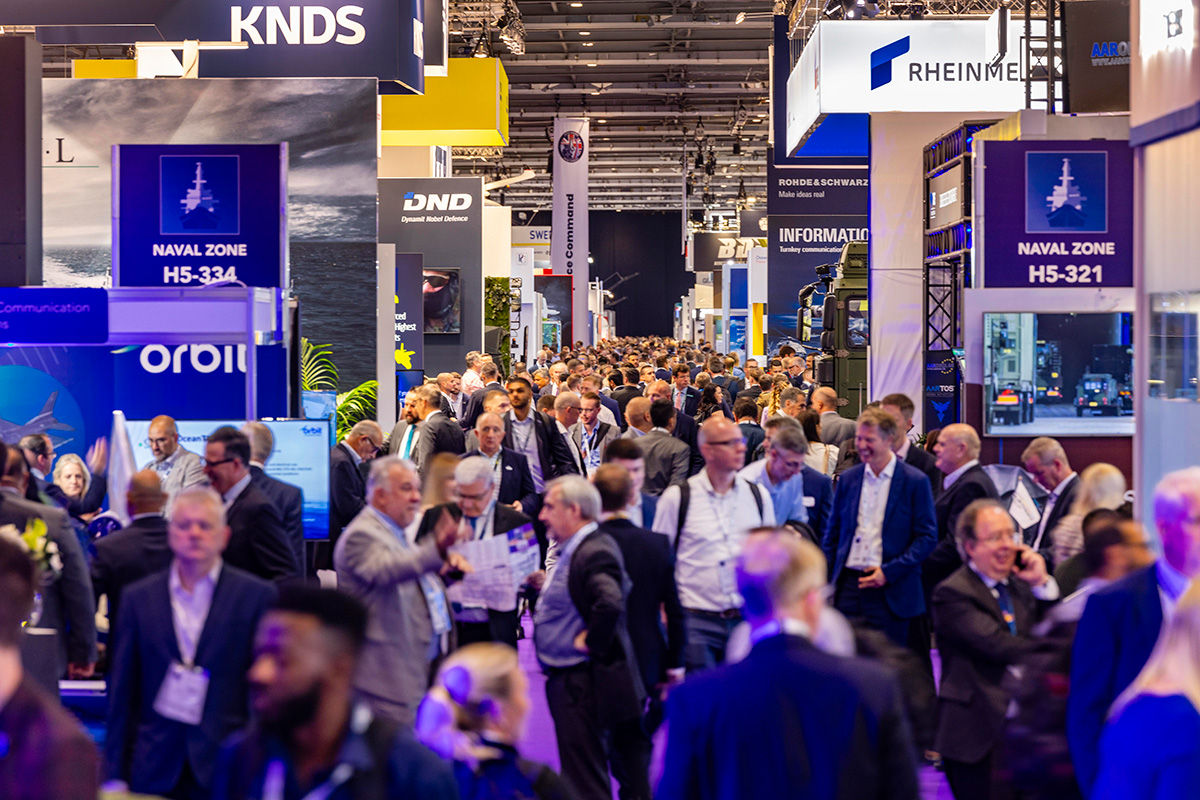
Germany is undergoing the most dramatic military build-up in its post-war history, and a new defence exhibition launching in 2027 is seeking to reflect that shift.
DSEI Germany, billed as the country’s first fully integrated defence and security exhibition, will open at the Hannover Exhibition Grounds from 9 to 12 March 2027, organised by Clarion Events in partnership with Deutsche Messe AG, with the whole thing structured around the domains and command architecture of the Bundeswehr itself. The Hannover venue, Europe’s largest exhibition grounds, will provide 75,000 square metres of indoor space and a further 25,000 square metres outdoors.
The context is a Germany that has fundamentally changed its defence posture, and the story of how that happened is worth setting out. For much of the post-war period Germany deliberately kept its military ambitions limited, a conscious political choice rooted in the legacy of the Second World War that held for decades, until the invasion of Ukraine in February 2022 and the subsequent announcement of the Zeitenwende by Chancellor Scholz marked a turning point from which there has been no retreat.
Bernd Kögel, the event’s Managing Director and a retired German Air Force colonel with 30 years of military service, is pretty direct about what that moment meant. “The threat against Europe and the Western world changed significantly throughout the past years,” he told the UK Defence Journal. “What we latest learned in February 2022 was that the idea we had for many decades, that Europe is not under the threat anymore of a military war, doesn’t hold anymore. A strong defence is the only way to ensure that we can continue our life in freedom and to secure our values.”
Kögel himself is a product of that world, with a military career that took him from the German Air Force through the Ministry of Defence, deployments to Bosnia-Herzegovina and Afghanistan, and two years in Scotland working on Eurofighter radar development at what was then GEC Marconi. After retiring from the military in 2016 he went on to run the Centre for Studies and Conferences at the German Association for Defence Technology, organising around 100 defence conferences before taking on the DSEI Germany role in October 2025, giving him an unusually clear view of both what the German military needs and how the defence industry actually operates.
The financial consequences of the Zeitenwende are considerable, and the numbers Kögel cites are worth sitting with for a moment. Germany has already surpassed €100 billion in annual defence spending, with Kögel projecting linear growth to €180 billion by 2030, and he says the bulk of that will flow into industry. “The majority of that investment will actually go into private companies, into the industry,” he said, pointing to a procurement and manufacturing ramp-up that has no real peacetime equivalent in recent history. He puts the scale of growth at somewhere between a factor of seven and nine compared to historical levels, and is clear that this goes well beyond anything the existing defence industry can absorb on its own. “Its not that the defence and security industry is being asked to produce just a little bit more,” he said. “We’re talking about significantly more than 350 percent.”
That industrial dimension is central to how DSEI Germany has been conceived, and alongside the traditional exhibition domains of land, air and space, naval, and cyber and information, the event will include a dedicated Industrial Solutions zone focused specifically on manufacturing scale-up. The thinking behind it draws on an observation about the current state of European industry, that sectors like automotive, which have faced significant headwinds in recent years, represent a reservoir of manufacturing expertise, robotics knowledge, and production line capability that could be redirected toward defence, and Kögel sees the partnership with Deutsche Messe AG, one of the world’s leading trade fair organisers and operator of the Hannover Messe, as directly relevant here, giving the event reach into supply chains and industrial networks well beyond the traditional defence sector.
The exhibition’s structure follows the Bundeswehr’s own organisation rather than a generic defence show template, which means a Joint Support zone covering logistics, military medicine, and NBC protection, reflecting Germany’s centralised joint support command that handles those functions across all services rather than embedding them within individual branches, and a dedicated Cyber and Information area. Germany’s cyber command is a standalone force equivalent in organisational status to the Air Force or Navy, and Kögel notes it is actually larger than the Navy in terms of personnel. “It’s a known command like the Air Force,” he said. “We have a cyber information command which is the same level, and I think they have even more people in it than the Navy has. It’s quite a significant one.”
Around 80% of the show floor is already booked or reserved ahead of an event that is still the better part of two years away, with Rheinmetall, Diehl Defence and Hensoldt among those confirmed and over 25,000 visitors expected across the four days. “It’s even bigger than I thought,” Kögel said. “I wouldn’t have thought we’d have it looking like this at this point in time, but it is the case. It’s a proof that we’re doing the right thing.”
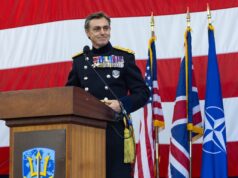
Three recently retired senior Bundeswehr commanders have been appointed to a military advisory board for the event, with General (ret.) Chris Badia, Lieutenant General (ret.) Frank Leidenberger, and Vice Admiral (ret.) Frank Lenski all having left active service at the end of 2025, between them covering air, land, and naval experience across decades of operational service. Kögel is keen to stress that their collective value goes beyond simply representing the three services. “The advisory board is much more than Air Force, Army, and Navy,” he said. “It’s also NATO and industry. They have quite a few significant roles that they held when they were with the military, and I think that makes them so powerful.”
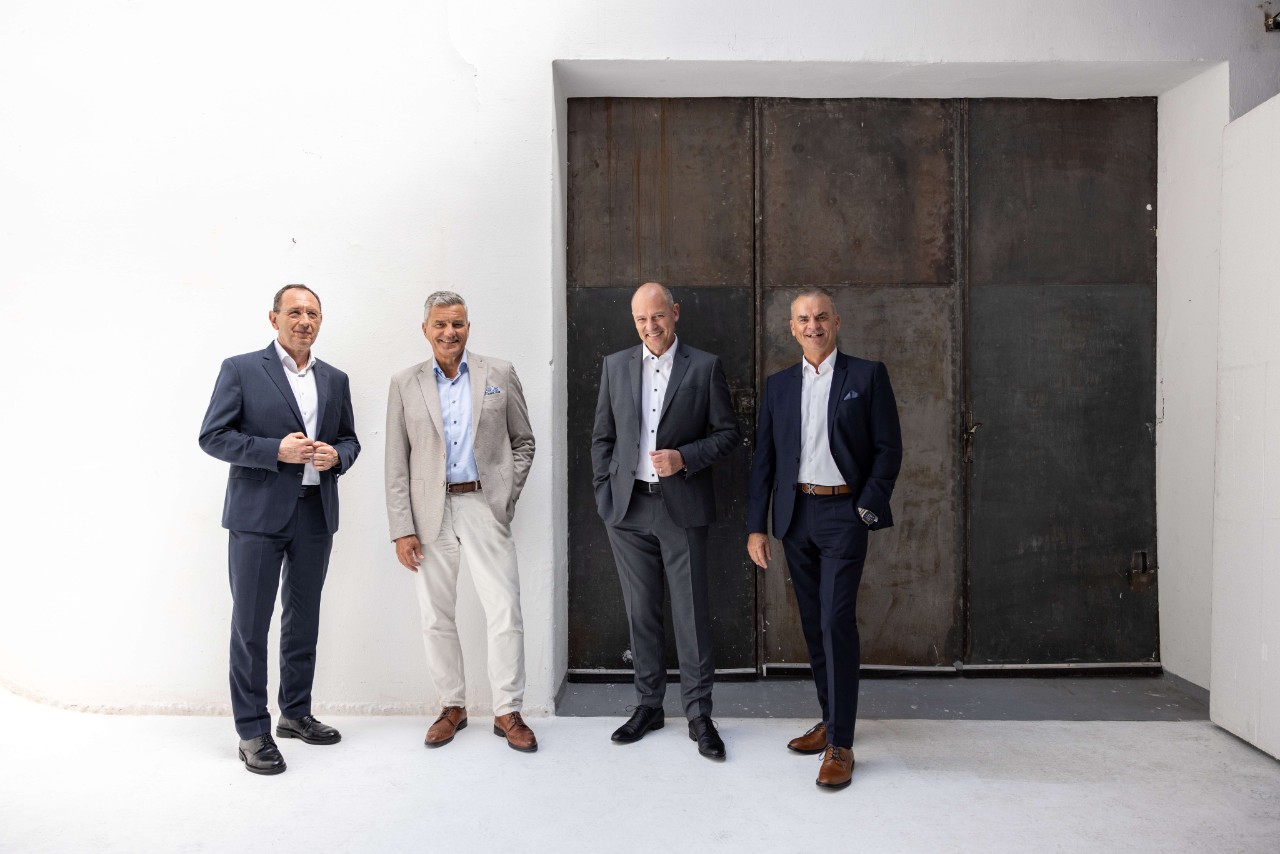
Badia began his career flying F-4 Phantoms in the German Air Force in the 1980s, going on to command Fighter Wing 71 in Wittmund and serving in Afghanistan before becoming Commander of the European Air Transport Command in Eindhoven and Head of Planning at the Federal Ministry of Defence. He was subsequently promoted to General and appointed Deputy Supreme Allied Commander Transformation of NATO in 2022, the role responsible for driving new technology and transformation processes across the alliance, and before his retirement was the highest ranking German officer in the Alliance. “Germany’s recently launched military strategy stresses the importance of adopting innovative technologies at pace, and DSEI Germany offers the opportunity for industry to showcase its solutions on a global stage,” Badia said. “As Germany takes a leading role within NATO, I look forward to driving conversations on strengthening the continent’s military capabilities and operational independence.”
Leidenberger joined the Bundeswehr in 1977 and over the following decades served as Commander of an Armoured Reconnaissance Battalion, deployed to the Stabilisation Force in Bosnia and Herzegovina and later to ISAF in Kabul, before serving as Commander of the entire German deployment contingent to Afghanistan in 2009 to 2010 and returning in 2015 as Chief of Staff for ISAF’s Resolute Support mission. His last position before retirement was as CEO of BWI GmbH, the Bundeswehr’s IT services provider employing around 8,000 to 9,000 people and responsible for managing the military’s software and cyber infrastructure in partnership with major technology firms, a role that gives him a perspective on defence technology procurement that few purely military careers could match.
Lenski joined the Bundeswehr in 1981 and rose through a series of naval and joint appointments including Commander Technical Group of Naval Air Wing 3 Graf Zeppelin, Head of Division at the Federal Ministry of Defence, Head of Planning in the Joint Support Service, and Chief of Staff at German Navy Headquarters in Rostock, before his final appointment as Commander of the German Fleet and Supporting Forces and Vice Chief of the German Navy.
The appointments are understood to reflect a deliberate effort to anchor the event within the German military establishment, with the advisers shaping both the structure of the exhibition and the content of the conference programme running alongside it, their value lying not just in the seniority of their former roles but in how recently they left service. “At a time when military strategy and defence planning is being renewed across Europe, DSEI Germany launches at the moment when it is needed most,” Kögel said. “The expertise and insight of DSEI Germany’s advisors will help us to ensure that the priorities set out in Germany’s military strategy and those of its allies are reflected throughout the event.”
Kögel is clear that despite its German identity the event is not intended to be a purely national affair. “We have to build up structures and spend the money in a way that is not only nationally used by Germany, but is compatible with all other European and NATO forces,” he said, with delegations from NATO member states and partner nations expected alongside representatives from allied militaries and defence ministries. The interoperability question sits at the heart of the event’s broader theme, with Kögel pointing to the proliferation of different weapons systems across European nations as one of the central inefficiencies the current moment demands be addressed. “It’s not that we need more companies to design more different tanks,” he said. “It’s to get it aligned and to get the numbers and the state of the art technology we need.”
The event’s overarching theme, Securing Europe: Advancing Defence Capability and Strategic Cooperation, is organised around three strands covering collective deterrence and joint readiness, strengthening industrial capacity and resilience, and what Kögel describes as the fight tonight, fight tomorrow principle, a concept that captures what he sees as a dual obligation facing European defence, to build on what exists and can be produced quickly while simultaneously investing in the next generation of capability. “Fight tonight means we have to build on what we have today, what is in the companies, what is available, what we can produce quickly,” he said. “Fight tomorrow means we at the same time need to develop the new technologies and get the latest, whatever AI and whatever other technologies are available, into the forces. Both happen in parallel.”
There is a wider question sitting beneath all of this that Kögel raises directly, if carefully, around the extent to which Europe can still rely on the United States. “We have the situation that we are not sure anymore if Europe is going to be forced to defend herself without support from the United States,” he said, a consideration that he argues makes the interoperability and industrial capacity questions not just important but urgent, and which provides perhaps the clearest explanation of why Germany is moving at the pace it is.
“In the past we had a lot of time but we didn’t have money,” Kögel said. “Now we have pretty good money but we don’t have any time anymore.”
DSEI Germany takes place 9 to 12 March 2027 at the Hannover Exhibition Grounds.





Hummm! An old German colleague once told me, ‘Germany must never rearm; it will only end badly again for us.’ This huge increase is to be encouraged; however, throughout our history, countries that obtain military strength tend to end up using it. I have some difficulty in naming one old empire that did not exercise might over the less prepared. In the case of a powerful German military, it is not the current governance, as that is stable, but what if the equivalent of Trump gets the Chancellery?
AFD is already a political force and only getting stronger