

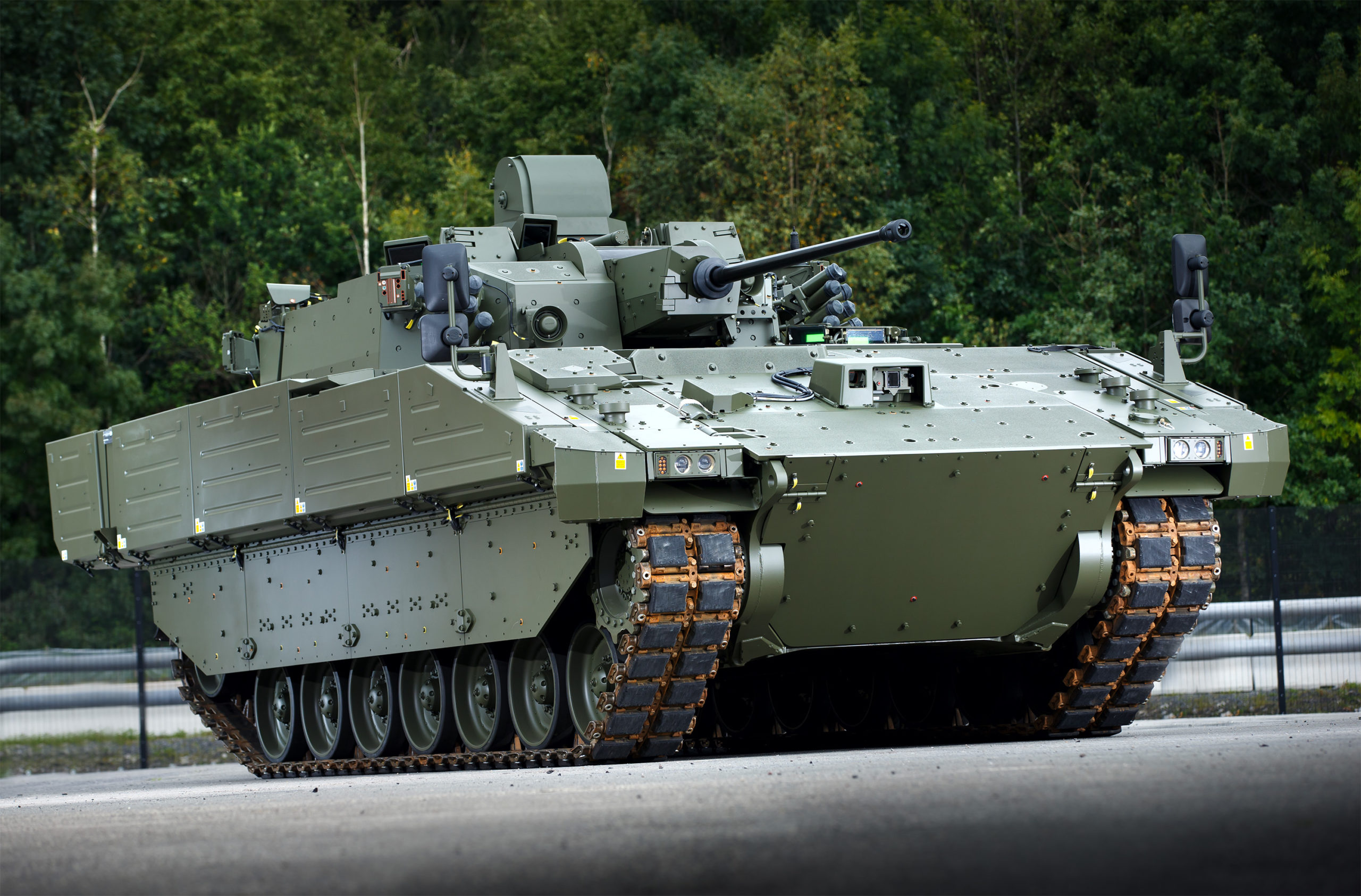
The Ministry of Defence has declined to give a clear assurance that the British Army can meet its NATO armoured reconnaissance obligations without the Ajax programme, following questions raised in the House of Commons during Defence questions.
Conservative MP Ben Obese-Jecty asked whether the UK is currently able to meet its NATO commitments given the problems surrounding Ajax, which he said had been designed specifically to fulfil the armoured reconnaissance role. He told the House that without Ajax deployable, the Army has “no formation reconnaissance capability and therefore no deployable armoured brigade”, adding that this called into question whether the UK is meeting its obligation to NATO.
Responding, Defence Minister Al Carns did not confirm whether the UK currently meets its NATO requirement without Ajax. Instead, he pointed to the ongoing review of the programme and the wider challenges surrounding it. “The hon. Member will recognise there is a review underway into Ajax,” Carns said, before adding that the programme has been “overspent” and that “the key user requirements have changed and oscillated from left to right for the last ten years.”
Carns said the government has “taken this on and recognised that we’ve got to secure the capability to provide our armed forces with the very best”, but stopped short of explaining how the reconnaissance role is currently being fulfilled in Ajax’s absence.
He also framed the issue in the context of changing warfare, drawing on lessons from Ukraine. “The reality is Ukraine is teaching us war is being fought very differently,” Carns said. “It’s not just about armour, it’s about a mix of uncrewed systems.”





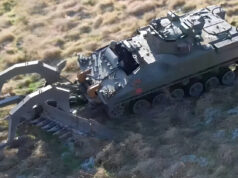


I saw one of these earlir this week, on my travels. It was on a low loader and looked Huge !
That’s it, nothing more to say !
They are big, but bigger Recce vehicles has been a trend all over the West (IIRC the Bradley C3 is a similar size which is what the US has been using for Recce for decades).
I need to take a trip to Bovington again, that’s such a great place to see all the different Vehicles. Might get a trip planned for next year.
Wiki is your friend,
Mk4 CV90,L-6.8m,W-3.2m,H-2.8m,W-38t
Ajax L-7.62m,W-3.35m,H-3m,W38-42t
They are all big mate😀
Just use the ones we’ve got and call it a day.
Geoff, so use 50-year-old Scimitars which were out of date at least 10 if not 20 years ago?
They were all withdrawn from service in April 2023. There were just a mere 97 left by that date – most, if not all, have been disposed of by now, some to Ukraine, some to members of the Alvis Fighting Vehicle Society and others to all manner of private collectors.
Many werre bought by Military Vehicle Solutions (MVS) Ltd, of Rugby is the single largest supplier of both the CVRT series of vehicles and Alvis Stormer variants in the UK; they carry a large inventory of CVRT for sale, for both international Defence Procurement as well as private vehicle collectors. MVS is currently selling on a number of vehicles from the CVR(T) family, including STORMER.
Not really what I meant Graham. I was just thinking about Ajax with all it’s problems. The army procurement is a shambles and it isn’t getting any better. Ajax is controversial, Boxer is delayed, Challenger appears to be okay but we’ll end up with two tiny brigades if we’re lucky. No artillery to speak of…RCH155? The medium helo seems to have disappeared. Will it ever end well? I doubt it.
Geoff, OK. I thought you were suggesting we could have or should have kept Scimitar until Ajax is sorted. My misunderstanding.
I recall seeing an article somewhere recently hailing the fielding of Ajax and sub-titled that it was the first British AFV fielded for 30 years. [Not totally true as 33 x Titan and 33 x Trojan were fielded about 22 years ago, but not far off it]. Very shocking. AFVs should be regularly updated during service and then replaced after about 25 years in general. If that had been done for all our AFVs we would have had smooth progression of roll-outs and no funding collisions – WCSP would not have had to be cancelled and we would not have had the IFV crisis (ie no IFVs in 2-3 years time).
The two armoured brigades in 3 Div will each have 58 CR3s and two unsuited wheeled Boxer battalions, and no Close Support artillery and no combat engineers. Thats underwhelming. The Deep Strike Recce brigade in 3 Div always was an odd construct without Infantry or tanks and will be hopeless without Ajax or a similar vehicle.
RUSI research determined that an effective armoured division should have 170-200 tanks; ours will have 116 CR3s and the Attrition Reserve is tiny.
1 Div has its problems, most of them considerable.
The army cannot now satisfactorily deploy a brigade group of 5,000 – 6,000 on an enduring operation without reinforcement from the Army Reserve and/or the RM.
Its a total mess.
SDR 2025 confirms that Britain’s commitment to NATO is an Army Corps of two divisions.
That Army Corps is not fit for purpose without even one armoured brigade.
Apparently the Prime Minister is concerned about the country’s ability to fund increases in defence spending.
That concern would disappear entirely if he only took the sensible decision to ditch the unevidenced and extremely silly pursuit of ‘net zero”
I wouldn’t get too worried. I doubt we could field a single brigade let alone a Dvision. Two? Ha!
Quite right. I mean, in the old days, our armoured Regiments had 60 ton tanks with only 650hp engines that needed a ‘rest’ (mechanical breakdown) every 30 minutes or so. Our Scout Cars were designed in 1945 and equipped with 1945 date stamped magazine fed MGs. How the Soviets trembled in their boots….
Monro, are you saying that neither of the two armoured brigades is deployable because of a lack of armoured recce? When Scimitars were withdrawn in April 2023, then a number of Warriors were re-roled as an interim armoured recce vehicle; surely they are still in place and ready to deploy?
The Warriors were pretty shot in 1990…..
The British Army will always go to war with what it has. But, if it is commanded to go to war in its current state against a battle hardened peer adversary with a massed drone arsenal, it seems likely that it will be annihilated in short order.
Monro, Warrior was first fielded in 1987. In 1990 the oldest Warrior would have been a spring chicken of just 3 years old and the newest might have been about 3 days old! They had not been deployed on any operation as far as I recall by 1990, except that by the end of that year a number were on their way to Desert Shield.
Certainly the British Army will always deploy when under political orders to do so, and will go with what it has got, as you say, and it will often go with insufficient numbers as politicians stipulate a manpower ceilng on each and every deployment. Some, inlcluding senior US officers and DoD politicians say that we Brits ‘failed’ on Op TELIC and HERRICK. Thats debatable but that was with a larger army and with fewer serious equipment problems.
I dread to think what the outcome would be if our army went to war nowadays against a peer or near-peer opponent with large forces, a strong industrial base, many AFVs and Air Defence, much artillery and drones, a callous disregard for their own casualty figures, and an ability and enthusiasm to wage a long war.
Indeed, but, by 1990, Warrior taken part in Exercise Keystone (1987), Exercise Iron Hammer (1988), Exercise Key Flight 1989, followed by extensive training manoeuvres in the desert, desert conditions, as I’m sure you know, taking a serious toll on anything mechanical. Heavens knows what kind of state they are in by now.
I can remember the disaster that was the Chieftain MBT in 1973, later Mk 5 (a bit) better. The first iteration of SA 80 had its problems, so the British Army is no stranger to poor kit nor, I would think, are most other armies but, as you say, it would be suicide for our guys to deploy to Central Europe in the Army’s current state.
Yet again, politicians intent on willing the mission but not the means.
Another spectacular debacle from those wonderful people over at Procurement…slow labourious cynical hand clap. 👏
I blame the then conservative government.
They refused to give the contract to BAe out of spite,……..
How can a fixed price contract for Ajax be overspent?
Al Carns is ex-military with a glowing service record so I’m going to assume a slip of the tongue.
The fixed-price contract is for delivering vehicles built to an agreed design that was assumed to be safe and compliant. That approach works if you’re making minor modifications to an existing platform, but adding 12–14 tonnes to the ASCOD chassis to create Ajax clearly isn’t a ‘minor change’.
When he mentions ‘overspent’, he is talking about the programme as a whole, not the price per vehicle. The programme is overspent because the MoD has had to fund extensive safety testing and redesigns to address the issues, all while keeping CVR(T) in service.
Sorry but he is a politician now and no longer speaks with his mouth. Most of what he says, if he truly believed it then he should resign but no he continues to insist we are upping defence spending and rebuilding our services when in reality we are doing nothing but navel gazing and promising the earth the day after next year.
“the key user requirements have changed and oscillated from left to right for the last ten years.”
Is that code for what the technical difficulties are with the vehicle as well or an unintentional pun?
It reflects a lack of control and discipline in the procurement system. Officers in post for two years or so are judged on the impact they have on the program and the most obvious impact that they can have is to get something that their unit thinks would be really introduced into the requirements. When I was a techie working in the procurement system (a very small cog and a big machine) I was dismayed when the ‘grown ups’ started to talk about ‘chilling’ the requirements rather than ‘freezing’ them. It was a meddlers charter and has set up any large and complex program for failure. It is far easy and quicker to change words in a requirements document than it is to design a widget to meet the requirement!
They should freeze the requirements and then hand them over to the companies to innovate and design the system to meet the requirement. If anything changes in the meantime any resulting requirements either go into something new or into a capability insertion program. You do NOT redesign every few months because – well Ajax..!
The Carriers are constantly under maintenance and have extra capabilities fitted because the RN has worked out that using preventative maintenance and taking the opportunity to fit new stuff to a platform works best when new stuff is ready and actually works! That approach recognises that no matter how much you may want a capability on a platform if the tech is not available for any reason you are better off with something rather than nothing! It also turns out that preventative maintenance cycles with capability insertions is also a pretty good way to maximise availability. The RAF have used spiral development to keep adding capabilities and updates to Typhoon for years. It works.
The other problem is that requirements documents are way too detailed. Hundreds of pages of stuff that quite likely isn’t coherent because there are too many people involved which leads to an extremely challenging and overly constrained design process because the MoD / services have tried to design the system they think they need. It stifles innovation as well. Serving officers are experts at being military, they should let the engineers be experts at what they do in turn and not try to do everything themselves.
Any Key User Requirements document that is hundreds of pages long should be shredder fodder and the team RTU’ed… If not, just fill a truck with £20 notes and set it on fire, it would sort out the overspend and save a load of time and, in Ajax’s case a few injuries as well..!
Between the politicians, Treasury, military and civil service there are far too many cooks – result is the tax payer gets fleeced and the military get one more gapped capability!
Cheers CR
PS. Sorry for the rant. Ajax is something as a big red button for me…
CR, great post! As an Equipment Support Manager at DLO Andover, I worked across to procurement staff at Abbey Wood for 2 years. I later spent 2 years there in Bristol as a civilian consultant, working in three different roles.
Requirements must be output-based and succinct. It is very unwise to be proscriptive about key aspects, such as specifying the exact cannon you want!
The best ‘Requirements document’ ever was for 155mm tracked SPG – AS-90. MoD issued a Cardinal Point Specification on one single page for a new 155 mm self-propelled gun; only 4 Key Requirements were stated. There is a longer story but that is the takeaway. It was created as a PV by VSEL who correctly predicted that SP70 would fail.
Thanks Graham,
Looks like some in the Army might actual understand the problem given the news about the new cruise missile… Fingers crossed they transfer the lesson that complex or exquisite systems do not necessarily need complex requirements…
I notice that General Reilly is an engineer..! Hmm, another lesson worth learning perhaps?
Cheers CR
CR, yes General Reilly is an extemely accomplished REME engineer.
Hi Graham, it would be interesting to hear what those key requirements were? Being part of the MIC now, it is too easy to see scope creep and over prescribing the requirements. The flow down should be pretty simple to follow, i.e. user requirements, system requirements then technical requirements. But it does seem those within “Abbey Wood” get into the technical details too early. I’m not sure they are taught KISS any more?
DaveyB, the Cardinal Points Specification for the project that was won by VSEL’s AS-90 focussed on 4 key requirements. From memory they were:
1. that the calibre was to be 155mm
2. that the chamber was compatible with NATO-approved dimensions
3. it should have a maximum rate of fire of 3 rounds in 10 seconds
4. the hull should be tracked and armoured.
Not at all, thanks for your rant. Very interesting. Hopefully something can be salvaged from the Ajax program.
H of C public accounts committee June 2022:
‘Dame Meg Hillier MP, Chair of the Public Accounts Committee, said:
“The MoD has made fundamental mistakes in its planning and management of this project. The Ajax tanks programme has been deeply flawed from the outset and the PAC now seriously doubts it can be recovered within existing costs and commercial arrangements.
Enough is enough – the MoD must fix or fail this programme, before more risk to our national security and more billions of taxpayers’ money wasted. These repeated failures at MoD are putting strain on older capabilities which are overdue for replacement and are directly threatening the safety of our service people and their ability to protect the nation and meet NATO commitments.”
Couldn’t agree more..!
The problem is there’s no plan B! Unless they look at doing a Boxer recce version similar to the Australian combat reconnaissance vehicle.
The idea of wheeled recce vehicles with big turrets makes me very nervous. Too many people die when they fall over.
Apparently they have/are trailing the Ajax demonstrator Blackjax with rubber tracks these first weeks in December!soooo🤞
Several folks posting here have suggested rubber tracks as a solution. Others say a complete replacement of the suspension system with an alternate design is necessary. I don’t have the expertise to give an opinion one way the another, except to say that if there was a cheap and quick ‘pareto’ solution i.e. fix 80% of the problem for 20% of the cost and time, then I would go for that on the existing and early vehicles with a view to doing a proper fix as the later ones get built. Similar to the approach we adopted with the T45 propulsion problem.
Rubber tracks must be the principal route to explore, along with a deep study of the PDi procedures that is releasing faulty goods to our troops. Surely, this vehicle has been subject to many ISO Audits during its long gestation period?
The prospect of the Ajax fleet being ditched is unlikely, however the UK Government could consider switching the manufacturing of these vehicles to another assembler and seazing the current plant assests under an emegancy act. Retaining the South Wales factory and employees whilst the rectifications are carried out might delay the general release by a year or so but what are the timly alternatives?
Might be showing my ignorance here, but how are rubber tracks going to help in the woods and fields? On the road I can see, but off road?
I have rubber wheels on my off road bikes, If that’s any help ?
Multiple cycles? You are so bourgeoisie.
I like Rubber 😎
PVC 4 me 🥰
At a guess I would say they would have a damping effect on some vibration frquencies; shock absorbers.
BFBS news has a video showing the state of some of these ‘new’ vehicles!
Ajax is a truly global product: European technology, Russian build quality, and an American price!
Rubber tracks are not going to fix the overweight issue and I’d be surprised if these tracks will be durable enough carrying all that weight! They may have to spend some more reengineering the suspension and or strip some weight off with a remote or lighter turret? Hopefully all parties chip in for the fix.
Remember 1982? Like 1940, albeit on a smaller scale, industry came up Trumps. Particularly Marshals at Cambridge.
Scrap this hunk of junk. Go for a quick build, tracked, fast and light, not 40 tons of drone bait.
Will voters ever wise up? Throw money at the MIC it will happily shaft the taxpayer time and time again. Make ALL lobbying of politicians illegal. Hold individuals within projects accountable. Perhaps Vlad will rent us a few scooby vans…
Spock where are you old son?
Some of us have full-time jobs,
whereas others clearly live on benefits.
Aye but you bite like a fish 🤣
And you punch like a vegan. 🤷🏻♂️
Benefits are great though, I’d be homeless without them 🤦♂️🙄😎😁
Me too mate, and that fuel allowance keeps us warm and toasty.
We have some great chats at the food bank too.
You might be getting a free TV license as well👍👍
Never watch it mate, only endless amounts of americanised shite and trash (rubbish) “reality” shows for brain dead “Sheeple”.
Free road tax would be good though, hopefully that Conservative Banacheck woman get’s in and we can all have V8 petrol guzzlers again. (my Cerbera doesn’t count as It’s packed away for the grandkids).
I rob ours. More fun that way.
Ouch !
I ,on the other hand, do neither. However I compensate for that by hardly ever posting on here…and never anything worthwhile.
Interesting spin using Ukraine as an excuse to be completely unprepared and without a plan.
“who can say how to prepare if we can’t see the future?”
I suspect they’re suggesting you might not need armoured reconnaissance in future, just send some drones out to do it instead.
‘The British Army…..has moved swiftly to integrate Unmanned Aircraft Systems across its armoured and reconnaissance regiments…..These drones serve as force extenders, enabling crews to conduct close and deep reconnaissance without breaking concealment or exposing vehicles to enemy fire. Drones can rapidly survey ridge lines, tree lines, and urban corridors, identify armour ambush positions, and even detect thermal signatures hidden from view. Their real-time video feeds….provide armoured commanders with an accurate picture of enemy disposition and terrain.’
I wonder how many drones we could buy with the money that was wasted on Ajax..?
Cheers CR
Errr…..let me think…..that would be three hundred and fifty seven million eight hundred and ninety five thousand seven hundred and twenty drones exactly…according to my model…..but I see one of the code writers was a Professor Ferguson……
The battle field Ajax was built for is no longer there its just a big target, do you 40 tons of armour to do recce?. The whole idea of such big vehicle is strange not as if it even has active protection or anti drone mesaures. Its in a way out of date for its role. CVRT was small quite but old.
Truth it is an out of date concept now. Maybe it will be scrapped because someone has twigged?
Active protection is a must, but Armoured Recce isn’t a dead concept, and will continue to be needed. Much like how modern ISR didn’t make OP’s and the old CTR dead concepts, Drone are just another tool in the recce book.
yet Ukraine still want MBT and Bradleys? why if they are just targets? Because drones while useful will never sieze and hold ground
Seen what old russian crap they have no wonder they want better kit, The Bradley is a life saver compaired to the death traps that some Ukraine forces have to work with. And yes Drones can not hold ground but the can deny it, And yes Ajax is a big loud target with no drone defence thats if it makes to the battle with out falling apart or injuring its crew.
its too big, etc for recce
Martin, Ajax is too big, heavy and noisy to do ‘recce by stealth’….but it seems we have now embraced ‘recce by fighting’, as other armies have done (US, USSR/Russia etc).
And which is the best Stealth or turing up for a fight and letting every one know you are there. Not every thing the great USA does is better. I prefer the stealth approch having trained as a Forward Op for guns,
We do not have the numbers or the kit to fight like the yanks or the russians its a stupid idea. Our Army qas good at many things we give them up just be like the Yanks, but thier whole way of fighting etc is way diffirent to ours they have the numbers and the ammo. We don’t have either and never will.
Park one permanently out side the MoD as a monument to incompetence. Can we start one of those petitions.
I’m still waiting to hear why they didn’t go with BAE and CV90. Someone in MoD procurement or Government clearly decided to send a statement to BAE when they went elsewhere for Ajax and WCSP and now they’re paying the price with one about to be cancelled and the other already cancelled, both at great expense to the taxpayer.
We are having all these problems yet GD are still turning out demonstrators/prototypes for IFVs etc and even upgraded Ajax (Blackjax)! Apparently these are for the export market and our requirements for an IFV,are they having a laugh or have the problems been fixed because I can’t see why anyone else would touch GD UK with barge pole!
If the suspension of the IFV and Blackjax are any better than on Ajax maybe GDUK can retrofit fit as part of any ongoing compensation and future work? Hope these rubberctracks are durable enough for military ops and can handle the weight on all terrain.
The tracks seem to hold up on CV90 at 38t,been used in Afghanistan as well as Europe so they should have proven themselves.
I can’t see how this vehicles can be marketed with the same issues as Ajax so here’s hoping🤞