

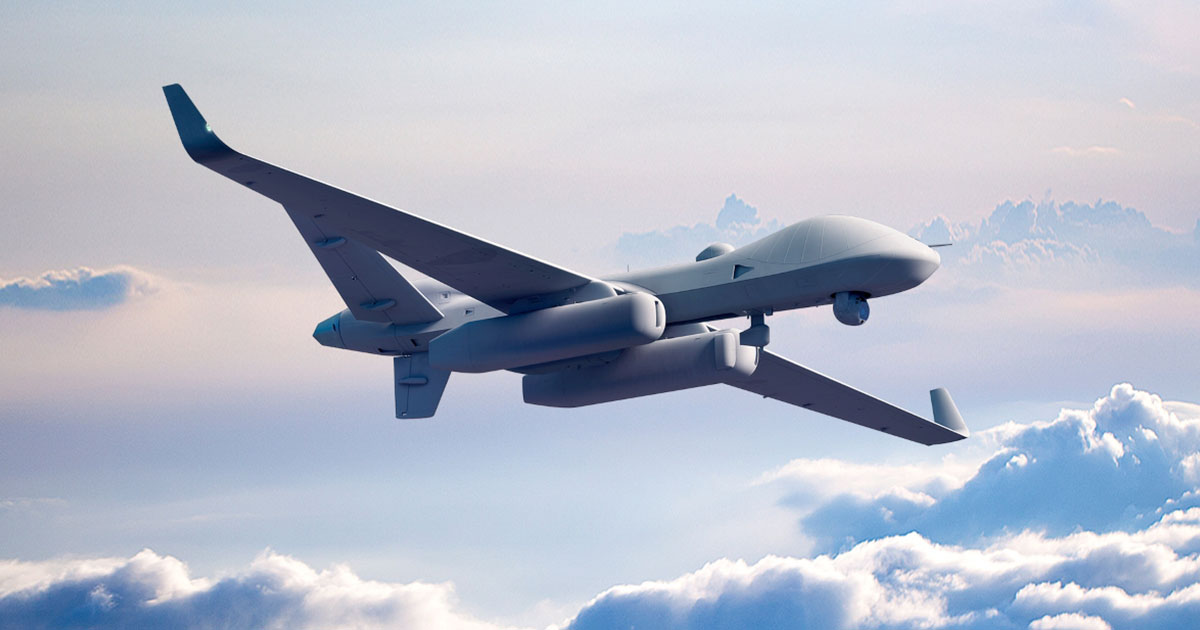
General Atomics Aeronautical Systems and Saab will demonstrate an Airborne Early Warning and Control configuration on the MQ-9B in mid-2026.
The trial will take place at GA-ASI’s Desert Horizon site in Southern California and will use an MQ-9B fitted with Saab’s airborne early warning sensors.
The project combines Saab’s AEW technology with what GA-ASI describes as the longest-range and highest-endurance remotely piloted aircraft in service. The firms argue that integrating AEW sensors onto an MQ-9B could provide persistent surveillance over land or sea, including in regions that currently lack such coverage or where crewed AEW aircraft would be too costly to operate.
GA-ASI President David R. Alexander said the integration is intended to give operators a survivable and continuous sensor presence. “Adding AEW&C to the MQ-9B brings a critical new capability to our platform,” he said, adding that the goal is to “deliver a persistent AEW&C solution to our global operators that will protect them against sophisticated cruise missiles as well as simple but dangerous drone swarms.”
The MQ-9B family includes the SkyGuardian, the SeaGuardian and the UK’s Protector variant, as well as a short takeoff and landing version in development. The AEW configuration is being positioned as a complement to these roles. According to the companies, a medium-altitude, long-endurance UAV offers high operational availability and removes aircrew risk entirely.
The AEW package will support early detection, long-range tracking and the simultaneous monitoring of multiple targets, with the firms pushing compatibility with line-of-sight and satellite communications links. The companies state that the demonstration will showcase options ranging from maritime warning for carrier groups to ground-based air defence cueing, reflecting the growing interest in unmanned platforms for tasks traditionally handled by large crewed aircraft.





This sounds like a very similar timeline to the MQ9B STOL development and demonstration.
We might actually be able to trial fixed-wing AEW on our carriers by the end of next year.
Hopefully. This would be a great move.
Oh Gawd, is really the best we can do?
Let’s wait and see what they come up with before writing the idea off entirely. I know your problems with the idea and they are important, but I think that getting Crowsnest out of the Merlins and the ASW/MPA capability are more important than aiming for the optimal AEW solution.
SAAB and GA are claiming a 100 nautical mile detection range for the radar, if true this is a very impressive capability for providing AEW and targeting for a carrier task force.
However it’s probably too limited a range to provide AWACS capability against an opposing airforce.
Definitely something the UK should invest in. This would be great for UK defence as well as well as carrier defence.
Be very handy. 100 Mile range, flying higher than a Merlin’s AEW capability. It’s the sort of capability that we should have maybe 4 or 5 on each carrier… As we’d use some to remain with the CSG, others to “scout” ahead and the need to have coverage constant by sending another up as one returns.
It’s a solution ……. of sorts ……. so well done to GA and SAAB so far but how long can that 100 mile range loiter for? How much of a penalty is that SAAB payload to the operational endurance of this system? If, and it’s a big if, a 2nd shipborne MQ-9B can use fuel tanks (in place of AEW RADAR) with a drogue system then perhaps this has the makings of a system the QE class have been looking for, for some time now. Lots of designing, testing and trialing before then though, I dare say.
Original MQ9B has >40h endurance, even if the STOL wings and the AEW power draw halve that it still hugely outstrips Crowsnest. I can’t see using it for refuelling as viable, it just doesn’t have the disposable payload to refuel anything other than itself so it would be a pretty pointless expenditure.
The STOL wing is much thicker and shorter than the standard high aspect ratio wing. Meaning it won’t be able to fly as high, plus the wing will be a lot more inefficient at a cruising speed. If it can cruise for 24 hours at 30,000ft. I think that would be good enough. Especially as it will be able to land on the carrier without being arrested. Though the thoughts of it slowing down on a deck that’s heaving and being slippery, I’m sure is going to be a headache if it veers off track.
Yeah. Even a 24hr endurance will be much better than Crowsnest. Hell, it having a longer endurance is great, but what’s key change is the fact you’re still on the ship, close to CIC and not listening to the constant sound of a helicopter and whatever heating is that helicopter rear compartment.
And when shift change happens, it’s as simple as getting up, changing operators and you’re set.
The other benefits is the Helicopters too, less up time, maintenance, etc. Combined with the VETREP drone that can replace the Helicopter’s role of moving containers 50KG or less. Means they can sit around with ASW more often or as Troop Carriers.
I very much doubt you’ll do any refuelling with this drone
Let’s wait and see.
I’m hugely sceptical about this as an approach for carrier AEW, for three reasons. First the quality of the sensors a MQ-9B drone can carry. Second, the weight an MQ-9B STOL will be able to take off and land with on a carrier. Third, the ability to separate the AEW funvtionality from Control.
The first two are a function of the drone and carrier’s sizes. The latter is down to being the first breakup of AEW&C into geographically separated capabilities. What’s new will always have teething problems, that seem in this case to be being ignored. That bodes badly for success.
Can’t be much worse than crowsnest. Unless they add a catapult to the carriers then this is probably the best option for when you can’t get a wedge tail in the area.
Less a “Bring a Wedgetail over here” and more a capability that the CSG could aloft themselves and maintain it without needing the RAF to say yes to. Also means the E-7 can do something else.
I think we are firmly in the ‘anything is better than Crowsnest’ stage, but there are other reasons why MQ9B is a good idea for AEW. The most important is that the platform isn’t just for one role; getting MQ9B STOL would also give us a long range carrier-based maritime patrol capability beyond any other navy in the world (because the USN got rid of their Vikings) which would be really useful for Atlantic work (where the carrier would be able to send MQ9s across essentially the entire theatre) and in the Pacific where hunting down lone ships would be a lot of effort.
The second is that we don’t have enough E7, and having some form of early warning that is interchangeable between ship- and land-based operation is a very useful boost to numbers. I’m not claiming that MQ9B is attritable, but having a drone rather than a hugely expensive manned platform that we can deploy closer to the front lines is a good backup to a system costing as much as a T26.
I can’t see any other way of getting the same capability for a similar cost. Tiltrotors etc would cost vastly more because there simply aren’t any projects around, and other fixed-wing solutions require modifications to the carriers.
TJ, I don’t understand how Crowsnest was deemed viable to begin with. Radar effectiveness is limited to the earths’s circumference, cant see beyond the horizon . I doubt an EH 101 helo operates effectively above 10-11,000 feet ? So why not go with a fixed wing at 25-30,000 ft?
Crowsnest at 3km altitude (~10,000ft) already has a radar horizon of 195km, which might well be more than the radar can manage anyway. From what GA and DaveyB have said I doubt MQ9B will have any more range than that against missile targets, so the extra altitude wouldn’t make a very large difference to detection ranges.
We aren’t in the E-2 category where the radar has a range of 500km, unfortunately.
cheers for the insights TJ
Bear in mind that radar horizon is for a surface or sea skimming target. You’d theoretically (ignoring transmit power limitations of the radar) be able to see a target flying at similar altitude 390 km away.
I would agree though, that the big benefit of the MQ-9B platform is the endurance given the limitations of the radar in terms of detection range.
GA said that the new system would have a detection range of ‘>100Nm’, though it’s hard to tell in the video whether the target is a fighter or a missile. Crowsnest has reported ranges of slightly less than that (again with the ambiguous target). SAAB Erieye, which the system looks to be based on, has a range of 400km but the array size is very much smaller for MQ9B.
As you say the main advantage is that for a given turnaround time and number of airframes, it is possible to have many more flying hours than from a Merlin.
It’d be great to have Erieye capabilities on this, but I agree with you that is going to be unlikely.
Mind you, an SU-34 is a big aircraft and a TU-95 even bigger, I’d be willing to bet that detection of one of those could be made quite significantly further out than “100 NM”.
I think you’ll need different pods for surface search and air AEW roles, not sure they can do both at the same time…
But I agree that it’s worth getting both types, for both of the roles you describe.
The last is the biggest concern for me. It’s assuming that we can pass back an awful lot of raw data for real-time processing (presumably on the carrier, or at Lossiemouth if it’s operating alongside the P-8As) without any interference and jamming from the other side. I don’t know how much of the processing and control is done on Merlin Crowsnest, but the E-2s do I believe, reducing the data load. Unless we’re going to trust some AI processing in the radar pod, it’s all going to need to go back to the control node…
All the Crowsnest radar data is processed on the Merlin, then certain information is data-linked back to the carrier/T45 etc, via a quad stacked Link-16. Quad stacking ups the available bandwidth allow for more data to be sent in one go. For live data to be sent back you’ll need a much beefier data-link, in the same league as the F35 MADL.
So we live in Northern Europe so most of our requirement would be over the North Atlantic or Arcticand the trials are being carried out in the California Dessert !
I think I’ll hang fire on getting too excited ?
Now if someone was to tell me that SAAB was tying up with Airlander to provide a persistent, manned, high altitude AEW, MPA, AWACS capability I might just get quite interested.
GA are a US company based in the California Dessert, so it makes sense that their testing is done there. MQ9B has already done a lot of maritime work in the Pacific, not sure what the worst conditions it’s been in are but I think we can assume the main barrier is shipborne operation which can’t be done yet anyway.
Yes Airlander is the obvious solution to our AEW problem but I don’t think HAV or the MoD are being brave enough in exploring the possibilities (that said, the recent reservation and HAV’s socials posts show they are interested). There are some obvious questions that would have to be ironed out, the obvious one being how to land something 98m long and 44m wide on something 284m long and 70m wide, but the end result would be fantastic and a full circle back to the US Navy experience with blimps in the 1950s, which was only ended because the nuclear navy sucked up all of the budget (sound familiar?).
No one’s operating a blimp off a carrier
You forgot to tell the Americans that in the 1940s. Or the blimps we operated from HMS Furious towards the end of WW1. And Airlander should be a lot easier than either of those to control, as it has more thrust to weight, thrust vectoring and doesn’t need to be held down onto the deck.
And if the carrier has to rapidly redeploy elsewhere what are you doing with the blimp?
Airlander (not a blimp) can transit at 50kts for 4000 miles, it would be very strange if the carrier were to outrun it even with a slight headwind.
And ordinary carrier aircraft can’t operate in a storm anyway, so a platform that can move away and continue operating independently for several days is an improvement, not a disadvantage.
I think it wouldn’t need to land on all the deck, just the rear. Doing a sort of rotors running refuel if you will, but for the HAV, i.e. doing a crew change, reprovisioning, etc.
I’m sure I’ve read that Airlander has secured a deal to provide 3 Airlander 10s to a military contractor. But hasn’t disclosed who that is?
Yes, the touch and go type evolution was what the USN did to refuel and do crew changes on their blimps, but it took huge numbers of crew to hold mooring lines until the fuelling was completed. Airlander should be able to use the suction cup legs to hold itself onto the deck, though a couple of cables to tie-down points probably wouldn’t go amiss depending on how long it would take (all of the other parts would probably take less time than the fuelling if done efficiently.
Another thing working in our favour is that on the HAV the engines are up on the sides of the envelope above head height, whereas the US ground crew had to deal with the propellers being right on the sides of the gondola.
Yes someone reserved 3 Airlander from the initial production run, it might be BAE looking at the UK in maritime patrol or AEW but most likely it’s a US company trying to capitalise on the DoD’s interest in Airlander for USMC logistics.
We’ve got those 2 spare E7 radars kicking around since we cut that order from 5 to 2 airframes.
Most AEW is done during peace time. This is a good cost effective alternative to the mundane tasks like flying over the North Sea or Eastern Europe for hours on end. This way we can save our valuable and expensive assets for when the poop hits the fan and for when those situations where there is concrete and identifiable target. Now of course, cost effective alternative in this day and age typically ends up being a cheap “permanent” solution resulting in a capability gap. Crowsnest for example.
If detection range is better and effective, we have lots of friends would be better having 2 or 3 leap frogging with the CSG from fixed bases to maximise the endurnace. Possibly keep couple of Crownest on Alert 10, if get susupicious contact/threat it scrambles right above CSG (within the T-45 protection) to provide the AAW commander longer over horizon?