

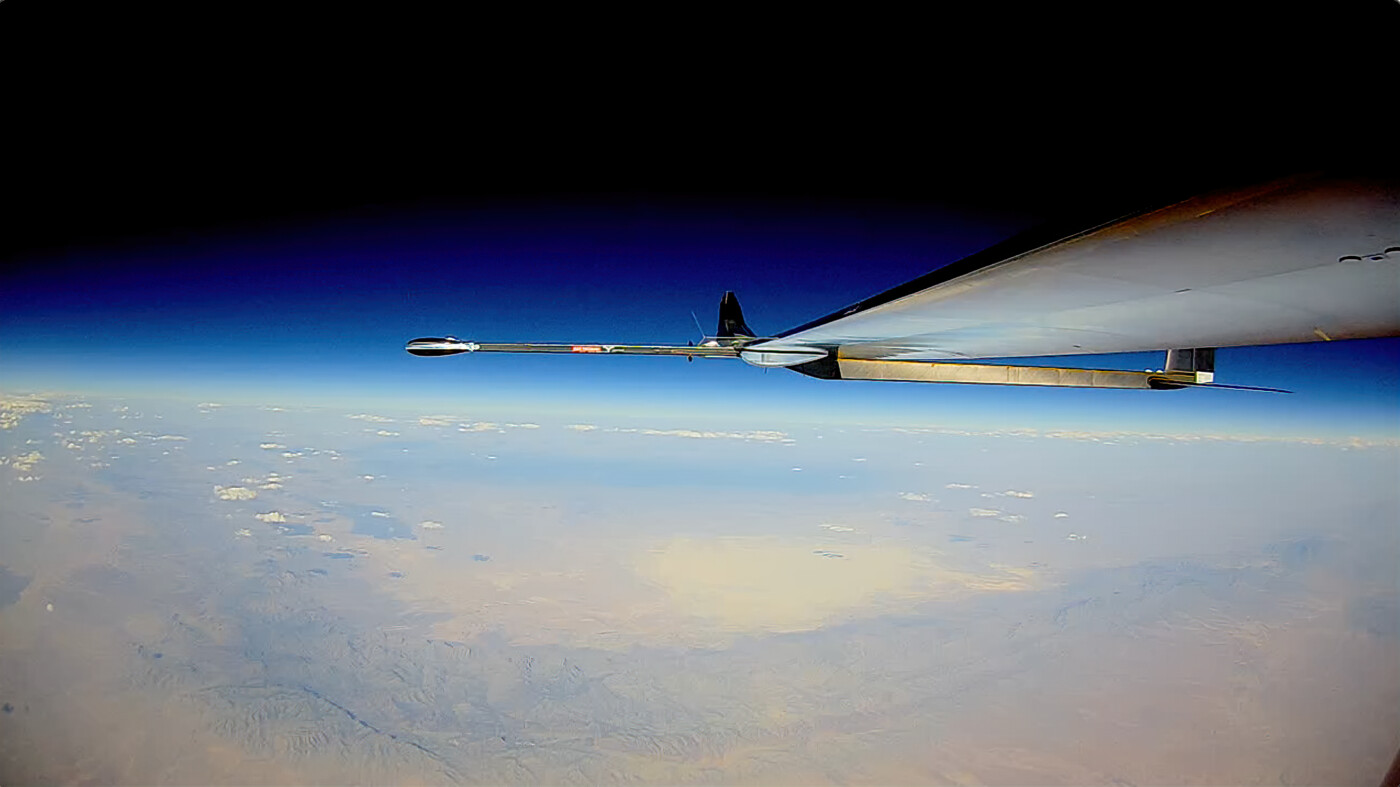
PHASA-35, the solar-powered stratospheric aircraft developed by BAE Systems’ Prismatic, has been selected as the flight demonstration platform for a power beaming technology intended to keep high-altitude aircraft flying through the night and the winter, under a £15.7 million contract linked to the Advanced Research and Invention Agency, the company stated.
The work forms part of ARIA’s Enduring Atmospheric Platforms programme, which aims to develop low-cost, long-endurance platforms for high-altitude communications. It runs in three stages over three and a half years and concludes with an integrated flight demonstration aboard PHASA-35.
The problem it addresses is the one every solar-powered high-altitude aircraft faces. Flight depends on the sun, and the company describes that as a significant challenge in places like Britain, where winter daylight is limited and the nights are long. According to BAE Systems, power beaming removes that dependency by supplying constant power regardless of season, making it easier to fly continuously for up to several months at a time.
The system uses what the company describes as a highly controlled ground-based energy beam directed at a dedicated receiver built into the aircraft’s wing, which converts it back into electricity to power the aircraft and charge its batteries. The release notes that similar microwave frequencies are already widely used in aviation, satellite communications and radar.
Bob Davidson, chief executive of Prismatic, said: “PHASA-35 has already proven its worth in the stratosphere as a low-cost alternative to satellites and now this exciting project will explore whether we can make it even more capable. This is a strong example of British organisations working together to advance an emerging technology.”
Rico Chandra, programme director for Enduring Atmospheric Platforms at ARIA, said: “This research expands the UK’s leadership in high-altitude platforms to become the place where this industry is designed, built and scaled. Getting there means backing bold ideas, from fixed-wing solar aircraft to designs nobody predicted, including aircraft that fly on spinning wings instead of propellers.”
PHASA-35 has a 35-metre wingspan and weighs 150kg, and according to the company has the potential to operate above 66,000ft for months at a time, delivering persistent communications, Earth observation and surveillance at a fraction of the cost of traditional satellites and with greater flexibility to deploy and upgrade.
According to the company the benefit may extend beyond endurance, since reducing the weight of onboard battery arrays could free capacity on an aircraft that already carries a payload of up to 15kg, which the company says can be used for sensors across intelligence, surveillance and reconnaissance, communications, Earth observation and defence applications.
Batteries are a large share of the weight on any solar aircraft of this kind, since they have to carry the aircraft through every hour of darkness, and the longer the night the more of them are needed. An aircraft able to draw power from the ground overnight could, in principle, carry fewer batteries and more equipment.
ARIA was established in 2023 as an independent body funding high-risk research, modelled in part on the American Defense Advanced Research Projects Agency, with the freedom to back programmes that conventional funding routes would not.
Prismatic became part of BAE Systems in 2019, and PHASA-35 has flown a series of stratospheric trials in recent years.



What would the survivability of these things be like? They must have almost no signatures, of any sort, and are hardly moving so they might be a real trouble for air defence systems.
Also this new power system might allow CSGs to keep one of these overhead for pretty much an entire deployment, which would be great if a practical military application for them were invented beyond what is essentially aerial photography.
If the AAM/SAM is in range none.
That said this is a very interesting project.
I was thinking that given the thinness (and all-composite construction) of the airframes and their high altitude that they might simply be overlooked by a search radar looking for much faster missiles in those areas.
Obviously if they get hit it’s all over because even a hole in the wing might push them the wrong side of being able to power themselves.
Amazing stuff – but if this is an energy beam from ground to altitude what happens to an aircraft (or bird for that matter) which flies through it… nothing or instant KFC?
Interesting thought. I did have similar thoughts when I read a few years back about the satellite to ground stations whereby proposals. In this case however the power would be a fraction of that no doubt, but yes what affect might it have. Considering microwave beams are being fired around everywhere not far above our heads and it is claimed to be safe even 9 feet away I suspect the problem might not at this level at least be much of a problem with a little caution. Similar technology actually exists to beam energy around your living room for mobile phone charging though I note isn’t the widespread solution it was expected to become nearly a decade ago. Don’t think an aircraft would be adversely affected though testing would be needed for any unexpected side effects but as they are designed to resist lightning strikes this would seem puny by comparison. Now Birds that’s an interesting one, a birds brain has quite complex quantum capabilities used for navigation and I suspect might be sensitive to such a beam. Which might go two ways it could affect them a bit like sonar and whales perhaps (though hopefully only momentarily) or they may be able to detect it to the point they could avoid coming into contact with it. Hopefully it won’t be powerful enough to zap them otherwise all you have to do to detect such an aircraft would be to follow the line of dead birds on the ground 🫣🦤
I had a feeling this might be related to the research set up a few years ago related to satellite reflection of the sun’s energy to ground stations whereby it can be turned into electrical energy. Having just checked on ARIA it seems that this is indeed an offshoot of that research.
As I said elsewhere yesterday separately regarding nuclear research investment, it’s always sensible to have an open mind and a degree of lateral thinking especially in pure research so as to fully exploit potential research benefits in addition to any core intent, thankfully Aria in part was set up to do just that. This use of energy beaming is clearly somewhat less testing and expensive than the original intent of the programme but offers mutual benefits along the way that can feed into it as it potentially not only benefits those larger more distant goals but can create income along the way. Equally it is making investment worthwhile even if those more complex goals prove difficult to achieve or take longer to accomplish than anticipated.