


Italian aerospace and defence group Leonardo has outlined plans to significantly expand orders, revenue and profitability by the end of the decade as part of an updated industrial strategy covering the period from 2026 to 2030, according to the company.
The firm expects orders to reach EUR 32 billion annually by 2030, compared with EUR 23.8 billion in 2025, while revenues are forecast to rise to EUR 30 billion from EUR 19.5 billion over the same period. Earnings before interest, tax and amortisation (EBITA) are projected to increase to EUR 3.59 billion by 2030, up from EUR 1.75 billion in 2025, while free operating cash flow is expected to reach EUR 2.06 billion.
Across the five-year plan, Leonardo anticipates cumulative orders of around EUR 142 billion and cumulative revenues of EUR 126 billion, with compound annual growth rates of approximately 6.1 percent and 9 percent respectively.
The updated strategy follows what the company described as the completion of its transition into a multinational “One Company” structure, bringing together operations across its land, sea, air, space and cyber activities.
“We have successfully met all the targets set out in our first Industrial Plan, exceeding all expectations. We now have platforms across every domain: land, space, naval and air, and we have invested heavily in digital technologies, AI and cybersecurity,” said Roberto Cingolani, Chief Executive Officer and General Manager of Leonardo.
“Today we benefit from a competitive advantage that few others possess, enabling us to develop products and solutions capable of addressing future threats.”
A key element of the company’s strategy is the development of what it calls the “Michelangelo Dome”, described as a multi-domain architecture designed to integrate capabilities across air, land, sea, space and cyber environments using artificial intelligence, high-performance computing and data fusion technologies.
According to the company, the system is intended to provide a modular and interoperable framework capable of detecting, tracking and countering a range of emerging threats including ballistic missiles, hypersonic weapons and drone swarms. Leonardo estimates that the initiative could generate around EUR 21 billion in potential business opportunities over the next decade.
“The new Industrial Plan defines the Group’s trajectory through 2030, with the aim of further strengthening our role as a high-tech player in global security,” Cingolani said.
“Today, Leonardo presents itself to the market as a unique industrial player, reinforced by the recent launch of the Michelangelo Dome, tangible application of the Group’s multidomain vision that will contribute to the development of sovereign and interoperable capabilities.”
The company also expects continued growth across its main business units during the period. Its cyber division is projected to record some of the strongest expansion, with orders and revenues forecast to grow at double digit rates, while the space division anticipates significant increases in orders and profitability as part of new European partnerships and programmes.
Leonardo said the strategy is designed to respond to what it described as a rapidly evolving security environment marked by the rise of drones, cyber threats and hypersonic weapons, alongside increasing global investment in security technologies.
The group also plans a major expansion of its workforce. After increasing headcount to roughly 62,700 employees by 2025, the company intends to grow to about 75,500 staff by 2030. Over the next five years it plans to recruit around 28,000 people, with a focus on younger workers and STEM related disciplines.
Alongside the growth strategy, Leonardo said it will pursue a “disciplined capital allocation” policy aimed at supporting both organic expansion and potential acquisitions while also increasing shareholder returns. The company expects to raise its dividend by 21 percent in 2026 and continue expanding payouts during the life of the plan, according to the company.

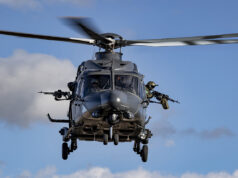






Do they intend to do this by charging triple on the NMH order?
Yeah £1 billion for 23 helicopters is part of it, all done just to save British jobs and keep the unions happy, to be delivered in 5 years time. No rush then.