

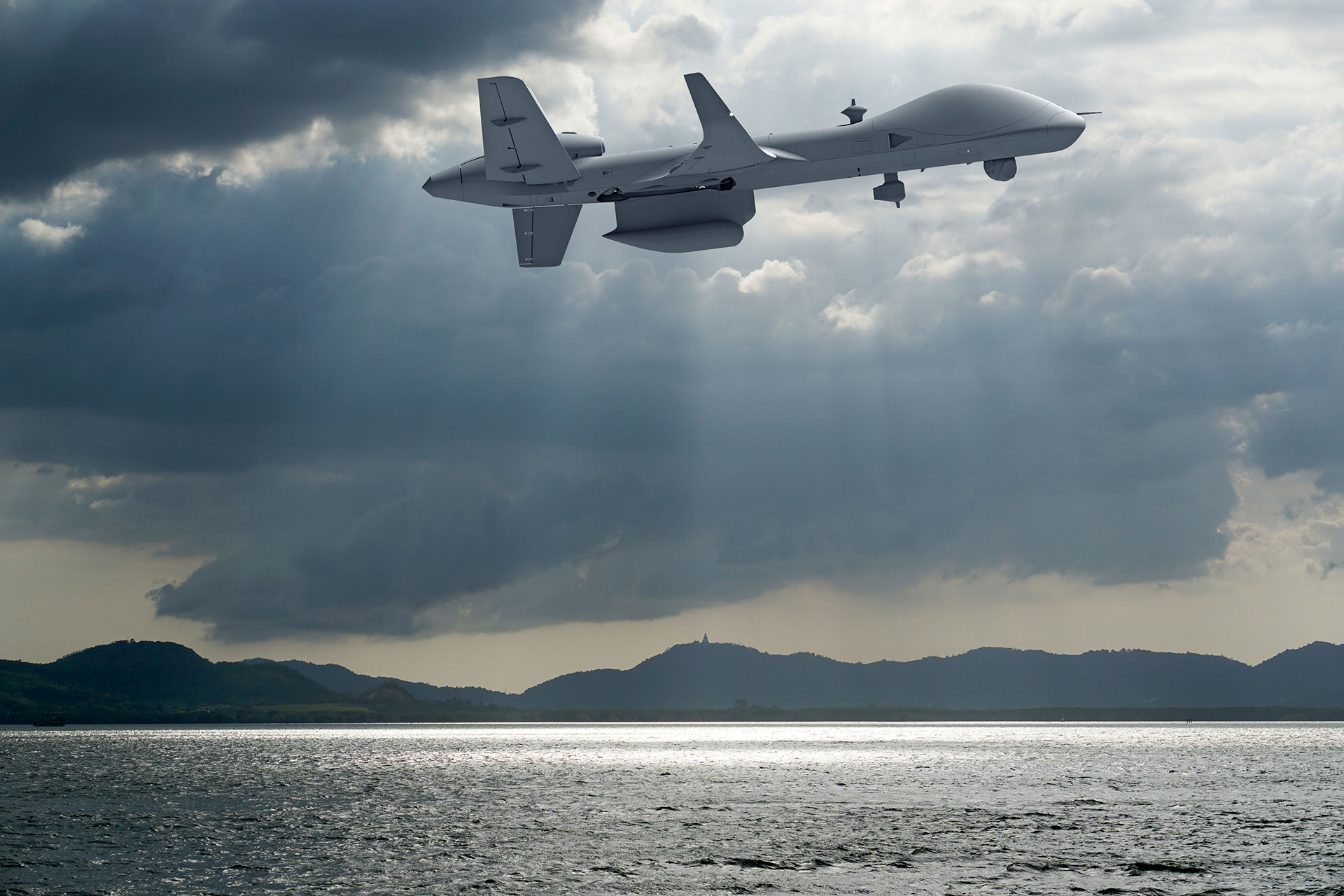
The Royal Navy is moving to expand its undersea surveillance reach through the development of miniaturised sonobuoys designed for use with uncrewed air systems, as part of a wider shift towards more autonomous anti-submarine warfare capabilities.
The work is being carried out by Ultra Maritime in collaboration with the Ministry of Defence, alongside the company’s £40 million contract to supply sonobuoys for the Royal Navy’s Merlin Mk2 helicopter force.
While conventional sonobuoys remain central to crewed anti-submarine ops, the miniaturised systems are intended to support smaller platforms and uncrewed aircraft, enabling wider and more persistent coverage of the subsurface environment.
Mini sonobuoys offer the potential to deploy acoustic sensors from a broader range of platforms, including drones that can operate at lower cost and risk than crewed aircraft. This would allow the Royal Navy to distribute sensors across larger areas, maintain surveillance for longer periods, and complicate the operating environment for hostile submarines.
Ultra Maritime has indicated that the work on miniaturised sonobuoys forms part of a broader effort to adapt undersea sensing technologies for future platforms, supporting NATO and allied requirements as well as UK national defence. The company has also expanded its UK manufacturing footprint in recent years.




Hopefully we see moves soon to start using the Protector fleet in the MPA role to augment the P8 fleet. These aircraft are too vulnerable to operate in even a moderately contested environment now and US losses on the MQ9B even against insurgent forces have been high.
However they are perfect for MPA and a secondary AEW capability. It’s seems the sea guardian can now fulfill all the promise of the MQ4C Triton at a fraction of the cost.
If we can get four on a Queen Elizabeth class carrier then we will have a potent addition to our air groups filling in many of the missing pieces and it will be a major vindication of the STOVL carrier concept the UK designed.
2 AEW and 2 MPA drones wowuld be the perfect, affordable addition to each carrier. The advantages of UAVs for AEW have not yet been fully realised, the long loiter time and high altitude performance would more than make up for them mounting a smaller radar than conventional E2 types and for MPA platforms again the range and loiter time would allow the carriers detection range, and therefore reaction time, against submarines to be significantly increased.
2 AEW and 2 MPA Guardians, 4-6 HM1 Merlin and 2 HMA2 would create a very lethal defensive and intelligence bubble against drones and submarines in a way the current rotary wing assets can’t whilst leaving enough tonnage and space free for 24 F-35s with a couple of small refueling type UAVs supporting them easily making the QE class one of the most potent airwings in the world. Supplement the existing systems to make them more lethal and accurate is what the ‘hybrid carrier’ concept should focus on doing not outright being a substitute, we have plenty of space to carry more on the QE class and filling it with off the shelf UAVs doesn’t have to be a multi billion £ project if they spend the money on the correct things.
I’d prefer having 4 of each of AEW and MPA on the carriers.
It would guarantee having one in the air and given the long endurance might achieve 2 of each for extended periods. Then the carriers would be able to support Atlantic Bastion by providing MPAs at short notice above sonar contacts, without the hugely intensive daisy chaining that we needed to keep P8s on station further North.
There is no such thing as a refuelling UAV, certainly not a Stovl one, youre not getting anything like that off the deck without cats.
Protector was just about the only platform repeatedly name-checked in the SDR and it was always in the context of upgrading it for ASW and maritime patrol. I think we can safely say that something of the sort will be included in the DIP because if not, it will ruin any pretence that it has been based on the SDR.
The carriers are a separate problem, it all depends on whether the MQ9B AEW gets selected as a Crowsnest replacement.
Using a MQ-9 for maritime patrol and assistance in ASW is a good idea, AEW not so much (I may have changed my opinion on this subject….slightly – see below!). If the MQ-9 fitted with the STOL wing, can be safely operated from our carriers deck. It would also give the carriers a useful ISTAR capability. The AEW that a carrier task group really needs, using a MQ-9 would be bit of a stretch. Although Saab are teaming up with General Atomics to trial a better radar on the MQ-9, than what has so far been used before.
The problem is the size of the antenna the MQ-9 can carry, as the antenna size dictates what frequency it operates at, along with the overall performance of the radar. Traditionally, drones like the MQ-9 have carried either mechanical scanned, PESA or ASEA X-band (8 to 12GHz) radars. Which much like the Searchwater (mechanically scanned X-band radar) used by Crowsnest, has a limited range of around 300km against large objects and a lot shorter when detecting something like a sea skimming missile. The performance is in part dictated by the how X-band frequencies are quickly absorbed by the atmosphere, but also the diminishing returns you get when upping the output power. Conversely lower frequency radars, suffer less issues from absorption, so will transmit further on the same amount of output power. To get the best performance they need an antenna that matches the wavelength, however antenna size is inversely proportional to frequency, i.e. lower frequencies need bigger antennas. The antenna’s area also plays a significant part in how sensitive the radar is. The larger the area, the better chance the radar will detect a very small signal.
This is the conundrum. A carrier task group needs an AEW platform that can detect objects as far as possible. Thereby giving it time to not only react to threats, but also what countermeasures to employ, e.g. shall we use the combat air patrol to intercept or use a T45’s Aster? You want to be able to detect a low flying aircraft before it can get into a position to either launch a weapon at the AEW platform or the task group.
The type of radar needed to detect objects as far away as possible needs to operate at a lowish frequency. The E2D uses a UHF (500MHz to 1GHz) AESA radar, the radar’s antenna array is carried in a mechanically rotating dome on top of the aircraft, it measures 24ft (7.32m) in diameter. To carry the antenna dome, you need a large aircraft, to not only carry the weight, but also one whose flight characteristics aren’t significantly disturbed by the airflow around the dome. Not forgetting that the aircraft must also be capable of generating the necessary electrical supply to power the radar etc. The only way we could in the short to medium term get the performance of an E2D, is to have the carriers converted to CATOBAR and purchase a few E2Ds. In the medium to long term, if Project Ark Royal does get paid for, a heavier drone could be looked at to carry a larger radar array. It could be possible to design a heavy STOL aircraft that could carry the radar, but that would take longer to design and test, than a conventional aircraft that uses CATOBAR.
The E2D has a published detection range of over 600km, which means the radar based on these figures, covers an area of at least 1,131,000km squared. A MQ-9 carrying an X-band radar with a maximum detection range of 300km, covers an area of 282,743km squared. So you would need a network of at least 4 MQ-9s to cover the area of one E2D. Not forgetting in a conflict or operating in the Western Pacific, a USN carrier will have at least two E2Ds up and on station. At some point you will need to rotate the 4 drones back to the carrier to get refuelled/maintained, where you will need another 4 drones to replace the four on station, plus a spare in case one has a fault. We would now be looking at a minimum of 9 MQ-9 drones being used purely for AEW. It could be possible to reduce the number slightly by doing staggered turnarounds. But you’d still need 6 or 7 MQ-9s to cover maintenance down times. A question that would need answering, is if our task group was operating in a conflict, would we be capable of putting eight MQ-9s up on station, as well having enough spares to rotate them for refuelling and maintenance?
Saab have intimated that the radar they are trialling on the MQ-9 is a S-band (2 to 4GHz) AESA radar, derived from the Erieye radar. S-band radars can transmit significantly further than an X-band radar, using the same amount of output power. It’s antenna size is considerably smaller than that needed for a UHF radar. But still needs to be fairly large compared to an X-band radar. Consider the NS100 radar earmarked for the T31 frigate, it is nearly 3m square. The shape means it generates a fairly circular beam, as there is more or less an equal number of transmitter-receiver modules (TRMs) in both the X and Y planes. If the number of TRMs in one plane is less than the other plane, the beam’s shape becomes less circular and more flattened. This is due to having less TRMS “squeezing” the beam into shape. A narrower circular beam will transmit further than a flattened cone, as there’s more energy concentrated in a smaller area. Also the output power is in a large part determined by the number of TRMs used to generate the beam.
There is no way a 3m squared array will fit under each wing of a MQ-9. I’m fairly certain an MQ-9 wouldn’t be able to power that number of TRMs that are in each array anyway! The antenna array shape will have to rectangular to ensure it fits under the wing and not hit the ground. Judging by the images GA/Saab have released of the underwing pods housing the array, they wont have the best number of TRMs either. So the beam they’d generate will be significantly less circular, and will not reach the same distances achieved by the Erieye radar, i.e. a lot less than 600km. But if it could reach 450km or over, this would still be significantly better than what a Crowsnest equipped Merlin could achieve. Just means that at least 2 (preferably 3) MQ-9s would be needed on station at any one time, to match the area covered by a single E2D. In an ideal World, you’d use a drone that could carry a either a pair of 3m squared arrays or even the Erieye radar.
I do feel there is a place for the Navy to have a VTOL drone operating from the Destroyers/Frigates, that does carry a X-band radar. That can do both maritime and air searches, say fitted to a Proteus type drone. As it would mean the ship’s local radar and communications horizon is then significantly extended. Allowing the ship to detect sea skimming threats in particular much earlier, a long time before they could be detected by the ship’s radar. It would also enable the ship to engage threats beyond the visual horizon or on the horizon. Therefore giving the ship more time for follow-up shots if required!
If you think converting the QE carriers to CATOBAR is near term I have news for you. It would be faster to get HAV to produce an Airlander 50 and sling an E2-D underneath!
I’m not holding my breath that an MQ-9B AEW could perform a STOL take off and landing from a QE carrier at all, much less with reasonable duration. Saab have stated that it’s not solely intended to be land based, but I remain to be convinced.
The obvious marine radar for Proteus is the Leonardo Seaspray 7500Ev2: the one that might go on the Protectors. If Leonardo could do Osprey radars at a reasonable price, that would be even better, but probably too expensive.
GA clearly think the STOL kit could be used from our carriers, they’re one of the main features of their advertising and we are one of the main reasons why they started development. It wouldn’t retain the 40h endurance of course, but would still very much exceed a manned aircraft. I am most concerned about the weather limitations. Most of SeaGuardian’s current service has been in the Pacific and I don’t have high hopes for the airframe standing up to gales on deck in the North Atlantic.
Seaspray 7400, the 7500’s smaller brother, is the radar already on Wildcat so I think for a radar-equipped Proteus that would have better commonality with the existing helicopter fleet.
Airlander is IMO the best option for us because:
a) It’s a uniquely British and sovereign solution, GA seem friendly but best not to take the risk with our carrier strike capability if possible.
b) It’s the only way we will be able to compete with CATOBAR air wings for radar power and size. MQ9B is a useful improvement on Crowsnest that fits alongside its MPA capability but Airlander can carry any currently in service AWACS or MPA equipment combination- I got that from HAV.
c) It also has other uses; MPA, logistics for the marines, COD, there’s a stream of spiral upgrades that could be made to the airframe to deliver really interesting capability. Fancy flying a new F35B onto the carrier, or lifting a broken-down LCVP home? Airlander 50 would be able to do that once they add VTOL capacity as planned.
d) It’s also really cool, which is why I shill for HAV more than is dignified.
wwwhybridairvehiclescom/news/overview/blog/airborne-early-warning-and-the-need-for-persistent-awareness/
7400 is out of date. Even the Army is looking to use 7500 on their Wildcats over the 7400.
Yes, the airships are cool. Nevertheless, I think the lack of VTOL on the A10s is limiting as is the slow speed, particularly for passenger use.
HAV are trying to implement VTOL now because they did a consultation with a bunch of remote logistics companies; Canadian mines and all that. It turned out that needing a 300x300m square is quite inconvenient for end to end stuff.
It’s competing with ferries and trains for passenger use, so it’s mostly competitive.
I think the HAV Airlander, in particular the larger 50 version could make a good maritime surveillance aircraft and airborne radar platform.
I do wonder if even this version would be able to carry and power a long range radar, along with crew, cabins etc. The envelop is an ideal environment for the radar. Sadly, although AESA radars are a step change over legacy radars. Their main disadvantages are their power and cooling requirements, but also the weight of the antenna array. Which means if you wanted to have a 360 degree field of view, using four fixed S-band panels, that measure at least 3m x 3m, the weight will be close to 6000kg. Or you use a mechanism to rotate one or two panels to reduce the weight. This might be the better option, where like Sampson, you have two panels mounted back to back, then rotate them. As your main interest is looking for threats/objects as far as possible. You could then use at least four fixed X-band arrays for the closer detection and tracking. Which are much better at detecting objects on or near to the sea’s surface.
The Airlander 50 according to HAV is designed to efficiently operate at 10,000ft, whereas the smaller 10 can go up to 20,000ft and probably has a pressurised cabin. Could Airlander 50 be made capable of operating at 30,000ft, as it will provide a much better and further radar horizon? If it could, then I think the HAV could be used in AEW capacity, but also used for the other MR, ELINT and ISTAR roles. Could the HAV’s habitation be scaled to use shift rotation, that then includes bunk, leisure facilities, galley, heads etc? Whilst still being able to carry the radar, processing, cooling, displays and other kit needed for the other possible roles. Powering the radar and all the other electrical needs is a big question. Pretty certain it will need a very powerful genset just for the electrical requirements, let alone propelling the HAV. But I think the HAV idea is more than doable and something the MOD should pursue, if it had the funding!
Wow, you’re really going for the long replies this evening! Thanks as ever for sharing your knowledge.
I had an interesting email conversation with HAV recently about the AEW and MPA applications of Airlander. My main takeaways were:
The 10- and 50- designations are largely for marketing purposes and don’t really apply to military applications. They can accommodate a radar antenna that weighs 3t, which by my calculations sits somewhere around Top Hat if only mass is considered. The power output is apparently only 80kW for HAV10 which isn’t great relative to E7’s 300kW but it could probably be improved by putting a compact APU on board.
The main limitation on the 5 day endurance is keeping the crew comfortable, so if a shorter time on station were specified then more power could be provided. They aren’t putting the radar inside the envelope because of how difficult it would be to install and maintain it, but the ballonet space is accessible from the main cabin and so they are considering installing beds and other amenities in there to hugely increase the space available for the crew. That leaves most of the gondola available for installing fixed arrays or a rotating radome.
I am a huge Airlander fanboy and I definitely think if the MoD took a step back and looked at their requirements from first principles they would see the applications for a more Atlantic focussed role.
CATOBAR is probably on the RN wish list. Without funding I doubt it will happen. But, going down the medium capability CATOBAR route is more likely. Where the carrier could launch and recover heavier drones like the Boeing Stingray, rather than the heavier manned aircraft. CATOBAR and the E2D is the gold plated solution and with the state of the economy and lack of willingness from the Treasury, it will probably remain on the wish list.
My worry using the MQ-9 from a carrier, is how it lands and is recovered. The STOL wing will slow down its approach speed and reduce its stall speed. Then rely on the brakes and possibly a reversable pitch propeller, to stop it. However, on a wet pitching deck. What is the risk the drone swerves left or right of the path as it hits the deck and rolls to a halt? The STOL wing on the MQ-9 has a wingspan of 63ft (19.2m), which is actually shorter than the E2Ds. But the E2D is stopped by the arrester wire, plus land son an angled deck away from parked aircraft. currently the MQ-9 would have to land along the length of the carrier’s through deck design and there’s no emergency barrier to catch it.
With safety in mind, if the the carrier is going to operate conventionally take-off and landing “aircraft”, then modifying it with the angled deck and an emergency barrier would be a must. Could the modification budget include an arrestor wire system? As this would open up the opportunities to recover heavier aircraft. I wonder if GA have looked at fitting a hook to the MQ-9, so it could catch an arrestor wire? But then the aircraft’s structure would need seriously beefing up, to be capable of handling the arresting loads.
GA have said that the MQ-9B fitted with the STOL wing will have a duration of around 30 hours, compared to over 40 hours with the normal high aspect ratio wing. 30 hours duration would still be significantly better than what a Merlin could ever achieve. The STOL wing will reduce the maximum altitude the MQ-9 can reach, as there’s less surface area generating lift, but it should still reach well over 30,000ft quite comfortably.
Both the Osprey and Seaspray would also be my off-the-shelf choices for a Proteus type drone.
Nice summary DB, thanks.
I think trying to get E2D level capability on our own carriers is not a viable plan even heading out towards 2040. The Vanquish RFI indicates that the MoD has abandoned cats and traps and I just can’t see a way of getting such a heavy aircraft down through STOVL. Protector is the hybrid of ‘better than Crowsnest’ but not a true AWACS, and I think any bigger or more powerful would require thrust vectoring and thus a much more complex solution.
IMO better to take the KISS win and spend the money on more complex ACPs.
Bring back the Sunderland, that’s what I say.
Hear, Hear!
I wonder why you don’t get billionaires funding start-ups to do cool things like that, space travel seems to suck up all of the budget. It’s what I’d do, anyway :).
More seriously, why not? We seem to be quite good at incubating niche aerospace stuff (see Airlander) and we have lots of small specialist shipbuilders with yards sized perfectly for flying boats- the Saro shed in Cowes is still used for building aluminium ferries.
PS I mean building modern jet-flying boats similar to the Russian ones for MPA and SAR purposes, not the actual Sunderland. I hope that was clear.
I’m not sure the RN have completely abandoned CATOBAR, more likely they’ve asked what can be achieved in the interim, if CATOBAR is significantly delayed. The Navy also really need a tanker aircraft, that can operate from the carriers, to extend the range/duration of the F35Bs. I don’t believe a STOL aircraft could be designed and built within 5 years, that could carry a similar weight of fuel as the Boeing Stingray. To get that kind of weight off the deck, you will need a catapult. But also an arrestor system to recover it.
I feel we could design and manufacture a STOL drone that is sufficient large enough to carry a good long range radar, perhaps based on Saab’s Erieye architecture that they are proposing for the MQ-9, but better packaged, as there’s significantly less weight to carry. If the drone was turbofan powered rather a turboprop. We could make use of the engine’s bleed air to power a laminar flow control wing. Therefore, you wouldn’t need an excessively wide STOL wing, but still have the same take-off and landing performance. I still feel the safest option for stopping the aircraft is using an arrestor system, which then also necessitate the angled deck.
Yes, thrust vectoring is an option, but a rather expensive and complex one. Doing a cost analysis of vectored thrust vs the laminar flow control STOL aircraft would be interesting. Finger in the air, I’d say the vectored thrust version would be the more expensive one. But it would definitely win on nerd value alone.
Hmmm. Even I don’t thing the RN will have the budget for CATOBAR before 2035-2040 and I usually try to be optimistic about these things. In addition a heavy STOL aircraft is an interesting design exercise between the blown wing and vectored thrust concepts.
One aircraft ‘design’ that occasionally catches my eye is the ‘Medusa’ from the game Nuclear Option. It has two large turbofans buried in the belly of the fuselage with two Pegasus-style nozzles each for thrust vectoring. A similar arrangement was proposed with two Pegasus in the early stages of Harrier but discounted as engine failure would lead to large roll moments and a near-certain crash in VTOL mode. But modern turbofans are so reliable I wonder if that side by side configuration is now viable in order to provide LOADS of vertical thrust. Then a dorsal radome could be fitted with hardpoints under the wing and maybe even a stern ramp for COD? Not sure about that last one given the fuselage volume that would be taken up by engines.
For the blown wings, one of the interesting ideas going around startups at the moment is the distributed hybrid-electric thrust concept. A turbogenerator or two in the roots of the wings would both provide bleed air to the wings and power to a set of powerful electric motors driving small-diameter fans across the leading edge of the wing. It wouldn’t be particularly rapid and I haven’t seen many applications of this concept bigger than personal mobility aircraft but given enough electrical power I don’t see why it couldn’t be scaled indefinitely; RR are doing a lot of work on the power supply for GCAP that might be useful. All of the air from the generator turbines could be diverted into the wings. In flight at cruise speed there would end up being a heck of a lot of power to run the radar, which is a nice side-effect.
Between the two the twin-thrust vectoring option would definitely cost more but I think the eventual performance would be better.
Aircraft like the Lilium eVTOL are very inefficient in the hover, as they have a very high disc loading. Due to the small diameter of the ducted fans. However, the company says the aircraft will only operate in the hover for no more than 30 seconds. The energy expended in the hover can be mitigated due to the shorter time. However, what the company has not said, is that as the fans are mounted on a moveable trailing edge, in theory this could aid STOL performance. Where the fans suck the air on to the wing, thereby providing lift, in part similar to boundary layer control. Meaning it could take-off/land in a STOL configuration carrying a heavier load, then a vertical take-off/landing. There is a problem with using multiple numbers of small diameter electric fans (propelling only ambient air) in particular, is that their thrust drops-off as you climb in altitude. Which is one of the reasons that Lilium says the eVTOL is designed to be flown “efficiently” at 10,000ft. Any higher I’d expect the thrust to drop off quite considerable, as the air’s density reduces. An aircraft like the Lilium would need a second means of propulsion to reach higher altitudes.
Never seen the Medusa before, interesting concept! Would it work, well yes. Rolls Royce did do a proof of concept engine for the BAE P1216 supersonic Harrier replacement. Where the hot section of the engine was not split between two nozzles, but in to a single articulating exhaust. Whilst the forward cold section, much like the Pegasus introduced used two cold air nozzles. But these included plenum chamber burning (PCB), a form of reheat to dramatically increase thrust. The Medusa looks like it has the engines fitted side by side. So if one fails, there’s not a massive roll vector. But if the aircraft was in the hover and one engine failed, I doubt a single engine would have the necessary thrust to stop it falling uncontrollably. However, if the aircraft did a short rolling vertical landing (SRVL), this method of landing with a failed engine would be a lot more manageable.
Using a lowish to medium ratio bypass turbo fan does open up the possibilities of making it an adaptive engine. In that the bypass airflow could be controlled to either be used by the forward nozzles, by-pass the engine core as per a normal bypass turbofan, or added to the core’s hot LP, combustion, HP sections for more thrust/efficiency. The bypass air could also feed the laminar flow control, thereby helping the STOL performance. Using a turbofan with a higher bypass ratio, due to their larger diameter fan, does mean they are slower to respond to throttle requirements. But as this isn’t a fighter aircraft, that shouldn’t be too big of a problem. Additionally as the turbofan produces a lot of thrust, you can now consider using a larger and heavier aircraft. If you rule out doing vertical take-offs and landings and instead concentrate on STOL (SRVL). The carriers wouldn’t need any drastic modifications. As it would be taking off and landing much like a F35B (if they finally clear SRVL).
On the Medusa design, I’d replace the each engine’s rear nozzle with a F35B like articulating nozzle, as these are more efficient, plus would give you the option of reheat. Will also need to find a way of hiding the front face of the engines, as the current setup would make it very easy to detect. I’d would change the rear canted tailplane and fin arrangement. Replacing them with a large V-tail and widening and flattening the rear fuselage. But the overall shape and profile I think could work.
With the distributed fans I was thinking more like the Electra Goldfinch with external fixed fans blowing over large flaps for ultra-STOL than the weird Lilium thing, which always looked very dodgy to me. But I see your point about altitude performance for small-diameter fans, that doesn’t sound great for AEW on a large aircraft.
I hoped you’d like the Medusa, it’s always hard to work out whether a fictional design would be feasible but in this case it’s marginal; side by side engines were always rejected in the past due to the ‘engine out stability’ problem but modern engines hardly ever fail- the F35B would be in a pickle if they did.
The Medusa has its engines deceptively high up and wide inside the fuselage, there’s actually room for an internal weapon bay between them in-game which if carried over into our unmanned version would allow AAR equipment or perhaps strike capacity. For that reason I agree that the hot nozzle could just eject straight aft and vector down vertically rather than using harrier-style side nozzles especially if the rear fuselage were made shallower. The wide engines and chin intake also mean that a level of S-ducting is present; if a narrower arrangement for engine-out control were adopted then wide cheek intakes would have the same effect and AAR gear could be carried in pods under the wings.
In the lore wiki it is described as achieving 140kN in cruise configuration and 225kN of thrust vertically using bypass doors to feed additional air into the engine at low speeds, but no PCB as it has to operate from unmodified landing ships. So 2 F135 class engines would be plenty for a ‘faithful’ adaptation, which carries over quite well to a Stingray capacity AEW and AAR drone. Afterburner for the hot nozzles seems a bit wasteful given that its roles call mostly for endurance and range, doesn’t it?
Something like that for our carriers would be exceptionally cool and probably very effective but also expensive. There is a big market for V/STOL support aircraft so I think it would export quite well as a more muscular alternative to MQ9B STOL- you’d better get cracking!
All good stuff if it works and we actually do it.
I wonder if there’s a cunning plan developing here? If the drone cover of the High North is effective, we won’t need to send out expensive ships or aircraft on search missions. Just when a contact is made or there is a perceived gap. So, we won’t need so many T26 (maybe 5). Or Poseidon. Or subs.
DIP sorted.
(I joke, of course, but knowing the MOD Think Mode I do worry!)
Is this the Ultra Electronics that HMG also allowed to be sold off?
It’s owned by Cobham which is also a British company but it has US based private equity buyers but then so does almost any listed company including BAE and RR.
British private equity owns major chunks of LM and Boeing.
Hi Jim.
All very confusing, as I understood Chobham was also sold off and asset stripped.
I accept that international ownership lines get blurred in business ownership, but it would be fun if Brit equity firms asset stripped LM and Boeing?! Cannot see it.
Well what coverage will a mini sono give maybe 5 miles.. you may as well spit in the wind.. they are only really any good for following up a contact.. at least a good dipping sonar can give a 40 mile detection bubble… and even they are for chasing a suspected contact down.. there is a reason to have a frigate with a full towed array or the massive flank array on an astute.
I have to say, I don’t really understand the point of developing new mini sonar buoys. The MQ-9B Sea Guardian can already carry 40 or 80 A or G sonar buoys respectively. The Merlin carries 30 for reference.
So we already have an option, that uses the exact same buoys already in use, can carry lots of them, has a range of 6,000 km which is far in excess of any current ASW aircraft.
Why do we need to spend money on developing something that we already have? We should just buy more of the current ones instead of developing a new mini version which won’t have the same performance.