

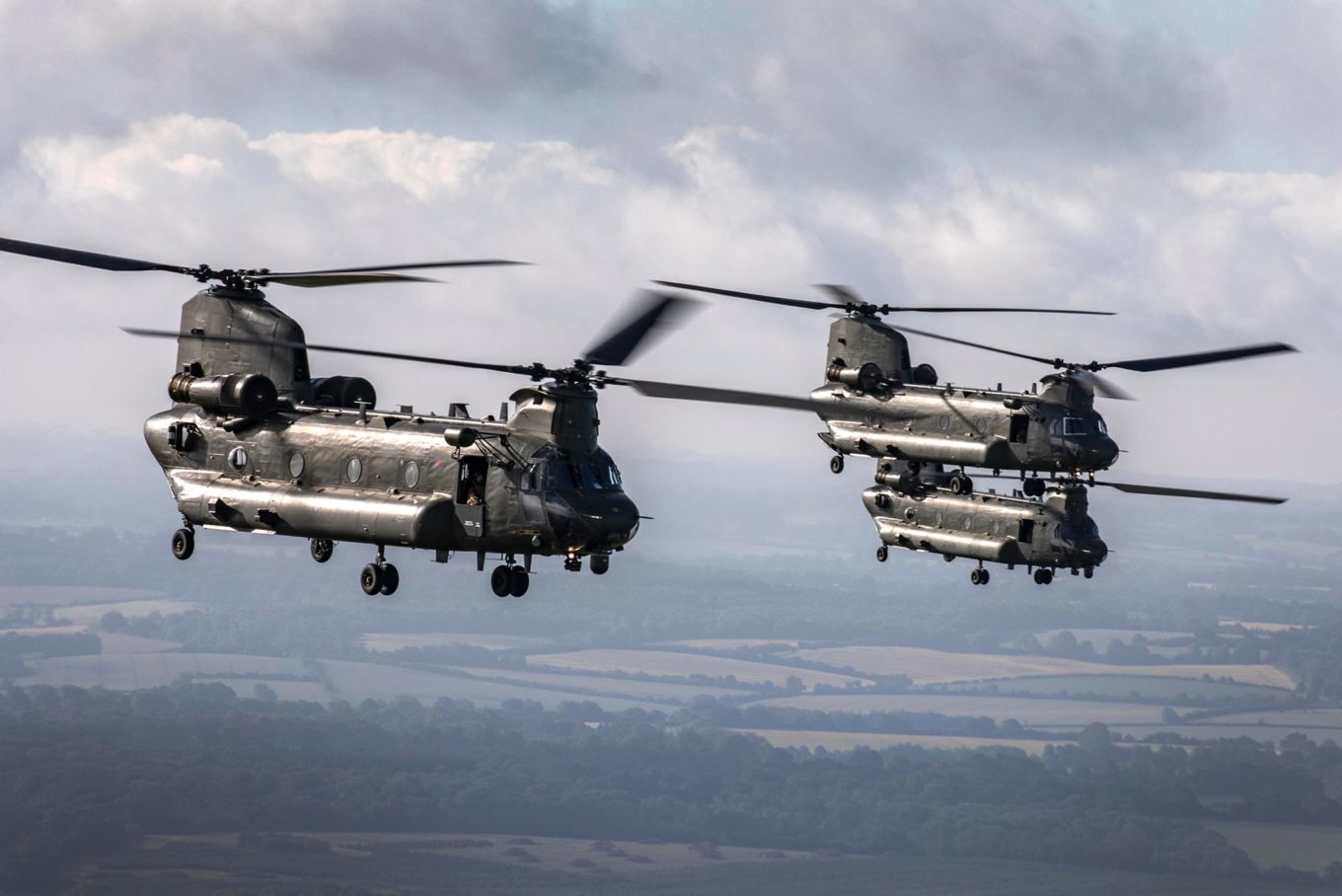
The Ministry of Defence has detailed what happened to nine Chinook helicopters removed from the reported UK fleet between 2024 and 2026, with aircraft retained for training, heritage and spare parts while five are being disposed of.
The breakdown was provided in a written parliamentary answer to Conservative MP Ben Obese-Jecty, who asked about the reduction identified in the UK Armed Forces equipment and formations statistics published on 20 August.
Defence Minister Luke Pollard said: “Nine Chinook helicopters were removed from the reported fleet between 2024 and 2026.”
Of those aircraft, three have been retained by Defence for training and heritage purposes, while five are being disposed of under existing Defence procedures.
Pollard said: “Of these nine aircraft, three have been retained for training and heritage purposes, five are being disposed of in accordance with Defence disposal policy, and one aircraft is being retained to provide structural spares in support of the remaining in-service Chinook fleet.”
The answer accounts for the full reduction of nine aircraft recorded between the 2024 and 2026 equipment figures. Five are therefore leaving the Defence inventory through disposal, while four continue to have a role supporting training, heritage or the operational fleet. The aircraft retained for structural spares will be used to support the remaining in-service Chinook force, allowing components from the airframe to contribute to sustaining other helicopters.
Obese-Jecty’s question followed publication of the latest annual UK Armed Forces equipment and formations statistics, which showed that the reported Chinook fleet had fallen by nine aircraft compared with 2024. Chinook helicopters provide heavy-lift support to the Armed Forces, moving personnel, equipment and supplies and supporting a range of military tasks. Maintaining structural spares from a withdrawn airframe provides another source of components for aircraft remaining in service.







Tip of the iceberg.
If tranche 2 of Chinook CSP doesn’t happen the Chinook force is about to drop through the floor, just as we need rotary assets.
I understand it’ll drop to 22, plus the 14 ER SF models, which I don’t think will be used much by the Field Army more widely.
Mate we know that will be kicked into the long grass by these clowns, and 22 will become the new benchmark! 14 extended range for SF, reckon that will quietly go down to 8 give or take!
God help us.
The 14 you talk about are in build and paid for.
Yes, they’re safe, DSF wants them. SF need something FFS with the Hercs cut.
Until they are all in service then experience will say some may be moved on, stored etc and I doubt they will all end up in service!
Yes enough of the MOD. Replace it with commentators from these pages. Fix their useless wastage and lack of foresight. FYI we used to have a Scout/Cruiser called HMS Foresight! We did things properly once upon a time.
I note that Spain has just upgraded some of its Chinook D to block one F standard. I wonder if any RAF Chinook D are in good enough shape to be worth upgrading to F block one standard?
Chinook’s have been converted into firefighting choppers, was that considered for any of these frames? Maybe they’re too worn out? Or, could be an addin-take out capability if when needed for future frames.
Add in the loss of Wildcat and the army can barely call on any rotary assets. The main issue looking ahead will be the lack of experienced crews. The govt and MoD at this time of heightened tensions really are incompetent. It’s like we have the Russians running our defence strategy!
There is talk of the army shedding 80% of its infantry battalions, the chinnooks main customer is the army, with the loss of wildcat and the apache becoming a drone carrier you can see where this is going.
Talk where? By shredding you mean what? What would they do with the personnel?
Typo shedding is the word.
There have been table top excersises in the last 18 months that’s all I can say.
Another day, another cut. Of course, now Healey has his reward, no help there.
Constant cuts – The legacy parties continuing on their quest to throughly destroy the British military.
As I warned earlier this year. Some would not listen, I’ll say it again fleet numbers will eventually by reduced to 33 before numbers increase. I cannot see a tranche 2 procurement. Look at current defence spending trends.
The cuts to equipment and training across all the services are endless yet there are still 62k civil servants in MoD.
Yet another example of a covert Ten Year Rule in operation.
The rotor fleet really does seem to be taking a massive hit in numbers.
The chinooks are the last tactical lift the UK has left.
Personally I cannot understand the binning of the army wildcats, Ukraine has evidenced that helicopters with good sensors are one of the best ways to hunt long range drones.
The remaining Chinooks will be flogged to death meaning more will be lost over time!
Wildcat is a strange one there were rumours the army didn’t want them,yet the army has had Soiux,Gazelle,Scout,Lynx and now Wildcat,why the supposed change of heart or is it back room manoeuvring by crab air who have ALWAYS resented the army flying anything🤔
Everything is on track sooner or later they will achieve their goal the complete and utter destruction of the armed forces .All that will be left will be a local militia who’s only job is to keep the natives in check ………..Then this publication will need to be re-named the UK Journal as there won’t be any defence….it would be hilarious were it not so serious ……
Like Jonathan,.I don’t understand the decision yo axe the army.Wildcats. The army clearly values attack helicopters and we have enough.now to support 3 Division. However we have nothing to support 1 Division. It would have been simple enough to fit weapons pylons on the AH1s and give it a useful attack capability.
I imagine that the air and ground crews.are being transitioned to some future drone-fighting force, of which there is as yet little evidence.
Otherwise, I’m not sure that the rotary force is being cut by much.
The 62 Chinooks that were there the last time I looked are being cut to 51, as I understand it. A further 14 are to be re withdrawn and replaced by 14 new extended-range Chinooks, which are in production.
The 24 old Pumas that were withdrawn will be belatedly replaced by 23 AW 149Es.
The 8 Bell 212 and 412 have been replaced by 6 new Jupiter 2s.
The overall problem for Joint Aviation Command is equipment legacy and budget. Much of the Chinook fleet is pretty old now and has been kept going by a succession of upgrades. Many that are being retired now should have been replaced by new aircraft a good few years ago, but there was never enough money in the rotary budget to do so.
The new Chinook ERs are costing a tad over £100 each, with a total bill of £1.5bn for the 14 on order. That puts a pretty large dent in the rotary budget, so the need to slim down new orders is understandable.
But I can’t see much.financial or operational justification for scrapping the Wildcats. If we have got to the point that we have to flog them off at a knockdown price to plus the holes in the budget, then Joint Aviation Command is seriously underfunded.
The new Chinook ERs are costing a tad over £100 MILLION each, alas not £100 each as I typed…
Can’t really blame the current and previous administrations, helicopter shortfalls haven’t been repeatedly raised in NAO reports over the past 20 years, nor was it mentioned in the Chilcot Inquiry…. Oh wait …😡
The 9 Mk6s that are being retired, are the original CH47 model Cs dating from the 1980s, that were modified from Mk1s to 2s, 4s and finally 6s. Although as a rotary aircraft they don’t have a fatigue life like a fixed wing aircraft. They do suffer a lot of cracking, due to the resonance going through the airframe created by the two tandem rotors. Which is basically trying to twist the airframe apart around the centre. A lot of the early Chinooks have warped skins due to the skin panting and stretching, as the airframe is actually quite flexible. As the frames and spars are made up from parts riveted together, unlike parts of the Model Ds and most of the Model Fs, that are staying in service. The Model Fs have significantly more frames that are constructed as single milled structures. Which means they don’t crack or flex as much. Though the cracking has moved to areas where the airframe is a bit more flexible.
However, it does raise a problem in that these aircraft that are being retired are much like the Nimrods, subtly different from each other. So airframe parts are not directly transferrable between them without a bit of fettling, let alone the model Fs and to a point the model Ds. Avionics, engines, gearboxes and blades will all be transferrable.
Spain has upgraded some D model Chinook to block one F standard. Are any RAF D Chinook in good enough nick, to be worth upgrading to block one F standard?
If I remember correctly the D only had the milled frames in the back end, whilst the F also has them in the front, plus there are also some other structural differences. A Chinook airframe is constructed in 3 parts, the cockpit, centre tube and rear end, where the rear pylon is then attached. Which kind of lends itself to having the front end and rear end replaced with the stiffer F versions. Though it will need a new rear pylon as well. As the F pylon is designed to be removed more quickly for air transportation.
The only issue stopping the RAF’s Ds from being upgraded in this way, is cost or in reality available funding. Furthermore, the Spanish Chinooks have had a much easier life that the RAF ones. I don’t believe the Spanish fly them as aggressively or do fighter evasion training with their Chinooks as we do. Up until recently, the Chinook (skinny tank version) used to do an amazing air display, this has been heavily reined in by Boeing, as they were pulling a lot more g than expected, which was having a knock on effect on the blades, gearboxes and structure. Not to mention the pilots were flying them like they had rigid rotor heads rather than the fully articulated ones.
I would expect if the RAF got the funding, each of the Ds would be thoroughly examined before going in to a modification program. Where like the Puma 1s, only the best and straightest aircraft would go on to the program.
Thanks for clearing that up. If only the claimed rise in defence spending was true, this might have been a way to keep some existing Chinook going on for another decade or so.