

The Ministry of Defence has issued a detailed update on its ongoing security overhaul, setting out new surveillance systems, restricted airspace trials and efforts to rebuild guard and policing capacity across UK military sites.
In a written statement to Parliament, Armed Forces Minister Al Carns said the department had continued to increase security measures after identifying serious weaknesses across the estate.
Carns opened by saying “we have identified the physical security of our sites as an area in need of greater focus” and that the MoD was using in-year funding to upgrade priority locations. He added that the department had “maintained our posture of enhanced vigilance and continue to strengthen our security culture”, including updated guidance and easier reporting routes for personnel and contractors.
A major part of the update focused on new surveillance technology. Carns said the RAF had made “significant progress in strengthening security through advanced technical enhancements, now operational at multiple main operating bases”. The Immediate Threat Mitigation Solution, a deployable CCTV system able to detect and track intrusions, is already in service.
At RAF Brize Norton, Carns said the upgraded systems “enable faster decision making and improve the Military Provost Guard Service’s ability to respond swiftly and effectively to incidents”. He also highlighted closer cooperation with Thames Valley Police and local landowners to boost perimeter reporting.
Airspace restrictions form the next phase, the MoD will “pilot restricted airspace above 40 strategic sites”, describing it as a precursor to national rollout in 2026. The aim is to reinforce restricted-place powers under the National Security Act and improve detection of malicious drone activity. He added that the MoD is “significantly investing in remote piloted aerial systems… to help deter threats and identify them when they arise”.
Manpower remains a critical issue, Carns said the MoD had “taken decisive steps to improve recruitment across MOD Police, MOD Guard Service, Military Provost Guard Service, and Security Services Group”. Incentive schemes for the MPGS have been successful and similar measures are under consideration elsewhere, alongside more targeted advertising and better candidate engagement.
Carns said the £20 million investment in modernisation is being directed to “three flagship systems to modernise defence security”: a critical national infrastructure knowledge base, a new incident case-management system and a real-time physical security assurance platform.
Looking ahead, Carns said “ensuring the safety and security of the defence estate continues to be a key priority”. He warned that “all those who seek to threaten the security of our bases should be in no doubt that we will use all the levers at our disposal to take swift action”, adding that the department “will not hesitate to pursue prosecution where criminality is suspected”.
The update confirms that the security overhaul is now moving beyond immediate fixes toward a longer-term systemwide rebuild, with further announcements expected as new technology and airspace measures are brought online.





Knowing people are coming on base is one thing
Slowing them is another thing
Stopping various modes is quite another.
There is a lot of defeatist rhubarb about not being label to stop trucks going through fences – as SF demonstrated.
However, you can used tensioned cables with RSJ posts to perfectly well do that. With a conventional fence to stop people on foot.
The next bit of rhubarb is that nothing can be done at the ends of the runway – whisked that is true it leaves a narrow slot to use virtual security and other measures. It is perfectly possible to use a medium weight fence that is designed to shear off at the base when impacted from airfield side.
Taken together these were the excuses for handwringing and doing nothing.
Looking at the above photo it looks like its a single layer of pretty lame fencing? You’d think on any base especially with the assets and facilities they’d have it would be at least 2 walls of fencing if not 3? Maybe this is not a good photo to judge by?
As always, the words sound good, but the devil is in the detail with these people.
“pilot restricted airspace above 40 strategic sites”
Will they be named? Some already have restricted airspace. How can you restrict the airspace above sites that are unacknowledged? Creating a restriction gives them away, does it not?
“He added that the MoD is “significantly investing in remote piloted aerial systems… to help deter threats and identify them when they arise”.
Which ones? And who operate them? Beyond the handful of ORCUS of 2 CUAS Wing for anti UAV work and others with the MDP they all seem to be TUAS or MUAS for the Field Army. Are they being given rolled out to the MDP in greater numbers? The MPGS AFAIK do not use them.
“taken decisive steps to improve recruitment across MOD Police, MOD Guard Service, Military Provost Guard Service, and Security Services Group”.
Yet we’d read here and elsewhere that MDP personnel figures have dropped dramatically and their basing footprint much reduced to what it was. Will it return to those levels? Not stated, easy get out.
Also, an interesting and rare mention of the SSG, a specialist org within DIO for a long time ( but seemingly now moved to Army Command, the SJC ) who are above and beyond mere MPGS, MDP, and fences, but deal I believe with the higher end of security at places like the AWE, Porton, and other sensitive locations.
How about doing what airports do, have mouts around the base and then multiple layers for earth walls and wire walls. Instead the focus is on survalliance. Which should be the backup to the physical defense not the primary asset.
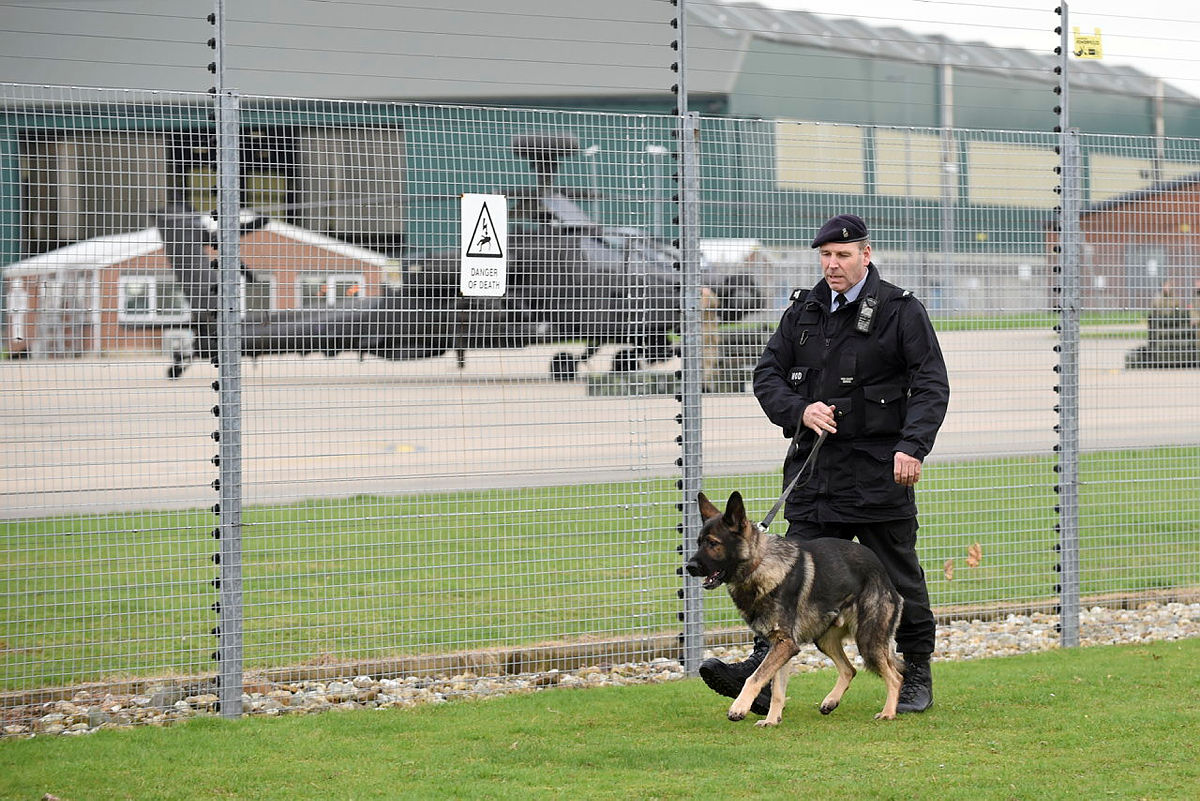
Carefully picked photo to accompany the release?! Electric Fence and Dog to boot at I assume the inner fenced area at Middle Wallop for 653 and 673 Sqns AAC and their Apache. I was aware of the fence, but had no idea it was electrified.
Definitely Middle Wallop. Driven past those hangars many many times, never seen a soul there
So have I. But I don’t think the hanger in the photo is visible from the road, its on the Eastern side of the cluster and has the inner fence for Apache.
The other option was of course Wattisham, but I don’t recall an inner fence line there separating the hangers and flight line from the airfield, though the MPGS there do have dogs, as in thos photo,assuming that chap is MPGS? I assumed, maybe wrongly, that they wear standard Army camouflage uniform.
So, no motion cameras or vibration sensors on the fence? Wheeled security Patrol Robots, automatic drone detection for non-aviation infrastructure. Armed guards are usually a good deterrent.
I thought, possibly wrongly, that motion sensors were common on outer perimeter fences.
Brize obviously wasn’t high up enough on their KP list, surprising given it’s a key node and point of failure.
How do you fit a sensor to a standard issue hedge?
🙄😏😆
Quite simply, an absolute disgrace.
These are Military Sites for goodness sake.
Things used to be so different eh? Then bean counters decided to cut, cut and cut a bit more. Ok, Spetsnaz will get in, create mayhem and get out. We are talking Greeny Weeneys on electric scooters with paint so far. It was a gross failure. I remember one RAF base having a 20 dog section in the 80’s. Now? There are two, and they cover another base 40 miles away!
Total physical is very difficult, but not impossible. Technology now can help. but boots, dogs and patrols are still the best deterrent.