

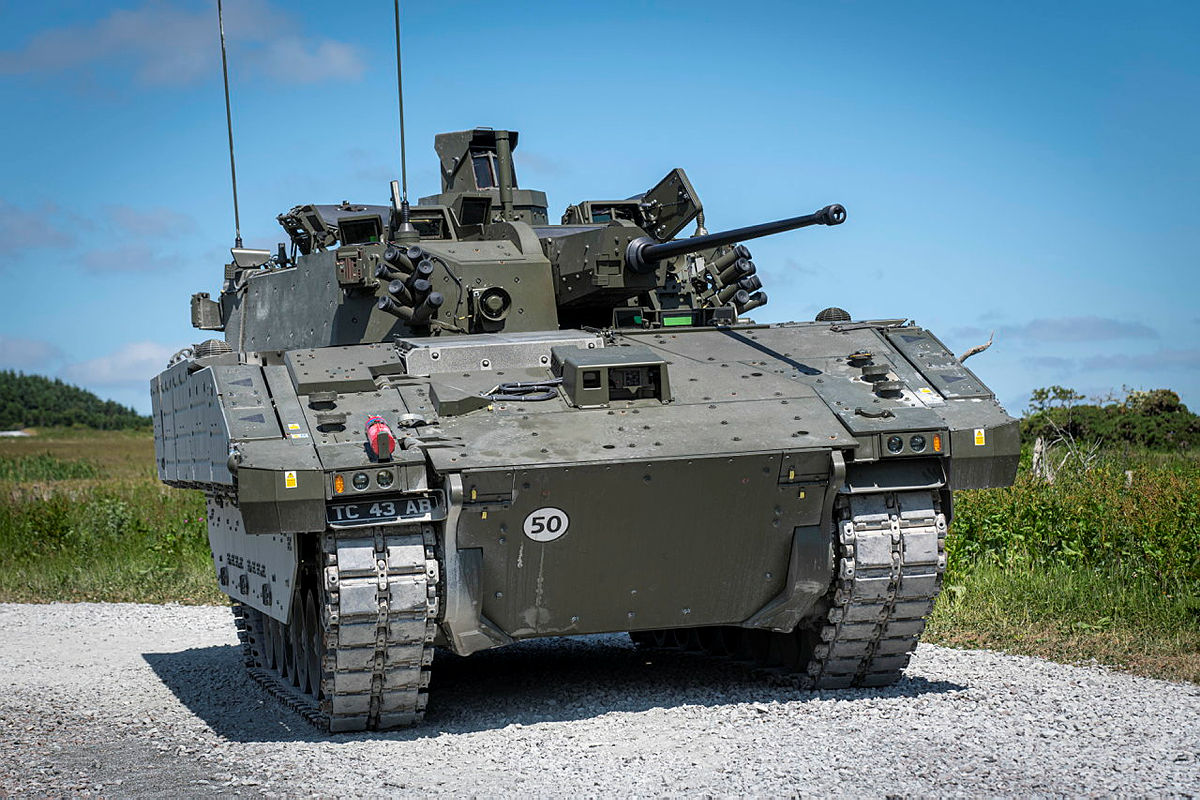
The Ministry of Defence had accepted 227 Ajax Capability Drop 3 vehicles as of 15 September, including 41 taken on since 17 April, according to an answer given in Parliament.
Ben Obese-Jecty, the Conservative member for Huntingdon, asked for the overall total of each variant now held, mapped against the current production schedule, following an answer of 8 September.
Luke Pollard, the Minister for Defence Readiness and Industry, gave the headline figure but declined the breakdown. “The Department does not routinely disclose fleet holdings by variant, nor provide variant-level delivery information against production schedules,” he said. “Such information is directly linked to military readiness and operational capability, and its disclosure could prejudice operational effectiveness by enabling assessments to be made about the availability, preparedness and deployment of capability.”
He added: “The Ajax programme remains on track to deliver all 589 vehicles as contracted.”
Forty one vehicles accepted in five months gives a run rate of roughly eight a month. At that pace the remaining 362 vehicles would take around three and a half years, though the answer gives no delivery profile and no completion date.
Ajax is a family of tracked armoured vehicles built by General Dynamics Land Systems UK, with hulls from Spain and final assembly at Merthyr Tydfil. The reconnaissance variant carries a stabilised 40mm cased telescoped cannon, and the family covers six variants in all. The programme was contracted for 589 vehicles at a firm price of £5.5 billion, and trials were suspended for a period after crews reported hearing damage and joint injuries linked to noise and vibration.







A different opinion to most I’m sure, but, good.
The Army needs a CVRT replacement and the vehicle has positives to go with the many failures.
Push on, get things going, hopefully fixes will arrive.
A better outcome than the RAC walking around on foot, in my opinion.
One has to agree with that if only because we desperately need them.
As a matter of interest when was the last concerning report released claiming there were still issues? It’s just that I thought it would have around 6 months back or is my memory failing me? If so this article suggests an awful lot of vehicles were supplied prior to it, indeed the majority. So how have they been brought up to scratch, judging by what Jim said elsewhere he may be able to enlighten us there. He did mention suspension improvements but if this has helped why on earth did it take so long to introduce, for example after the initial troubled tests.
It was a while, yes.
Over ten years?
As far as I am aware they have only updated procedures around maintenance and track tightening thus far while developing plans for a long term fix with Ajax 2.
Sounds fair to me. The thing does look like a beast for capabilities. Course someone will always say something else is better. But apart from the issues this thing looks amazing. Plenty Russian bots about these days though. So you never truly who is saying these things. Less of them now hopefully now Ukraine has started hitting Russian data centres. 🤣
But yeah I am glad to hear this. We need it badly.
Yes apparently the MAGA bots have reduced by 90% after those hits, any obvious fellow travellers on UKDJ suddenly gone quiet I wonder. 🕵
It has a very good gun, good armour protection, and state of the art ISTAR.
The Conops may need changing though, the Armoured recc role with the Strike Bdes, and then the DRSB, demanded these go deep into the FEBA and possibly beyond to find for the Deep Fires along with other ISTAR assets.
With Drones about, surely that no longer applies unless it’s guaranteed that Drones are sanitized?
It is a good gun, but the ammo is expensive.
The CTAS gun will be a huge change over the previous Rarden in both effectiveness and use. Interesting to see the US Army Bradley replacement requirement. Which insists on a neck up 35mm Bushmaster, that fires a 50mm round, i.e. uses the same 35mm cartridge, but fits a 50mm round to it. The blurb on it gives very similar performance to the CTAS, but with a higher explosive content.
Still like my idea of a fourth crew bod (sitting in the back), who’s role is to operate a reconnaissance drone from the Ajax. Could do the same with Ares, but with more operators as well.
I’ve heard that the Army’s institutional obsession of certain Corps only rigidly doing certain things is starting to rightly fade. Indeed, the Armoured Cavalry and Light Cavalry on Jackal should all have Drones integral to the force rather than relying on the traditional “owner” the RA.
Agree, that part of the force structure is to rigid and not flexible enough. A FPV drone should be considered the same as an man-portable ATGW, such as NLAW. Which is a squad weapon, not a specialist weapon.
“We need it badly.”
It is already obsolete! and without APS can’t survive.
Convert them to long range missile fire with Brimstones or others LRM’s- Retain a couple for the armored brigades recon and divisional recon and that’s it.
I can’t see how the Army or the government has any other choice at this point. Replacing it with something else would mean enormous costs that we can’t afford, a long capability gap before that “something else” arrived, and the usual endless wrangling about the specifications and where it’s going to be built. The roads not taken are too far behind to go back and try a different way, so the only option is to keep steadily fixing and improving until all the early problems have been resolved. The ISTAR may be good, but the TINA is invincible.
TINA… There is no alternative? Agree.
Keeping it means rewarding a contractor that appears to have lied and deceived about everything to do with the project. Arguably installed a revolving door from main building to their board room. Has failed to protect personnel from harm and is not competent to complete basic engineering tasks. Can it and GD
We all know the hulls have not been sufficiently well engineered. We are bolting very expensive systems to metalwork that won’t stand the test of time and will be hugely expensive to maintain. We need to create a factory in the UK that produces a well-engineered alternative and swap the hulls over time. Call it the Mk2 if you will. When a Mk1 Ajax fails, as they inevitably will, rather than pay stupid amounts to to fix them, move the systems over to new British hulls.
But these vehicles are dangerous to the users and after a few months storage demonstrates appalling availability. Apart from demonstrating appalling lack of consistent build standards and quality. This vehicle is obsolete in its intended role and is in no way a replacement for CVRT. Haven’t heard one good thing about it from any user.
Also now the subject of damages claim, as the Army knew it was dangerous but recklessly endangered personnel anyway.
Are you involved in the process are you. Must be with your vaste swathes of knowledge on the subject. Or just reading headlines and foreign propaganda?
Yeah it’s had issues but they obviously sorted them out. Availability is due to those issues. They haven’t even got them all. What you on about. It’s better than what Russia has no?
Hope you are right Lee but have we had any official announcement that finally the problems have been truly fixed this time, or is it more nuanced than that leading to acceptances that might, or might not be long lasting, but desperation to have them available deemed to take necessary precedence? Wouldn’t be the first time such decisions have been taken in the hope they won’t be needed in a full on conflict but if they are health and safety issues will be considered a lower priority through immediate necessity. Rock and Hard place come to mind considering the options available.
I don’t believe the issues will be truly fixed until they replace the suspension and tracks, as shown on the Booker and the Griffin/Wolf that’s been submitted for the Bradley replacement. Which I believe GD are incorporating in the latest ASCODs.
Whrn the Poles were considering Ares as a possible future AIFV, one change they stipulated was switching to a hydro pneumatic – is that the right term? – suspension system.
The Patria 6 x 6 has very thin armour, but Patria offers an up-armoured version at about 24 tonnes. One of the principal differences between the two versions is that the suspension system changes to hydro pneumatic.
Makes one wonder about the standard (rack and pinion?) suspension on Ajax. At around 40 tonnes, surely the suspension method should have followed the Polish Ares spec and heavier Patria one?
I know little about vehicle suspension systems on heavier off-road vehicles, is there a DaveyB-type knowledgeable peeson in the house who has an overview?
Even if such a change were needed on Ajax, I suppose the budget has all been exceeded already and GD would not want to admit to a fundamental design flaw that would cost them big to rectify.
I doubt that the basic issues with Ajax have been resolved or we would have heard all about it from the MOD’s PROs. Have to assume that the minimal mitigations put in place make it at least usable, probably under strict rules governing operation.
Graham is ex-Reme, and would probably have better knowledge, but I’ll have a good stab at it. Ajax uses torsion bar suspension, which are long metal rods nearly the width of the hull. Where one end is linked to the suspension arm, whilst the other is fixed to the hull. They therefore twist when loads are placed on them acting as a spring, so have a given load rating. Torsion bar suspension is used on much heavier vehicles such as the 60t+ Leopard 2 series, Abram, but also on most of the Russian/Soviet T series (T62, T72, T80 and T90) including the T14 Armata. Which doesn’t suffer the same noise and vibration issues, especially when additional weight is added to it. The torsion bars and suspension arms would have been designed with an additional load factor, to allow for weight growth. So as an engineer, I’m a bit perplexed why there has been issues with the tracks and suspension, when the weight growth due to meeting the STANAG Level 6 requirement over the base ASCOD was a known factor. This is manufacturer’s feck up plain and simple!
My cousin is also ex-Reme, and like me worked his way up from noncom to commissioned. He was pretty much on armoured vehicles for most of his career, especially Warrior and Challenger. From his point of view, he thought the Leopard has crap suspension which is not as good as the Challenger. The Chally’s hydrogas suspension, gives a much more compliant ride, making it a much more stable gun platform across broken ground, compared to the Leo.
I do have a dit I can share that shows a major issue with torsion bar suspension. I was part of convoy where the Canadians were providing force protection. It was along one of the main supply routes from Pakistan to Kandahar city (end point for the convoy was the airbase) in Afghan. The Canadians provided two Leo 2s, that were located one at the front and one towards the rear. The front Leo had a command wire IED set off underneath it. EOD said it was a stack of old Russian 152mm shells buried next to the road. They reckon it was at least 5 shells bound together. The effect was very dramatic and unforgetable. Our Foxhound was two vehicles back, so we caught a fair bit of the blast, which covered us in stones and dirt. The Canadian Leo had additional mine protection fitted (spaced belly plate). So it was well over 60t, but it was still lifted up by about two feet, before crashing down. The outcome, was that a number of road wheels were blown off and both tracks were split. Also a lot of the suspension arms were buckled or missing. There was a lot of blast damage all over the vehicle, such as missing antenna, cracked optics, the crew’s kit strewn everywhere etc. Crucially the crew only suffered concussion and a few knocks, so the mine protection worked.
However, the outcome for the Leo was bad. The Leo was trucked back to the airbase, where it sat for 4 months. It was eventually airlifted by an Antonov back to Germany to get fixed. The Canadian REME equivalent could not fix it, as the torsion bars within the hull had also buckled and needed to be cut out, which required the turret off and a full internal strip, which they couldn’t do. The Chally by comparison has its suspension units external to the hull. So if damaged can be replaced in the field and gets the tank back in to the fight a lot sooner.
Exactly so! None of the US ASCOD variants use the torsion bar and Spanish dampers. They all use InArm hydropneumatic suspension AND none have exhibited Ajax’s Noise, Vibration and injury to personnel issues….
Was at one stage. Another MoD mess. Had we stuck with it we would still have a domestic A vehicle business. In the light of the fact that we are broke, it’s a RR solution when Patria CAVS is a more pragmatic solution.
The Army have wasted tens of billions over the last thirty years without fielding a major fleet. Twenty I remember working on VERDI2 and other vehicle developments. An object lesson from MoD in how to destroy an entire industry sector and generations of knowledge and end up funding crap Spanish industry and competent Germans
I think there needs to be an agreed MOD policy that is intergovernmental supported, much like the national shipbuilding strategy. Where vehicles and aircraft are replaced on a regular drumbeat. Rather than the boom and bust method that’s currently being used. It would have prevented the collapse of the UK’s armoured vehicle manufacturing.
Yes! Stop doing one and done replacement programmes as the default. Drip-feed upgrades annually if needed.
“they obviously sorted them out”
Not at all an obvious conclusion to me, nor obvious to many others.
Why would they all of a sudden behaviour accepting them when they wasn’t accepting them before? Obviously sorted them out. But who knows. You might be right. Let’s hope not. Eh
Sorry autocorrect got me. I meant why would they all of a sudden be accepting them when they were not accepting them before. If they haven’t sorted them out.
And…. Just what will capability Drop 4 be? As originally planned or something entirely suboptimal?
The ultimate MOD vehicle. Cannot be used and cannot be got rid of.
The people that were in charge of this fiasco should be lynched however, how many are now directors or senior bods in Lockheed Martin?
Stand corrected General Dynamics
Well they could have ended up at Lockheed Martin here, plenty of projects they are involved in and bidding for more, and has the convenience of not looking too obvious a direct transfer. Stealth is all the rage after all.
Good to know they are still building this vehicle. Ajax 2 packs will no doubt be fitted in REME workshops as and when sign-off is achieved.
If it can be fixed which it will be then its right push on with it, was a really stupid idea to retire the CVR Ts before they were fully replaced but that was yet more cost cutting. The vehicle group will be fixed and enter service and to be honest we can not afford to scrap it and start again we as a nation simply do not have the money. Plus buying some thing else we would be at the back of que for orders.
Big question is will be buy the offered IFV variant? would make sense to but will that be a 8 years late nightmare as will, but sensible for spares, training. Or do we still to boxer with a machine gun?
An observation Latvia have recently ordered the latest GD EUROPE Ascod 2 and will be built and in service in record time compared to Ajax . Maybe we could order that version that seems to work fine and is good enough . I got a hunch the UK may wait for the outcome of the USA IFV contest between Rheinmetal and GD . If GD wins then perhaps a new order for these to be built assembled in Wales . With chassis preferably built in USA or Wales .
The big difference with all US versions of ASCOD, ie M10 etc is without exception they all scrapped the appalling torsion bar with crap Spanish damper system and opted for a professional hydropneumatic inarm system, which is far superior. Even the Austrian partners of ASCOD elected to fit a modern suspension system.
The suspension noise & vibration of Ajax has been its downfall from the start.
MoD are now facing damages claims from personnel discharged through disablement/injury. All the ‘mitigation’ measures are failing to address the root cause of these issues. Has no one asked why Ajax has these issues with N&V but other ASCOD variants of the same weight class but fitted with modern hydropneumatic suspension systems don’t? Surely there is a clue there- even if you disregard the fact that every hull is different with appalling standards of workmanship. We could also ask why UK taxpayers are being asked to fund an American company’s incompetence and Untrained Spanish workforce?
The issues with the vehicle are never-ending.
Luckily there are people working on the issues and [thus far] ironing them out.
Or sticking plasters on them? Next parliamentary question should be ‘ what was Ajax vehicle availability after being stored due to the stop notice?’….
The GD vehicle is new that means it will have issues unlike the Rheinmetal which is in service, we will buy which ever is cheapest but costs the most to modify and has the most expensive in life service costs, we always do,
The whole point of Ajax was that GD stated it was a low risk mature project verified to 42T – it is a 1990’s vehicle with 1960’s suspension.
What about the the CV-90? Take over the Ajax factory and bring in BAE to produce , maintain and upgrade a fleet of CV-90s. Any one got 10 billion?
Great response DaveyB, thanks v much for that. So basically, the torsion bar suspension on Ajax should work fine… in theory! It does sound like GD didn’t factor in the increased weight of armour. Equally, there were so many MOD changes to the configuration with the weighty CTA cannon and the heap of ISR kit loaded in the back, that maybe the engineers’ original calcs were rendered obsolete. Still, GD should have adjusted the spec for the suspension.