

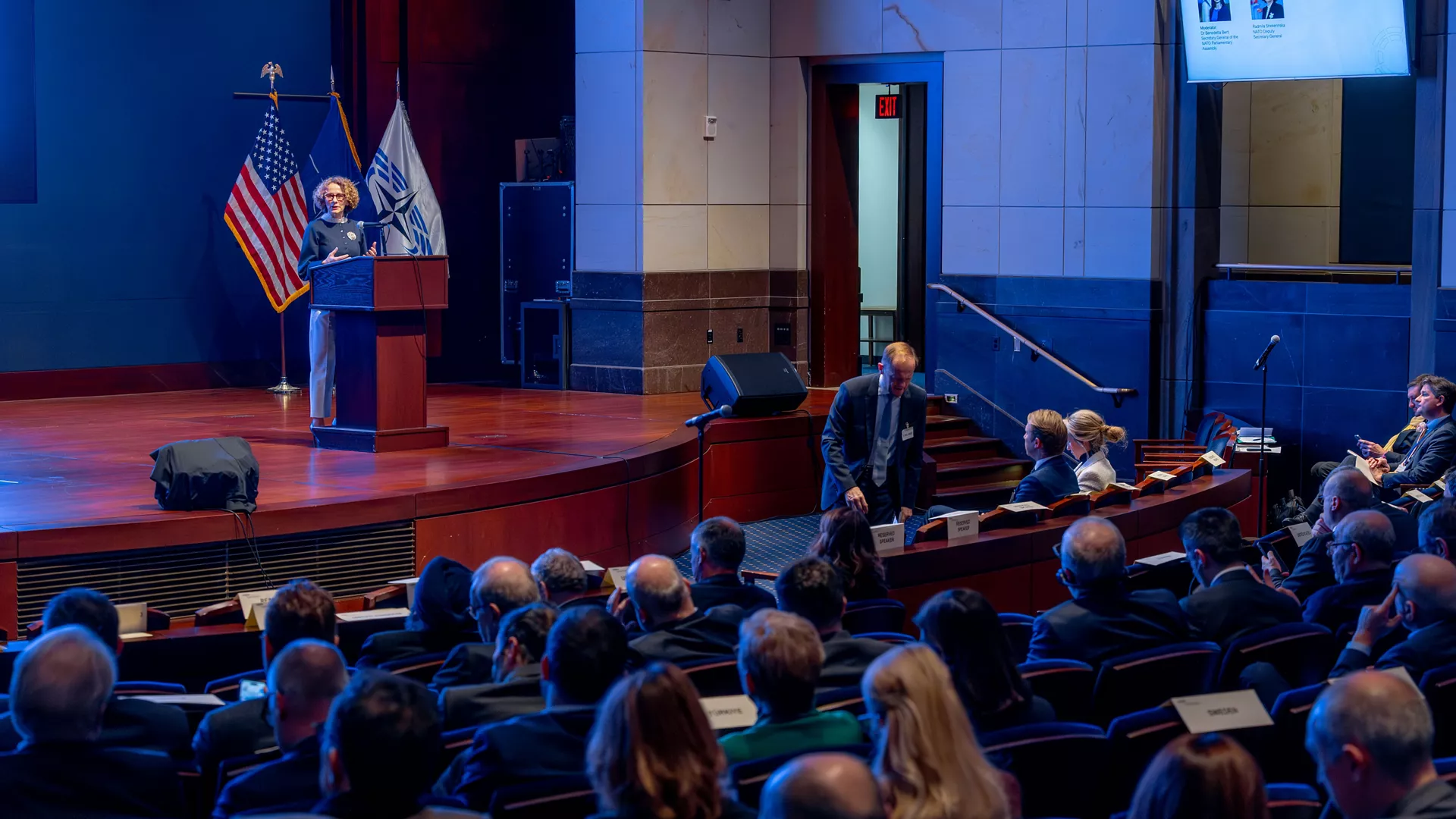
NATO Deputy Secretary General Radmila Shekerinska addressed alliance unity, relations with Russia and support for Ukraine during a fireside chat at the 2025 Aspen Security Forum in Washington.
Speaking alongside PBS NewsHour correspondent Nick Schifrin, Shekerinska declined to comment directly on the language of the Trump administration’s recently released US National Security Strategy, stressing that NATO does not publicly assess national strategy documents produced by individual allies. She said the alliance remains focused on its core mission of collective defence and on decisions agreed by all 32 member states.
Shekerinska pointed to outcomes from the NATO summit in The Hague earlier this year, describing it as a significant moment for alliance cohesion and burden sharing. She said allies had agreed to higher defence spending targets and reaffirmed their shared assessment of Russia, stating that “we had a very, very short but very clear sentence that Russia remains to be the direct long-term threat.” She acknowledged that agreement among all members can be difficult, adding that consensus-based decisions are a longstanding feature of the alliance.
On defence spending, Shekerinska said NATO expects all allies to meet or exceed the longstanding 2 percent of GDP benchmark this year, with a new commitment that, according to the organisation, includes 3.5 percent for core military capabilities and a further 1.5 percent for defence-related areas such as industry, readiness and military mobility.
The discussion also covered NATO’s support for Ukraine and the role of the United States in peace efforts. Shekerinska said the alliance welcomed US President Donald Trump’s initiative to bring Russia to negotiations, while emphasising that NATO is not a party to the talks. “Our goal was … to try to help them be stronger at the battlefield, be stronger at the negotiating table and be stronger in the future,” she said, referring to Ukraine.
She outlined a new support mechanism known as the Prioritised Ukraine Requirements List, or PURL, which she said channels key military equipment from US stockpiles to Ukraine, financed by European allies and Canada. According to Shekerinska, NATO expects to secure around $5 billion in commitments by the end of the year, with plans to move toward a more predictable, monthly flow of assistance. She described air defence deliveries through PURL as critical for protecting civilians and energy infrastructure.
Shekerinska said she was unaware of any formal US cap on future PURL funding, noting that discussions with US counterparts had remained open-ended. She linked continued military support to the goal of achieving what she described as a durable peace.
Questions on NATO enlargement and the alliance’s open-door policy were also raised. Shekerinska said that while the principle remains, any decision on new members requires unanimous agreement, and that there is currently no consensus on Ukraine’s membership. She characterised debate over the policy itself as secondary to the practical reality of alliance voting.
Addressing the challenge of countering low-cost drones, Shekerinska said NATO commanders are working with member states and defence industry to develop more sustainable responses. She described this effort as ongoing, adding that flexibility and experimentation with new technologies are central to the alliance’s approach, according to NATO.










Im sure Aspen in December was the most cost effective place to put on a Confrence and no one brought their skis.
For sure no US defence contractors are renting massive chalets.
Worth mentioning as a historical point that the 2% goal for NATO members was initiated by the much-maligned David Cameron when he chaired the NATO conference in Wales in 2014. But perhaps he was trying to make amends after his disastrous 2010 SDR.
Just wondering how dozens or 100’s of people flying to Washington, helps NATO’s ‘carbon footprint’ at all.