

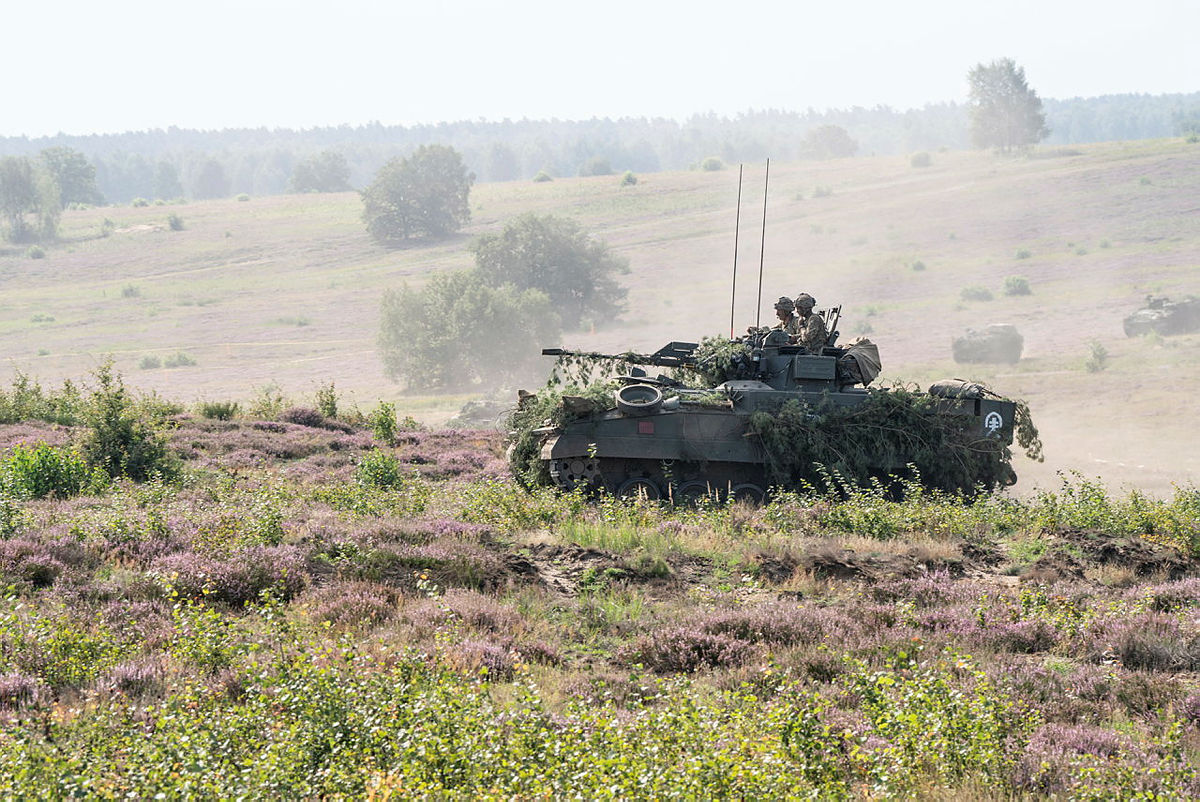
A new paper published by the 878 Institute argues that the UK’s ability to deter a peer adversary is being eroded by armoured vehicle delays, a shrinking tank fleet, the cancellation of a key military satellite programme and a naval recapitalisation plan that leaves the Royal Navy without destroyers after 2038.
Britain’s Military Deterrence Gaps, written by Robert Clark, who heads defence research at 878, is published with a foreword by General The Lord Dannatt, the former Chief of the General Staff. It lands three weeks after the Defence Investment Plan (DIP) set the direction for defence spending, and days into a new government in which Andy Burnham is Prime Minister, former Defence Secretary John Healey has moved to the Treasury, and Wes Streeting has taken over at the Ministry of Defence.
The paper’s central contention is that last year’s Strategic Defence Review produced sixty-two recommendations and a clear read of the threat, but that the DIP did not fund the implementation of them.
Lord Dannatt is blunt about the consequences in his foreword, writing that the country remains at severe risk and that “neither our enemies nor our allies can quite believe” how relaxed the Government appears about British security. He closes with a direct message to the new Prime Minister: “Priorities, Prime Minister, that is your job, not wishful thinking.”
The report is derived from written evidence Clark submitted to the Parliamentary Joint Committee on the National Security Strategy in July.
Land manoeuvre: the 3rd Division problem
The paper’s longest section deals with the British Army’s principal warfighting formation. NATO has assigned the UK-led Strategic Reserve Corps the job of retaking ground, and 3rd (UK) Division is the point of that spear. Lord Dannatt’s assessment of what it has to do that job with is a single word: its equipment shortfalls, he writes, are “woeful”.
On armour, the arithmetic is set out plainly. Three tank regiments sit under the division’s brigades, the Queen’s Royal Hussars, the Royal Tank Regiment and the King’s Royal Hussars, each fielding 56 main battle tanks, or 168 in total. Adding the 22 tanks held at the Armour Centre and other training estates gives a requirement of 190. The Challenger 3 programme will deliver 148. As the paper puts it, “at current force levels the 3rd Division will be under-strength by 42 MBTs”, with Initial Operating Capability scheduled for 2027 and the full fleet not expected in service until the end of 2030.
The report devotes more space to Ajax. The programme is now nine years past its original 2017 in-service date, with 245 ISTAR variants and 93 Ares support vehicles intended to form the backbone of the Deep Recce Strike and Armoured Brigade Combat Teams. Trials were paused again in late 2025 after 35 soldiers were made ill by noise and vibration, and the then Minister for Defence Readiness and Industry, Luke Pollard, was obliged to reverse the declaration of Initial Operating Capability in early 2026. The paper notes flatly that “there has been no update on the Ajax IOC since then”. This summer’s DIP guaranteed the programme’s funding, but Clark questions the value of what would eventually turn up, warning that “if Ajax ever enters service it may be outdated” and in need of extensive uplift to stay competitive.
The most immediate risk the report identifies is the gap between Warrior and Boxer. Warrior is due to leave service in 2027 and units are already decommissioning theirs. Boxer missed its Q4 2025 IOC on supply chain grounds, and only 100 of 623 platforms had been delivered for unit trials by June 2026, with no revised date for the remainder. That, the paper argues, “will leave a significant capability gap” for the Army’s four armoured infantry battalions, with knock-on risk to the 72 howitzers planned for the Royal Artillery from 2028.
The cumulative effect, Clark writes, is to leave serious doubt over the Army’s ability to conduct combined arms manoeuvre with a digitalised force, “severely limiting the UK’s ability to achieve (conventional) deterrence by punishment”.
Space: the SKYNET 6 cancellation
The DIP’s cancellation of the narrowband Ultra High Frequency element of SKYNET 6 is a further focus of the paper. Lord Dannatt calls the reinstatement of the UHF system “essential for connecting sensor to shooter”, and the report notes that the 6A and 6EC programmes were designed to deliver around three and a half times the capacity of Skynet 5 with improved anti-jamming protection.
The timing concern is that the four Skynet 5 satellites were launched between 2007 and 2012 and have either passed or are approaching the end of their fifteen-year design lives, with Skynet 6A not due in service until 2027. An allied procurement route for a replacement narrowband capability is acknowledged as possible, but the paper argues the details remain scarce and undeveloped, and that the decision will “inhibit the MoD’s aspiration to double, then triple, lethality”. There is also a warning that the UK could quietly demote itself from NATO’s leading European space power if it pursues further integration at the expense of sovereign capability.
The Hybrid Navy and life after the Type 83
On the maritime side the report examines the First Sea Lord’s Atlantic Bastion strategy and the Hybrid Navy concept, backed by at least £1.3bn over four years and intended, in the Royal Navy’s own words, to let the UK “find, track and, if required, act against adversaries”. Lord Dannatt’s verdict on the concept in the foreword sets the tone for the section: the proposals are “catchy to the eye but mask an underlying deficiency”.
Clark accepts the logic of distributed sensing, and concedes that a force of around 30 Large Uncrewed Surface Vessels operating alongside a reduced escort fleet could deliver useful deterrence by denial across a wider area than crewed hulls alone. The objection is to what is being traded away. The Type 83 destroyer has been cancelled in favour of six Common Combat Vessels acting as command ships for four as yet undesigned classes of autonomous platform, all of which must be designed, built, tested and doctrinally proven by 2035 when the Type 45 leaves service. In practice, the report argues, this means “cutting proven (and crucial) crewed platforms for untested and uncrewed ones”, and that “the Navy is currently set to have no destroyers after 2038”.
The paper is also sceptical that uncrewed vessels will be left alone. It argues that Russian forces will probe them and seek to jam the links back to their command vessels, and that “Russian military doctrine would think little to denying, blinding, screening” and in the worst case destroying them. No NATO navy has yet fielded these systems at sufficient scale to test the response. Recent incidents, including the harassment of HMS Prince of Wales in the Norwegian Sea by a Russian maritime patrol aircraft that dropped sonobuoys around the carrier, are cited as evidence of the operating environment. The conclusion is that this should not be an either or proposition: “In short, we must also replenish our conventional fleet.”
Recommendations
The report makes eight recommendations for the next spending review:
- Halt Warrior decommissioning and fund the previously shelved Warrior Capability Programme, upgrading 380 vehicles with a modified turret and 40mm cannon and extending service life past 2040, at a revised cost of £1.25bn.
- Set a deadline on Ajax, at which point the Government pays the roughly £1bn remaining on the £5.5bn firm price contract and moves to an off the shelf alternative such as BAE’s CV90, estimated at £4-5bn, or “risk losing combat effectiveness and leaving 3rd Division with no Deep Strike Brigade”.
- Increase Challenger 3 from 148 to 198, at around £650mn, restoring three full regiments plus training and spare vehicles.
- Reverse the SKYNET 6 narrowband UHF cancellation, and move policy beyond “achieving space control” towards offensive in-orbit combat capability.
- Use the Type 31 design as the template for the CCVs, minimising production risk and keeping Rosyth working as the Type 31 run ends in the early 2030s.
- Extend the Type 45 with a ten-year Capability Sustainment Programme, noting the current updates only complete in 2032, described as “a wasteful upgrade for only three years’ planned use”.
- Pursue a Denmark agreement on the Type 26, modelled on the Lunna House deal with Norway, to build a shared anti-submarine capability in the North Atlantic.
- Commit to 3% of GDP by 2030, as a bridge to making the 3.5% commitment for 2035 politically feasible “and not merely aspirational”. The paper’s closing line: “Our nation’s security demands it.”
Background
The paper arrives at a point of change in the defence ministerial team. Andy Burnham became Prime Minister on 20 July, appointing Wes Streeting as Defence Secretary and John Healey, who had resigned as Defence Secretary the previous month over defence spending, as Chancellor of the Exchequer. Streeting has not previously held or shadowed the defence brief, and inherits delivery of the Defence Investment Plan published weeks earlier under his predecessor.
Several of the programmes covered by the report have been the subject of previous parliamentary scrutiny, including National Audit Office and House of Commons Library work on Ajax, and the Government has previously ruled out retaining Warrior in service. The Ministry of Defence has not yet responded to the paper. We will update this article if it does.
Britain’s Military Deterrence Gaps by Robert Clark is available in full from the 878 Institute.










Is this a new report based on the new money or a reupload of the same Hollowing out that’s been happening for decades?
It’s regurgitated nonsense.
The usual headline grabbing stunt form an unheard of think tank promoted by a general who was only too happy to gut defence when he was in charge but now surprisingly thinks the answer to us deterring Russia is tanks.
If only the UK had 50 more tanks there is now way Russia would ever think about invading Western Europe 🤦♂️😂
It’s easy to see why defence is in such a state with muppets like these guys in charge.
On the 50 tanks line, it does make me wonder. A Challenger 2 is what, £4m new? 50 of those sets you back about £200m. For the same price, you could get a pair of maritime patrol aircraft, for example. Or, three F-35As. Or, 200 Tomahawks. Or, looking to the future, 400 Nightfall SRBMs, or maybe 6 new CCAs. Or, 500 Brakestop. You could probably get a new, basic offshore patrol vessel as well for that kind of money.
I know those numbers are likely inaccurate on a micro-level, but it is worth thinking about what would benefit the UK more.
I agree. I’d take most of those before 50 extra Tanks.
In the Land domain I’d take many things over more Tanks.
A RAMS Regiment.
A RLC Regiment.
Another GBAD Regiment for the RA, or heaven forbid….a GBAD Regiment with BM capability for Jim!!!
Even more accute, how about more ISTAR, CB radar and such. We’ve a single Regiment and ISTAR is King.
Having daid that, there is no doubt that 144 Tanks is too few for the existing 3 Regiments plus trials, training, maintenance, and a small reserve.
New Boeing P-8 are just over $320m each. F-35A are $139m each.
The UK definitely does not pay market rates on the F-35. None of the build partners will. It’ll be similar, but not quite that high.
I’ve seen prices given for the P-8 ranges from $180m through to $400m, but given there are a variety of MPA options, including unmanned versions, I didn’t specifically reference the P-8. I gave a ballpark figure.
You’ll of course note that I commented on likely minor inaccuracies above.
The F-35A price of $139m comes from the USAF FY27 budget request. The P-8, if you order one now you will get it in 2028 at a price of $328.5m, according to Steve Parker, Boeing Defense CEO.
I should have added, that in the past, a P-8 was $175m..
Boeing is seeing sharp price rises. An E-7 Wedgetail AEW has gone from $550m to around $725m. AKC-46 tanker is going from $199.8m to $321.9m in 2028.
Those specific inflation figures explain exactly why our conventional deterrent is hollowing out despite nominal budget increases. When an E-7 Wedgetail jumps to $725 million and a KC-46 scales past $320 million, defence inflation completely outpaces standard Treasury funding increments. We are caught in a trap where we are spending significantly more money just to procure fewer, smaller fleets. It proves that trying to rebuild conventional mass through traditional heavy hardware acquisition is financially unviable. The Ministry of Defence has to pivot towards software-defined capabilities and autonomous mass, where the unit cost can be decoupled from these soaring legacy aerospace production lines.
My consideration is there is no number of soldiers that Britain can add to a full time professional army that would serve as any deterrent to Russia. Even if we had an Army of 200,000 men it would only represent 10%/of ENATO forces professional forces and around 3% of ENATO total manpower.
These apparent experts don’t understand deterrents, they banned the word around trying to gain political and financial support for their pet projects or what ever parts of the army they represent, in this instance armoured maneuverer.
If the UK was serious about actually deterring Russia with a land force it would be investing in large reserve forces like Germany and Poland are. Both nations are working on a 1 to 3 ratio of regulars to reserve forces. That’s similar to the USA.
For some reason the UK is the only nation in NATO that’s working on a basis of 1 to 0.5 but I guess our generals are just so much smarter than the rest of NATO 😀
Germany is hoping to increase its Bundeswehr numbers to 260000 by 2035 without using conscription. The army will be the largest component but will still be lower than 200000. If a UK ground force of that size won’t deter Russia, why would a German force?
As of now, the German army is smaller than the British army and despite large numbers on the reserve list couldn’t equip most of them.
The Germans are increasing their Army by 2030 but only planning for 70,000 regulars and 200,000 active reservists.
Not really. The German Army hopes to have it’s principal reserve force be two Heimschutzdivisone, which are non deployable, non-combat formations principally there to provide internal security, MACA, and logistics assistance to NATO forces moving through Germany. The Polish Army *is* having a large reserve, but the vast majority of those are static TDF forces, much like the Estonian Reserves, which, unlike British Reserves, do not have to move across a continent to get to a fight.
I know you like to think Reserves are the greatest thing since sliced bread, they are not, and have limited utility compared to the regular forces.
The German Army isn’t actually smaller than the British Army on paper, it appears smaller because various services like the Logistik Truppen and Sanitaeter have traditionally been counted seperatley. If the Streitkraeftebasis and other branches are counted the German Army is about 85,000 regulars.
Germany is hoping to increase its Bundeswehr numbers to 260000 by 2035 without using conscription. The army will be the largest component but will still be lower than 200000. If a UK ground force of that size won’t deter Russia, why would a German force?
As of now, the German army is smaller than the British army and despite large numbers on the reserve list couldn’t equip most of them.
The point about the Bundeswehr’s equipment bottlenecks is entirely accurate. A massive reserve list is just a paper army if the state lacks the stored stockpiles of armour, ammunition, and small arms to equip them during a rapid mobilisation. However, the structural comparison between the two nations hinges on geography. Germany acts as NATO’s primary continental logistical hub, meaning their reserve structure focuses heavily on domestic security, infrastructure protection, and host-nation support. For an island nation like the UK, conventional deterrence relies far more on projecting naval, aerospace, and deep-strike capabilities. Both arguments prove that raw manpower figures are meaningless without the industrial mass and equipment reserves to sustain them in a prolonged conflict.
Agreed. It remains to be seen whether Germany can increase its effective reserves. The numbers of registered reserves is meaningless.
The size of the German armed forces fell from @ 540000 in 1989 to @180000 after conscription ended in 2011. This was a larger percentage than in the UK.
For years Germany spent little more than 1% of GDP on defence. It has a lot of catching up to do.
Exactly. Germany’s post-1989 and post-2011 decisions are the ultimate cautionary tale of what happens when you treat defence spending as a peace dividend to be cashed in. The 1% GDP trap took them decades to dig into, and as you rightly note, it will take them decades to dig out of. That is precisely why the warnings in the 878 Institute report about the UK hollowing out are so critical—once you let industrial mass, skills, and training pipelines decay, you cannot just turn them back on overnight with a sudden injection of cash when a crisis hits.
The majority of the German Reserves are going to the Home Defence divisions, which will be MACA/Rear Security/Logistic Enabling forces rather than full on deployable reserves. Germany *is* intending to increase it’s reserves within it’s combat units (eg each Artillery Battalion should have one reserve company going forwards), but it’s a much smaller part of the reserve that will provide that.
It’s also worth remembering that Germany went from two nations on either side of a front line in the cold war, that where both expected to provide large amounts of troops to defend their territory, to a single nation with a massive combined army, to a nation with only friendly countries on any border and zero national security threats. It’s not exactly surprising that it reduced it’s size massively from the 550,000 high point when the Bundeswehr and Nationale Volksarmee united at the end of the cold war.
It’s also worth remembering that while the Bundeswehr shrunk dramatically, the German MIC survived and has remained formidable, given them a much better grounding for expansion than we have.
The Lord Dannet was CGS around 2008 time frame I think. Around that time then he was happy to oversee the “conversion” ( cuts by another name ) of 19 Mechanized Brigade which became 19 Light Brigade garrisioned in NI, of course now bereft of it’s Warriors, Ch2 Tanks, Saxon APC, CVRT assets, and the Regiment of AS90 SPG.
The excuse of course is that we were fighting COIN in the Middle East and wars with other nations were no longer a thing.
As an Army man and not a politician he should know better, but I guess being a CGS means you say yes to every cut HMG degree, unless you’re a rarity and fall on your sword.
Carter, Stirrip, and that despicable Lord West are other examples of hypocrisy who frequently lament cuts they themselves waved through.
Are you suggesting he was intent on cutting or picking what he thought was the lessor of several other evils.
Hi Mark. I don’t think I was suggesting? I’m pointing out what happened on his watch, at a time when the Army was still strong compared to now. And who would ever know for sure what choices he faced, maybe you’re right, I only point out the cuts.
On the lesser evil thing a suggested example of that was General Jackson “saving” a Bn of Paras by making them the nucleus of the SF Strike Group. That I think worked well, as there was a need for more Grey Zone SF support elements.
We did not need more Light forces in 2008, only 15 of the Army’s Battalions were Armoured or Mechanized around that time, less than half, most were still light.
That is fine, but a bit rich now lamenting the lack of assets of which he himself let go, so I don’t apologise for highlighting it.
Carter and West are the worst examples, though, I don’t hold anything against him compared to Stirrup, West, and Carter.
Well said mate. I think it’s important to call out the hypocrisy of these leaders. If cuts need to be made then fine but the same people should not then make a career as soon as they are out of the military decrying the current set up that they themselves had a part in producing.
The core issue is that when service chiefs continuously accommodate severe cuts behind closed doors, they inadvertently validate the Treasury’s assumption that the military can always do more with less. By the time these leaders transition to the civilian arena to sound the alarm, the structural damage to frontline mass and capability footprints has already been done. It highlights a fundamental flaw in how British defence thresholds are debated and maintained over the long term.
Leaving aside the political point for a moment, it’s still a valid point.
The current defence plan is based on the 3rd Division maintaining it’s armoured brigades. Whether that’s right or wrong, the current plan doesn’t even have enough tanks planned to meet it’s own barebones aspiration, and highlighting that is at least a step in the right direction.
So not worth reading. Danke.
go to the 878 Institute website: they are bunch of Judeo-Christian nut jobs straight out of the JD Vance playbook of weirdos, not worth even reading a word and why they are allowed to post crap on here I have no idea.
Anyone with an ex general on staff gets to post no matter how senile they are. 😀
The Telegraph is full of them 😂
The 878 Institute is not a neutral or academic research institution; rather, it is a highly ideologically driven, right-wing, populist think tank.
… And it’s getting two articles, each dripping multiple links to the same pdf paper, more links in just two articles than links given to other sites in the year … This definitely nails UKDJ colours to the mast.
The institute has strong, elite connections within conservative political factions in both the UK and the US. It was co-founded by prominent British Conservatives like Jacob Rees-Mogg and Toby Young, and it maintains deep ties to Trump-aligned political networks in the United States.
The institute openly campaigns on highly polarising cultural and social issues. Its stated core missions include “ending mass-immigration”, implementing the “deportation of illegal immigrants”, and “restoring Judeo-Christian culture”, which places it firmly on the populist right of the political spectrum and isolates it from mainstream, non-partisan academic consensus.
If you are looking for objective, independent, peer-reviewed data, the 878 Institute is not viewed as a neutral authority. However, it is an increasingly prominent and well-funded player. There is a direct alignment, but the $7 million US State Department grant is intended to fund the institute’s broader operations rather than being a direct “pay-for-play” order for that specific paper.
The relationship between the 878 Institute and the Trump administration’s State Department centres on shared ideological goals, funding transparency, and systemic influence. Official US government documents revealed that the Trump administration’s State Department intends to allocate $7 million to the 878 Institute. This is part of a broader $12 million package distributed to European groups viewed favourably by the administration.
Rather than the State Department dictating the contents of the Britain’s Military Deterrence Gaps report from the top down, the relationship is one of mutual interest.
The 878 Institute was explicitly designed from its inception to bridge the gap between the British populist-right and the Trump administration’s “America First” foreign policy network. Instead of influencing a report after the fact, the State Department chose to fund the institute precisely because they already approved of the institute’s existing national-conservative platform.
Former US officials and foreign policy critics have forcefully argued that the funding represents a form of indirect influence. They contend that by injecting millions of dollars of American public money into a partisan UK think tank, the Trump administration is effectively subsidising right-wing political advocacy to alter domestic policy debates within an allied nation.
Begs the question then why this website allows them to post their views at all or at least with a caveat as above
sportourer1
… I do not think this website is ‘allowing’ them to post anything. This may be Lisa’s article, but this is George Allison’s website, any articles published by UKDJ are in essence through George. Looking at the three (3) embedded links in this and the other article indicates to me that George is heavily pushing the 878 Institute. It’s not subtle and comes across as overt, seemingly ardent that people should follow the links.
My biggest gripe regarding UKDJ, is generally the absolute lack of links to the underlying reports, proceedings, transactions etc. that George publishes. I feel that allowing the reader to follow the story back to its core, provides a greater insight and understanding than “just” being given abridged details of cherrypicked information. (I used the word “just”.)
Absolutely. This is a Jacob Rees-Mogg venture with his old Parliamentary SPAD. What the former knows about defence could probably be crammed on the back if a postage stamp.
Question to Rees-Mogg – you were a member of the ruling party for 14 years and Leader of the House. Everything he is grumbling about now – Challenger numbers, Ajax problems, Skynet replacement, etc was a result of Conservative government decisions. I cannot recall Rees-Mogg making any intervention in the House on these defence issues.
878 apparently refers to the battle where King Egbert defeated the Vikings, sort of indicates what a daft bloke he is. It was set up to defend judeo-christian people or values, so another right wing ethnic lobby group a la JD Vane and P Hegseth.
I doubt they know very much about defence and would not take anything they say too seriously.
All very sensible recommendations which is refreshing. And especially why be in a race replace the T45s so soon after all the mega-money and missiles have been spent on the upgrades and considering theres still next to no integrated high tier GBAD in existence? Maybe some of the drone vls and radar platforms could also be adapted for land based GBAD operations like a mini Aegis-ashore for the UK?
What about T26s for Holland and Belgium if their ASW frigate programmed has stalled? Or ASW based AH140?
The hybrid navy version of ASW T31 is interesting. Instead of putting a CAPTAS-4 on a quietened hull, you send half a dozen UUVs and USVs 20 miles in front of the ship, using multistatic thin-line towed arrays from the drones. you drop an active sonobuoy from a UAV, and pick up the echoes on the vabguard swarm. Triangulate. Put a Merlin in the air for the kill. Subs are designed to minimise returns directly back so having the elements dispersed helps.
Because of the delay to HMS Venturer, Stirling Castle is expected to trial the concept, or another vessel of opportunity.
It’s a great concept if it works Jon, the physics is sounds and the data exchange should not be too difficult, if their is an issue it’s likely in computing to combine the sonar picture.
With UUVs involved, I’m not entirely sanguine about the data exchange, but I think they’ll crack it. The good news is that SEA already do multistatic combination for their Krait Arrays. That’s the system I think the Yanks are trialling, and we have an AUKUS pillar 2 project to share techniques. Babcock are driving the UK concept, called ARMOR, and they are working with HII on some of the drones, such as the Remus UUVs. It looks like a lot of effort is going into this area.
The biggest problem, I think is being able to deploy and recover these vessels from/to the T31, in your typical North Sea or Atlantic swell. I’m sure it works perfectly well when the sea’s nice and flat. I remain to be convinced.
The launch and recovery bottleneck is the absolute defining operational constraint. A drone screen looks flawless on a corporate animation when the sea is flat, but the reality of operating Launch and Recovery Systems (LARS) in a North Atlantic Sea State 5 is a mechanical nightmare. Lifting a heavy, multi-tonne autonomous vessel via a crane davit or managing a stern ramp launch in a heavy swell risks catastrophic hull-strike damage. The Type 31’s large mission bays provide the physical footprint to carry these assets, but until automated, motion-compensated launch systems are fully matured, the Royal Navy cannot rely on uncrewed swarms to protect a task group in rough winter waters. Legacy hull silencing and organic towed arrays remain essential simply because they work regardless of the weather.
By utilising the COCONO (Contractor Owned, Contractor Operated, Naval Oversight) model, the strategy bypasses the worst of the frigate-handling bottleneck through a clever division of labor. Specialised commercial or defence-industry providers, using purpose-built auxiliary ships, shore-based remote operation centres, and flexible support vessels, handle the dirty work of launching, recovering, recharging, and maintaining the USVs and UUVs, thus, freeing the frigate to fight.
A Type 26 or Type 31 frigate doesn’t have to waste its limited crew bandwidth, risk its hull, or halt its tactical tracking to wrestle drones out of an Atlantic swell. It simply plugs into the digital network to ingest the data …” ASW as a service” while third-party contractors manage the physical logistics in the background.
While the commercial COCONO model handles some aspects of “ASW as a service”, the RFA is uniquely positioned to handle the heavy-duty lifting, launching, and recovering of drones in harsh environments for several reasons. The RFA already acts as a floating mothership for uncrewed systems.
The RFA is no longer just a provider of fuel and food like traditional tankers; it is actively being transformed into a platform for heavy autonomous and seabed-warfare logistics.
– RFA Proteus, the Royal Navy’s dedicated seabed warfare and multi-role survey ship, acts as a heavy launchpad for complex remote and autonomous underwater vehicles, utilising commercial style handling gear adapted for military use.
– Bay-Class amphibious landing ship docks have large, open work decks and stern/side ramps. The RN has actively modified them to serve as motherships for uncrewed mine-hunting systems and heavy USVs, deploying them into regions like the Middle East.
Unlike a lean crewed Type 31 frigate, which has limited deck space and a crew focused on war-fighting, RFA ships are large, stable commercial standard hulls built with massive working decks, heavy-duty cranes, and large crews of professional civilian mariners who specialise in cargo handling, heavy lifts, and operating in rough seas. If the Royal Navy needs a state backed military option to babysit the Atlantic Bastion drone network, rather than relying entirely on private commercial contractors, tasking an RFA auxiliary ship to loiter near the GIUK gap as a dedicated drone tender and maintenance base makes total operational sense.
The RFA could absorb the pounding of the Atlantic swell, pull broken USVs/UUVs aboard using heavy-duty, stabilised systems, fix them in onboard workshops, and kick them back out into the water, leaving the Type 26 and Type 31 frigates completely free to hunt submarines at high speeds without ever having to stop and touch a drone.
When a Type 31 or Type 26 frigate operates within the Atlantic Bastion framework, its job is to act as a consumer and coordinator of information, not a floating garage for the drones. The frigate links into the digital targeting web and AI-enabled acoustic networks dropped or maintained by the uncrewed systems. It sails alongside autonomous escorts or receives telemetry feeds via satellite and sub-surface acoustic links.
If a USV needs to be pulled out of the water for major servicing, it is routed toward a dedicated auxiliary support ship … like an RFA vessel or a pre-planned coastal logistics node where heavy weather handling equipment and civilian or specialised logistics crews are waiting.
The Royal Navy deliberately designed Atlantic Bastion to break the paradigm of forcing multi-role warships to babysit uncrewed gear. Type 31s will leverage the network to hunt submarines, but the USVs will be launched, recovered, and maintained entirely by different means, keeping the frigates free to manoeuvre at high speeds without getting bogged down by the North Atlantic weather bottleneck.
Without a Air Defence ship, I fear the RN is repeating the mistake of Falklands 1982. We lost six ships? Sheffield, Coventry, Atlantic Conveyor, Ardent, Antelope. The RN needs a future air defence ship. We cannot afford £3 billion on just R&D, so something off the shelf. The Canadian version of the Type 26 with its Spy7 radar & Mk41. Or even cheaper, a UK built version of the Spanish F110 with its Spy7 radar & Mk41. With all the cheap, anti ship & ballistic missile & drone threats, air defence is vital, not just nice to have.
I’m not convinced a dedicated air warfare ship is the way to go. A single air warfare ship can be overwhelmed especially with Satellite ELINT location and anti ship ballistic missiles. Distributed should be a better approach especially in a combat situation where attrition can be sustained.
That being said we need a large manned combatant with a good radar and substantial missile inventory which is what I believe the command ship will be.
Following on however I think we should start to develop a T26 follow up using the T26 hull and a larger radar like the River class for a more general purpose destroyer that can do ASW and AAW.
I think what was proposed at the start of the year is the still best and less risky option. Where you’d have a dedicated anti-air warfare (AAW) ship (T83) as the mother ship, that controls a number of other lean-manned ships (semi-autonomous), that can either be used independently or be used as a networked extension to the mothership to increase the low level sensor view and overall missile count.
The critical factor is that the AAW ship must be able to operate independently and has sufficient capability to do so. But also provide the RN’s primary anti-ballistic missile (ABM) capability. So it will need the very long range search radar, along with the ability to track multiple ballistic and hypersonic threats. Along with suitable interceptors for very high altitude engagements. Initially with missiles that can reach endoatmosheric (150,000ft+) altitudes, then exoatmospheric low earth orbit altitudes.
Anti-ballistic missile defence is not cheap. At some point the T26s will be required to have some capability primarily for self defence, as anti-ship ballistic missiles become more prevalent. The ship’s current Artisan, will not be capable of providing the necessary data for search for and tracking ballistic missiles. Similarly the T31’s NS100 will also struggle against this threat. The Artisan and NS100 should be capable of detecting and tracking short range ballistic missiles, however.
Look at the better radar Poland is fitting to its Arrowhead 140 (T31).
I looked it up. The Polish A140(T31) get a Thales SM410 radar backed up by a Thales NS-58 X band AESA 4D. They also get Captas 2 towed array sonar.
The Polish Miecznik configuration is the perfect case study for this exact argument. By opting for the four-faced Thales SM400 block array and the CAPTAS-2 towed array, Poland has proven that the Arrowhead 140 hull possesses more than enough structural growth margin, electrical power, and top-weight stability to carry a high-end, multi-mission combat suite. It completely demonstrates that the UK doesn’t need to import foreign designs from Spain or Canada to solve our air-defence bottleneck. The physical platform is already sitting in a British shipyard; the limitation is purely down to MoD funding choices. If the Strategic Defence Review requires a more robust, ballistic-missile-capable radar shield before the Type 83 matures, upgrading later tranches of our own Type 31 hulls to a high-end configuration akin to the Polish model is the most industrially viable and cost-effective path available.
Just to add, that Babcock has said that the forward 40mm Bofors can be replaced with an extra VLS, probably for CAMM/CAMM-ER.
That forward VLS swap is exactly the kind of plug-and-play modular flexibility we need to be exploiting. Swapping out the 40mm Bofors for extra canisters perfectly highlights that the Arrowhead 140 hull isn’t some dead-end design—the space, weight, and top-weight stability margins are already sitting there waiting to be used. It just reinforces the fact that leaving our Type 31s under-armed is entirely a political choice rather than a technical limitation.
In reality we have been largely without AAW destroyers with T45 availability severely limited by pip improvement programme. With CAMM added, and availability set to improve, it makes no sense to retire them so early, especially in favour of some untested USV fantasy. The CCV needs to be a proven platform in its own right able to succeed T45 even if the drone ambition fails to deliver. With mk 41 planned for retro fitting to T31 and MBDA confirming it could launch Aster, a T31 based option would be low risk.
The point regarding the Type 45’s hard-won availability is entirely accurate. Now that the Power Improvement Project is systematically resolving the propulsion bottlenecks and CAMM integration is expanding the missile capacity, the fleet is finally delivering the high-end radar and air-defence canopy it was designed for. Scrapping that operational capability early in favour of unproven uncrewed concepts is an unacceptable risk. Furthermore, MBDA’s confirmation that the Aster family can be integrated into the Mk 41 VLS is a complete game-changer for our wider shipbuilding strategy. Since the Arrowhead 140 hull is already slated for a Mk 41 retrofit, utilizing that exact architecture for our future air-defence and CCV requirements offers an exceptionally low-risk, sovereign path forward. It allows us to field a proven, survivable hull that can carry a flexible mix of Aster, CAMM, and deep-strike munitions, ensuring the fleet remains highly capable even if the wider autonomous drone timelines slip.
In terms of the British Army, future planning is lamentable, with a patchwork of new vehicle deliveries. If only the MOD employed personnel with the same enthusiasm for decommissioning were transferred to new procurement. Still no movement on CH3 fleet increases and more manufacturing issues with turret gearbox redesign now in the works and more delays. Wouldn’t you consider that a heavier new turret may require a stronger gearbox from the outset? As for Ajax2, it may take more money and further delay and as for the decommissioning of Warrior, it’s simply crass.
Ajax needs to be cancelled, you can’t just keep chucking money at something for the corrupt sods at GDUK to not bother to fix the problem. 16 years and we are not even close to reaching FOC. It’s time the MoD and the Army accept they got it wrong and go and buy a off the shelve solution that has been proven in Ukraine (CV90 or something german).
Have RBSL build CV90 at Merthyr Tydfil so we don’t loose the skills. Perfectly affordable on a pathway to 3%+…
Challanger 3 does need a fleet increase, I hear new builds were possible? But only after we have converted every CH2 and how much will it cost?
Did he mention Drones even once?
He needs to be briefed by the MoD Communications Directorate with the new “vogue” lines to take.
All the items on his list are the result of Labour 97 2010 cutting, and deferring many conventional peer war programmes, then the Tories 2010 on finishing the job with more cuts. When they have ordered kit it’s years late.
None of with can be placed at this governments door.
What can be levelled against them is action to deal with it, and that’s either lacking or is going to take time.
There is a growing realization in the US that the UK is an albatross on defense that can’t and won’t fight. The day will come in the not-too-distant future that the US will realize that it should rid itself of this albatross in the interest of its own security; an action that will be met with thunderous applause by the anti-Americans who dominate this forum but with great relief by Americans.
If you proof read your post it is good evidence you are not a native english speaker.
Can you point to any instances where “can’t and won’t fight” has actually happened? Anti American is not really the case is it? How about anti trump and co cosying up to pootin and threatening fellow NATO members? Please make the decision are you in or out of NATO and then perhaps we can get on with sorting our defence out! (Needed I’ll grant you that)
Is there not a little skirmish in Iran that you’re supposed to be winning? For the 57th time.
This pkcasimir is a Russian troll for sure
I was gonna go with simply “dipshit”, but yep troll will do.
He’s been here for a long long time….. I was searching back to the earliest articles and spotted him with the same type of comments. Probably just another name from a whole list he uses.
And you are a complete waste of space Jim, nothing you write is EVER worth reading
Maybe If you didn’t read them….. ? 🫡
No AI produced comments from your today David. 😀
Do you even read anything on this website or just jump straight to the trolling 🤣
Oh dear Mr Clark. A few things wrong here. But firstly who is this gentleman? He works for the 878 Institute, which I have never heard of. Looking at their website they are described as ‘a leading British and American think tank, dedicated to strengthening the civilisational partnership between the United Kingdom and the United States.’ They spread themselves thin as they also cover energy (‘Rejuvenating energy abundance for urgent re-industrialisation’), borders (‘Ending mass-immigration and deporting illegal immigrants’), and culture (‘Restoring our Judeo-Christian culture and Constitution’).
As importantly …what are Mr Clarks qualifications for discussing British military equipment; the job title of Head of defence research at 878 Institute is not good enough.
The problems.
1. The true Requirement for MBTs is not 190 or 198 (he uses two figures) but many more as he omits Repair Pool, Attrition Reserve and a Reference Vehicle. That is if he is sure that the army is established for three Type 56 regiments, however we are all conviced that the army is coming down to three Type 44 regiments.
2. Setting aside the point that he doesn’t know the difference between armoured infantry and mechanised infantry, he recommends reinstating WCSP (which was much more than fitting a modified turret and cannon to the IFVs) and touts a cost of £1.25bn to modify 380 vehicles (it was £1bn in 2011, so the price may be a bit higher than £1.25bn now). The 380 figure clearly includes the cost of upgrading the WR variants (not all of which would need a new turret /cannon but would need other work).
3. No mention of the number of RCH-155 or Sky Sabre being inadequate.
4. No mention of other army capability gaps in 3rd Division, covered by others here including Daniele.
Gen Dannatt in his foreword to the 878 report says: “an AJAX programme that should be scrapped in favour
of upgrading the WARRIOR infantry fighting vehicles”
How does a past CGS conflate the AJAX programme with WARRIOR?
AJAX is a recce vehicle and if scrapped would mean there is the most enormous capability gap in armoured recce. More money would have to be found for some alternative recce project whether it be CV90 recce or some other vehicle. How does doing that release much, if any, money for resurrection of WCSP?
I was very disappointed with Dannatt’s book ‘Boots on the Ground’. It was largely written by an academic (with no military background) and it included many mistakes. Perhaps Dannatt was too busy to read the woman’s words befre publication.
The 878 Institute appear to be an ultra right wing Uk/Yank Christian nuthouse so why George is entertain their kak on here is anyones guess?
Posters were banned from this site a few years ago for expressing the view that the UK could not afford the military forces it aspired to and that posters on here were living in a dream world if they assumed that the UK could afford to be any other than a bit player. Well, now that is all coming to be.
No they weren’t.
😆 What?!
I recall a few posters being banned, but they were warned on several occasions about their attitude, not opinions on force levels.
A couple of persistent trolls also got the chop, some infamous names some older posters will remember well.
Good luck with that , no one in power is bothered. Get by, make do and mend and keep quite about shortages . Been the way for years and those that served know that.
The report hits the core of the problem regarding the obsolescence trap. The fundamental flaw in British procurement isn’t just a lack of funding, but the glacial pace at which we integrate software and technological upgrades. If a satellite architecture or a surface warship takes over a decade to transition from an initial requirement to operational deployment, the underlying tech is already a generation behind the adversary on day one. We are consistently spending top-tier budgets on exquisite, low-number platforms that risk being digitally outmatched before they ever reach the frontline.
You say the flaw in British procurement but realistically it’s the flaw in all military procurement.
You can see the exact same issues in the USA, Germany and Russia to name but a few.
True, bureaucratic inertia and tech obsolescence are universal challenges across NATO and beyond. However, the critical difference is scale. When the US suffers an expensive procurement delay or over-specifies an exquisite platform, their massive baseline budget and sheer volume of existing assets allow them to absorb the failure without a total collapse in capability. The UK operates on such razor-thin margins that we simply do not have that luxury. For a tier-one military with low hull counts and tiny fleet sizes, a procurement delay isn’t just an industry headache—it is an immediate operational black hole that completely hollows out our conventional deterrent.
We don’t have enough of anything full stop. We have quite literally no attrition reserve on any item of equipment or stocks, including ammunition and spares etc. Our armed forces are capable of deployment, but not capable of anything beyond that, and won’t last two minutes in a peer comflict. A cursory look at the war in Ukraine shows how much of everything you need.
Russia has burnt through nearly their entire stock of soviet era vehicles, circa 30,0000 armoured vehicles of all types. People need to get real. If we want to get ready for war we need to get north of 3.5% of GDP as a bare minimum. I love our armed forces and am a veteram myself, its dreadful seeing where we are now. We are so far away from 1990 levels its shameful.
At last some sense although there needs to be more capital investment in rebuilding and sustaining the RN’s SM flotilla with an insurance there are at least 12 SSN/GN,s available from 2040. In addition the RAF needs to be beefed up with strike capability but also heavy lift helicopters and more P8’s. Both RN and RAF need EW aircraft. Skynet is vital as is the upgrade of other communications systems. A review on artillery, heavy armour and drone warfare with a reality check that HM Armed Forces are too small and there needs to be a drive to get back to over 280000 service personal across all three services. Good point on a common hull for future CCV and I would work on the Type 26 hull as the future needs stealth. You can call the Type 26 really a Destroyer as at 8000 GRT she is a light cruiser in WWII terms. Frigate or destroyer is irrelevant what is important is capability and the ability to upgrade through life. Basically the country needs a plan for the future without Politian’s cutting the recommendation down every 5 minutes. You need a plan for 50years!!