

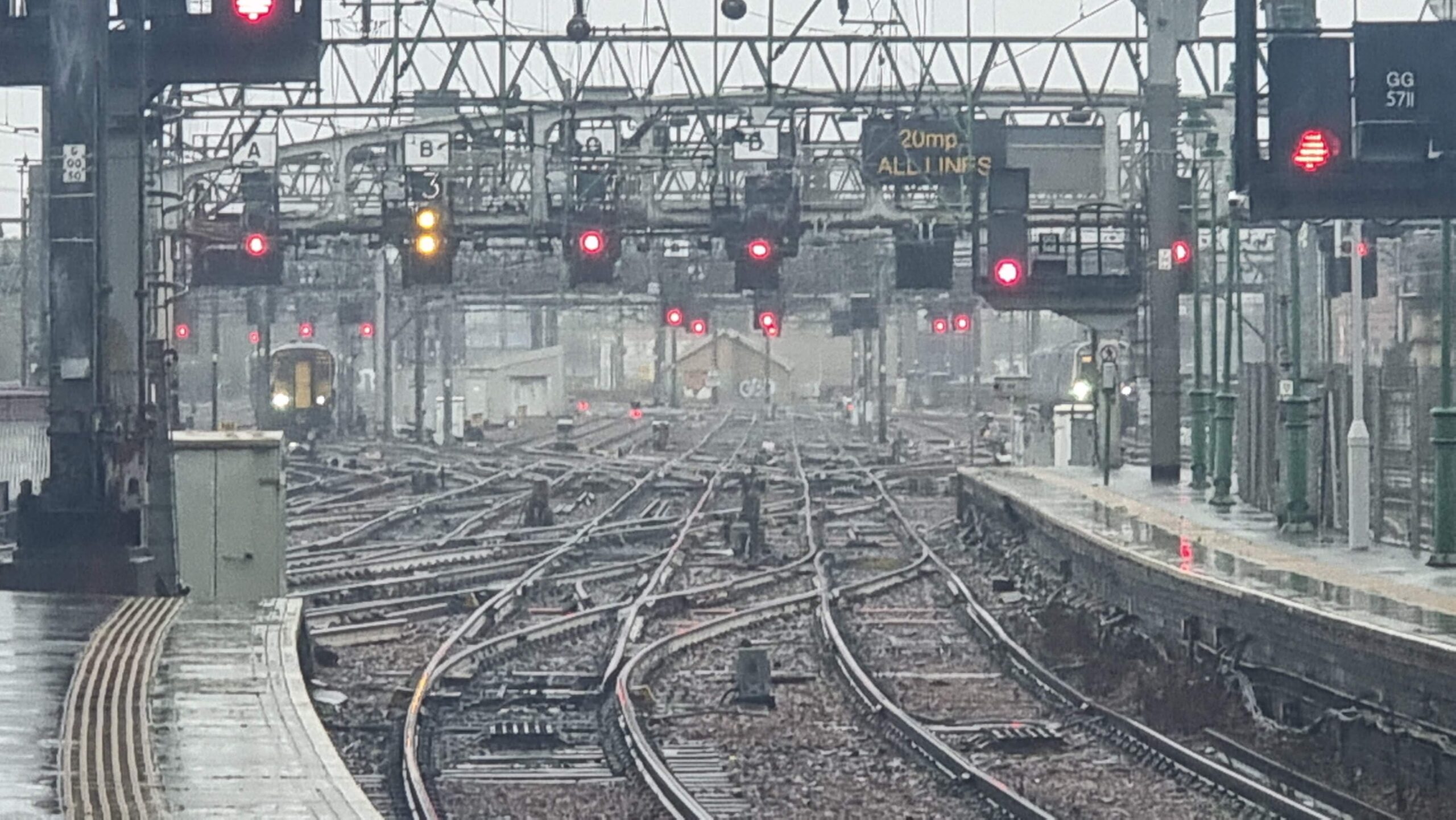
The Ministry of Defence has said work is continuing on a more integrated approach to domestic and international military rail movements, but no completion date has yet been set.
Defence Minister Luke Pollard provided the update in response to a written parliamentary question from Conservative MP Ben Obese-Jecty, who asked when the department expected to establish the integrated approach referred to in an earlier answer in July.
Pollard said: “The Ministry of Defence recognises the important role rail can play in strengthening military mobility and is progressing work to develop a more integrated approach to domestic and international rail movements.”
The work forms part of wider efforts to improve the resilience of Defence’s strategic logistics network, including the ability to move personnel, vehicles, equipment and supplies within the UK and across international borders. Military rail transport can provide an important means of moving heavy equipment over long distances without relying solely on road transport, particularly when large formations or armoured vehicles need to be moved rapidly between bases, ports, training areas or allied territory.
The MOD said it is working across government and with industry and international partners as it develops future rail arrangements.
Pollard said: “Defence is engaging across Government, with industry and with international partners to ensure that future rail capability development supports operational requirements at home and overseas.”
The issue has taken on greater importance as NATO focuses on military mobility across Europe, where the ability to move forces and equipment quickly between countries is a central part of reinforcement planning and collective defence. However, the MOD has not yet established a deadline for completing the work.
Pollard said: “Whilst no specific completion date has been established, this remains an important area of ongoing capability development.”









No date for this – no date for that – just more horrendous incompetence and bs from the Labour Party.
The country needs a general election to remove the parasitic Labour Party from office asap – Labour Party MPs their members and supporters are clueless – toxic – traitors – liars and massive hypocrites.
😂😂😂 Yeah, I’d trust the well paid Communists and life-long IRA sympathisers of the RMT to handle troop and equipment movements 😏
Glad they recognise it. In 2010 they short sightedy scrapped most Army rail capability.
Interestingly some pop up from one of the railway groups on facebooks about two weeks ( not a group I am a member off ) saying there had been a four or five fold increase in trains going in and out of MOD Donington this year. Only a post I had a glance at
A mate of mine is a big spotter anorak type, I’ll ask him. I didn’t think Donnington had a rail link?
Kineton, Ashchurch, Bicester, Longtown, Ludgershall, Douglas yes.
From what I understand it was taken out a few years ago. Then the local council funded a new rail drop at the industrial estate next door. It hasn’t seen a lot of use so the MOD have taken it over . You can see it on Goggle maps
Thanks, I’ll have a look.
Isn’t funny that 80 years ago we had the capacity to plan huge operations like D-Day, all without computers, and now we have a tiny army and no capacity to plan anything. Why are they always talking about, we will be able to do X in X amount of years, why can’t we do it now?
Luke, I well remember hearing that Churchill would often pen the words ‘Action This Day’ on briefing papers on proposals. Woe betide military and civilian staff who failed to do so.
What happened to the rail movement unit at Bicester then.
We should already have a military rail capability but the tracks aren’t rated or wide enough to move armour.
Long, long gone. The Sqn was cut during the 2010 SDSR with residual bits remaining.
Today, AFAIK, unless it’s expanded with no publicity, there is a single Regular STRE in one of the Works Groups.
Daniele, As I recall STREs (in the REs) largely provided a consultancy and design service. Their troops can build small and medium scale enterprises but I doubt they would build marshalling yards or spur tracks (that would probably go out to contractors) and of course it was the RLC that ran the military rail service.
Hi Graham.
Yes, pretty much my understanding of a STRE.
There is also a reserve I think with Network Rail employees to provide a slither of extra depth.
DM,
Any thought w/in E-NATO to procure armoured trains (both locomotives and rolling stock)? Obvious practical limits, but perhaps sufficient to resist small caliber weaps. and shrapnel? (Idea generated as a consequence of viewing Dr. Zhivago and old WWII flicks.) Trained crews to rebuild roadbeds and re-lay rail under fire? Believe Uncle Sugar has US Army CoE, USN USAF Red Horse battalions and USN Seabees (org titles probably not current for USAF and USN). Dunno, capability might prove useful if principal logistics route is anywhere w/in hailing (or shelling) distance of the FEBA. Would seem an ideal investment w/in the 1.5% of GDP to be allocated for ancillary defence infrastructure/operations CAPEX and OPEX. Of course, there may be laws, regs and traditions which preclude the investment … 🤔😉🙄
Pardon, formal org titles:
USA: US Army Corps of Engineers (USACE) Engineering Regiment
USAF: Rapid Engineer Deployable / Heavy Operational Repair Squadron Engineers (RED HORSE) Squadrons
USN: Naval Mobile Construction Battalion(s?) (NMCB(s?)) (aka Seabees)
Again, apologies for not utilizing formal titles from the outset.
Regarding original text: “Trained crews” (pun assuredly not intended) 🙄
I’ve no idea!
I saw Russia had them.
I think in the Cold War we had a few NBC proof carriages but behind that, unsure.
It would be interesting to know what progress on standardisation of the Estonian, Latvian and Lithuanian railway gauge away from Russian and on to EU gauge if we are using it to move NATO armour.
Prevents Russian use the other way also.
Rail Baltica. A new link from Poland to Estonian, Latvian and Lithuanian
Hopefully that project stays on track then…..I’ll get me coat.