

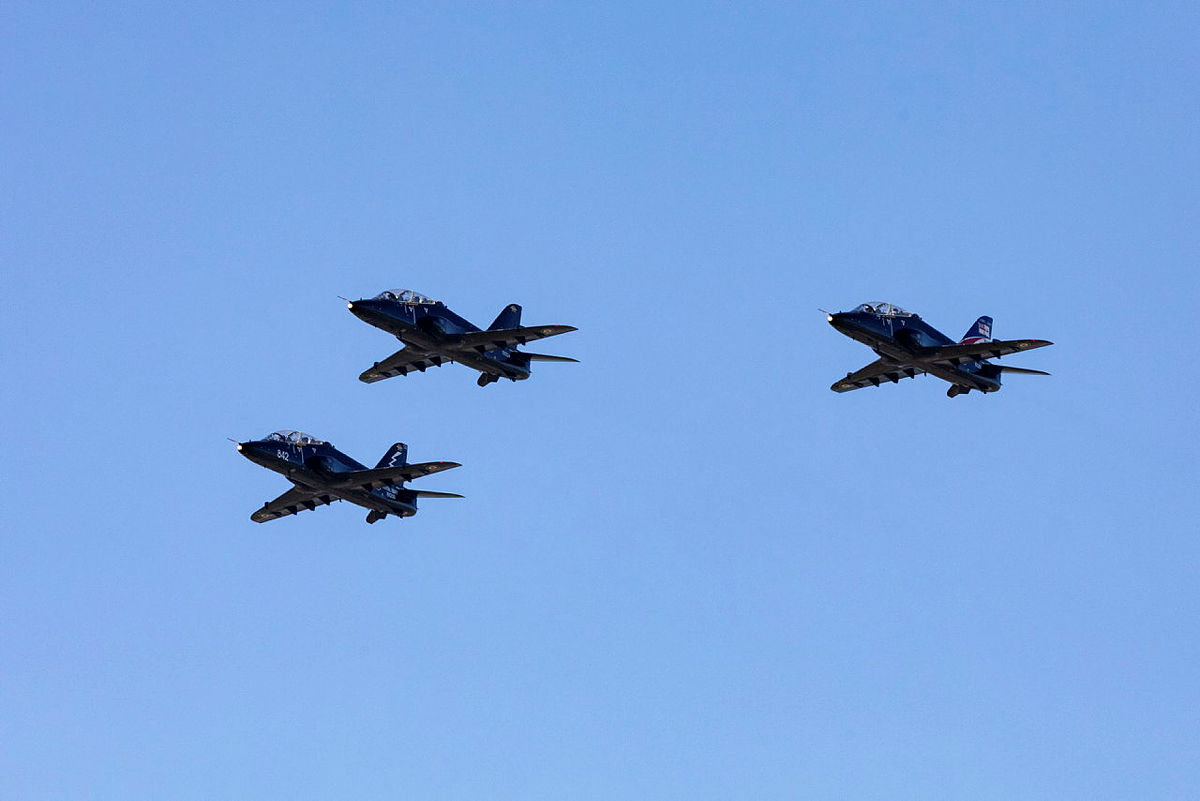
The Jet Training System programme is ongoing and no final procurement decisions have been made, according to an answer given in Parliament.
Ben Obese-Jecty, the Conservative member for Huntingdon, asked what comparative assessment the Secretary of State has made of the effectiveness of the Collins Aerospace ACES 5 ejection seat fitted to the Boeing T-7A Red Hawk against the Martin-Baker seats used across the rest of the RAF fleet.
Luke Pollard, the Minister of State for Defence, said: “The Jet Training System programme is ongoing and no final procurement decisions have been made.”
The Jet Training System will replace the Hawk T2 that trains fast jet pilots at RAF Valley, with the older Hawk T1 already retired and the T2 fleet running towards the end of the decade. A competition is expected, and Boeing, Saab and BAE Systems have offered the T-7A Red Hawk with local assembly in the United Kingdom, with Leonardo’s M-346 among the alternatives.
Ejection seats carry unusual weight in a British competition because Martin-Baker is a British company that has equipped almost every RAF type since the 1940s and holds a worldwide position built on that record. Choosing an airframe fitted with the American ACES 5 would move that work, and swapping a seat into an airframe designed around a different one is a design and certification exercise in its own right.
The T-7A’s escape system drew sustained criticism during American testing, with problems identified around the performance of the seat and canopy for pilots at the light end of the weight range and around the sequencing of the escape itself, and Boeing has worked through a series of modifications. Programme delays in the United States have pushed initial operating capability for the American air force to the end of the decade.
Martin-Baker’s Mk16 variants are fitted to Typhoon, the F-35 and the Hawk, which means an RAF trainer on a different seat would put student pilots through a different escape system from the one they meet on the front line.




Does anyone know how much it costs to get Safran to fix its fan on Adour? Saudi paid up & seems to have no issue on its Hawks. The fix is there, but the MoD does not seem to want to pay it.
Taking a logical path is not he MOD’s way. Very few meetings and staff increases.🤔
The primary driver behind the UK’s requirement to replace the Hawk fast-jet trainer is the need to modernise pilot training for a new generation of combat aircraft while addressing the growing cost and complexity of sustaining an increasingly fragile fleet. The Hawk T2 has suffered from availability and engine reliability issues, prompting concerns over its long-term viability and the resilience of the RAF’s fast-jet training.
At the same time, the RAF must prepare pilots for fifth-generation aircraft such as the F-35 and future sixth-generation systems under the Global Combat Air Programme (GCAP). According to Fast-Jet Pilot Training Modernisation Choices, modern training aircraft need to support a blend of live flying, advanced simulation and synthetic training environments that can replicate the complexity of future air combat.
As a result, the UK is increasingly viewing the replacement not simply as a new aircraft programme, but as the introduction of a modernised fast-jet training system that can deliver more effective, scalable and future-proof training for the next generation of RAF combat pilots.
Perhaps, but you cannot magic that out of thin air. Fixing the Adour engine, gives you time for whatever new shiny word salad you want, to become real. T-7A Redhawk will not be available until at least 2031. Plus it is Boeing so…………..
Kicking the can ever further up the empty road
Labour dont have a great record so far on ordering jets for the RAF – or have I missed them? Cuts yes orders no?
They’re not ordering any fast jets through the entirety of this Parliament I believe.
No P8.
No E7.
No Shadow replacement.
No additional F35 as waiting for 2030s for tranche 2.
No additional Typhoon.
No additional Atlas.
We did order 23 AW149 after the MIC threw its toys out the pram and HMG thought think of the jobs, so there’s that.
If one actually looks closely at the DIP it’s mostly existing ongoing programs and ongoing funding.
And never mind air, that applies to the RN and the Army as well.
All words, very little action unless you prioritise jobs, infrastructure and industry, which they have done. All of which naturally go hand in hand. All needed, sure, but rhe conventional force structure is at the back of the queue and shrinking further. Ah yes, and Drones, cheap, fewer people, in vogue, so plenty of purchases there.
And the AW149’s won’t come with armor, weapons or a defensive aids suite.
Literally green painted executive taxi helicopters.
So, what is the ejector seat fitted to the M-346?
If they go for the BAE/Boeing bid, which will be the most expensive and carry the most risk then they really are corrupt, there’s no other word for it
Go back to the Aeralis Modular concept and reconstitute the company (get out of receivership) with a UK MOD equity funding of GBP100 million and get Leonardo UK (formerly Westland), BAE Systems, Rolls Royce, Mitsubishi (Japan partner), Bombardier (Canada partner for project) and Norway Sovereign Fund to each contribute GBP50-100 million in equity to create the NEW AERALIS with focus on delivering and requisite jet trainers of the future.
For Leonardo with its stable of current trainers (345 and 346 models) this would be preparing a future replacement. For BAE Systems this would keep it in the trainer business (replace Hawk but with lower investment) while helping integrate some of the Tempest technology into the trainer. For RR this would be opportunity to work on delivering a UK sovereign engine. Mitsubishi is Japan’s lead partner in Tempest project, they will be (that is Japan Air Self Defense Force) in need of a jet trainer and this involvement would help them in the move to be less reliant of the USA. Bombardier’s involvement is also rationalization of the RCAF need for a new jet trainer in the near term, currently their advance trainer is a turboprop (PC21) which will be sufficient for future requirement like acquiring the TEMPEST. Norway Sovereign Fund as cash and this project may appeal to them as a potentially lucrative investment over a 30 year horizon.
Europe is going to be looking for trainer as the aging fleets of Alpha Jets, Czech L-39s, Italian M345/346, and variety of turboprop trainers (PC-7/21, Embraer Tucanos etc.), start needing replacing for 5th and 6th gen fighters. The current USA posture towards Europe (who knows how long this will last. A future USA leader after Trump might want to use the same playbook, albeit more intelligently, to gain leverage and major concessions from the UK and EU), makes reliance on USA aircraft like the T-7A or USA component heavy trainers like the Korean T-50 risky.
Aeralis Was vapourware fantasy
Better to restart Hawk production, T3?, based on 2017 advanced Hawk with more agile wing & optional F-35 similar cockpit.
The Hawk is the finest 1960’s aircraft technology. It’s hopelessly obsolete.
By that standard is the C-130J, Boeing 737, Beech KingAir, F-15EX, F-16V, F/A-18 Super Hornet. The point is that they may look the same as early models, but have been massively updated. New engines, radars, avionics etc. Same applies to Hawk. We would not be building a 1970s spec one. It would be updated for now. A 2026 spec.
So a 100% new design.
Or, we could just buy a proven jet trainer.
A lot of the comment above ignores reality. We are all aware, however dimly, of the myriad of new platforms and weapons needed.
The real question is, where on earth is the money to come from to fund them all?
There is only £10bn extra currently on the table for defence, or £2.5bn a year for the next 4 years. It is a welcome and overdue increase. But is has already been allocated to service pay rises and thinly spread over base infrastructure, service family housing, weapons factories and unmanned equipments. With by far the largest slice going to recapitalise our hopelessly run down Defence Nuclear programme.
The RN seems to have done very well for itself, with no less than 28 ships and subs either contracted or announced, plus 4 classes of unmanned vessels in the wings.
Not so its sister services,the ones that would be key in any fire war, air and land.
The large part of the RAF procurement budget will go to GCAP development, which is estimated at somewhere between £18 snd £26bn. There is very little left over for other procurement, such as the Hawk replacement. The future 10-year-plus equipment spend will go on
* 27 F-35s
* the C-UAV development
* 3 Wedgetails
* 14 Chinook ER
* 23 AW-149 medium helicopters
* 6 Jupiter
… and will have to somehow find the money for the Hawk successor.
That’s it, the full extent of the RAF’s pyggibank. The service has been woefully underfunded for at least the last 14 years, so there is a large pile of kit that now needs funded, which there is not the money to do.
The Army is in by far the worst position. If we deduct the in-year savings it has been compelled to make, it will have just £500m extra from the DIP settlement, which is frankly ridiculously small. Par for the course unfortunately, the Army is always the Cinderella service where funding is concerned, somehow the Navy always manages to elbow its way to be first in line at the feeding trough. It’s always the same old story – ‘It takes us 10 years to build a warship, so we have to stock up in peacetime, even though Air and Land will be the dominant factors in any future conflict’. Even though the RN has a pretty simple main priority task, to deploy about 6 subs and escorts in the North Atlantic, even this seems to be a continual uphill struggle for them.