

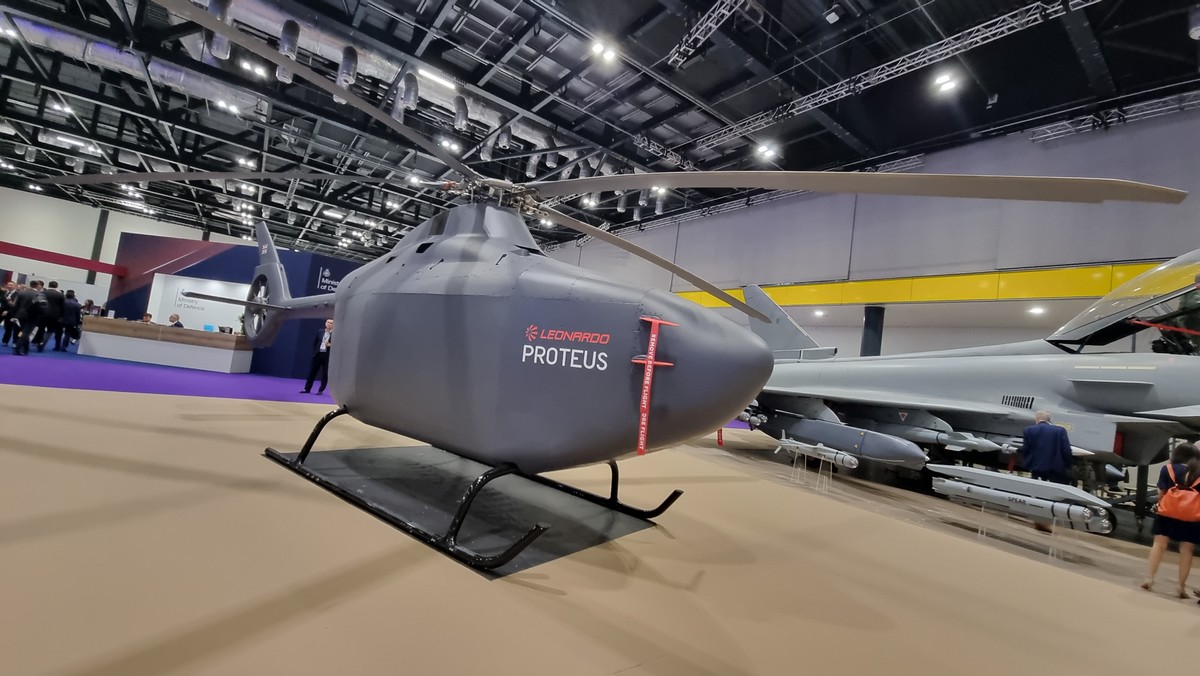
Leonardo will use Shield AI’s Hivemind software to develop autonomy for Proteus, the uncrewed rotorcraft it built with the Royal Navy and UK Defence Innovation, under an agreement that gives the company’s engineers the tools to write their own mission autonomy, according to the companies.
The two firms will work together through the Hivemind software development kit so that Leonardo engineers can build new autonomy capabilities for rotary-wing operations, including anti-submarine warfare, intelligence, surveillance and reconnaissance, and contested logistics helicopter operations.
Tom Schaefer, vice president of Hivemind engineering at Shield AI, said: “Leonardo builds some of the most widely flown rotorcraft in the world, and Hivemind gives its engineers new tools to add autonomy to them. Autonomy software is never finished. It changes with the mission, the threat, and the sensors on the aircraft. Leonardo’s engineers can therefore tailor Hivemind software to their mission sets, and the work stays with them.”
Adam Wardrope, vice president for market development in helicopters at Leonardo in Britain, said: “As we look to the demands of our customers and the reality of military and security operations in both wartime and in peacetime, there is a need for autonomy powered by AI. The ability to develop and integrate mission autonomy using Hivemind onto Proteus will support the implementation of autonomous capabilities.
“When combined with our long-standing design, development, and manufacturing expertise in crewed and uncrewed rotorcraft, we believe we will be able to benefit from Shield AI’s software to support the development and delivery of autonomous solutions, potentially also extending it through other programmes within our rotary-wing portfolio.”
Proteus is a vertical take-off and landing technology demonstrator developed with the Royal Navy and UK Defence Innovation under the Rotary Wing Uncrewed Air System programme, designed around a modular payload bay that can take about a tonne of equipment or two standard NATO pallets. That bay is what makes the aircraft interesting, because the same airframe can carry sonobuoys, a radar, or stores for resupply depending on what is bolted into it. The aircraft made its first flight early this year after demonstrations in synthetic scenarios, with Leonardo-designed autonomy already on board.
The Royal Navy’s Maritime Aviation Transformation strategy, which Proteus informs, sets out how maritime aviation develops to 2040, and the Strategic Defence Review’s hybrid navy depends on uncrewed aircraft taking on tasks that currently consume Merlin and Wildcat flying hours. Anti-submarine warfare is the task where the pressure is greatest, with the Defence Committee reporting this month that it is not persuaded British attack submarines are putting to sea as often as they should and that the department has accepted a serious anti-submarine warfare gap.
Shield AI’s Hivemind is the autonomy software behind the company’s V-BAT and X-BAT aircraft, and the arrangement here supplies the toolkit instead of the finished product, so Leonardo owns and sustains what it builds. Keeping that work in house matters for a British programme, because autonomy that cannot be modified without going back to a foreign supplier is autonomy that cannot be adapted at the speed operations demand.
Leonardo employs around 8,000 people in Britain, with its helicopter business based at Yeovil in Somerset, where the Merlin and Wildcat fleets are supported.











What happens when Hivemind is bought by someone who disagrees? How is that risk managed?
The product is owned by Leonardo not hive mind so will also be ITAR free.
Absolute nonsense from Jim again.
How so… If Shield AI’s Hivemind software is used to develop the product, would its absence not compromise Leonardo’s ability to support the product?
I get the impression that this is only for the demonstrator, so that Leonardo doesn’t have to invest in an autonomy software if the program gets shut down. A possible derisking solution.
I can use Claude code or Micorsoft co pilot to develop software but I still own the software product that’s developed.
This is what Leonardo is doing.
As the article states Hive Mind is producing the tool kit to Leonardo not the finished product. The finished product will be owned by Leonardo.
And the finished product will contain software built and owned by Hivemind.
If an aircraft has ITAR components, the aircraft is subject to ITAR no matter who “owns” the complete aircraft.
If you use other people’s code in your software, those components do not magically become yours.
Sorry Jim but the Cloud Act puts that whole concept into question, the Netherlands owned the information that US companies were by law forced to hand over to Congress and revealed the names of Dutch civil servants (indeed EU ones I believe) involved with the EU Online Services proposals, deemed nebulously a threat to US interests. That is the whole pretext for all US Govt policy now. They can now be targeted in the same way as the ICC personnel are presently being if the US Govt decides to do so.
Such matters will almost certainly be used as leverage, arguably threats in transactional EU/US ‘discussions’ most of which will never be revealed, they have done so with Canada and others already. The UK police are claiming information containing all manner of sensitive information on Uk citizens run through Palantir software (one of the companies involved in the Netherlands debacle) is Uk sovereign property, some experts have claimed this is simply naive in the context of the Cloud Act and other US policy.
Now I am not claiming an agreement of this nature would inevitably encounter similar threats, but equally I would not presume that any contract or agreement under the present situation in the US or likely future scenarios there too, would be safe from potential serious US Govt interference in all manner of ways I fear. After all one of the first executive orders was to remove virtually any legal control or limits upon US secret service operatives and agencies operating abroad. Hopefully this contract would preclude the ability of foreign actors with intimate knowledge of its workings being able to interfere substantially, but after the Starlink example, simply relying on cooperative relations with the US Govt simply precluding it would be madness. Europe is already learning this the hard way.
Xenophobic claptrap. Nothing to do with the issue raised by Jim.
Morning, I fully agree- claiming we’re just ‘buying the toolkit’ doesn’t stack it with software in the way it does with spanners. Most software comes with licences on a subscription arrangement, so if you want to keep using them you need to keep paying. And there’ll be underlying security software etc. that may even transfer to the finished product, that may still be covered by those licences. I don’t believe that this will be truly ITAR-free and I share your information security concerns.
Hopefully, this is just an easy-fix for getting the demonstrator to where it needs to be without having to develop the tools themselves. But I find it a little hard to imagine that Leonardo couldn’t have found a European outfit they could have worked with…
Will Hivemind be tested in air on Proteus, or is it just a desktop exercise?
What the heck!!!! We spent £60m in the last round of funding and it almost all went on the software and proving the software. We were told that the autonomy software was so good it could make any rotary autonomous. We were told to accept an unsuitable drone, because Leonardo now had this wonderful software. And now they are replacing it with American software that will cost the UK extra money.
I am pretty angry right now.
@(angry😡) Jon.
The baseline flight software established under that £60m is the foundation UPON which Hivemind is now being added.
The decision to license Shield AI’s Hivemind Enterprise SDK is an architectural choice regarding tactical SOFTWARE LAYERING rather than an admission of failure. Leonardo built the software that flies the aircraft. Shield AI provides a software development engine (Hivemind) that specialises in high-level tactical decision-making when communications are jammed or GPS is lost. Rather than spending another decade and hundreds of millions of pounds writing edge-AI algorithms for multi-drone swarming or complex anti-submarine search routines entirely from scratch, Leonardo is using Hivemind as a software toolkit. Crucially, Leonardo isn’t replacing its software with a “Hivemind Black Box”. Leonardo engineers in Yeovil will use the SDK to write and OWN the final mission code themselves.
This does not represent a core engineering failure on Leonardo’s part. In early 2026 Proteus successfully completed its maiden flight running Leonardo’s own in-house flight control and autonomy software. Leonardo successfully proved it could build the airframe, the digital twin models, the flight control systems (FCS), and safety-critical deterministic autonomy required to keep a full-scale uncrewed helicopter airborne and stable without human intervention.
The USA has an extremely large lead in ‘General Tactical Edge Autonomy’ … Dynamic, real-time dogfighting or multi-drone swarm manoeuvring in GPS-denied environments without human data links this is the environment where Shield AI’s Hivemind operates.
And the USA also leads in ‘Enterprise Intelligence Fusion’, large-scale operational data synthesis, this refers to the automated process of gathering massive volumes of fragmented, real-time data from hundreds of different military sensors and fusing them into a single, coherent picture that humans, or tactical AI engines can act upon. In practical military terms, a single modern naval task group generates gigabytes of raw data per second, radar tracks, sonar acoustics, satellite imagery, thermal video feeds, electronic SIGINT, and ship telemetry. Human operators cannot manually read and compare thousands of incoming data points during high-intensity operations. “Data synthesis” software automatically cleans, correlates, cross-references, and interprets those disparate feeds in real time. Instead of an operator looking at 50 different flashing dots across three screens, the software synthesises the data to say: “Track 12 is 92% likely to be a hostile submarine based on sonar frequencies matched with historical acoustic profiles and satellite wake tracking.”
The £60 million allocated under the Rotary Wing Uncrewed Air System (RWUAS) Phase 3B programme was not wasted or “thrown away.” It funded the complete physical development of the Proteus demonstrator airframe at Yeovil, the digital twin simulation environment, structural composites testing, and the core flight-control software that allowed Proteus to achieve its maiden flight in 2026.
You were sucked in by PR, no biggie, we all fall for it, especialy when we are invested in the outcome. Public Relations teams around the world in every industry, including defence marketing, frequently oversimplify technical milestones and ‘big note’ themselves and their products.
Leonardo’s flight-control algorithms proved that rotary-wing platforms could achieve autonomous flight, baseline stabilisation and waypoint navigation are fundamentally different from combat-edge tactical AI. However … making a helicopter fly autonomously on a pre-planned track is a solved engineering problem. However … making it dynamically alter search patterns for a quiet submarine while under dense Russian or hostile electronic jamming requires specialised tactical algorithms.
Regarding platform size. Proteus was designed as a technology demonstrator rather than a final production front-line aircraft. The Royal Navy accepted a demonstrator airframe specifically to mature autonomous operational concepts for its Maritime Aviation Transformation strategy. It is a testbed meant to establish how uncrewed systems will operate alongside crewed Merlins and Wildcats.
– A Wildcat HMA2 weighs around 6.0 tonnes with a 1,400 kg payload capacity.
– A Leonardo Proteus Demonstrator weighs around 3.0 tonnes with a 1,000 – 1,500 kg payload capacity.
– A serial-production front-line Leonardo Proteus variant, fully weaponised will still weigh around 3.0 tonnes with a 1,500+ kg payload capacity.
Proteus has always been a 3.0 tonne helicopter. By stripping out flight controls; cyclic/collective sticks, rudder pedals, crashworthy armoured seats, windscreen glass, heating/ventilation, display consoles, and emergency equipment saves roughly 450+ kgs. (means more fuel).
“And now they are replacing it with American software that will cost the UK extra money.”
As established, Leonardo is NOT replacing its core software stack. They are licensing an autonomy toolkit (Hivemind) to SIT ON TOP of Leonardo’s existing flight control architecture. While licensing American IP does introduce ‘re-export’ and commercial costs, building equivalent edge-AI mission software strictly from scratch in the UK/Europe would take significantly LONGER and likely COST FAR MORE than the licensing agreement. The UK and Europe have recognised that while licensing American baseline SDKs accelerates short-term fielding for demonstrators like Proteus, they also realise that long-term operational independence demands sovereign funding. European funding for edge-AI mission software will continue at high levels, focused strictly on classified domain applications, platform integration, and ITAR-free 6th-generation combat systems (GCAP amongst them).
– Proteus specs, scale and dimensions –
Maximum takeoff weight 3.0 tonnes (3,000 kg).
Airframe footprint, full-size light single-engine helicopter derived from the Leonardo AW09 architecture.
Single main rotor paired with a shrouded tail rotor (Fenestron) for safer warship deck handling.
Landing gear is fixed skids fitted with attachment points for automated shipboard tie-down systems and deck wheels.
Engine comprises of a single Safran Arriel 2K class turboshaft gas-turbine engine (~1,000 shaft horsepower).
Standard aviation jet fuel (F-44 / JP-5 / Jet A-1) stored in crashworthy internal fuel tanks.
Payload capacity and modular bay
Total payload capacity 1,500+ kg.
Reconfigurable internal modular payload bay occupying the central fuselage. Its modular roles include … anti-submarine warfare, dipping sonar winches, sonobuoy dispensers, and acoustic processing racks.
Logistics for standard NATO cargo pallets, resupply pods, or external slung loads.
ISR / Surveillance includes Multi-spectral EO/IR turrets and maritime search radar modules.
The target for flight endurance is approximately 4 to 6 hours on station depending on payload weight and transit distance. Shipboard operations will be fully autonomous launch, search, and recovery on Royal Navy flight decks of Type 26 and Type 31 frigates in heavy seas and harsh weather.
Weapons and combat systems wise the demonstrator is currently an unarmed testbed focusing on envelope expansion, sensor integration, and software maturation. A production target for loadout, hardpoints and bay clearance for NATO lightweight torpedoes UK Sting Ray, 260 kg per round, depth charges, and sonobuoys.
As they are the Royal Navy’s primary requirement for the 3-tonne uncrewed ASW platform operating from the flight decks of the new T-26 and T-31’s they are aligned to enter service with the frigate commissioning schedules.
“Mind Hive toolkit” means routines written and owned by Hive mind will be incorporated in the Leonardo product. Ownership of those routines will not transfer to Leonardo anymore than Gripen’s use of an American engine makes that engine Swedish intellectual property, or free from ITAR.
@Grinch.
Wrong.
Comparing a software development kit (SDK) like Shield AI’s Hivemind Enterprise to a physical engine, like the GE F414 turbofan inside Saab’s JAS 39 Gripen, misrepresents how software IP works. An imported US engine is a physical black box subject to strict ITAR export license tags on every spare part, turbine blade, and overhaul procedure. Sweden cannot modify or re-export the Gripen without US State Department approval.
Hivemind Enterprise SDK is a different setup. Shield AI’s explicit business model for Hivemind Enterprise is “You build it, you own it. Retain full rights to the intellectual property built for your unmanned system.” Leonardo engineers in Yeovil use the SDK’s baseline algorithms and simulation environment to author, compile, and run the mission application layer.
Shield AI’s official statement confirms that “partners retain ownership of what they build and can maintain and modify those capabilities independently”.
The “Work Stays With Them” clause Tom Schaefer (VP of Hivemind Engineering at Shield AI) stated directly – “Leonardo’s engineers can therefore tailor Hivemind software to their mission sets, and the work stays with them.”
You assume that Hivemind drops pre-written, proprietary binary code blocks into Proteus that remain locked away under American ownership, they don’t. It doesn’t.
The underlying engine, the SDK belongs to Shield AI, that includes the foundational math, the simulation environment, and the baseline reinforcement learning frameworks. The mission application code belongs to Leonardo. Meanwhile, the UK specific acoustic algorithms, sonar search patterns, automated weapon release logic, and anti-submarine tactical profiles authored (made by) by British engineers using that framework are owned by Leonardo and the MOD.
It is the exact equivalent of using Microsoft Visual Studio or Apple’s Xcode to build a secure banking application. Microsoft owns Xcode and its core libraries, but Microsoft does not own the banking software you write with it, nor does it get a say in how you deploy it.
It is true that as a result of using Shield AI which is a US defence firm, that licensing their commercial/defence SDK inevitably introduces US export control compliance (ITAR/EAR) during the development of the ‘phase 3B technology demonstrator’.
However, for long-term sovereign fleet production the UK MoD and European partners maintain parallel sovereign software funding lines … such as for GCAP/Tempest.
Licensing Hivemind allows Leonardo to quickly flight-test complex tactical swarming on a demonstrator TODAY, while parallel sovereign software mission stacks are developed for final front line production in the 2030s.
Your statement relies on outdated hardware analogies to describe modern software SDK workflows. While Shield AI retains ownership of its core underlying SDK framework, Leonardo owns the bespoke mission capabilities and code built on top of it.
Comparing an SDK-based development model to bolted-on foreign jet engines ignores how modern software IP, local code compilation, and enterprise licensing actually work.
… thus
Shield AI (US) owns the base software, the core Hivemind SDK / engine.
UK MoD holds the sovereign operational/Crown rights to any UK Tactical Code / Algorithms created using the SDK.
Leonardo UK Ltd holds the UK industrial developer rights.
Leonardo Italy, has no direct IP claim or access to that UK-authored military code without explicit UK MOD export approval.
ITAR applies to software.
.. and in particular applies to Hivemind.
Now you are repeating what I’ve already said.
I’m glad you agree with me. I must admit I didn’t read all of your posts. Way too long.
Ah, yes, but don’t forget Jon £59 million went on meetings. 🫣
44 Merlin.
Only 30 were updated to HM2 I recall, and one of the Squadrons cut.
Oh, and 849 NAS was cut too, so the remaining Merlins have to do the ASCS task as well.
Meanwhile, 11 HM1 sat in hangers and I assume were cannibalised, scrapped, or are now instructional frames.
👏 👏 👏 👏 👏 👏 👏 👏
Yes, ASW is as thin as everything else, courtesy of HMG.
Cannibalised extensively – Mr Sawzall liberally applied
Don’t buy American. Simples.
Quiet embargo on buying anymore American kit where we can find an alternative. That includes F35s. Just walk away from America and encourage all our eNATO and Canada to do the same, don’t buy ffffFrench mind, but cut the US off at the knees and let the rednecks know what happens when they support the orange dummy.
Rise and Fall of Empires will take care of the rest.
The F-35 kill-switch was a thing, then we were reassured it wasn’t, then the reality filtered through on the quiet that there may not be a switch, but hey in reality the US could pretty quickly make F-35s seriously less effective or probably maintainable as a 5th Gen platform if they wished. A salutary lesson I think. There’s no point having the best if someone else can make it decidedly far from the best or far worse should they decide to do so. US policy at the moment is quite openly about forcing dependency on as much of the World as it can. It’s why Trump only respects those he cannot actually do so. They are independent in his eyes while the rest of us in his view simply are not, we are proto-colonies until/unless we prove otherwise. Probably best not to increase that dependency wherever possible. Ai will be the major sector where the US is trying to dictate dependence, of course a Companies like Leonardo often make decisions on orders, profit and convenience rather than a sense of national expediency.
Now, you enter the rabbot hole of soviergn independence and howcwe have allowed so many companies to be sold to the Septics.
This Govt could set a bar on Defence sales and distinctly against the USA.
On top of which, bare minimum on US acquisitions and ensuring there is reciprocity in Americans accessing our tech as the US protect their tech.
So next iteration of Dorchester stays with us and is not shared.
The era of American exceptionalism is over, time for them to embrace the sho!te and assume their rightful place in the world.
So do you think UK is developing advanced armor when do not any AFV (tracked and wheeled) building capability for years?
Yes, the UK is.
The US allows the UK to buy US companies. Bae bought one of their largest defense suppliers. If you cut off US ownership of UK companies, the reverse will be swiftly applied to the great loss of UK Inc.
Except the UK invest in US companies.
The US gut the UK company and take the technology back to the US
Xenophobic bullshit.
Just fact.