

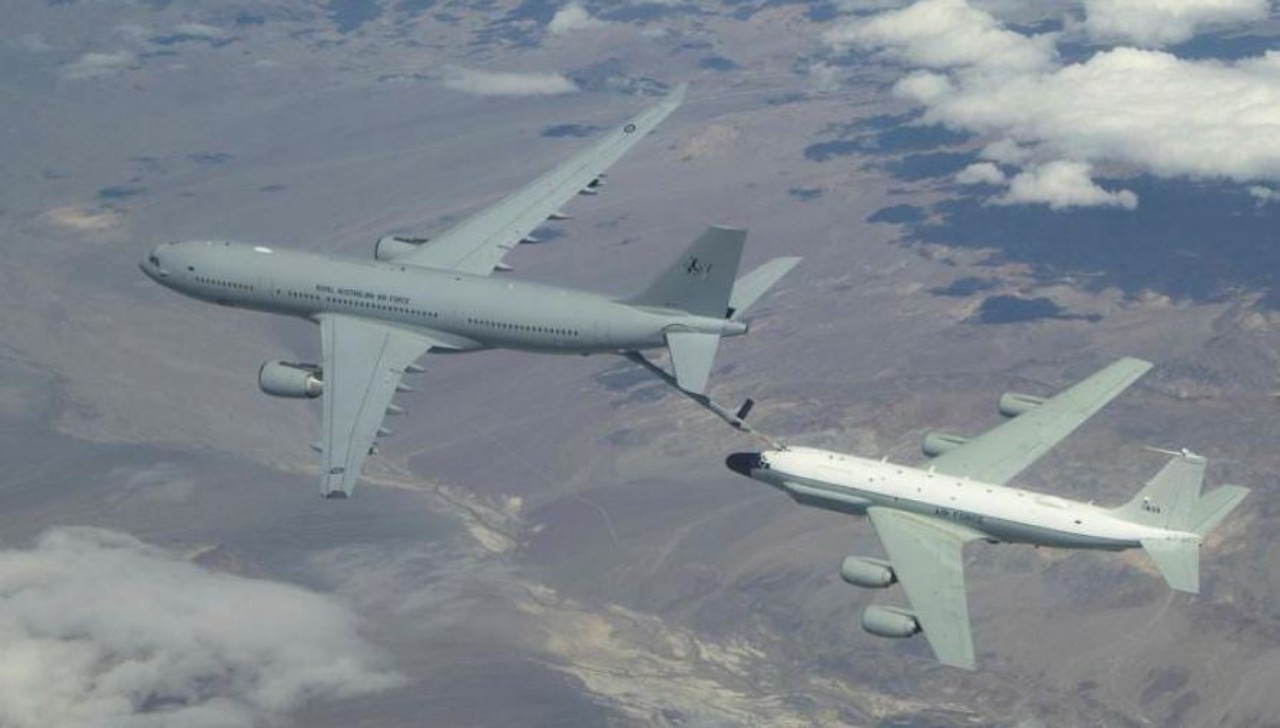
The Royal Air Force will develop a boom air-to-air refuelling system to complement the probe and drogue arrangement it currently operates, in a change that would allow it to refuel American-pattern aircraft in British service without relying on allied tankers, according to a written answer published this week.
Luke Pollard, Minister of State for Defence Readiness and Industry, was responding to Ben Obese-Jecty, the Conservative MP for Huntingdon, who had asked what assessment had been made of the demand for a solid boom capability to refuel the future F-35A, the E-7 Wedgetail, the P-8A Poseidon and the RC-135 Rivet Joint.
Mr Pollard said: “The Royal Air Force currently operates a probe and drogue air-to-air refuelling system and will complement this with the development of a boom system. This will ensure we have a sovereign air-to-air refuelling capability for the future Royal Air Force fleet that enhances interoperability with NATO Allies and partners.”
Two ways of passing fuel
Probe and drogue refuelling works by trailing a flexible hose behind the tanker with a funnel-shaped basket on the end, into which the receiving aircraft flies its own probe, an arrangement that puts the work on the receiver, allows several aircraft to be refuelled at once from wing pods, and is used by the Royal Air Force, the Royal Navy, the French air force and most of the world’s naval aviation.
A flying boom is a rigid telescopic tube lowered from the tail of the tanker and flown into a receptacle on the receiving aircraft by an operator aboard the tanker, transferring fuel considerably faster, which matters a great deal for large aircraft, and it is the standard across the United States Air Force and among most NATO air forces operating American-built types. An aircraft built with a receptacle cannot take fuel from a drogue, and one fitted with a probe cannot take fuel from a boom, so the two systems have to be provided separately.
The aircraft concerned
All four of the types named in Obese-Jecty’s question are American in origin and all four are refuelled by boom. The E-7 Wedgetail, the P-8A Poseidon and the RC-135W Rivet Joint are either already in Royal Air Force service or entering it, and have depended on allied tankers for air-to-air refuelling, in practice usually American ones. The F-35A, which Britain committed to buying under the Strategic Defence Review, is refuelled the same way, unlike the F-35B flown from the carriers, which carries a probe.
The Voyager fleet, based on the Airbus A330 and operated under a private finance arrangement, was ordered in probe and drogue configuration only, although the airframe can accommodate a boom, since the A330 MRTT is offered in that fit and operates that way with several other air forces.
The Global Combat Air Programme adds a further dimension, since the aircraft being developed with Italy and Japan is expected to use boom refuelling, which on the current fleet arrangement would leave the Royal Air Force operating a new fighter that its own tankers could not service.
Sovereign capability
The phrase Mr Pollard uses in his answer, sovereign air-to-air refuelling capability, is the language the department has applied to this area for some time, and it reflects the practical difference between coalition operations, where allied tankers are available by arrangement, and national ones, where they may not be.
Obese-Jecty has put a series of questions to the department on Royal Air Force capability in recent months, including on directed energy weapons beyond DragonFire, where Mr Pollard’s answer confirmed £490 million of funding over four years and said further announcements would be made when appropriate.



Good news!
I presume this is upgrades to Voyager; I can’t see any new AAR aircraft being developed in Europe and boom refuelling is harder to automate than probe and drogue.
Have you not been following Airbus and their MRTT+ (A330-800 or Neo/New Engine Option) and the automated refuelling with the Singapore Airforce F-15s, which, incidentally are all boom capable. So ummm, I’m gonna comment this now and reply further with Press Releases from Airbus and whatnot.
Airbus, Singapore achieve world-first on A330 MRTT auto-refuelling full certification
https://www.airbus.com/en/newsroom/press-releases/2026-02-airbus-singapore-achieve-world-first-on-a330-mrtt-auto-refuelling-full-certification
Royal Thai Air Force orders next generation Airbus A330 MRTT+
https://www.airbus.com/en/newsroom/press-releases/2025-09-royal-thai-air-force-orders-next-generation-airbus-a330-mrtt
Aerial refuelling without human intervention
https://www.airbus.com/en/newsroom/stories/2023-11-aerial-refuelling-without-human-intervention
I suspect not, the Airtanker contract expires in 2035, so they are probably going to include the system in its replacment.
Hopefully an owned fleet this time around.
Air tanker is very keen for an extension beyond 2035 so I think it’s likely the may offer an upgrade on existing tankers as part of their bid for a five year extension.
It’s pretty straightforward to upgrade the existing voyagers with the boom. All the plumbing is there already.
We need rid of Airtanker as fast as possible. Buy outright a fully equipped air refuelling tanker (A330-800 MRTT+) next time.
Out of interest, what do you see as the problem with the Air Tanker approach? Aside from the lack of boom, which was a UK MOD choice, I’m not aware of any major published problems in terms of failure to provide service.
In a time when we’re struggling to find enough cash to manage the aircraft fleets we have in the RAF, I’m not sure why we’d want to bring something that is, by most accounts, cost effective in-house and put further strain on resource.
Some twenty something Spad saw air tankers & thought airliners, then had a genius idea. Why not lease the spare aircraft to charter airlines? At that moment it was doomed. A charter airline runs on thin margins. It cannot afford the weight of refuelling gear, cockpit armour, self defence & military comms. So we spent a fortune fitting this gear, another fortune taking it off & if we need these planes again, yet another fortune fitting it back on again. So the UK paid top dollar for half equipped aircraft. No UARRSI or freight door. No boom. Also a restrictive clause not allowing A400M to refuel. To my mind that is low level treason. That clause should never have been allowed. Also at the time of the contract coincided with the financial crash, so instead of saving money, the government had to bail out the consortium. The trouble was (& audit reports confirm this) that HM Treasury/MoD had decided on this PFI & would not look at any other options.
I’m aware that 4 of the 14 aircraft are leased to airlines and reserved as a ‘surge’ capability, but I’m not aware of any instance where that has resulted in us not having sufficient capacity for the operations we’re involved in. If the RAF owned the fleet, you can be sure that we wouldn’t have any surge capacity at all- and the 10 remaining aircraft might have been cut to 8… While we’d all like to see greater capacity across the armed forces, do you honestly think we’d have more available aircraft if we’d kept the air to air refuelling fully within the armed forces? I personally don’t think so.
As far as UARRSI, freight door and boom go, if it wasn’t part of the spec for the Air Tanker, what makes you think that it would have been part of the spec for an RAF-owned capability? You can’t criticise a service model for gaps in the requirements set out by the customer. I agree that all three would make sense, but all could have been included if the MOD wanted to I expect.
With regards the A-400M refuelling, the restrictions in the contract are that the RAF cannot use other methods of refuelling when the AirTanker contract could have fulfilled it; A-400 refuels helicopters etc. and in forward/austere places where an MRTT wouldn’t be able to go- so that clause in the contract couldn’t be exercised. Ultimately, the MRTT and the A-400M fulfil separate refuelling needs, so they’re not going to be in competition the majority of the time.
I’m not sure why the service model can be blamed for the contract being signed at the time of the financial crash- that’s certainly poor timing and would surely have incurred some additional cost as you say. But, if we look at the alternative of it being an RAF-owned capability that got signed in at the same time, what would have happened? Would the MOD not have pushed expenditure on it back, cut aircraft off the programme, or otherwise looked to cut costs? I think we both know the answer is almost certainly yes. At least, with the commercial contract signed, they were obliged to follow through.
I agree with you that the ideal would be a capability held 100% by the military. But I honestly don’t think the AirTanker contract is as bad as it’s made out to be. It’s worth noting that NATO and the USAF both use similar contracts for AAR, although obviously the USAF also has a huge in-house capability.
Hang on, no other airforce has been mad enough to copy the airtanker PFI. If it is that great, they would have. Other airforces have bought their tankers outright, or clubbed together with other airforces to buy them outright. Some airforces have bought the bulk of their tankers, but have an option to buy tanker hours from private firms on demand. But no other airforce in the world has been crazy enough to copy the airtanker PFI.
Airtanker have offered new frames, it’s cheaper than retrofitting the existing fleet. The aircraft are not owned by the MOD and airtanker are looking to extend the contract.
About bl**dy time!
Why do we need to “develop” a boom refuelling system? Why can’t we buy the already designed and tested one from Airbus? Is there something wrong with that one or is the fault in the minister’s vocabulary?
Possibly in the area of training is what is meant by ‘develop’. I don’t know if RAF/FAA pilots (F35As) both of the tankers and receiving aircraft have been trained on the boom method.
I think that’s what they mean, not something new.
The MRTT boom is very sucessful compard to other solutions and all aspects of the modification are well understood by Airbus Military. An issue may be where in the MRTT producion line this change can be fitted into the programme as there is a healthy demand for new build MRTT’s at the moment. I doubt a UK contractor would be sought to carying out the conversion given past experience with the original conversions. The area of likely cost increase is the extent to which the MAA require extensive flight testing to support their Release to Service . I would imagine that there may be scope for the RAF to gain experience of the boom in the NATO AAR Force prior to delivery of the first modified aircraft. A similar process was adopted for the RAF E3D force build up where RAF crewmembers and maintainers were trained in the NATO AEW Force prior to to delivery of the first E3D many years ago.
AB,
Do the French and Spanish governments have recourse to any near equivalent of the US Defense Production Act? Obviously does not win friends and positively influence others (customers), but damned useful when one is forced to push into a queue.
I am not aware of any National law in France or Spain which is equivalent the US Defense Production act. Its more likely that Airbus themselves will decide on prioities but as they are close to their Governments they would make a decision which best suits Airbus Objectives but taking into account their Governement’s position if they have one. Also, as with major US Defence contracts, the current AirTanker Contract is complex and that alone might take time to change.
‘would leave the Royal Air Force operating a new fighter that its own tankers could not service.’
…that would be such a typical thing for the MOD to do, TBH.
i suppose that if Tempest uses boom so will the CCA
Correct. CCA is being designed to use boom. Thought thod article would have gotten more comments and stayed as headline news for longer considering its been a hot topic for some time.
The RAF need 6 additional large jet powered aircraft 3 additional P-8’s and 3 A330 MRTT’s in the same the same configuration to those in use by RAAF
Well hoo flippin ray. I know it’s a cliche and has probably already been said, but it’s about time. Having a large portion of the RAF’s force unable to be refuelled by the RAF’s tankers and not doing anything to rectify the situation could have been described as potentially incompetent bordering on negligence.
It has been a bit of a farce for some time that we cannot refuel so many of our types ourselves.
So jolly good.
I won’t hold my breath though, this for me is about GCAP, and the Voyager contract still has some time to run.
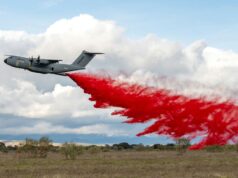
While they’re at it, what about some AAR for Atlas and some fire fighting kit as well?
Better still, by some Hercs!
In my fantasy fleet, the RAF would get 4x MC-130J for special ops.
‘ An aircraft built with a receptacle cannot take fuel from a drogue, ‘
A-10s, built for boom refuelling, can be fitted with an adaptor that plugs a probe into the receptor, to allow hose and drogue refuelling.
Retrofit of the these vanilla spec tankers ,is a huge expensive job .Heavy structural modifications and plumbing and then training for boom operators to fly the boom .
Would also be able to refuel the C-17 I didn’t see that mentioned.