

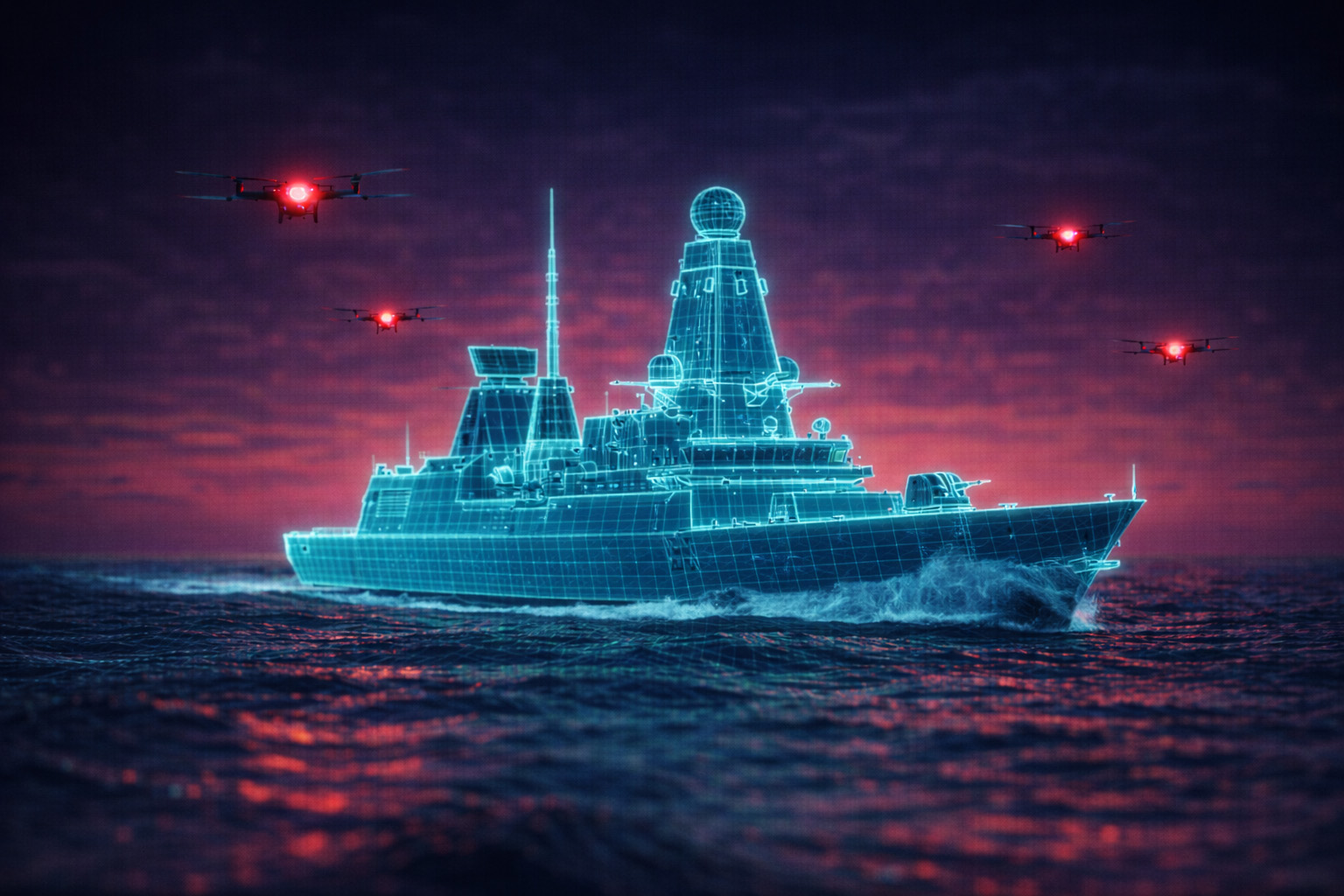
The Royal Navy is exploring the rapid procurement of a maritime counter-drone capability under a new pre-procurement initiative known as Project TALON, according to a Request for Information (RFI) published by the Ministry of Defence.
The notice, published on Contracts Finder, seeks industry input on systems capable of detecting, tracking, identifying and defeating uncrewed aerial systems (UAS) from maritime platforms. The project aims to deliver a rapidly deployable capability that can be installed on Royal Navy vessels with minimal integration.
The RFI states that the Navy requires “a rapidly procured and installable Counter UAS capability suitable for maritime platforms to detect, track, identify, and defeat airborne threats.” Systems are expected to operate with a high degree of autonomy and be deployable aboard crewed vessels with minimal changes to existing ship systems. The ministry is seeking solutions that can be fielded quickly, with a focus on mature technologies that can be delivered at pace.
According to the document, the initiative is designed to move faster than traditional defence procurement. The Ministry of Defence says the intention is to conduct a rapid market survey and, if suitable systems are identified, move quickly to contracting and delivery. The RFI notes that “Project TALON is focused on mature products, requiring no/minimal integration and with providers that are able to work at pace,” with the ambition of contracting and delivering an initial capability within roughly a month if a viable solution is identified.
Project TALON is intended to provide both kinetic and non-kinetic capabilities to counter the growing threat from uncrewed aerial systems. The ministry says the programme “will deliver kinetic and/or non-kinetic effectors and sensors to allow a scalable capability to RN units,” while also introducing a broader system-of-systems approach using multiple lower-cost effectors. The aim is to provide flexible mission configurations that can complement more complex missile systems in a rapidly evolving threat environment.
The RFI highlights the increasing challenge posed by the proliferation of drones and the need for scalable responses. It states that the authority requires “a mix of effectors both kinetic and non-kinetic to counter a mass of threats from the proliferation of uncrewed air systems (UAS) to complement current Complex Missile Systems.” Solutions must be able to defeat NATO Class 2 drones using either electronic or physical attack methods.
Operational requirements outlined in the document indicate that systems should protect a significant area around a host vessel. The defended area requirement ranges from around “100 km² (threshold) up to 2,500 km² (objective),” depending on the capability offered. The ministry also expects systems to handle large numbers of targets during an attack, stating that a platform should be capable of defeating “25 targets (threshold)… with the aspiration to defeat 100 targets (objective), before resupply.”
Because the capability is intended to be rapidly deployable with limited ship integration, the RFI suggests that systems should rely heavily on their own sensors and operate with a high level of autonomy. Solutions are expected to take initial cues from onboard sensors and minimise operator workload during engagements. This approach is intended to allow the capability to be deployed across multiple platforms with minimal modification.
Installation and sustainment requirements also make clear simplicity and speed. The equipment must be installed and certified quickly in order to maximise ship availability, and the ministry expects solutions to rely on common ship interfaces where possible. The RFI also specifies that systems should have minimal maintenance demands and must not significantly interfere with other shipboard activities such as flying operations.
For the purposes of assessment, the Ministry of Defence states that the minimum viable capability must demonstrate the ability to defeat drones from a crewed maritime platform operating at sea. As the RFI notes, “The Minimum Viable Product for assessment will be able to demonstrate effect against UAS from a crewed maritime platform underway at sea.”
Responses to the RFI are due by 17 March 2026.






Is the easy answer to improve the 30mm systems as per the recent NL article?
It wouldn’t harm.
It would not work.. look at the range thresholds.. essentially 100km2 min to 2500km2 objective.. that’s a 10km to 50km range band.. a 30mm cannon is a 2km range band.
Warship = single highly localised target. GPS guidance alone will miss; you do know ships all types move. Point defence is just that . . Point. 30mm with ProgFrag will do fine. Why am I explaining this, it’s simple.
Because point defence is not the question asked here.. they have asked for something to cover 2500km2 a point defence gun will cover 4km2… if someone asks for a vehicle that can fly them 2500km in 4 hours you don’t offer them a pushbike.. why am I explaining this it’s so very simple.
The easy answer is that this Urgent Operational Requirement would not be necessary if this damned Labour government would fund Defence properly.
That means 5% or more of GDP NOW.
Starmer needs to switch on. resign, die I don’t care. We need a leader and that isn’t it.
He’d have to check whether any of those abide by international law first….
Agree Daniele. And in the meantime he’d be happy to see the UK suffer and to be the cause of it.
With Trump’s Iran war there won’t be ANY governmental funding available. The UK economy isn’t shielded from energy prices volatility. We should be as we have North sea oil and gas but instead chose to pay for Norwegian gas exports on the volatile wholesale market and French electricity via trans European interconnectors as all our multi billion pound taxpayer supported offshore wind aren’t connected to the national grid.
Article in the papers today. Britain has 2 days, 2 days only of LPG and natural gas storage due to cuts to storage facilities rather than paying for renewal and upkeep. EU average is 18 days at peak demand. With many countries like Norway, Sweden, Germany, The Netherlands, Italy and France opting for 6-12 weeks storage at peak demand. So the UK is uniquely unsurprisingly (as we’ve just had 15 years of nothing but cuts by the scum Tories) at extreme risk from energy prices volatility that will be passed down to the consumer and lead to another round of rampant inflation and interest rate rises.
Millibands moronic cancelling of offshore oil and gas programmes that would shield the UK from these events because of his net zero ideology are now coming home to roost.
thats a desired range of between 5k and 30k
25 rising to 100 targets being engaged in quick succession. Huge degree of autonomy and ability to differentiate between ‘friendly’ helo or drone sounds hugely expensive per ‘vehicle’. The ranges implied by the spec also suggests something with a lot of humph either from muzzle velocity or internal propulsion. It just all sounds expensive. The 3P ammunition that goes with the 57 mm and 40 mm guns sounded like a reasonable solution. Is this now inadequate given this specification? Any idea how many targets Dragon Fire can theoretically engage in a minute? Is the Type 31 already out of date? 😆 🤔
Gotta be gold plated, right.
It’s not a gun system they are looking at, the coverage is to large.. 100km2 to 2500km2 is essentially a 10km to 50km range band.. range bands for 57mm, even 76mm and Dart and dragonfly are sub 10km…
Are most ships going to be able to provide the electrical energy required for Dragon Fire? The PIP’d Type 45s Will due to the increase in generator capacity, possible the new Type 26s and 31s too.
But existing vessels? 🤔
Spock ‘electrical’ systems have (rapid – hopefully) regeneration and storage systems that are then generally ‘pulsed’. The easy/classic example for old & grey fcukers like me is radar. Radars had a big capacitance/resistance (CR) network store a steady stream of energy to be pulsed. I have no doubt it’s got a lot more sophisticated but when I did of digging online about EMALS, I was quite surprised (initially) to see hoe GA were storing the energy in the system. A few pulses od DragonFire might be easy but, consecutive pulses over an extended period are an engineering challenge…….
Unmanned Seaborne system proving to be just as deadly, at least one oil tanker has been hit by an Iranian uncrewed surface vessel.
Sounds like something like ASELSAN Smash 30mm with organic EO sight + some sort of friend or foe target image AI.
Sounds like a Remote 30mm and Dragonfire combo really… Plus a smattering of remote 50 Cals MGs and maybe a smarter flak ammunition for the Deck Gun.
Bofors 40mm Mod 4 mounts
Read the NL article, not much advantage of 40mm over 30mm.
3P ammunition makes a difference. And it’s about 1/3 less maintenance
Rubbish – 40mm with 3P is a quantum leap over 30mm
Again with the reading exercise? Do I need to post the link.
A quanta/quantum is extremely small
A quantum leap doesn’t refer to distance, but states.
I never said anything about distance.
Only four years late – so far. That’s good for MoD procurement.
Good to see it getting addressed, wise move. Rapid fire with airburst and other smart ammo would be needed though no idea what form it might take. Though glad see the problem being delt with and sooner rather than later. and RFA ships should get it as well as escort i doubt can stop UCAS/Drones getting to them, Fit the same system to the RAF base in Cyprus or some thing similar may be?.
World war 2 vintage light anti aircraft weapons would suffice, just with a modern aiming system. If we want sustainability and affordability gun options are way to go, we don’t need a gold plated solution!
As far back as 2011 a five tube Thales LMM system was fitted experimentally to RN 30mm mounts aboard the frigate HMS Sutherland – an apparently inexpensive way of augmenting firepower that was not taken up at the time. I wonder if that decision is being reconsidered?
LMM doesn’t have huge range and reloads cost and it will never have 25 shots unless there is some kind of revolving cassette system.
The 40mm 3P would be a better solution as that has 100 rounds and at maybe 4 rounds per target sounds about right. The range doesn’t make a lot of sense unless 57mm 3P was the proposal.
Even the 57mm does not really cover it… 100km2 to 2500km2 is essentially 10-50km range band…I suspect they are look for anti drone drones.
I agree that it is anti drone killer drones.
IRL how do you launch those from an AAW destroyer without integration into the AAW system otherwise your systems shoot them down….
They’re flying away from the ship, would be pretty easy to filter out surely? Would be a very clever enemy missile that exploits that loophole.
The Doppler shift is away.
But it is never that clear cut depending on the drone’s path relative to the radar(s).
Supportive bloke; doppler is interesting (bordering on nightmare!). I’m showing my age but the earliest doppler radar in the RN was 967 (967M). Whilst the antenna rotated at 30 rpm, each rotation transmitted at one of three frequencies. These 3 frequencies were selected to avoid range ambiguities caused by spectoral lines. My radar knowledge stopped in the early 1990s and things have moved on massively but inbound or outbound is hard particularly if the object/target has a rotor like a drone or your friendly helo!
That was the point I was making to TJ and J is that it isn’t that simple in some flight regimes particularly where the returns from the body of the drone are not that strong.
Coming or going is down to phase which is down to quadrature detection.
That is much less of an issue these days as the quadrature detection is in the digital domain with huge oversampling mitigating the need for aggressive analogue filters which could reflect these artefacts into even more puzzling ghosts that flipped velocities +/- at random.
Early Doppler systems were great for suppressing clutter and not so much use for the finer things in radar. But that is, as you say, the march of technology.
The spectoral (spectral) lines that you refer to are something that I am very familiar with and the theory/practise of how to suppress them.
Yep and your going to need your air defence system to look for slow targets.. so the filters are all going to have to be tuned right down..
I think one of the problems will be in the future.. we may see a how slow can you fly your drone anti radar tactics develop..because you can take a drone down to 30-40 miles per hour if you want.. especially if you can predict where the enemy ships are going in an enclosed sea.. that will mean separating the drone from clutter will become impossible because if you drops your filter down to 40mph it’s going to be full of clutter as every seagull becomes a possible drone.. it may end up that ships need specific micro Doppler drone radars for drone defence and then keep their main radar filters as they are…
You could process the raw data differently to extract the data and compare it then cross compare with EO etc
It isn’t that hard – you can’t fool all of the sensors all of the time.
That’s a good point single sensor.. two data processing routes.
Although the micro pulse Doppler essentially allows you to put a filter around movement and vibration on the object itself ( props and mechanical vibration) which is why you can take off the Doppler filters around speed and it can tell a 40kmh seagull from a 40kmh drone… I’m not sure the big high end search radars actually do that.
Propellers show a shuttering effect to radar.
So they can do that micro Doppler filter that’s needed.. good to know… so it’s “just” sticking a IFF tag on your own anti drone drone so you don’t do a whoopsie.
Oh that’s funny, of all the times to make that announcement I am thinking now was probably not the best. Even if we get this stuff onto a ship, will the ship be capable of deploying?
“100 km² (threshold) up to 2,500 km² (objective), and to o defeat 100 targets. No doubt another project that will be canned when they don’t want to pay the price.
Well said sir, although I do this time sense panic going through the halls of the MOD. Not just multiple drones they fear but multiple chickens coming home to roost.
Well said, well spoken!💯😒
So looking at the specs this is not a gun system.. 100km2 to 2500km2 is in the 10-50km range band ( short to medium range AAW missile)…. Assuming it’s not just stick more CAMMs on our ships ( essentially the spec could be covered by pile on CAMMs), it means they are looking at something completely different..
The none kinetic bit could be High Power Microwave (HPM) devices or Cyber takeover, or cyber takedown.
The kinetic bit could be an anti drone drone like Falconet… 30Km range.. fires 9 40mm shotgun grenades…. The anti drone drone is probably pretty easy.. after all you could just fling the buggers off your flighdeck en mass…
We have nothing that can do this at the moment. CA Skyhammer is 30km range and I think would be suited, but there isn’t an interceptor drone out there that does 50km, that’s basically a manoeuvring cruise missile.
Do you know if we are looking into interceptor drones in any of our programmes, or are we waiting for the capability to mature/DIP?
There’s been a whole host of anti-drone RFIs in the last week or so so that must mean something.
I don’t think there’s a procurement programme associated with them though.
Just checked, and apparently we’ll be making interceptor drones in that new Ukraine factory in Mildenhall, so it puts us in a good position going forward.
No need to shout about its location,
👍🏿🤪
Falconet seem to be a close fit essentially 180km per hour speed for 10 mins.. so 30Km range..
That’s 180km/h dash speed and 10min maximum flight time to my reading, not sure both could be achieved in the same sortie. For a 30-50km range over reasonable time intervals for local area defence (which is surely what this is talking about) something like Skyhammer is a good fit because it does 500-700km/h out to the same distance for a four minute maximum flight time instead. Also the radar seeker would allow independent targeting by each missile against swarm targets, though at the price point they wouldn’t be very clever.
It’s 10mins at high speed I’m pretty sure.
I’ve posted this link a couple of times before and it doesn’t fit this requirement but interceptor drones like these look like they could be the next big thing. If I recall correctly a European country has already placed an order with MARSS, and the US Army has fielded the Coyote interceptor drone in vehicle‑based systems, but like in the video, containerised launch is also an option. MARSS website (I’ve added a space): https:// marss.com/products/interceptor-mr/
Are our Ukrainian friends not the current experts in anti drone measures, as mentioned before anything with a helicopter pad could launch and small enough to keep a plentiful amount boxed up in the hold surely.
Im sure a Ukrainian interceptor drone design built by a factory in UK good jobs here economy of scale and only minor modification for use at sea, are we already not building drones for the here with them anyway??
Might be worth buying some nets to protect the bridge an other sensitive areas lol
I was just reading that the UK has agreed to produce Octopus‑100 interceptor drones for Ukraine in large numbers. The Mildenhall factory is already producing Ukrainian drones, and Octopus‑100 production should be coming online soon — so as you say, hopefully we’ll buy some.
Of the shelf and made in uk proven tech. Very eay to put on all sorts of ships even small ones Id have thought.
Some Arleigh Burke destroyers already have Coyote drones, so hopefully it won’t be too difficult to integrate. We just need to get production lines going and place an order. These types were literally designed to defeat the Shahed drone, so it’s a no-brainer. Let’s see if HMG feels the same way, though.
We should be considering helping defend ourselves in Cyprus and at home. How about our friends in the Gulf as well? Starmer and his mate are so completely unprepared we can do nothing at pace, despite the war in Ukraine raging away for 4 years. They are an excuse for HMG.
Any one who knows, knows Fighter Jets are pretty useless against Drones and absolutely hopeless against Ballistic Missiles. New management required at the RAF please. Still fighting WW2 which ended over 80 years ago.
Why don’t we just get on and install Dragon Fire on all our surface escorts, particularly the Type 45s?
Because Dragonfire takes 30 seconds to burn down a small drone in good weather.
The solution, and everyone knows it, but it’s not sexy, is a radar laid rapid fire small calibre guns with timed or proximity fuzed AAA natures.
Truck mounted 40mm Bofors is being sent to Ukraine for exactly this mission.
Where does the 30s figure come from? The videos of it shooting down a Banshee in testing certainly weren’t 30s long bursts.
30 seconds in good weather? So it’s not the all by wonderful piece of kit it’s supposed to be and a bit pointless….. guns seem to be the short term answer
The solution is to recruit tall men that can throw explosive peas at incoming drones. Simples.
Ideally small, cheap interceptor drones to take out cheap attacking drones. Either colliding with &/or with a small warhead. Or carrying micro-air to air munitions.
The whole missile fit of our warships needs to be enhanced so they can sustain defence against waves of drones & missiles. Otherwise cheap drones & basic missiles exhaust all our defensive missles so there’s little to stop the main wave of anti-ship missiles. That 16 cell(?) sea ceptor farm onthe T31s is far too few.
Not much use coming up with new ideas to fit anti drone measures to our ships when the vast majority of the fleet is laid up and non operational. MOD full of bright ideas but no money from this government to purchase them.