

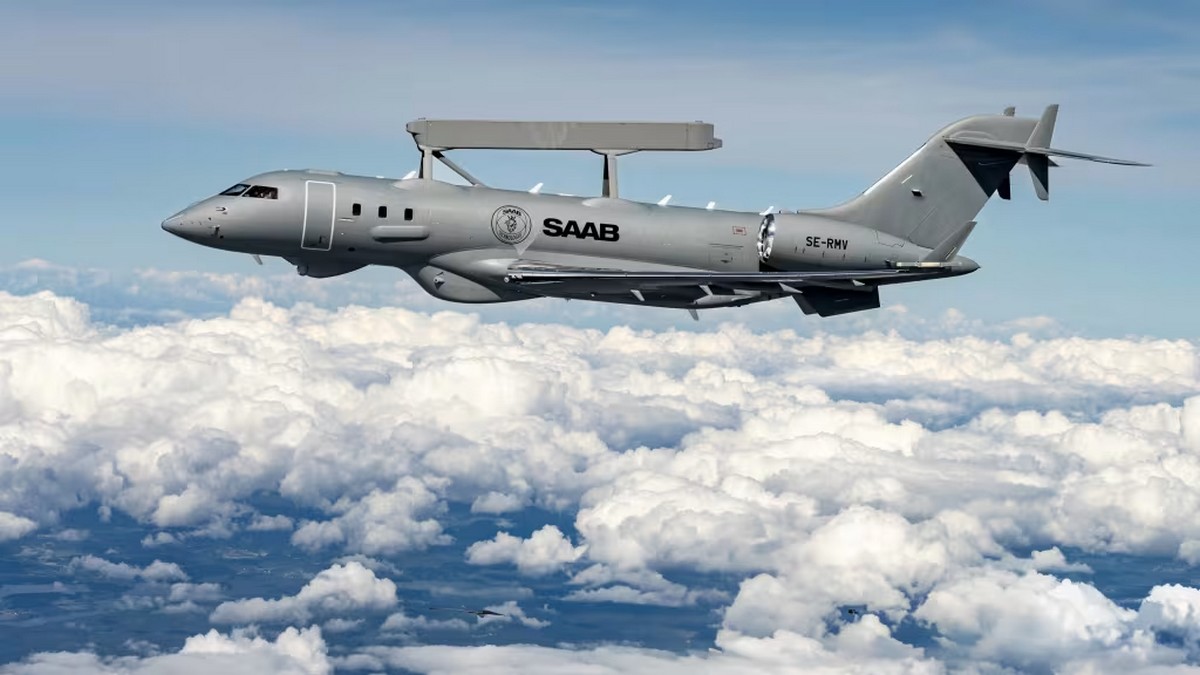
Saab and CAE have signed a new global cooperation agreement aimed at developing advanced training systems for Saab’s airborne early warning platforms, including the GlobalEye surveillance aircraft.
The agreement was concluded during the Swedish Royal Visit to Canada and is presented by both firms as a step forward in their long-standing relationship. It brings together Saab’s work in multi-domain sensing, command and control and AEW integration with CAE’s simulation and training expertise.
The companies say the goal is to create high-fidelity training environments that mirror the complexity of modern airborne surveillance missions for GlobalEye operators worldwide.
Saab President and CEO Micael Johansson said in the announcement that the arrangement reinforces the company’s long term approach to AEW capability. He stated “This partnership strengthens our commitment to GlobalEye customers and reinforces our strategy to deliver world-leading airborne early warning capabilities with best-in-class training. CAE is a trusted partner with unmatched expertise of training solutions, and together we will increase the operational readiness for Airborne Early Warning platforms users around the world.”
CAE President and CEO Matt Bromberg said the agreement reflects a growing need for integrated partnerships. He said “The agreement between Saab and CAE sets the stage for a global AEW&C training franchise anchored in Canada. Today’s announcement reflects years of trust and joint success with Saab and responds to an evolving geopolitical landscape that demands stronger, integrated partnerships.”







You do have to wonder if the UK could do with high low mix in its AEW aircraft.. wedgetail is top draw, but it’s a 700 million a pop strategic platform.. that buys you a strategic platform with potentially 24 hours+ endurance and the ability to operate a good few thousands of KMs away from UK sovereign bases, 600km range air search and 270km range surface search as well as signals intelligence out to 900km means you plop one of these over a carrier battlegroup and you have completed sea control.. buy the full five five but essentially assign 3 as cover for the carrier battlegroup and wider strategic sea control away from the UK.. keep 2 at home. Augment the home cover with global eye cost about 260 million that is almost 3 for the price of a wedgetail.. get a squadron of 6 and use them for UK and EEZ AEW and maritime patrol ( supporting the P8s so they can focus on sub surface)..the 11 hour endurance.. as it can also do signit and electronic intelligence work as well as wider ISAR you could expand the fleet as rivet joint goes bye bye for 2035… as a fantasy fleet for 2035 5 wedge tail, 9 P8 and 9 global eye would not be a bad gig for AEW, martime survalance, land based surveillance and electronic and Signit.
I assume the radar and the r&d are the most expensive parts. Considering we had 2 spare radars and need to pay the r&d costs anyway for the existing purchase, I do wonder how much it would have cost to get them additional 2 platforms brought. Although it sounds like we have flogged the 2 radars off to the US.
What about MQ9B? If as the Navy seem to want we get it for the carriers, it would make sense to also use the land-based variant for the drudge border and maritime surveillance. Obviously less capable than GlobalEye, but also cheaper and with the unmanned advantage in endurance and forwards deployment options.
It remains to be seen what Saab can bring to the party. Will the radar be X-band or a lower frequency such as S-band, as used by the Erieye? I remain to be convinced that using a STOL version of the MQ-9 is the right choice. As the airframe is pretty small, and the engine isn’t massively powerful, which kind of limits the electrical generation, as well as the size of the antenna array that can be carried.
But if the requirement is for a platform that has a duration of +10 hours and can mount a radar with more performance that the Merlin when its using the Searchwater. Then the MQ-9 fitted with an X-band AESA would be sufficient. Sadly it’s more of a bronze standard to what is really needed for carrier operations. It would also be sufficient for peacetime operations monitoring the UK’s air and maritime EEZ etc.
However, for use against a near or actual peer enemy, it would be next to useless for any AEW role. As the X-band radar likely fitted to the MQ-9, does not have sufficient detection range. To enable it to detect threats, before they could launch a very long range air to air missile at it. For AEW you need at least double the detection range that an airborne X-band radar can provide.
If Saab can mount a pair of S-band arrays that provide adequate beam forming. It should provide better detection range than using an X-band radar. But it won’t be in the same league as Erieye, with its much larger area array.
I’d be quite surprised if Saab go for X-band with MQ9B. Their existing experience on Globaleye is with S-band and as you say the power requirements of X-band are much greater.
IIRC you’ve mentioned in the past that there are issues with array size and accuracy with S-band? In that case I wonder why Saab haven’t chosen a single double-sided array under the fuselage, as that could be made longer. Perhaps there are other antennae or there are issues with airflow over the tail or something like that.
Saab design and produce really good X and S band AESA radars. But given the requirement, I will guess that the radar they are proposing for the MQ-9 is an S-band. As it will generate a lot more range for the same amount of electrical power that the X-band uses. With active electronically scanned array (AESA) radars, the number of individual transmitter-receiver modules (TRMs) that make up the antenna array, will determine the effective radiated power, i.e. the power of the transmission. But they will also to a great degree, determine how sensitive the receiving part of the radar is. A lot of signal processing also plays a significant part. But the larger the array, the more chances it will detect a miniscule returning signal, for the signal processing to play with!
In theory, if the signal processing is done off-aircraft, then there should be more weight available to play with, allowing for a larger surface area array. However, the relatively small size of the MQ-9, dictates the general architecture of the radar array. Could an array be fitted underneath the aircraft, yes, but there’s not actually that much ground clearance. This will limit the shape of the array. Fitting a much larger rectangular array above the aircraft, will make a more efficient array, that can generate more circular beams. However, it will have an aerodynamic impact on the airflow reaching the propeller. Plus you have the engine’s air intake on top of the fuselage. The turbulence being generated will affect the propellers efficiency, will it also affect the airflow in to the intake, by how much will need testing. I suppose you could replace the turboprop with a turbofan, but you’ll still need to check if/how badly the airflow to the intake is affected.
Fitting a pair of arrays that look port and starboard, in underwing pods, does make a bit more sense. If placed on the 2nd inboard pylon, the disturbed airflow is probably only hitting the propeller blade tips. But it does mean that the radar has issues looking up, as the wing will block this view. Back in the day with the Sea King AEW/ASAC, it made a lot of sense for the radar to be X-band and looking predominantly down towards the horizon. As the priority threat at the time were sea skimmers that popped over the horizon giving a ship less time to react. As a ship’s more powerful search radar would cover the looking up search requirement. Today, sea skimmers are still a threat, but there so many more types of threat now. That the radar must be more rounded in capability, i.e. it must be good at watching and tracking threats that pop over the horizon and hug the sea. But be equally capable of looking horizontally and up! Where hypersonic threats are now a real thing, and the radar must be capable of detecting and tracking these threats as far away as possible, to give the ship/operations time to coordinate a response.
The other location antenna arrays could be fitted, is conformally along the sides of the MQ-9. Which would place the arrays ahead of the wing, allowing it search equally well up and down. The thinness of the wing will cause some blockage, when the radar beam looks aft, but its thinness will only block a couple of degrees. Plus as the MQ-9 flies about, this blocking will be mitigated. Could the arrays be part of a role fit where they are temporarily bolted to the sides of the MQ-9. Possibly, they will need fillets and fairings, to make sure the airflow over them is as smooth as possible. But it does mean the MQ-9 can be re-rolled for a different task if required. Again, due to the small size of the MQ-9, the conformal arrays will need to pretty small. So they don’t interfere with the Satcom antenna mounted above the nose.
Mounting the arrays in pylon mounted pods, is probably the best compromise. The radar’s performance will not be in the same league as Erieye, let alone the Globaeye with the newer more powerful radar. But it should be better than what Crowsnest can do. Without seeing the size of the arrays, I cannot give a good estimate of the detection range. But I’d safely predict they’d add at least 100km on to the Crowsnest detect range. Which is ok, not brilliant and not what a carrier group really needs, especially when operating F35s.
Thanks DB, really nice info
I sort of like the idea of cheeky conformal arrays, they’d look good on MQ9B, but there might be CoG issues on such a light airframe.
MQ9B is certainly limited, but I can’t see any other way of getting an improvement over Crowsnest in service by the early 2030s. There’s V-247 but we’d be the only customer and it’s probably going to be very expensive. There’s AW609 but with no military pathway and it’s on the back burner.
If Vanquish produces a useful drone then an evolution might be able to include conformal arrays, but that probably wouldn’t be before 2035.
Agreed, AESA panels can be pretty heavy, especially lower frequency ones. There are very few alternative airframes that are off the shelf currently. There’s loads of prototype eVTOL/eSTOL, that in principle could be used. But their main problem, is due to their small wing areas, wont be able to reach say 30,000ft and cruise there for 10+ hours.
I did read in another post, someone suggesting an unmanned but modernised Swordfish. Which actually could be heading in the right direction. It kind of depends how much the MoD is willing to spend? A biplane will be able to give you excellent STOL characteristics. With the right wing design and area, it should be capable of reaching 30,000ft. After all the Gloster Gladiator could reach higher altitudes. The problem would be the traditional upfront twin stacked wing design and its placement near the CoG. It won’t give you much room to place conformal arrays. Though a top of the fuselage mounted array would be doable.
Recently, there is what is called the box wing design, which is where a lower rearwards swept wing is joined to a forward swept upper wing. This gives plenty of surface wing area, so that it reaches high enough altitudes, reduces drag, but also generates a lot more lift. Which when combined with high lift devices should give a decent STOL capability. Something about the size of the Embraer Phenom business jet would be about right. It could mount either conformal arrays or have an array mounted on top of the fuselage. It doesn’t have to be crewed. The problem may be that its wings won’t be able to fold, so it will take up a lot of deck space. The current wingspan will allow it to go down the lift and into the hangar, after all its smaller than a Chinook.
Another STOL option would be using a circulation control wing (CCW), which has been shown to be capable of increasing lift by nearly 300%. This is where high pressure air is blown of the leading edge, mid-chord and trailing edge of the wing. This means the aircraft doesn’t need a second wing, i.e. bi-plane or box wing style. Plus you can also incorporate a wing folding mechanism. But it will need a powerful engine to provide the high pressure air, as well as still providing enough thrust to get the aircraft off the deck at max all up weight.
Ideally a small business jet like the Phenom mentioned above could be the foundation. But most are low wing so not really suited to STOL. Plus I’m not sure if the airflow around the wing would be too close to the ramp when taking-off. Though NASA did a number of successful trials with a B737 using CCW, so perhaps it could be made to work.
Failing that, a possible choice would be to use the Bell MV-75 (V-247). It does not have sufficient ground clearance to mount an array under the fuselage. Meaning it would either be side mounted or on top of fuselage mounted arrays. How the top mounted array interacts with the prop-rotor’s downwash, when in helicopter mode, will need careful studying.
Give us £10M, I think some colleagues and I could do a project based on an uncrewed Phenom, that incorporated a CCW wing and high lift devices along with a pair of more powerful engines. Fitted with an S-band radar mounted on top of the fuselage, but also include an X-band radar, mounted under the airframe.
I still think for safety’s sake, the carriers need an angled deck for any fixed wing aircraft that are traditional high speed landing using arrested recovery or that use STOL. The through deck, has too many inherent risks when landing, especially in heavy seas, during strong winds or in icy conditions. VTOL, is significantly safer in these conditions.
I think the ‘modern swordfish’ guy might have been me, though I was talking more about the ruggedness, STOL and adaptability than the aircraft itself.
I did suggest the Faradair BEHA, which as a box wing triplane is close to what you suggest. It’s about the same size as the Phenom but a lot slower with similar payload.