

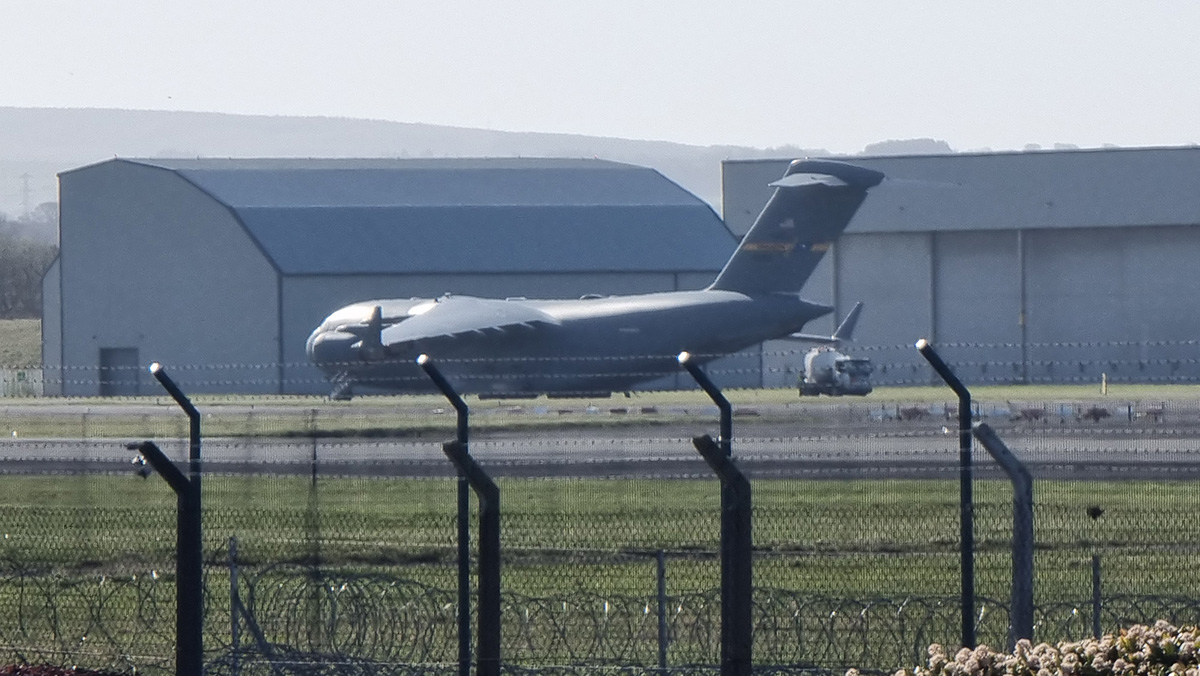
The Scottish Government has rejected a Scottish Greens push to end US military use of Scotland’s publicly owned airports, with External Affairs Secretary Angus Robertson arguing the proposal is not deliverable under devolved powers and framing Prestwick’s role as providing regulated aviation services rather than hosting an American base.
The debate, triggered by a motion from Scottish Greens co-leader Gillian Mackay, focused on Glasgow Prestwick Airport and Highlands and Islands Airports Limited sites. Mackay argued that Prestwick has become “a major de facto military base” for the US Air Force and urged ministers to “evict the United States Air Force from Prestwick and block its passage and refuelling through our publicly owned airports across the Highlands and Islands”.
She cited data showing US military aircraft landed at Prestwick 565 times between 1 April 2025 and 12 February 2026, with flights arriving “on most days” and sometimes multiple times per day, including a claimed peak of 15 landings on a single day in May 2025.
Mackay linked those patterns to wider events and alleged operations, telling MSPs that landings rose by 76 per cent in January during an incident involving the seizure of a tanker in Scottish waters, and that activity last summer coincided with US military strikes during a conflict between Israel and Iran. She argued that continued access risked making Scotland “complicit in the current and future actions of a foreign Government” and said Prestwick’s finances were increasingly tied to military custom rather than passenger growth, claiming passenger numbers were at late-1990s levels and “less than half what they were when the airport was nationalised”.
Intervening for the Liberal Democrats, Alex Cole-Hamilton challenged Mackay on her references to maritime interdictions, asking whether she recognised that seizing vessels in Russia’s shadow fleet is “critical to upholding sanctions and supporting the fighting men and women of Ukraine”. Mackay replied that sanctions enforcement mattered but argued that “when vessels come into our waters, our laws apply”, adding that the removal of individuals from Scottish waters was, in her view, “in contravention of what the Court of Session said should happen”.
Robertson responded by stating the Scottish Government’s support for the rules-based order, sanctions against Russia, and solidarity with Ukraine, but rejected the Greens’ characterisation of Prestwick as an American base. He told the chamber: “the US Air Force does not have a base at Glasgow Prestwick airport, has not operated one since 1966 and does not have any personnel based at the airport.” He added that Prestwick “does not determine the policy, destination or mission of any aircraft using facilities there” and instead “provides regulated aviation services in line with UK law, international aviation standards and long-standing agreements between allied nations.”
While acknowledging disagreements with US positions, including on Greenland, Robertson argued that the Scottish Government would continue to “speak out in support of Scotland’s interests and Scotland’s values” while maintaining ties, describing the US as “our ally” and noting “the bonds of friendship between the people of Scotland and the US run deep.” He also sought to shift the constitutional focus of the debate, stating that “foreign affairs, defence, national security and air transport policy powers are all reserved to the United Kingdom Parliament and the UK Government.” He said the Green motion “appears to invite us to consider taking steps in contravention of the Scotland Act 1998”.
Instead of backing the Greens’ call for eviction and denial of access, Robertson lodged an SNP amendment that removes the demand to bar US military aircraft and replaces it with a statement that the Parliament “supports Scots law, international law and the rules-based order”, “respects the future of Greenland as a matter for the people of Greenland and Denmark”, and is “unwavering in its solidarity with and support for Ukraine”, while also supporting sanctions and action against Russia’s shadow fleet.
The Conservatives attacked the Greens’ proposal as economically damaging and strategically reckless, with Murdo Fraser dismissing it as akin to a student politics motion and arguing that US use of Prestwick supports the viability of the publicly owned airport. Fraser said: “Thank goodness that the US military is using Prestwick, and paying handsomely for that benefit.” He claimed that preventing those movements would simply divert flights elsewhere while leaving Scottish taxpayers facing lost revenue. Conservative MSPs also stressed employment around the airport, with Brian Whittle pointing to an engineering cluster employing thousands and planning further jobs growth, and arguing the focus should be on skills and apprenticeships.
Scottish Labour took a similar position in rejecting the Greens’ motion while placing greater emphasis on legal compliance and alliance commitments. Labour’s Neil Bibby said: “any nation’s use of Scottish and UK infrastructure must be carried out in accordance with domestic and international law.” He argued that banning US military use of Scottish airports would send a “reckless” message about collective defence at a time of heightened instability, and welcomed the UK Government’s defence spending commitment, describing Prestwick as part of a defence-linked employment base. Bibby also argued that US military use of Prestwick is long-established, saying that the airport has supported NATO-aligned customers for decades and that US aircraft have used it since the Second World War.
Cole-Hamilton, speaking for the Liberal Democrats, criticised the Greens for conflating opposition to a particular US president with Scotland’s long-term security interests. He said: “we do not confuse our dislike for one political figure with the long-term security interests of our country.” While voicing concern about the Trump Administration’s approach to alliances, he argued that NATO remains central to European security and Ukraine’s defence, and warned that expelling US personnel would risk signalling division.










We should remember that after Alex Salmond moved to Moscow, on 9 November 2017 the RT channel (formerly known as Russia Today) announced he would host the “Alex Salmond Show” on the network
Salmond took the opportunity to produce virulently anti-English & pro-independence programming, demanding that Scotland became a “nuclear-free zone”, the closure of Faslane and that American SSN and British SSN be barred from Scottish waters
Nothing would benefit Russia more than an independent Scotland, which would open up the possibility of Putin taking control of the military bases. Doubtless involving the deployment of Russian troops to “protect” their assets from the British Army