

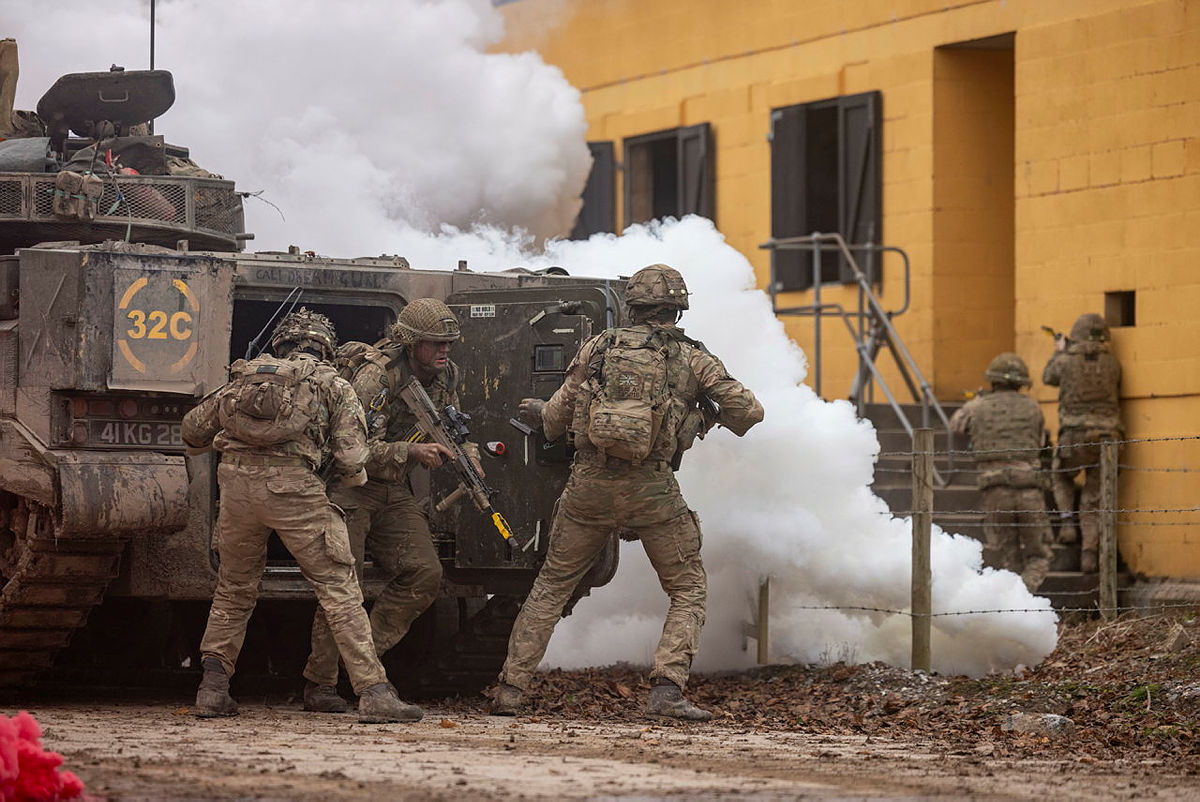
A Singapore-based manufacturer, ST Engineering Advanced Material Engineering, has will win a contract worth almost £66 million to supply the British military with 40mm grenades, according to a contract award notice.
The competition, run by Defence Equipment and Support, covers nine variants of 40mm high and low velocity grenades, the notice said, with the contract valued at £65.84 million excluding VAT, or £82.3 million including VAT. The award decision was taken on 20 March 2026, with the contract expected to be signed on 7 July and to run for five years, to July 2031. The notice carries an option for the Ministry of Defence to buy additional quantities of munitions during that period.
Three tenders were received and assessed in the final stage, with ST Engineering’s bid chosen ahead of two unsuccessful suppliers, NIOA Nominees and Ian Edgar (Liverpool). The notice was later corrected to record the prime supplier as ST Engineering Advanced Material Engineering, after the authority initially named GTDS Europe, which it clarified acts as the authorised representative of the winning bidder rather than the contractor itself.
40mm grenades are fired from under-barrel launchers fitted to rifles, from standalone launchers and from automatic grenade launchers, and form a staple of infantry firepower. High and low velocity natures suit different weapons and engagement ranges, with low velocity rounds used in hand-held launchers and high velocity rounds in heavier, mounted systems. The contract locations listed in the notice span Singapore, the Netherlands and the United Kingdom, reflecting the international supply chain behind the order, which was run under the rules covering defence and security procurement.
The award places a five-year supply of a core infantry munition with a Singapore-headquartered manufacturer, with the two unsuccessful bidders registered in the United Kingdom.
Publication of the award notice opens a standstill period of at least eight working days before the contract can be signed, a step required under the Procurement Act for awards of this kind. Once signed in July, the contract sets the framework against which the nine grenade variants will be delivered to the British armed forces over the following five years.












Sick of hearing that our defense is spending money outside the UK for equipment all the time. When we have mass unemployment,we should be building them here in our country paying British workers who in return pay tax back into the system. No wonder the countries debt is so high when we keep buying from outside all the time.. At this rate we will be owned by another country as borrowing is getting out of hand
Andy …take a breath mate! or you’ll bust something!
There aren’t any 40mm grenade manufactures of scale in the UK. Ian Edgar is a distributor, not a munitions manufacturer, if they had won all they would be doing is UK assembly, quality assurance, and distribution logistics; according to UK Gov.. NIOA Nominees is Australian, would also not have involved any physical UK munitions production. While NIOA is a massive global munitions powerhouse that actually owns heavy manufacturing plants, unlike Ian Edgar, those factories are located entirely outside the UK.
So its down to scale, saving money and “soft power” … Soft power, geopolitics, and deep-rooted strategic alliances that played a massive role in this decision.
Plus, Andy.
75% OF UK DEBT IS OWNED BY THE UK, ONLY AROUND 26.5% IS FOREIGN OWNED.
The VAST MAJORITY OF THE DEBT IS OWNED DOMESTICALLY AND DENOMINATED IN BRITISH POUNDS.
The UK is at a very low risk of a foreign debt crisis. If a country owes money in a foreign currency, like US Dollars, to foreign banks, it can easily go bankrupt. Because the UK borrows in its own currency, mostly from its own institutions, it retains a massive amount of financial control.
Sorry for shouting, but some times you have to cut through the noise.
“as borrowing is getting out of hand” Rich and delicious irony here on UKDJ … I think this is/was the reason Rachel Reeves as the Chancellor of the Exchequer has been trying to steady and pay off the debt by curtailing budgets.
Excellent point with a nodd to broader related arguments around debt and what risk are present if any
Just to pre-melt; one could argue argue that because of the the above, perhaps there should be more borrowing – that’s not an argument I’d make though
Anyway, everything consider and back to topic, there not that much to criticise (especially when considering the comment above from Magenta
The point of tax payers money is to develop and sustain UK jobs and supply chains. If Singapore can do it then so should the UK. This is defence and we don’t make a certain product then the state should be setting up a company to do it. State aid and state ownership is allowed under WTO and EU rules for a reason. It doesn’t confirm to normal market rules.
The problem is scale. It simply might not be worth it to do a whole production line just for a limited customer base. While “Singapore” might sound small (and physically is), their 40mm grenades are sold worldwide which makes up in scale for the low profit margins. Then, thinking of it further, there is also proprietary tech. From what I recall, ST Kinetics has a very evolved grenade line, its not just a kitbash and anything goes, you have to test and government certify that your munitions work as intended and does not work as not intended, like not cooking off in fire or heating or explode when hit by bullets.
All this means that just introducing one grenade type to supply just one organization is really a lot more trouble than it is worth, especially when you have to design it from scratch. It really is better to let specialist organizations handle it for many people. Especially if the specialists know what they are doing. From what I recall, ST Kinetics had a formulation for 40mm grenades that gave about 3 times more blast power than the normal composition 5, which is why they have such a market advantage. If the UK did its own, I doubt the new government company can match the effectiveness of the same offering.
Perfectly logical, I think the true question which covers a lot more than grenades how did we lose so much of our capability to produce weaponry and support matériel. I look at Germany which allowed defence to sink to barely detectable levels, and all manner of new German built weaponry and vehicles with numerous variations are being built, exported or shown off. All we can mostly do in these areas is decide to buy them or get licences to build them here with some uk input. Germany preserved much of its capability by nurturing companies that exported even as internal demand like here failed to deliver. Sadly overwhelmingly our equivalent companies went out of business or like Bae decided to invest in such capabilities abroad where they have been exceedingly successful at exporting those platforms though not to Britain. Raises (if now belated or moot) questions to at least consider I think. One such less moot one is perhaps how Singapore managed to generate a business like this with virtually no internal demand and what is not a cheap internal production base by any standards. That’s a lesson we need to learn more generally in our economy indeed and stop making excuses for past failure while allowing similar complacency and self defeatism to prevail leading to present and future failure.
I suspect that the answer would depress some people lol.
They did it through heavy automation, so claims that it can create more jobs is a forlorn hope.
I did some digging after this article came up and interestingly enough, there is a short that shows the building process of the ammunition. Lots of automation, very little manpower.
https://www.channelnewsasia.com/watch/inside-our-factories/grenades-1537461
Thinking back, I remember vaguely that one of the main reasons for the contraction of the defense industry in the UK was the budget. There was something called the East of Suez movement then where the budget was so bad that the government abandoned all military commitments “East of Suez” save that of Hong Kong. It was a short time before I was born but I did remember that time period when “austerity” was the big thing in politics.
Reposted because the site seem to have deleted my other reply with an external link.
I suspect that the answer would depress some people lol.
They did it through heavy automation, so claims that it can create more jobs is a forlorn hope.
I did some digging after this article came up and interestingly enough, there is a short that shows the building process of the ammunition. Lots of automation, very little manpower. Look up CNA and “In Our Factories: Grenades”. I posted a link here but it seems the site took exception to it.
Thinking back, I remember vaguely that one of the main reasons for the contraction of the defense industry in the UK was the budget. There was something called the East of Suez movement then where the budget was so bad that the government abandoned all military commitments “East of Suez” save that of Hong Kong. It was a short time before I was born but I did remember that time period when “austerity” was the big thing in politics.
What do you value more capability for our armed forces or paying off the national debt. Our track record of buying from the UK hasn’t always been great resulting in significant increased costs for the MOD.
Truth teller
Exactly, we have and indeed continue to exacerbate this problem.
We have another one to consider not directly related but indicative I fear of future widespread consequences. All major powers now are creating digital versions of their currencies, Europe is doing so with the digital Euro which it is estimated will seriously threaten the position of Visa and Mastercard transactions and more importantly give an option to keep such transactions business and personal off of US servers. Fact is everyone of those transactions potentially can be inspected by the US Govt and if it wishes it can close down the facility to nations, officials, organisations, targeted businesses or even individuals like Court Judges for example if it so wishes. Till Trump came along the danger seemed relatively remote but no longer. Within a decade Europe will be resistant to this, Canada is going the same way as is India, Russia and BRICS of course so one has to ask what is Britain’s plan. Anyone heard of one, because without one we seriously risk being an effective colony of the US with national decision making totally at the whim of US Presidents, Congress and increasingly oligarchs and tech bros and their influence. It’s one of many similar risks but perhaps the most crucial one if we want to retain independence because potentially any decision we make will eventually need US approval, like the Digital Services Act, which is vital to replacing traditional methods and sustaining at all a national tax income commensurate with providing the services including defence choices we need to make. Ironic considering much of the motivations that fuelled Brexit, but few people realise these new dangers staring us in the face. Even politicians seem to be oblivious, certainly keeping quite but then they did ai till it hir them in the face years after fears and opportunities were there to be seen.
RIP Dame Penelope Keith.
“We have an established order in this Close, Barbara! A way of life!”
Where maybe, the UKDJ is a metaphor for the “Close” in Surbiton. wtf!
OH NOOO!!!!!!!! I was so very fond of that lady…..seen her in Milford at the Garden Centre.
A national institution much in the way John Cleese is for me.
So sorry to hear this….
Oh sad news 😔. She always struck me as being so wonderfully English. God bless.
Should name a ship after her. HMS Penelope.
There was a Penelope in modern times, a Leander I recall.
She supported the Armed Forces as well I believe.
Could they be made here if not when whats every one crying about, no time to wait to build a factory etc, buy what we need when we need it not 2 years time .
Several points. First, as others point out this is money leaving the UK, we won’t see it back, that means the economy shrinks and people lose their jobs here. Second l, did we not learn anything from the Falklands, if you don’t make your weapons you can’t guarantee supply when you need it l, the Argentinians did t get the exocets when they needed them and lost. We lost our position as the world’s greatest creditor before world war one because the idiots in charge wouldn’t buy British and spent all our money abroad then borrowed more and spent that turning us into the world’s greatest debtor. We killed our car industry because the police bought foreign, we killed our van industry because the councils bought foreign, we killed our ship building by buying from Korea, our government is run by bone heads, when you make a mistake learn and do t repeat, they seem incapable of learning. Our civil servants actively work against our national interest and our politicians are happy as long as their back pockets are kept full
Wow … “We killed our car industry because the police bought foreign.”
I’ve read some dudes on UKDJ but that takes the biscuit. Congratulations!
No the police buying foreign cars didn’t kill the British car industry. It was actually the other way around, the decline of the domestic car industry forced the police to look elsewhere.
It became a massive symbol of national embarrassment, the police shifting to foreign vehicles was a symptom of a failing industry, not the cause.
Up until the mid 1960s, British police forces almost exclusively bought British cars. But a turning point came in 1965 when the Hampshire Constabulary controversially bypassed British manufacturers to buy a fleet of Volvo estate cars for motorway patrol.
They didn’t do it out of malice or to save a buck; they did it because British manufacturers simply weren’t making what the police needed. The police required vehicles that were fast, structurally safe, could carry heavy equipment, and, crucially, wouldn’t break down during a high-speed pursuit. At the time, British alternatives were notorious for overheating, suffering from electrical failures, and lacking structural rigidity.
The true collapse of the mass market, British owned automotive industry, most notably British Leyland, which owned brands like Rover, Triumph, Austin, and Morris, came down to severe internal and structural failures throughout the 1970s and 80s. British cars developed a global reputation for unreliability. Loose trim, oil leaks, and notorious electrical faults, often blamed on Lucas electronics, jokingly called the “Prince of Darkness” alienated regular buyers and police forces alike.
Constant, crippling strikes and poor industrial relations between militant unions and combative management paralyzed factories for weeks at a time, halting production lines and tanking build quality. While German and Japanese competitors were pouring money into modern, automated factories and cutting edge engineering, British factories were using outdated machinery, some dating back to before WWII.
Later on, European Union public procurement rules mandated that public contracts (like police fleets) had to go out to competitive tender. The police were legally required to choose the vehicle that offered the best value and performance, and British cars rarely won those bids against robust competition from Ford Germany/Europe, Volvo, and BMW.
Nuance, if you care … The UK car industry isn’t actually dead it just looks completely different. While mass-market British owned companies collapsed, the UK remains a massive automotive powerhouse. Today, major foreign companies build hundreds of thousands of cars in highly efficient UK factories, like Nissan in Sunderland and Toyota in Derbyshire, and the UK still thrives in premium, luxury, and motorsport engineering, Jaguar Land Rover, MINI, McLaren, and Aston Martin.
You need to grow up and get yourself an adult perspective on facts and economic history … ditch your high school cartoon version.
Spellcheck typo, second paragraph, for “dudes”, read – doozies. 🤷🏼
Interesting, I see the website has swapped out my iPhones, iOS. 🤷🏼 (Shrug) for a totally different one that’s not even in my Emoji library.
You can pretend you are right, but lets face it we had a British car industry delivering British cars while the police were buying Volvo, BMW, Porsche even Mercedes and VW. We produced estate cars, we produced sports cars, we produced saloon cars but the British police shopped abroad while we were still making them – just check. All of this was Thatchers ‘competition’ idea, backfire horrendously. You see it would have been fair if the Germans at the time were not able to claim bribes against tax – so common in Germany to bribe potential customers. Even today if you go to Germany you will see a mix of German police cars to the exclusion of all other nationalities, over one police car per cop and all under 6 months old as they use the police budget to create government support for their motor industry. The French dont go quite as far but there are no other makes of police car in France than French. The Italians strangely enough only have Italian, even the Americans whose cars are notoriously bad only have American police cars.
As to you assertion, the police didnt need to buy Volvo, at the time we did make large solid cars with storage room that could lug heavy equipment without breaking down – yeah, I will grant you that an Austin 1300 or a mini was probably not fast or big enough (though they were more than reliable enough even at speed) .
The ‘prince of darkness’ bull sit came from the yanks who like to bugger the British where ever and when ever possible, its a national passtime. Amusingly perhgaps the culprit in this saga was a component in the Jag, one which was a rebadged American product. Today my two MMorris Minors (1959 and 1960) and my 1966 Viva HA all sport this supposedly unreliable Lucas electrics with no reliability issues though I do admit that at some point the ‘lucas cup’ battery connectors have been replaced with clamps because that was one component that did cause trouble if you didnt maintain them.
You are correct that in fact, although foreign owned, we do still make a lot of cars here – not many vans or lorries though – as councils worked hard to destroy those as well – however despite the strength you point out the Police STILL buy BMW, et al and not local
Pretend I’m right … give it up Dave, you’re living in the past.
I’m as passionate about British cars and the British car industry as anyone can be … I lived through and experienced its demise, I understand the facts and I accept them, regardless of how fscking hurtful they are.
Your revisionist history ignores the cold, hard operational realities of the 1970s and ’80s. The UK mass market car industry wasn’t killed by a foreign conspiracy or a sudden policy shift; it committed industrial suicide through a toxic combination of militant unionism, abysmal management, and catastrophic quality control.
The UK police didn’t buy foreign cars out of unpatriotic bias; they bought them because they needed vehicles that would actually start in the morning. Motorway patrol units were desperate, and the Home Office quietly looked to Sweden.
[You could almost believe the Chief Constables of the era were avid readers of Peter O’Donnell’s “Modesty Blaise” novels; I was! … they certainly shared Willie Garvin’s legendary fondness for Volvos because they were practically indestructible. Much like Willie testing a car’s structural integrity by aggressively bashing his fist against the wing without leaving a dent, the police needed a vehicle built like a tank.]
The Volvo 240 and 740 estates could be loaded with heavy steel signs, traffic cones, and radio gear without the suspension sagging or the engine giving up. It was a massive brick that kept working, 24 hours a day, 365 days a year.
BL wasn’t just a car manufacturer; it was an industrial battleground. Militant union leaders like Derek “Red Robbo” Robinson credited themselves with over 500 walkouts at the Longbridge plant in just two years, costing hundreds of millions of pounds in lost production.
But management was just as culpable. Arrogant and out of touch, they completely failed to implement modern quality control. They used the profits from successful brands like Jaguar and Land Rover to subsidise abysmal mass-market failures like the Morris Marina and Austin Allegro, starving the premium brands of crucial R&D funding and cementing Land Rover’s long-term reliability issues.
Your somewhat quixotic and deeply rose-tinted defence of Lucas electronics by citing a 1959 Morris Minor or a 1966 Vauxhall Viva completely misses the point. A 1950s car has an incredibly primitive electrical system, consisting of little more than a battery, a generator, a distributor, and a few basic lights. There is virtually nothing to go wrong, and it does fail can be fixed with a screwdriver and some sandpaper.
Cars by the 1970s, became vastly more complex, requiring electronic ignitions, electric windows, safety sensors, and intricate wiring looms. Lucas tried to manufacture these modern components using outdated machinery, cheap materials, brittle plastics, poor quality copper, and a demoralised, striking workforce. The resulting systemic issues, such as water ingress, corroded ground wires, and switches that literally melted under normal voltage, weren’t an “American pastime” myth, they were a global consumer nightmare that rightfully earned the company its reputation. Everyone seems to know and accept this except you.
What Thatcher actually did and did not do … despite her free-market rhetoric, Thatcher did not instantly swing an axe at BL. Fearing mass unemployment, her government actually kept BL on life support, pumping roughly £1.5 billion of taxpayer money into the firm to fund the Austin Metro, Maestro, and Montego. equates to roughly £8.35 billion in today’s money … to put that into perspective, an eye-watering sum of taxpayer cash spent on just three mass market hatchbacks and saloons, and goes to show that the Thatcher government didn’t starve BL of capital; they heavily funded it, but the structural flaws within the company were simply too massive for even billions of pounds to fix.
However, thatcher did attached strict conditions. She fully backed Chairman Sir Michael Edwardes to break the crippling power of the shop stewards, balloting workers directly with a simple choice: accept massive downsizing or the government pulls the plug. She then forced a crucial engineering lifeline with Honda to inject Japanese reliability into Rover, before eventually breaking up the company and selling off the pieces.
It must be acknowledged, however, that Thatcher’s broader economic policies actively accelerated the downfall of exports. In her aggressive fight against inflation, her government raised interest rates dramatically. Combined with booming North Sea oil revenues, this sent the value of the British pound skyrocketing to $2.40, making UK exports incredibly expensive overnight. This economic squeeze effectively dealt a death sentence to mass-export sports cars. It killed off the Triumph TR7, the V8-powered TR8, the iconic MG MGB; leading to the closure of the Abingdon MG factory (my beautiful home town) in 1980, and affordable staples like the MG Midget and Triumph Spitfire, while pushing independent makers like TVR and Lotus to the absolute brink of bankruptcy because they could no longer sell into America at a profit.
The hard truth is that while the Thatcher government’s high Sterling policy effectively killed off the UK’s automotive export business, the domestic mass-production industry was already terminally ill from its own internal failures. The government didn’t invent the terrible reliability, the abysmal management, or the crippling strikes, but their economic policies ensured there was nowhere left to hide.
Even after the scandal and tragic experince of the N57 straight-six diesel, 3.0-litre engine the police still buy European cars, including BMWs today, it is a matter of economics and specialisation, not unpatriotic bias. In Germany brands like BMW have long had dedicated, factory-level “Authorities” divisions. They don’t just sell standard civilian cars with blue lights glued on. They build “police spec” vehicles right on the main assembly line with integrated heavy-duty wiring looms, upgraded alternators, deep-discharge batteries, and reinforced suspension to handle heavy police kit. Because they buy in bulk, the police get massive fleet discounts on vehicles explicitly designed to take 24/7 operational abuse.
Ultimately, the public … and the police, simply voted with their wallets for cars that worked.
The point of tax payers money is to develop and sustain UK jobs and supply chains. If Singapore can do it then so should the UK. This is defence and we don’t make a certain product then the state should be setting up a company to do it. State aid and state ownership is allowed under WTO and EU rules for a reason. It doesn’t confirm to normal market rules
Correct, we should BECAUSE it is defence and if we cant make it we cant defend ourselves with it. The yanks will NOT supply F35 spares or replacements if we are using them to defend the Falklands – they wont supply the missiles either – look how they have screwed Ukraine. Frankly while trump is in power I doubt they would even help us if Putin invaded.
It’s 40mm grenades. The UK does not have the tech for it. ST gets the orders because they somehow lucked onto a formulation for explosives that gives it 3 times the energy of the current day Composition 5. You want to build a new grenade plant? Sure. But how are you going to match their technology edge? Accept grenades that are 3 times weaker? Not to mention it isn’t even one grenade type, the article refers to 9 different types, which I’d take as probably a mix of live rounds and training rounds. The time and cost needed to redesign NINE different types of grenades and to certify them as safe for use is a serious waste of time and money for a single buyer.
Their explosive was called the MX-09 if I recall correctly. You can search for it with a combination of ST and MX-09.
Yes I do want to build a grenade plant. When we have a war and need grenades we will need the plant, we will need someone to have sent time creating a suitable explosive and learning the skills to make these things, and all other armaments we need. We cannot protect ourselves relying on the foreign policy whims of others. If Russia invaded do you honestly believe a trump led government will actually help? Even the Biden government didn’t fulfil the promise to protect Ukraine
Right, if only everyone could have scientific breakthroughs on demand, the world would be so much more advanced. Skylon would even be in service now!
Have you ever thought that you could spend millions and end up with no breakthrough at all and a sub-par product? Not all Horbart’s Funnies were successes. If you really want a plant, talk joint venture with the Singaporeans. Money will still flow over there but it’s better than gambling and getting nothing. You’ll be paying for guarantees and not a gamble. Think I heard something about them and Poland already doing it.
I am sure scientific breakthroughs are hard to come by, heavens above, I have been a science trained engineer for long enough too understand that. I also understand that donating money to other countries doesnt help this one make any scientific breakthroughs. We know where to get some of the current chemical to analyse it so we could even just be cruel and copy it, maybe we could licence it as a start point, maybe it is worth us actually starting to learn to do these things as we will HAVE to if we want to defend the country.