

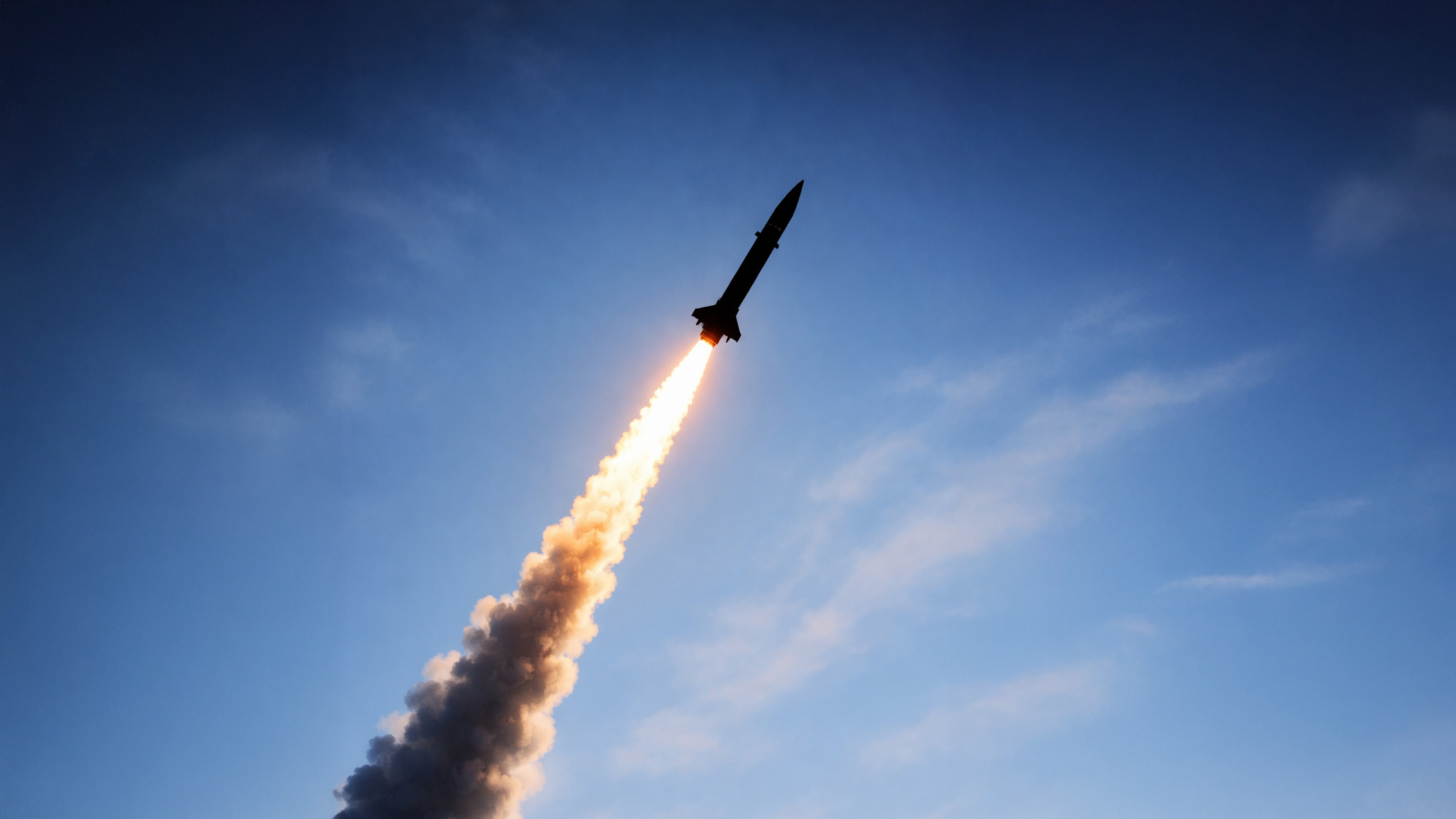
Defining deep precision strike as the ability to put a missile on a target hundreds of kilometres away is thinking about the problem too narrowly, a capability presentation at the Apex Europe conference in London heard on Wednesday.
Luke Wattam, co-founder of the British company Labrys Technologies, titled his talk the missile is the easy part and spent it arguing that reach matters more than range.
He said: “Deep precision strike is not simply about range, it’s about reach. It’s about being able to sense, understand, decide and act against an adversary at distance, potentially through a combination of military, commercial, partner and proxy capabilities.”
What that definition covers is a good deal wider than a missile. It might be a long-range weapon, or sabotage conducted by a proxy, or forward-deployed systems, or local actors generating intelligence, or a partner force identifying a target that a commercial sensor then confirms before a military effector delivers the result.
His point was that none of those have the weapon in common. “The common denominator is not the weapon. The common denominator is the ability to extend trusted command and control beyond the traditional boundaries of our military network,” he said. “The easiest part of deep precision strike is actually the missile. The much harder problem is everything that has to happen before the missile is fired.”
The questions he listed are the ones a targeting cell has to answer about a source it cannot see. How do I know the person giving me this information is who they say they are, how do I know where they actually are, how do I know the image they have sent has not been manipulated, how do I know the person receiving my instruction is authorised to act, and how do I hold any of that together when they are thousands of miles away in a place I cannot physically verify.
Procurement, in his account, is not currently set up to answer any of them. “We procure radios. We procure military networks. We procure encrypted communication systems. And we ask, how secure is this radio? But we don’t necessarily ask a much bigger question, which is what is the technology ecosystem, embedded security and trust primitives that I need to conduct a full-spectrum hybrid operation?” he said.
Commercial messaging applications have become important in recent wars because they do something military systems struggle with, which he described as opening the funnel. In Ukraine the people who suddenly matter include a farmer with a drone, a civilian with a smartphone, a local soldier, a resistance network, a commercial satellite provider, a logistics company, a conventional unit, a special operations team and a government agency.
“We spend extraordinary amounts of money buying encrypted military communication systems, and then when the crisis actually happens, people reach for Signal or WhatsApp. Why? Because they’re free. They’re encrypted end to end. They are familiar. They’re easy to download. And quite critically, because you can put them into the hands of a partner, a contractor, an irregular force or a civilian in seconds,” he said. “The user has already voted. The user is telling us what they need.”
Those applications were never designed to be the command and control backbone of a military operation, which is the gap he says sits between the two options most forces actually have. One is the traditional military green box, secure and controlled but limited by the number of trusted users a force can equip, train and manage. The other is the commercial application, ubiquitous and encrypted but without any trust architecture behind the conversation.
Mobilising people at scale is where he thinks the distinction bites hardest, since a population cannot be asked to become signals specialists first. A call to arms that does not require anybody to join the military is how he put it, with someone photographing enemy equipment and that image reaching an authorised operator with its provenance attached. Farmers and hauliers already own machinery capable of blocking a route, and nobody doubts they can move a tractor.
Labrys builds a platform called Axiom around this argument, and has signed a short-range precision strike and sensor effects integration programme intended to carry the same approach from a phone out to sensors and weapons.
His conclusion was about where the advantage in all of this will actually come from. “The future of deep precision strike is not simply going to be about building a bigger missile. It’s going to be about building a wider, deeper and more trusted network around that missile,” he said. “The decisive advantage will belong to the force that can extend its reach without losing its trust.”







Valid points, but 100s of KMs isn’t enough in a country the size of Russia.