

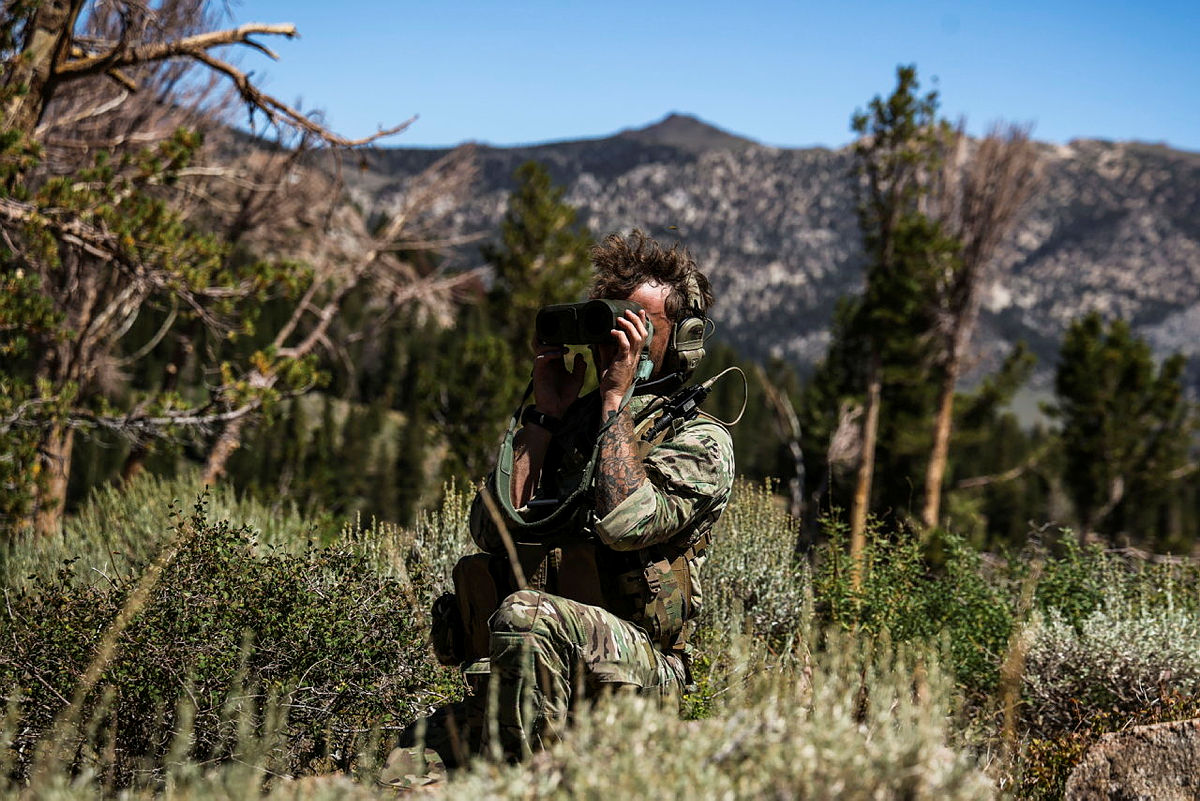
The Defence Science and Technology Laboratory has developed a thermal imaging detector more than ten times as efficient as current designs, work that could lead to cameras small and light enough to fit on drones or be carried by individual soldiers, the laboratory stated.
The problem being addressed is temperature. High-performance thermal cameras have to be chilled to around minus 193 degrees Celsius to work properly, and the cooling engines that achieve it are bulky, heavy and power-hungry, which is why the best sensors tend to sit on vehicles, aircraft or fixed installations rather than on a person.
Dstl worked with Amethyst Research and Lancaster University on a detector architecture combining three changes. A thin absorber layer cuts unwanted thermal noise, a semiconductor layer acts as a mirror to reflect and confine infrared light within the detector, and structuring at a scale smaller than the wavelength of the light itself improves the fraction absorbed.
Together, those changes raised efficiency more than tenfold while lowering thermal noise, which, according to Dstl, opens a route to cameras that work at closer to minus 123 degrees. That is 70 degrees warmer than the current requirement, and warmer operation means a smaller cooler, less power draw and a lighter package overall.
The next phase will mature the technology and build an imaging demonstrator.
Thermal cameras detect heat rather than light, which is what allows them to see through smoke, dust and darkness and to find targets at long range in conditions where ordinary optics fail. That capability has become more valuable as battlefields have filled with obscurants, and as both sides in Ukraine have learned to move at night and to screen their positions.
The distinction the research turns on is between cooled and uncooled sensors. Uncooled thermal cameras already exist in quantity, are cheap enough to appear on commercial drones and hunting scopes, and need no refrigeration, but they are markedly less sensitive and slower to respond, which limits their range and their ability to pick a warm object out of a cluttered background. Cooled sensors do all of that far better and cost and weigh a great deal more. Narrowing the gap between the two is what a detector working at higher temperatures would achieve.
The applications Dstl names are small platforms, drones and dismounted soldiers, all of which are weight and power constrained in ways that have kept high-performance thermal imaging out of reach. A drone that could carry a cooled-quality sensor would see considerably further than the uncooled cameras fitted to most current types.
Dstl is the Ministry of Defence’s research arm, based principally at Porton Down in Wiltshire and Portsdown West near Portsmouth, and now sits within the National Armaments Director Group alongside Defence Equipment and Support. Amethyst Research is a semiconductor company specialising in infrared detector materials, and Lancaster University has a long-standing physics group working on infrared semiconductors.








So the research is done and there’s no money in the DIP to develop it. Does DSTL sit on it until other countries have overtaken the tech, or what? Give the tech away and hope the company they give it to isn’t bought up by a foreign concern?
Not sure how relevant the DIP is. It will almost certainly be revised if not completely re-written.
Amethyst Research are an American concern. So the scenario will be Amethyst will take the knowledge from Lancaster University and DSTL and transmit all relevant key data to America. UK will not fund it. US will develop the technology UK loses any IPR, copyright and the UK will buy it from the USA at grossly inflated prices, complete will ITAR, restriction son use and export.
That will be another British innovation destroyed
Amethyst Research comprises two affiliated companies, Amethyst Research Inc. based in the US and Amethyst Research Ltd in the UK. I’m not saying you are wrong about the rest, it seems all too possible, but I’d rather hope DSTL is currently working with the British arm.
I agree Jon – I base my realism (cynicism?) on 45 years of experience. We are brilliant at ideas, inventions, R&D but all too often foreign competitors swoop in for the main course! I hope I am wrong.
I know DSTL will be doing this for a reason. My only comment is that the viper sight (that we have on the Rifle and have since 2008/9) is already very good. We used to be able to see freshly laid IEDs with it. I remember an RTR officer I showed it to being blown away by it because it was more effective than they had on Chally 2.
If they get something better and lighter then it would be epic.
It would not be a great surprise to see a Government initiative to boost troop numbers and consequently equipment would need to be bought. I can see a budget emerging from that. Disposes of youth unemployment in one move.