

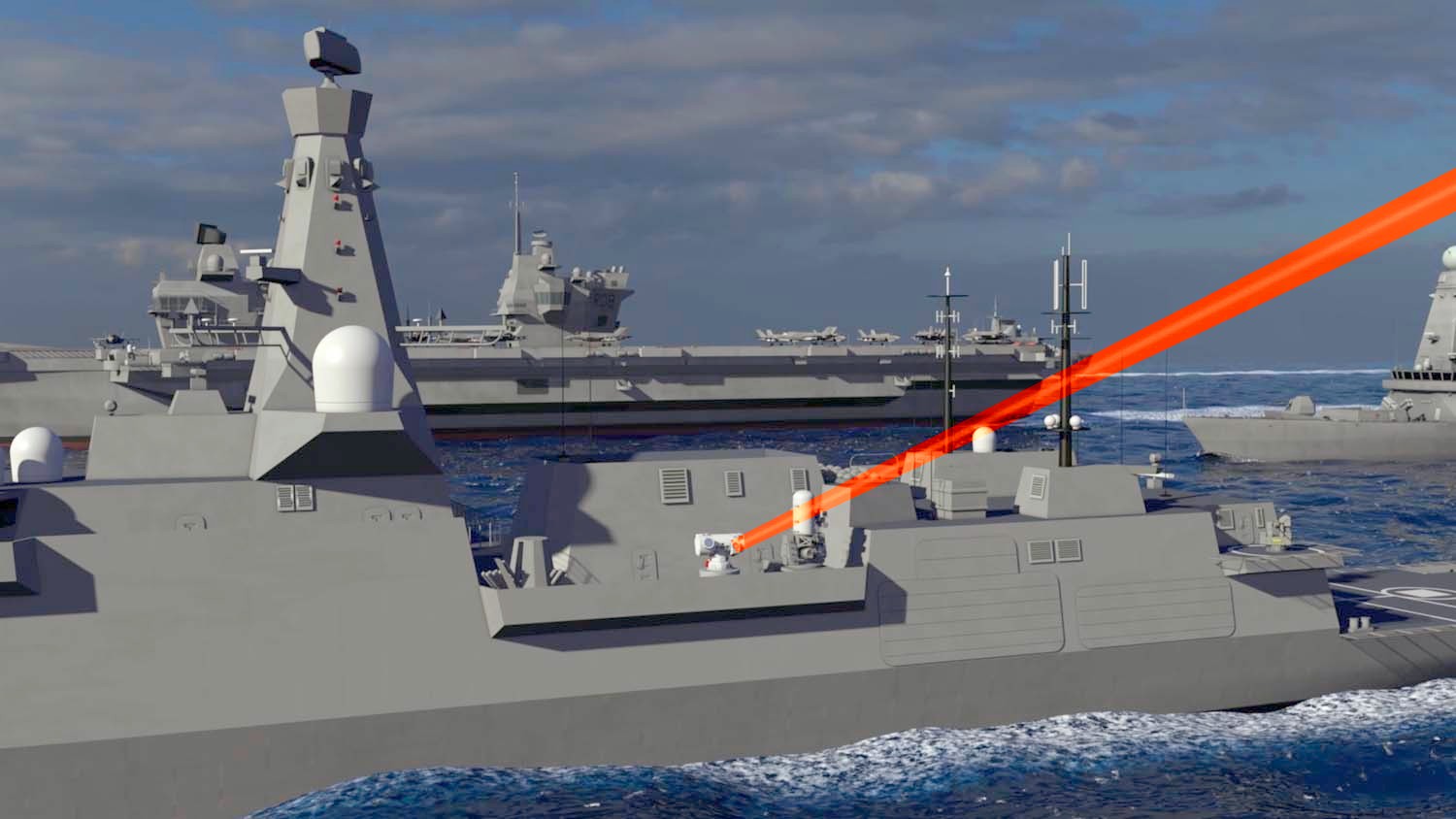
The Ministry of Defence has confirmed that the first DragonFire laser weapon will be installed on a Royal Navy vessel in 2027, while leaving open when and whether the system will be expanded to additional ships.
The position was set out in a written answer on 4 December to Conservative MP James Cartlidge, the company stated.
Cartlidge had asked whether departmental policy was to fit DragonFire on four vessels in 2027. Defence Minister Luke Pollard replied that “the Ministry of Defence plans to install the first DragonFire system on a Royal Navy vessel in 2027” and that further installations “will be in accordance with the Defence Investment Plan.” The answer confirms the initial fit but does not commit the department to a wider rollout.
The UK Defence Journal has previously reported that DragonFire destroyed high speed drones during recent trials at the MOD Hebrides range, with the department stating that the system achieved above the horizon tracking, targeting and engagement against targets moving at up to 650 kilometres per hour.
The government recently awarded a 316 million pound contract to MBDA UK to deliver the first ship fitted systems from 2027, with the initial integration planned for a Type 45 destroyer. In the trial announcement, Pollard said “this high power laser will see our Royal Navy at the leading edge of innovation in NATO.” Industry figures also highlighted the programme’s momentum. Chris Allam of MBDA UK said the latest contract “reaffirms the UK’s intent to be at the forefront of laser directed energy weapons,” while Leonardo and QinetiQ pointed to the accelerating test cycle and the system’s precision.
DragonFire is expected to be the first high power laser weapon fielded by a European nation.






Surely the appropriate number of ships to arm with Dragonfire is every ship that can take it.
– Both carriers
– All frigates and destroyers
– Any and all amphibious assault ships/landing ships/MRSS
It’s an incredibly expensive system, and will be demanding on power requirements
Not remotely as expensive as replacing a lost ship or worse it’s crew. Cost is a poor excuse to skimp on defensive weaponry.
But it is a lot more expensive than some systems that are (at least for now) more capable, like the Bofors 40mk4.
No Dragonfire weapon cost has been published. Your comment is pure speculation.
It’s not pure speculation we’ve seen contracts for fitting and the weapons cost nearly a million each
If it costs less than a million each it’s an enormous margin and every ship in the fleet should have several of them!
I was wrong. 89m per ship set according to NL
Inaccurate figure
That is profoundly cheap: a basic 30mm cannon system will set you back about 2 million a pop.
Turns out I’m completely off on price but it is actually expensive, NL says 89m per ship set
I was going to 1mill a pop would be a fit 4 to everything sort of price,
Always fact check, I’m about 88 million off the mark
NL derived the figure by dividing the Dragonfire development contract by 4. The contract includes R & D and is not purely for the production of weapons sets.
So hardly a “fact” dude.
Cost per weapon has not been published.
And you really think it’s going to be any cheaper than existing gun based systems
And you really putting words in my mouth?
A million each is not expensive when you consider the price of a sea Ceptor missile .
Got the price wrong, 89m per ship set off recent contract
Do you have info you can link to 89 million seems a bit high.
Ummm….£316 Mn/4 = £79 Mn 😉
Ah yeh, a bargain…
So simply divide a development contract by number of units gives the unit production cost??
Gimme me a break dude.
By definition, for developmental units. Production units, different cost basis.
Nonsense. The assertion being debated is the high cost of dragonfire weapon systems. Seeing that the cost is unknown, its impossible to prove.
The carriers were built with large amount of excess power generation as were the 26s and one would assume the type 42 as well.
As an engineer one would hope that every RN surface vessel has been specified with excess power generation capacity.
“Type 42” is probably no longer able to receive them !
Why do you think that? Either way. If they don’t have it in raw power generating capacity. Their are ways round it such as flywheels , capacitor banks etc.
Because … Typo ……
Type 42 ?
🫡
Probably because the last one was scrapped in 2015…
If by Type 42 you mean Type 45,fitting 3 new DG sets of a much greater Power Rating than the original 2 doesn’t sound to me they were built with an excess of Power Generation.The Type 26’s should have the required capacity but it only has 1 GT fitted ( though a good one ) but until Trials are completed it is a bit too early to say.The Carriers i grant you likely have plenty.
GT is direct driving the props though, not generating power
Bollux. Type 45’s are 100% electric drive.
I was referring to T26
Then say so.
Certainly ALL the 45’s and the carriers. After that I would have thought that every new ship should have Dragonfire. Otherwise we have developed a very expensive nothing., a very unusual experience for the U.K.!
The 45’s will get it…
But how much does Dragonfire cost? Because if a CAMM installation and DS-30M on the QE class is anywhere close I’d rather see that.
Last I read the carriers won’t get CAMM because of the potential damage to the deck and the “danger” to embarked aircraft.
I think the CAMM excuse is False. Its just another excuse to do nothing and endanger the crew. Its the HMS Hood excuse of keeping her in Commission and not correcting know faults, because it was ‘Just Good Enough’.
The issue is that the US Carriers have a rocket defence system. The French and Italians have Hot Launch Missiles on their Carriers. However CAMM is cold launched so it doesnt create the problems AT ALL if mounted on the stern. You can see how clean launch it is on endless videos. The Italians are adopting CAMM probably for that reason.
There problem solved if we can realign our thinking and priorities. I blame the Admirals.
To be fair HMS Hood was scheduled for a complete rebuild along the lines of the Queen Elizabeth class battleships and HMS Renown. Unfortunately, the war got in the way… with tragic results.
Had she been upgraded as envisaged she might well have been more of a match for the Bismark.
What might be a useful compromise for the carriers would be a couple of missile carrier drone ships directly controlled from the carrier’s CIC. Would potentially be an easy fix as well and would not require major works to the carriers themselves while providing potentially a greater number of ready to fire missiles. It would also get around the admiral’s apparent aversion to putting missiles on the carriers and would create an extra supporting requirement to hustle forward with arsenal ships. I still think a basic arsenal ship i.e. no radar or CIC system on the drone, is the way to go at least in the first instance as most of our high value assets (carrier and large RFA’s) all have ARTISAN radar and a CIC so should be able to take the upgrades to control a basic arsenal ship / missile carrier.
Dragonfire on the carries and RFA’s et al. is also a must as far as I am concerned, provided they have enough power generation capability, of course.
Cheers CR
I think the priority is to get the gun and missile armaments up on all actual crewed ships/carriers before starting to spend millions/billions on drone ships. All those Mk41s marked for the T91…what happened with the T45 upgrade right now? Why none there or even the ExLS? Same on the T26, why not ExLS instead of the CAMM farms? And what’s happening with the T31s CIP?
A couple of 6 CAMM sIlos might be okay on the B2 River’s or in a container on the back deck.
Totally agree with regarding Hood’s never to be refit. She would still have been a battlecruiser but would have been toughened up a bit; though she was already overweight :/
Blame the Treasury. They hold the purse strings.
Thats the “FOD” excuse thst other navies seem to deal with okay. And if the RN was/is thinking of launching missiles off the carriers deck well that has to a be a pretty big “FOD” grnetstor? What are they thinking there? They could easily add 30 or 40mm or even an additional Phalanx/RAM or maybe even CAMM/CAMM-MR down the starboard side sponsons with a little bit of re-arranging.
*sorry for the typos.
Morning J and Q. I can’t see what the problem is either. I did actually suggest the idea in a post ages ago here. I can’t remember where the article was about the difficulties with the fitting but as you say the Italians in particular don’t seem to have any issues.
CAMM for carriers has been doing the rounds not just here on ukdj but NL and others sites. It’s bonkers they don’t improve the defensive abilities of these carrier’s considering the assets and personnel onboard and all the new stuff still to come. Even HMS Ocean had 3xPhalanx’s and 4x30mm. As a lot of us have said look at what our allies do and ask why doesn’t the UK?
Correct, it’s utterly bonkers but so much of UK defense is that same way these days.
I agree with you entirely but with the penny pinching going on these days we probably can’t afford a second hand bofors.
I agree but there seems to be no money for anyhting beyond round robin meetings that achieve nothing.
I’m not aware of any official statement blaming FOD for the absence of QE self defence missiles.
OTOH, the internet is full of “experts” claiming this.
Always sems a bogus argument when most other carrier operators have SAMs.
We’ll either lose or suffer devestating losses in the next war becuase we flatly refused to fund the numbers & gear we need.
From what I’ve read our dragonfire is probably the shortest ranged laser system. 40mm plus Dragonfire would be my choice, though there’s ultra light, cheaper anti drone misiles coming onto the market. Plus directed microwaves to fry the electronics. We need all to give survivability.
The other systems also remain operational when smoke/wether makes lasers inneffective.
Yes, yes and yes!!
Perhaps we could put some bright lights on our P8’s – light up a few Russian spy ships, or Chinese for that matter – Australia could try it out from their P8’s which got the same treatment.
I keep getting different information, is it 316 million pound all type 45s or a type 45?
Please ignore.
The figure includes research and development, how much a weaponized system would cost has not been published.
I realised when I posted.
Cool, dude.
Easy answer, anything that can meet the weight and power requirements and potentially sails into harms way should be fitted with it!
I wonder what the cost is of one Dragonfire v a 40mm Bofors including maintenance and per shot costs. And given that, what would a serving sailor honestly say they would prefer to have on the ship if it was a choice.
Good luck hitting a supersonic missile and motar rounds with a pom pom
At this stage (as much as I support serving personnel having their say generally) I really don’t think their opinion would be of much value as it would NOT be based upon experience or actual performance and there is always a tendency to stick with what you know which is why we had some Generals wanting cavalry, Admirals wanting ICE (or even sail) over turbines and Squadron Leaders preferring biplanes to monoplanes, timing and proof of concept is everything. In 2029-30 it might be worth taking note mind as they will by more involved in real time experience.
I guess its going to be Glasgow or a T45 coming to the end of PIP
Diamond
Their position seems reasonable. First off, install one system on a working warship, then sail it out into the north atlantic in winter and find out if it can still do what it can do from a static platform in the UK. Then decide whether to spend millions on more of them.
That is indeed the plan: install a few systems for evaluation before rolling out more.
Yes indeed something this new you do want to try with one.. the secret is to then roll out quickly.
Agreed experience generally brings up unexpected factors. Find as many of them on installation one and then modify if required for further installations. Could save a lot of pain, money and even time in the end.
Would be fine if we hadn’t already spent nearly £400 million developing it.
Cheap for the capability. How much was Sea Ceptor development cost?
Only cheap if it’s fitted to all our ships of size and I can’t see that happening sadly.
I would like the MOD to also consider a land based option that works alongside the directed RF weapon. As we seem to only have 6 main operating bases for the RAF, is there the budget to protect them. But we should also consider how key Army bases and depots need protecting. As the Ukrainian-Russia war has clearly shown. Drones are now a key weapon, where missile defence isn’t really cost effective, so a cheaper alternative is required. A laser or RF based defence system seems like a possible cheaper target per shot solution.
What’s the advantage of buying a novel laser-based system system when we don’t even employ the cheap 30mm systems that we send to Ukraine for VSHORAD, MSI Terrahawk Paladins. Surely we should start with something tried and tested. Five or ten years from now when we understand the properties of Dragonfire better and are moving on to a second generation, that’s the time to volume splurge to get the price down.
Well said. And if I can add even the Boxer Skyranger 30 or some equivalent. Why the waiting on this. Sorry to be flippant but all those decommissioned T23s have two spare sets of 30mm each that could be repurposed or upgraded? Plus their CAMM. They could probably kit out a small fleet of the newer BAE Leander’s if they ever got built!
In a war time scenario, I would agree. Using the Terrahawk or any SPAAG would be much quicker to deploy and probably a lot cheaper. However, we the UK are not at war. If we fielded a Terrahawk system and it detected a drone flying near an airport, say Heathrow. It will be using either a 30mm or 40mm autocannon, probably with time sunburst shells.
Will the operator, speak to air traffic control or will they start blatting at the drone? If the drone’s over a residential area, will the operator still fire. Are the timed shells guaranteed to airburst or will a percentage fail and keep going?
A laser and directed RF weapon are inherently safer to use in a peacetime environment. But you’re correct that a Terrahawk like system would be able to provide similar levels of protection.
Equipping RAF bases should be relatively straightforward given their locations and the need to avoid a big hill at the end of a runway. Manufacturing and warehousing can have AA as a matter of course in the event of a war. The issue with that is we are effectively taking a knife to a gun fight. Hypersonic missiles are hard to hit with any manually aimed ordinance. Ukraine has shown this. They are more akin to making the populace happy that “ something” is being done. The Russians and Chinese don’t tend to send just one missile at a time. The basic defence to anti-missile missile systems is to swarm the target and overwhelm it. The issue any dragonfly would have on land protecting factories and warehouses, making/holding parts, is the surrounding buildings/hills. As a small island, we can’t build them in the middle of nowhere like the Americans can. Instead, they are all in built-in areas surrounded by other buildings and hills, so mounting the lasers at least 10 meters high would be required to have any chance of a line-of-sight hit. Otherwise, you are left with no time for lasers to burn through or traditional ordinance to hit the missile in its pop-up terminal phase.
I have worked on anti-missile systems using automated interception, and you have only seconds to act when a Zircon travels at Mach 5. CF-1000, YJ-17 & YJ-19 are all hypersonic missiles. The British Army/RAF/Royal Navy are still armed with defence systems designed to counter subsonic non-ballistic missiles.
In two minds about this. On the one hand, if it works as well as it’s claimed we want it on as many ships as possible. On the other hand, new technology… how quickly will this system be made obsolete? It’s a trade off – I would think a slow roll out on ships liable to be facing drones first, then see if updated systems available for the rest of the fleet.
Be interesting to figure out which current and future ships have the power capacity to use Dragon Fire to the best of its ability.
Maybe this is an unintended nice consequence of the T45 PIP project.
T45 always had loads of power margin with the two GTs running. Now it will have even more power margin.
The question is more around the ability to draw transient loads?
Sounds like the “10 pence per shot” might be a tad under estimated if we have to run both GT’s to fire it ! 🫡😂
Aah reminds one of the ‘too cheap to Meter’ claim for nuclear power.
Don’t get me started !!!!
I’m getting a Wind Turbine fitted next month, going to do a personal test to see how it works.
I have an excess of wind !
You do like to “wind” us up…
I love inflicting “Heavy Blows” ! 😁
Yes, the 10p per shop measurement even changed every time I saw an article on DragonFire, hopefully they have settled on £10.
Ahh, It was the same with T45 Radars detecting Cricket/tennis balls.
Hi SB,
Dragonfire will likely have a energy storage system associated with it as the transient load would / could create a significant ‘spike’ on the platform system. Plus there is the rate of fire issue which would put considerable energy demands on the platform systems which if not met would effective equate to ‘running’ out of ammo…
Even if the first few platforms have an abundance of ‘spare power / energy capacity’ I would suggest that the system would need include some kind of energy storage system otherwise it would have an inbuilt limitation on it’s deployability. In other words if the system lacked an energy storage system I would suggest we would never have spent the amount of money on it that we have as it would be very limited in its mobility and application to deployable forces, etc., and that is not the kind of system we can afford.
Plus the engery / power system for Dragonfire is surrounded in secrecy so my guess is they have an interesting solution to the problem. There has been a lot of work carried out on advanced high energy rapid recharge capacitor banks over the last few decades. Choosing a platform with a high level of ‘spare’ energy generation might have more to do with the ability to recharge sufficiently quickly and hence engage multiple targets in quick succession with plenty in reserve. Any kind of failure now would set the program back years so a bucket load of caution would be a smart move.
If it works in a deployed situation it is likely that it can be deployed far more widely than we might think, IF the energy storage system works as well as the targeting and engage cycle does… My feeling is that it does, but I have no evidence to support that. If I’m right the energy storage system will be scaleable so a bigger storage system could be fitted to platforms with less spare energy knocking around and the system would still be a useful addition to a mixed and balanced close-in defence capability.
Cheers CR
It is a mixture of those things.
Even with storage the RMS power has to come from DG or GT. So the prime movers must have margin not to limit number of shots.
I agree the super capacitor banks probably backed by Li batteries allows a degree of smoothing.
The load needs a maximum ramp rate to prevent the T45 issues.
“The load needs a maximum ramp rate to prevent the T45 issues”
T45 “issues”were caused by the WR21’s. So would not be repeated on other classes.
No really.
It was a combination of the way loads were ramped which didn’t respect the limitations of WR21.
WR21 didn’t perform to specification in that regard.
When the software co trolling ramp rate was fixed the issue was mitigated.
Yes really. Basic problem was that WR21s failed catastrophically in hot conditions. Not slow degradation like MT30s.
Crikey we have been over this so many times.
And yet you still get it wrong. Talk about horses and water.
One of us was there in the room when some of the decisions were made and the other one of us wasn’t.
Sure, you were there and now you post inaccurate comments on a fan forum. Gimme a break. Say hi to the minister next time you see him.
The WR-21 problem report is publicly available. Go read it.
Totally, agree mate,
The main point I was trying to make is that it is not a simple issue and that it is a complex set of trade offs including the operational situation. In effect we can consider lower energy or power availability as being akin to the limited ammunition available on non deck penetrating gun mounts, which we do use. These Directed Energy Weapon (DEW) mounts could be usefully deployed on smaller vessels with more limited power available and still be useful and potentially represent an up lift in defensive capability.
It seems many on here think they will only be useful on big ships with loads of spare power available. I disagree. That’s not say these things won’t require some extra power, of course they will, but I think DEW will find their way onto smaller vessels as the technology matures and costs come down. The smaller vessel will have to manage its ‘ammo’ differently to big ships, as they do anyway today.
Cheers CR
Big problem is heat management. Small ships don’t have the capacity for the amount of energy involved.
Hi Grinch,
Agreed. It depends on the amount of energy involved or the size of the weapons system and the overall efficiency of the system in question.
Basically, I am not suggesting that the same system would be appropriate for all ship sizes rather a family of different systems with appropriate output characteristics could be developed overtime. They would have different energy usage profiles suitable for the intended role of the platform, for example, a patrol ship operating in low risk situations.
Different classes have always been sized and equipped to fit their intended role. From Battleships to Corvettes different missions have always had different levels of firepower so I don’t see why it would be any different for DEW weapons. Big and heavy firepower for big ships and smaller lighter firepower for small ships is my basic point.
The current Dragonfire system may not be appropriate for smaller vessels but a Dragonfire Lite might well be, n time and as the technology develops.
Cheers CR
Batteries are usually planned in any install to ensure sufficient power is retained for a shot or two.
The carriers have the capacity if Dragonfire is the expected 50KW system and is maybe 50% efficient. If it required more power the carriers can easily increase power generation as they have the space. I’ve never looked at the T26s, which are not IEP, and it might be a lot tougher to get the power out of a CODLOG system when the ship is using diesel electric propulsion.
We’re not going to cut the carriers open to put more gens in
The difference with the carriers is that you can bring things like generators in via existing very large openings.
Also there is loads of space higher up and metacentric weight isn’t really an issue as they are so huge.
Try 5% efficient. Lasers are one of the least efficient things out there which is why heat management is so key to them.
Jon,
RN should be complimented for a significant achievement re development of DEW. However, all should realize this is a nascent technology and will have a steep maturation curve. Casual Wiki search reveals USN developing systems up to 500kW. Virtually certain RN will gain access to this enhanced capability/tech via AUKUS Pillar II. Probably only a matter of time before some bright lad suggests DEW as a defensive aid/measure for Virginia and SSN-A classes. Additionally, the Columbia and Dreadnought classes, in due course. Power reserve for nuke vessels? No problemo! Beware however, of any MIC rep from the colonies espousing the term “Spiral Development.” Code for invitation to participate in another F-35 Block 4 clusterflock. 🤔😉
Can’t you put a power source in a container?
Considering how limited the defence’s on the carriers are, they should get priority for the lasers
Love the name tag “Clunker” . Brilliant. And add in the Ancilia system for the carriers and not just two as is with the current system.
I wonder if Dragon Fire will continue to be upgraded. If the core technology is combining multiple beam…and if the optics can handle it maybe a higher output device is on the cards and this current cohort is used to prove integration and provide immediate coverage against drones.
“Considering?” There should be no “considering” about it. If it works, multiple units need to be fitted onto Royal Navy ships, the carriers being the first, especially as they have very little in the way of self-defence armament. Their screening ships are woefully underarmed, too. You only have to look at war game scenarios and the number of missiles the Chinese and Russian ships have, and the sheer number of missiles just two regiments of Russian backfires can carry in an attack, to see they can lob a third more missiles than two Royal Navy T45 and T26 working as screens. That would result in sailors knowing they have shot their last anti-missile missile and still expect the fleet to be hit with 20+ Russian or Chinese anti-shipers. The time has come for the members of our armed forces to stand their ground and tell the politicians and civil servants, through various channels, that they will not put themselves in harm’s way unless they are afforded the appropriate level of protection in the event of a war.
That would be a military coup, I think they’d prefer to keep their jobs
No Military coup, did I say that? The British way by an eminent retired bod or the odd anonymous letter to the Times or Beano. At no point did I mention coup.
Youre suggesting they refuse to do their job in protest, while not a traditional kind of coup it still puts the whole idea of the armed forces into doubt.
Agree.