

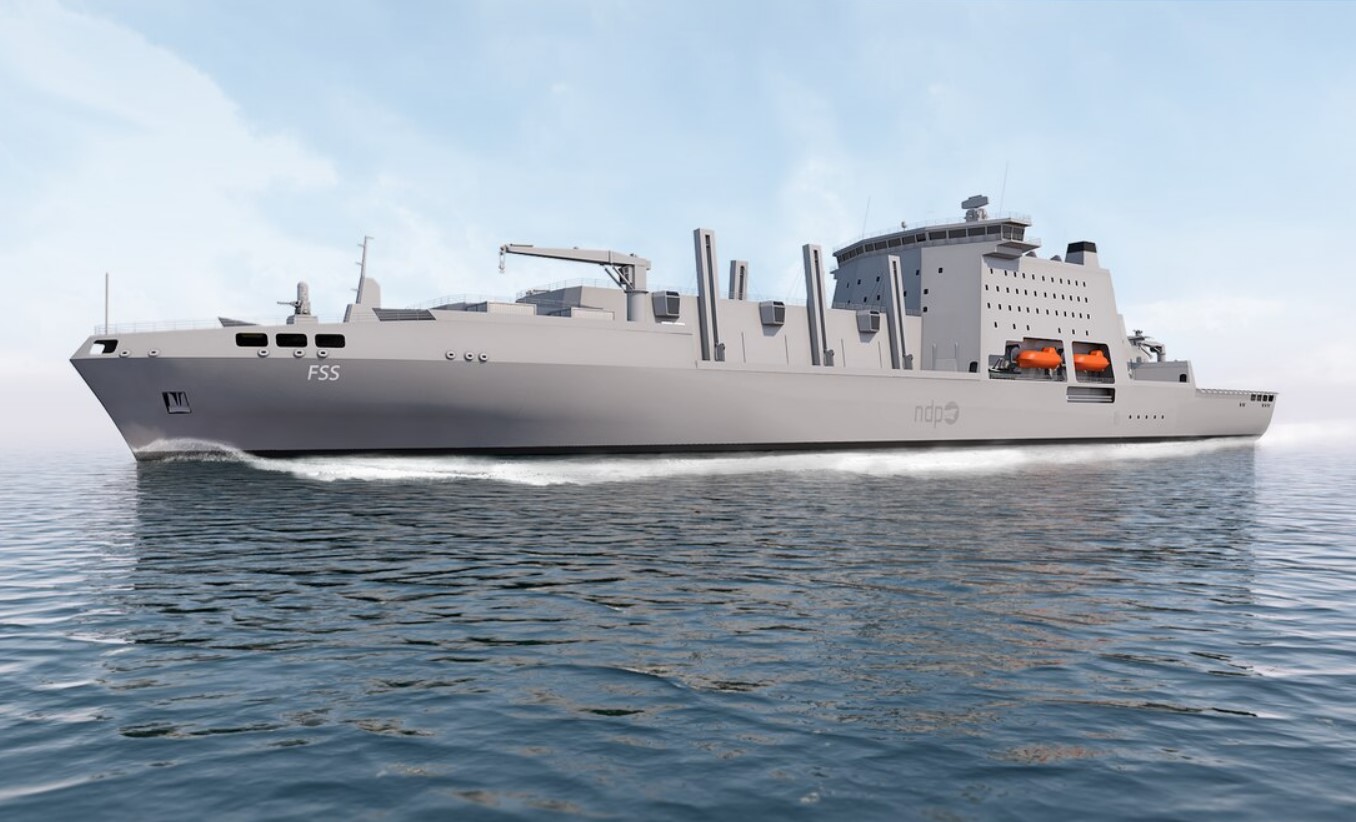
Work has begun on the first of the Royal Fleet Auxiliary’s new Fleet Solid Support ships, following a steel cutting ceremony at Appledore shipyard in Devon.
The event also confirmed the vessel’s name, RFA Resurgent, marking the programme’s transition from design to full-scale construction.
According to the Ministry of Defence, the FSS programme is a core Strategic Defence Review commitment intended to ensure the Royal Navy can sustain global operations by providing munitions, spares, food and specialist stores at sea. The department states that £115 million has been invested across four UK shipyards to support the work, creating 1,200 skilled jobs and recruiting more than 200 apprentices.
Minister for Defence Readiness and Industry Luke Pollard initiated the steel cut, saying “this is a significant moment as we begin the build of the RFA’s newest ship that will keep our Royal Navy ready to fight and able to deter future threats.” He added that “by backing British shipbuilding, we are creating more than 1,200 skilled jobs in Devon, Belfast and beyond,” calling defence “an engine for growth” for communities across the UK.
Construction of modules will take place at Navantia’s Appledore yard and other UK sites before final assembly at Harland & Wolff Belfast. The MoD says the programme ensures, for the first time in over a decade, that all four Harland & Wolff shipyards in Northern Ireland, Scotland and Devon are active and contributing to defence output.
Navantia UK chief executive Donato Martínez said the milestone reflects sustained commitment from UK and Spanish industry partners. “It is a proud day for the whole team, whose commitment has brought us to this point,” he stated. Martínez argued that the programme delivers both critical capability and “long-term sovereign industrial capacity for the UK through investment in infrastructure, technology and skills.”
Commodore Sam Shattock, head of the Royal Fleet Auxiliary, revealed the ship’s name during the ceremony. He said Resurgent is designed to meet modern environmental and operational requirements. “The ship is innovative, meets the latest environmental protection standards and is designed from the bottom up to deliver maritime sustainment as efficiently as possible,” he explained.
Shattock added that the programme supports jobs and local economies across multiple shipbuilding regions and described Resurgent as “a true warfighting enabler for the Royal Navy of tomorrow.”
According to the department, RFA Resurgent is expected to be delivered in 2031.





It’s a good name. Fitting, given the current state of the solid support ships 🙂
Interestingly from the NL article the H&W yard in Methil (up the road from Rosyth) is building a new barge specially for moving blocks from the satellite yards to Belfast.
It bodes well for their ability to fulfil Project Euston if that ever happens.
Wonder if the rest if the names will begin with the R as well?
Just seen in Navy Lookout saying the chances are the other two will be called RFA Resource and RFA Regent.
It be the R Class, said he. Arrrr, said I. Shiver me timbers.
R for ridiculously late class.. resurgence is a fitting name for one of the ridiculously late class.
Fingers crossed the Defence Investment Plan gives the go head for the MRSS and additional frigate orders. The west probably needs as many naval ship yards open as possible given the cluster f**k that is the LCS/SCS/constellation class program in the USA. Having three British ship yards and targeting 30 surface combatants could make us the dominant naval force in the Atlantic allowing the US to focus what production it can get into service to the pacific.
Three MRSS vessels is probably plenty especially if they are large and Belfast is the place to build them allowing Rosyth to build more T31/32 vessels for either the RN or export.
I agree that three large MRSS would be enough. The Marine Nationale have three helicopter carriers and little besides that to make up their amphibious force, despite arguably having a greater need for amphibious assets given their higher amount of overseas territories.
Just so long as the Point class are more flexible with traversing ramps and a helipad so they are useful in the event of infrastructure attacks rather than being (hardly) glorified ferries.
The Bay auxiliary concept isn’t viable, we need to split the fleet upwards and downwards.
Three wouldn’t be enough. MRSS needs to replace Ocean, Albion, Bulwark, Argus and the Bays.
If you make them all 30,000 tonnes then 3 is enough.
We only have three at the moment and they are all 16,000 tonne range and massively less capable. Ocean has already been replaced with PoW.
Ocean has not been replaced, when was the last time Pwls served as a marine carrier, thats right never.
Yeh we only have 3 at the moment because of cuts and theyre not living upto needs.
Forget about additional frigates, focus is on LUSVs
Why is 3 plenty? Weve needed more than 3 for our current commitments so well be cutting back again.
3 much larger ships is what we are likely to get.
These vessels will need there own air and missile defence capability which is expensive so larger less numerous platforms makes the most sense. Much more survivable and much easier to protect.
Expect 30,000 tonnes and CAMM and CAMM ER load out with AESA radar.
3 larger ships doesn’t change what I said, 3 ships usually only gets 1 at sea most of the time so we’re ditching one LRG or the other
Do we need both LRGs?
Well that’s our current commitments, once again we’d be cutting those back
A fairly simple ship system wise should hopefully give us more like 50% availability
What’s 50 percent of 3….
Personally I would like to see 2 really top end LHD like the Italian Trieste that can act as the beating heart of a large littoral response group.. even give it the capability to run F35b… then the RN can run one carrier and one large LHD concurrently.. added to that 4 smaller littoral surface combatant’s.. maybe a T31 verson that takes it back to the beingings of the design in the Absalon class, the perfect littoral patrol and raiding frigate..
If we did that they’d retire the carriers
Always negative
Don’t tell me I’m wrong
I suppose it depends on how convinced HMG is it’s going to go to war.. but they probably would use it as an excuse to dump one.
In this case i’d agree. Keep the F35 concentrated on the carriers where it has the correct level of support and facilities. Perhaps give the LHD an emergency operating function for F35 lily-padding. Maybe a sacrificial deck covering for the landing spot?
I have been think along similar lines (2x LHD) for several years – makes good sense to me! I do recall a plan to allocate one of the 2 QE carriers to the “commando carrier” role- prior to the 2020 defence cuts?
Well 3 MRSS are fully foundered or at least were!
So no increased defence spending needs to go on them. Sam goes for all the 13 frigates.
We just need to order at least 3 more MRSs, 5 type 32s, Prehaps 2 extra type 26s then go into the new Type 83s.
We MUST speed up type 26 production
I sincerely hope they haven’t already foundered!
Jim,
Agreed, anticipate and trust the DIP will define the acquisition pathway for the next ten years and perhaps even yield some surprisingly positive developments, if the core MoD budget increases in incremental fashion to 3% by the next Parliament, and 3.5% by 2035. RN/RFA is already on the path to rearmament w/ a minimum of 13 (and possibly more) new ASW and GP FFGs under construction, refurbishment of 6 DDGs to the originally intended standard, completion of Astute class SSNs and the appropriate upgrade of submarine maintenance infrastructure, continued construction of Dreadnought class SSBNs (nominally on schedule and budget), completion of SSN-A design and initiation of construction, continued capability maturation of 2 CVs post FOC declaration (including additional F-35Bs), 3 FSS vessels in the construction phase, a possible MRSS acquisition decision, increasing munitions stocks across weapon systems, etc. Despite the daily vagaries and vicissitudes, the blokes at the Admiralty have a handle on maritime issues.
RAF will acquire F-35As (and share additional F-35Bs), fund development and possibly low-rate initial acquisition of GCAP/Tempest, upgrade some Typhoons to latest standard. RAF section of DIP may disclose some surprising additions: E-7s, P-8s, additional Typhoons? Reasonably certain RAF will become healthy again, upon adequate additional funding.
Least reassured by disclosed pathway forward for the BA. Additional funding will hopefully not cause additional issues/trauma.
In any event, hope the DIP reveals presents, not coal, for UK military. 🤞
Steel from where I wonder?
The report on the local news said specifically mentioned British steel.
Is someone being a wee bit ironic with that name…
RFA cannot even crew the handful of ships it’s already got.
If anything like the Vauxhall, I had in 1970, we are in big trouble.
At last! A decade late at least, but, anyway….
Pollard gets his soundbyte priorities in I see.
Any news on Fort Vic in the meantime?
No real surprise repeating names of previous RFA, good choices.
I would have said that, outside of war, Ft Vic won’t serve again. In fact I’ve said it two or three times, at least until the extraordinary decision came to extend HMS Bangor in service. Now I have no idea what they’re thinking.
This is really good news for Appledore and North Devon as a whole.No issues with skilled labour either with another twenty plus apprentices soon to swell their ranks.If Appledore had have gone under,and it has been touch and go over the years, then it would have been devestating for the area.
Where is the plate steel coming from because I very much doubt it’s from the UK.