

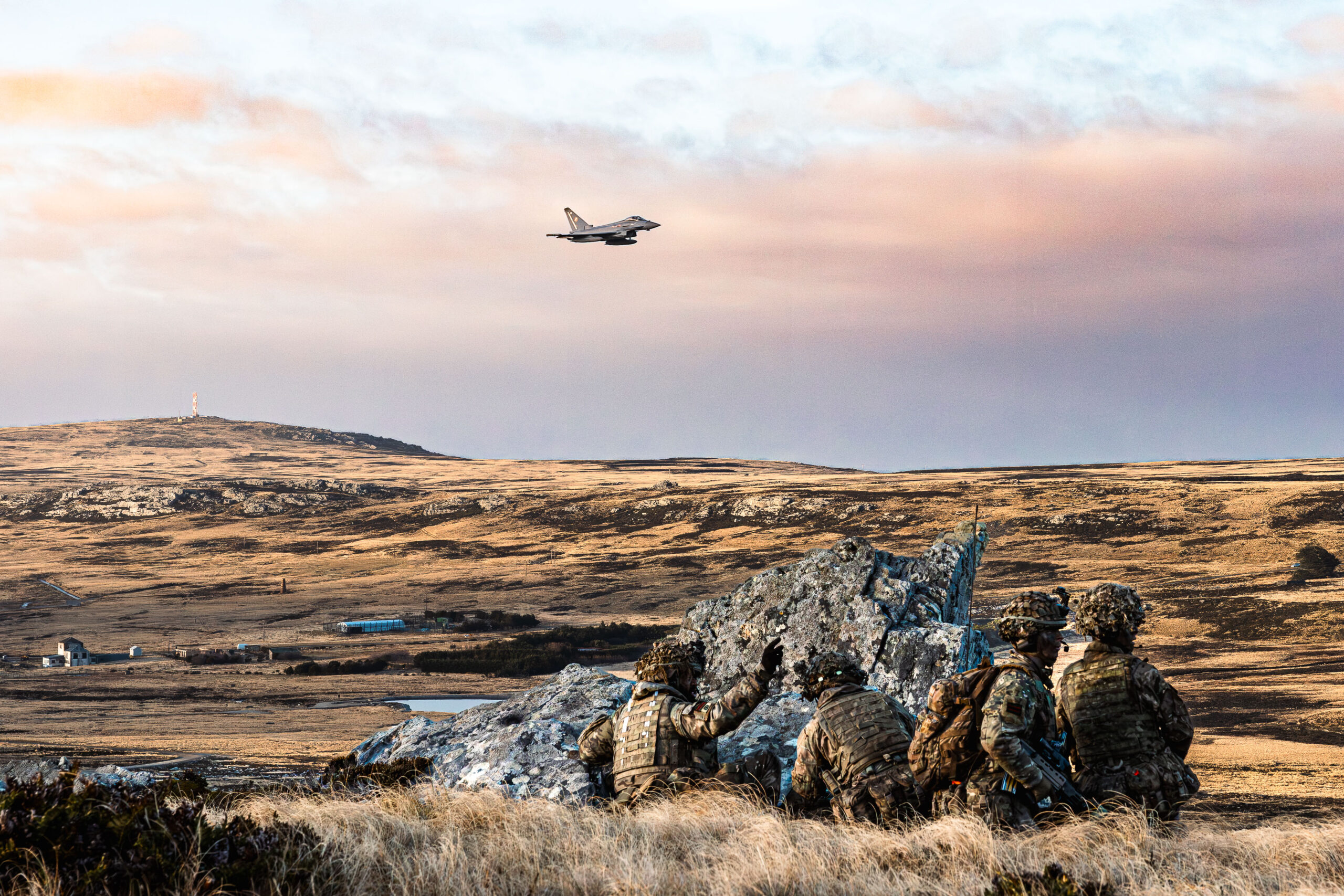
Britain maintains a “robust” air, land and maritime military presence in the South Atlantic and considers current force levels sufficient to defend the Falkland Islands, Armed Forces Minister Louise Sandher-Jones has said.
The assurance came in response to a written parliamentary question from Liberal Democrat MP Clive Jones, who asked what steps the Government was taking to ensure the security of the Falkland Islands. Sandher-Jones began by restating the Government’s position on sovereignty and the wishes of the islanders.
She said: “The UK Government is steadfast in its support for the Falkland Islanders’ right of self-determination.” The minister said Britain would continue to maintain a defensive military presence in the South Atlantic specifically to protect the Islands.
She said: “The Ministry of Defence is committed to maintaining a defensive military presence in the South Atlantic to ensure the protection of the Falkland Islands.”
That presence spans all three traditional operating domains, with personnel and capabilities permanently stationed on the Islands and other assets contributing to the wider South Atlantic posture. Sandher-Jones said ministers remained satisfied that the current military posture was appropriate for the defence of the territory.
She said: “I am confident that our military presence is at the appropriate level for the defence of the Islands, and we keep this under constant review.”
The Falklands remain one of Britain’s most prominent permanently defended overseas territories, with the UK maintaining forces in the South Atlantic as both a deterrent and a means of responding to any threat against the Islands. The Government’s approach, it seems, remains based on a standing defensive presence rather than relying solely on the ability to reinforce the territory after a crisis has begun.
Sandher-Jones also left open the possibility of changes if that assessment shifts, saying the military presence and level of defence provided to the Islands remain under constant review.







OT with acknowledgement to George
During the highly successful July–August 2026 counteroffensive in the Lyman sector, Ukrainian forces cut off a prominent Russian salient north of Lyman, liberating over 200 square km of territory and a number of previously occupied settlements and capturing over 2000 prisoners
Official Ukrainian military briefings, independent open-source intelligence (OSINT) analysts, and Russian military bloggers (milbloggers) paint a clear picture of how this developed.
The operation had the objective of cutting off the large Russian salient north of Lyman; to push Putin’s forces back behind the Zherebets River and the methodical isolation and elimination of Russian resistance pockets. It would also seem that Ukraine has blunted Russia’s northern approach and has secured logistic routes toward Sloviansk and Sviatohirsk
Official updates indicate that the operation relied heavily on persistent drone surveillance, precision artillery, and highly coordinated, small-unit infantry manoeuvres. Instead of risking rapid, exposed armoured columns, Ukrainian troops focused on cutting off logistics and striking Russian elements before they could regroup.
The Ukrainian military regained control of critical territory north and east of Sviatohirsk. Their forces successfully pushed Russian units back from positions west of the Netryus River, significantly easing the pressure on Sloviansk
A spokesperson for the State Border Guard Service of Ukraine confirmed an influx of captured Russian troops from the Pomsta Brigade’s sector, where waves of desperate Russian “meat grinder” counter-assaults were repeatedly broken with heavy losses
French OSINT analyst Clément Molin verified via satellite and mapping data that the Russian salient north of Lyman was cleanly sliced off. Although a localized Russian presence remains west of Kolodyaziv, the broader flank collapsed. Geolocated footage confirms that Ukrainian forces succeeded in driving the primary Russian lines back across the Zherebets River
Unlike the sweeping 2022 Kharkiv breakthrough, 2026 geolocated footage shows highly localized, gruelling combat. Footage released by Ukrainian brigades reveals destroyed armour, abandoned defensive trenches and drone strikes targeting hidden infantry clusters
Initially, Russian sources tried to frame the movement as “tactical regrouping” or claimed that the lost ground was merely a fluid “grey zone”. However, prominent milbloggers ultimately conceded that Russian flanks were left dangerously exposed, fragmented, and cut off from the main forces, forcing a withdrawal west of the Netryus River to avoid complete encirclement. There is uncertainty about whether this retreat was ordered and where it stopped. N Korean blocking troops have been reported in this area
The most immediate strategic impact is the partial relief of Sloviansk and Kramatorsk. Sloviansk sits just over 20 kilometres southwest of the liberated area. Prior to the counteroffensive, the Russian salient north of Lyman served as a dangerous staging ground for a northern pincer movement aimed at encircling these fortress cities. According to assessments by the Institute for the Study of War (ISW), flattening this bulge has significantly minimized the imminent risk of an operational encirclement from the north.
The war criminal Putin has publicly doubled down on his demands that Russian forces capture the entirety of the Donbas by late 2026. Military analysts, including Emil Kastehelmi of the Black Bird Group, note that while this localized counteroffensive does not alter the massive overall map of the war, it severely disrupts Moscow’s offensive timeline. Pushing the lines back to their mid-2025 configuration forces the Russian military to spend months rebuilding logistics and staging areas just to return to their previous launching points
A straighter frontline requires fewer active personnel to hold than a jagged, vulnerable flank, allowing Ukraine to re-allocate valuable reserves to under-pressure southern sectors of Donetsk Oblast, such as Pokrovsk or Chasiv Yar
According to official statements from Ukraine’s Third Army Corps, the advance also restricted Russia’s ability to use the heavily forested areas north of Lyman to mask infantry infiltration tactics
The victory creates a defensive buffer that extends beyond Donetsk Oblast. According to OSINT mapping data, clearing the threat north of Lyman simultaneously protects Borova in Kharkiv Oblast (25 km north), preventing Russian forces from exploiting gaps between the Kupiansk and Lyman operational axes to roll up Ukraine’s north-eastern flank
A major secondary effect, affecting the wider front, is psychological and systemic. The rapid collapse of the salient exposed a pervasive culture of exaggerated or false battlefield accounts (“beautiful reports”) being passed up the Russian chain of command. The public unravelling of these lies – such as Brigadier General Andrii Biletskyi proving Sviatohirsk was firmly under Ukrainian control after Russia claimed its capture – has triggered intense infighting among Russian milbloggers. This domestic friction has severely undermined trust in the Russian Ministry of Defence during a critical window of the Donbas campaign.
It also challenges Putin’s narrative of the inevitable victory of Russian forces and demonstrates Ukraine’s ability to mount a successful counter-offensive and start the liberation of the Donbas.
Well said. Thanks.
I liked a Russian blogger’s suggestion that Ukraine has been keeping quiet about it so Putin doesn’t hear. My suspicion is that they will trumpet it during the Russian election run up.
I have no doubt that Armed Forces Minister Louise Sandher-Jones would have said exactly the same thing before the Falklands war.
Also zero doubt she would also describe the defences of the UK in similar terms.
In this case, surely she would be correct. Unless things are truly so hopeless that the Falklands cannot be defended against a non-existent navy, and a small collection of F-16s without the range to fight over the Falklands
I suspect the defences are completely inadequate should Argentina actually want to take the islands by force. However I suspect our intel is far better than 82 and if the government acts on it then they could be reinforced before a threat occurs.
The typhoons there are older models and likely low air worthiness levels due to the harsh conditions. They are also not capable of firing the more modern missiles that would outrange the f16 missiles. Likely 1 or 2 could be launched. Up against equally poorly maintained f16s, so maybe 16 to 1 odds. The typhoons would hold their own, but would get saturated.
That is assuming that Ukraine doesn’t learn from Ukraine/Israel and sneak drones onto the Island to do a surprise attack on the base, taking out the typhoons on the ground.
With the UK having no land based (or air for that matter), anti shipping missiles, once the typhoons are out of the equation the small base at Stanley would be rapidly over powered. The river2 wouldn’t stand a chance against the remaining f16s/ Argentine navy.
Then it comes down to could they hold it. You would have to assume they would learn their lesson and move a load of jets to the air bases on the island, so they could maintain decent air defence against any attacking force. However you would have to assume the arriving f35b would make easy work of them.
The RAF are retiring the Tranche 1 Typhoons stationed on the Falklands and replacing with Tranche 2’s. This in itself is a major upgrade in the defences. As it stands now, and even with all 24 F-16’s, Argentina has no realistic chance to re-take the islands. They will require significant Naval and Air power regeneration should they wish to attempt something that could come close to succeeding.
That still doesn’t answer how the Argentina air force plans to make it to the Falklands, fight, and fly home. To say nothing of how the Argentina navy might attempt to make it there.
You might have missed it by the way but it was very recently announced the T1 Typhoons are being replaced by T2 with Meteor compatibility, meaning the F-16s are massively outranged.
More to the point, Mount Pleasant would be significantly bolstered in short order by air bridge from Brize.
F16 combat range would be adequate to fly directly, just wouldn’t give them much time on station.
The tranch 1 typhoons aren’t due to be replaced until late next year. So that upgrade is still some time off.
It is common knowledge that the Argentines are keen to buy retired KC135 from the US. BOB just might let them have their wish.
Mount pleasant can’t be reinforced by air if Argentina win the air battle. Any air lift would be easily shot down.
There’s a SAM battery around Stanley that’ll make any attempt to strike the base there very difficult. The Argentinians don’t have much in the way of SEAD/DEAD capability.
The islands are 600km from the mainland, and 1400km from the planned Argentinian F-16 base in Tandil, where weapons will be stored and maintenance conducted. In either case, endurance for combat-loaded F-16s will be limited, and flights from Tandil directly to the Falklands with the intention of combat operations basically impossible without tanker support, which the AAF lacks in significant numbers.
Argentinian warships use the ancient Aspide as their principal air defence missile, with at best a 15km range. Typhoons could toss guided bombs from beyond the range of that missile system, or use Brimstone to shred key sensors and weapons from beyond the range of those Aspides.
The Argentinians would be challenging to deal with in the air, but not a existential danger. Their navy would likely never make it to the islands. Attempts to airlift forces into the islands would be met by the SAM battery.
In a traditional warfare scenario then potentially. But my assumption is it would start off with a drone attack on mount pleasant during which the typhoons and the landceptor would be damaged. Followed up shortly after by the f16 finishing the job.
However I really don’t think there is a polictical desire to take the islands in Argentina and I don’t think they could hold them once taken.
It’s quite hard to get smuggle stuff onto the islands, so unless you mean an Op Spiderweb type thing, it’d be tough to pull off.
Just looking at satellite imagery, there are aircraft shelters as well.
Do those shelters have doors?
Russia found that Ukraine just fly their drones under the concrete hangers into the planes, as the traditional reinforced hanger was just a n shape to prevent damage from above.
I’ve looked at those shelters several times, they don’t appear to be proper HAS like in the UK which have doors and are even, I understand, CBR proof.
Why hard there are thousands of tourists a year arriving on cruise ships that are loading and unloading massive supplies. Easy to smuggle drones onto them for a national state. Also fishing boats coming and going
You do realise that the islanders virtually know each other by sight and name don’t you?any outsider trying to do dodgy stuff would be sussed in pretty short order!
Any way we have had this discussion a couple of weeks ago,did you miss it?
They do but if Argentina is smart they will time it with a cruise ship where there would be thousands of people wondering around the island all looking suspicious. It’s not hard to then hide out, like the sbs /sas did.
The weather is likely the best defence against small UAS.
Average wind speeds must be up near the maximum that UAS can operate in!
Steve you are giving Argentina hope where there is precious little.
If they follow your plan they would probably end up with no air force (again) no navy and little defence against neighbours.
Argentina has huge internal problems and is probably just generating internal propaganda to boost support for the current regime. I doubt they have any military plans. Also I don’t think they will have forgotten that they actually captured the islands in 82 yet still lost. The UK would, in it’s own time, be able to cut off the islands and recapture when the time is right.
You are asking perhaps a little too much of Argentina.
I doubt it’s anything that anyone interested wouldn’t have thought about. The idea of a special forces attack on the island has been around for decades,.it’s only the invention of fpv drones with RPG shells attached that has made it far more difficult to defend against.
I did mention I don’t think they could hold them, but that wasn’t the position of the government, it was that they were adequately defended, which I disagree with.
Saying that what are we meant to do, can’t really deploy the whole army and air force to the islands. Reality is they are difficult to defend so far away with realistically zero strategic advantage of keeping them outside the islanders want to stay, which I support.
It’s often forgotten that a lot of luck and external backing helped get them back last time. If Chile hasn’t covertly supported us (they stages a drill at the border making Argentina think they might attack diverting forces away and provided intel /.airbase), or if the US base on assension hasn’t provided fuel against offical US government position at the time, or Argentina hadn’t messed up with their bomb fuses or, had there been wind on the day and their carrier been able to launch jets etc etc and things would have been very different. The main one being Argentina air force was playing games and didn’t want to support the army to try and gain more power at home, resulting in them not being fully deployed to the island.
Not difficult with a civvie container ship parked offshore flying in drones. MPA may need to be reinforced with counter drone capabilities at some point when intelligence the threat levels evolve. They have the intent but not yet the means
There are 10/12 container ships docking in the FI per year ALL direct from the UK,now you would think that HM customs would know exactly what’s in what container given the place they are going!
So unless there are some very treasonous seaman on those ships including the captain then your scenario is not at all likely is it?
Read the final sentence.
You make a good point re: pattern of civvie vessels however that’s superficial. it’s the capability that’s really important as by the time any civvie vessel has left Argentina (or wherever!) with a complement of drones/ operators it’s possibly too late to counter. MPA needs at some point counter drone capabilities as threat levels and intelligence picture evolves
The defences seem to be a fair balance currently. As somebody else said with an earlier post – Tranche 2 Typhoons later next year, that in it’s self is a further upgrade. Sky Sabre based in the Falklands and a Company group of infantry soldiers. Falklands Islands defence force which can mobilize to a full company strength if needed plus RAF Regiment based at Mount Pleasant. There are also good intel capabilities based in the FI to. Finally when it comes to the UK there is always the UK – Ascension Island – Fi air bridge… Extra jets and personnel could be sent fairly quickly. When it comes to Argentina and the mentioned F16’s ) I read an article recently saying Argentina would only receive 6 jets around December each year. If that’s the case they only 6 jets currently with I guess 6 more this December.. Also as we know Argentina’s air re – fuelling capabilities are not good plus the F16’s are no match when it comes to taking on a Typhoon Tranche 1 or especially a Tranche 2 Typhoon jet.
* refuelling
Course with the MOD we could find the Sky Sabre unit was deployed with 3 live missiles to save cash ie: cancelling all live firing in exercise’s as just done!! lol
How on earth do you think they can sneak drones to the island. Nothing moves for hundreds on miles without us knowing about it. The island have very good radar coverage plus satellite coverage. As soon as salior farts near a ship in port we know about it.
Steve, your post: “I suspect the defences are completely inadequate should Argentina actually want to …”
You don’t mention the army contribution to defending MPA.
Small base at Stanley? Do you mean MPA or MPC? It’s not at Stanley and its not small!
The FI could be reinforced with additional Typhoons within a couple of days, if tensions increase. Make use of the Voyagers to tank additional Typhoons.
If the Argentinians really want to try it on we could fire Tomahawks at their military airfields to take out F16s and transport C130s. Even if the F16 could reach the islands.
Then blockade the islands with a submarine or two, with HG issuing a statement that any ships coming within an FI exclusion zone are open to being sunk.
Its not easy invading (and sustaining supplies etc) across 300 miles of South Atlantic when your foe is alert and prepared
Fire tomahawks from what platform? the 1 Astute that is currently sea worthy?
If there was a war need as many boats as possible would be rapidly generated
Not without a dry dock and parts. There all benched for moths through lack of parts and qualified engineers. Maybe other platforms could be brought up to strength but a doubt a nuclear sub can be bodged with tape chewing gum or 3d printer
The Intel in 1982 was pretty overwhelming. The problem was no-one in Whitehall was listening!!!!
An exact situation that could well be repeated today.
Different threats today but still Whitehall not listening!!! Hence prevarication on Defence Spending by the present government.
From what I understand the diplomatic service did flag the concern back in 82 but it was ignored. I’m sure the same would happen now. Governments like to procrastinate military decisions until their hands are forced. I highly doubt if the intelligence service warning thst an invasion was likely, that many UK government no matter the party, would trigger reinforcing the islands, in fear of annoying the south American trade partners. It wouldn’t be until Argentine forces had landed that the decision would be made.
Simply don’t believe a single word from the horrendous – lying – traitorous Labour Government – their members or supporters.
The sooner the Labour Party are utterly destroyed the better for the U.K
Well to be safe, a pair of RN Wildcat armed with Sea Venom based in the Falklands would prevent any stunt by the Argentinians.
The military situation down there today isn’t anywhere near what it was in 1982.
Back then, Argentina actually had a proper navy with an aircraft carrier, destroyers, subs, and amphibious landing capability, plus a well-equipped air force. Today, their navy can barely put to sea, their army is starved of funding, and a small batch of second-hand Danish F-16s isn’t going to change much—especially operating right at the absolute limit of their combat radius.
Meanwhile, Mount Pleasant is a proper fortress. Between Sky Sabre, the Typhoons, and the Batch 2 OPV on station, the Falklands actually have better ground-based air defence coverage than the UK mainland, which relies almost completely on QRA jets rather than SAM batteries.
What’s there now is more than enough for the actual threat level. There’s zero reason to dump any more cash into defence spending on the islands.
To those who know such things…
Lets say, right now, the Argies started coming. Do we have enough tankers to get F35s and maybe Typhoons as well, on patrol over and around the islands. From Ascension. And maybe even home again if the runaway had been hit and they couldnt land to refuel. Thinking operation black buck type op. One thing that struck me on the documentary about it was how the Vulcan found the tanker on the way home (luckily) but surely with modern comms they all know exactly where each other are etc.
Lots of press articles mention the F16s they are buying, but surely if we can get fighters down without thw carriers then they arent a big problem?
In a word yes, although it’s a bit more complicated than simply flying a load of Typhoons and F-35B’s from UK mainland to the Falklands in one stint. I would guess that there would be the capability to surge up to a full squadron of Typhoons within 48 hours or so via the Ascension Islands, with greater numbers if required over a less rushed period of time. We lease 14 MRTT, 9 of which are available I believe straight away.
As Steve quite rightly states, we have the Voyager tanker. The distance from Ascension Island to the Falklands is roughly 3800 miles (6100km).
Compared to the Victor tankers used during 1982, these are a massive improvement, but they still have their limitations. The Victor K2 tanker could carry 41,000kg (91,000lbs) of transferrable fuel. Whilst the Voyager KC2/3 can carry 111,000kg (244,713lbs) of internal transferrable fuel. It can also carry additional fuel cells in the cabin if required. Additionally, the Victor was powered by four low bypass RR Conways, whilst the Voyager is powered by two high bypass RR Trents. The Trents are significantly more fuel efficient than the Conways, meaning the aircraft itself can go a lot further without needing to be refuelled itself. Both aircraft (Voyager K3 only) use a 3 point refuelling system. However, the Voyager unlike the Victor cannot at present be mid-air refuelled. The Voyager can fly around 9200 miles (14,800km) on just its normal internal fuel. At the moment the RAF Voyagers don’t use the additional cabin fuel cells.
What this means in practicality is that you require less Voyagers vs Victors to get Typhoons/F35Bs to the Falklands. However, after refuelling at Ascension, the Voyager can fly most of the way to the Falklands do a bit of loitering, but will have to turn back and land at Ascension, if the Falklands airfield is a no go. It won’t be able to loiter in the area for a long duration without additional cabin fuel cells, as it can’t be mid-air refuelled. But with a pair of Voyagers, you can easily get 6 Typhoons/F35Bs to the Falklands really quickly.
There’s one crucial asset we have now, that we didn’t have in 1982. Which is the Astute class SSN armed with Tomahawk cruise missiles. This would effectively replace the Black Buck requirement. But instead of just taking out the runway on the Falklands if captured again, I highly suspect Tomahawk would be used against Argentine mainland airbases and naval facilities. To deny Argentina the capability to blockade, resupply by sea, and provide offensive air support.
Let’s just practice a minor reinforcement exercise, no major press releases just quiet non verbal statement of intent.
I do like this approach. Seems sensible though so it won’t be done 😀
At some point, we must surely look at sending a carrier strike group down south to do show the flag type of stuff. Now that really would get them complaining!
Scholarship question. Why does the govt support the principle of self determination for the Falkland Islanders but not the wish of the Welsh and Scottish parliaments for independent nationhood?
Paul P, have you forgotten about the Scottish independence referendum in 2014 already? A once in a generation event so perhaps the Scottish Government could ask the PM to run Indyref 2 in 2039.
It has only been since the GE of 2024 that Plaid Cymru have formed a Government in the Senned, but they are weak, lacking an overall majority. Perhaps if and when they get that they will ask the PM for an independence referendum.
BTW it is the wish of the People for independence that is paramount not that of a devolved Parliament/Senned.
Just being the Devil’s advocate Graham. I suspect the only way to rationalise these contradictions is by reference to pelagianism.
Yes the Falklands are in great great great peril.The Currently 6 or if delivered 12 Argentine block 20 MLU F16’s from the late 1990s that basically make them an F16C are a huge threat .Add the formidable naval power of the 3 Destroyers from the 1980’s and 1 non active submarine and we have a massive problem ….. This would make a fantastic movie staring Steven Seagal a kind of sequel to Underseige 2 . Thousands of Argentine troops storming ashore from the cruise ship MSC Splendida ….. I can see it now Argentine flag raised in Stanley the Servicio de Inteligencia del Ejército (SIE) toasting champagne at the success of their genius plan it’s all over ……
I wouldn’t say robust, but adequate. but the long and short of it is Argentina won’t invade because they don’t have the Navy to do so. Likewise if they ever took the Falklands we wouldn’t be able to take them back because we don’t have the Navy to do so. Until that changes it’s all big talk and loud mouth diplomacy. Argentina is trying to isolate the UK from the US in the hope we will cave. With this Govt probably a good tactic.