The U.S. Air Force has completed the latest iteration of Exercise Virtual Flag: Coalition (VFC 26-1), a multinational synthetic training event designed to strengthen interoperability and mission command across air, space and cyber operations, the service stated.
The annual exercise is hosted by the 705th Combat Training Squadron, also known as the Distributed Mission Operations Center (DMOC), at Kirtland Air Force Base in New Mexico. According to the U.S. Air Force, Virtual Flag: Coalition is intended to provide combat-representative training across multiple domains, allowing U.S. and partner forces to test tactics, techniques and procedures in a simulated high-end conflict environment.
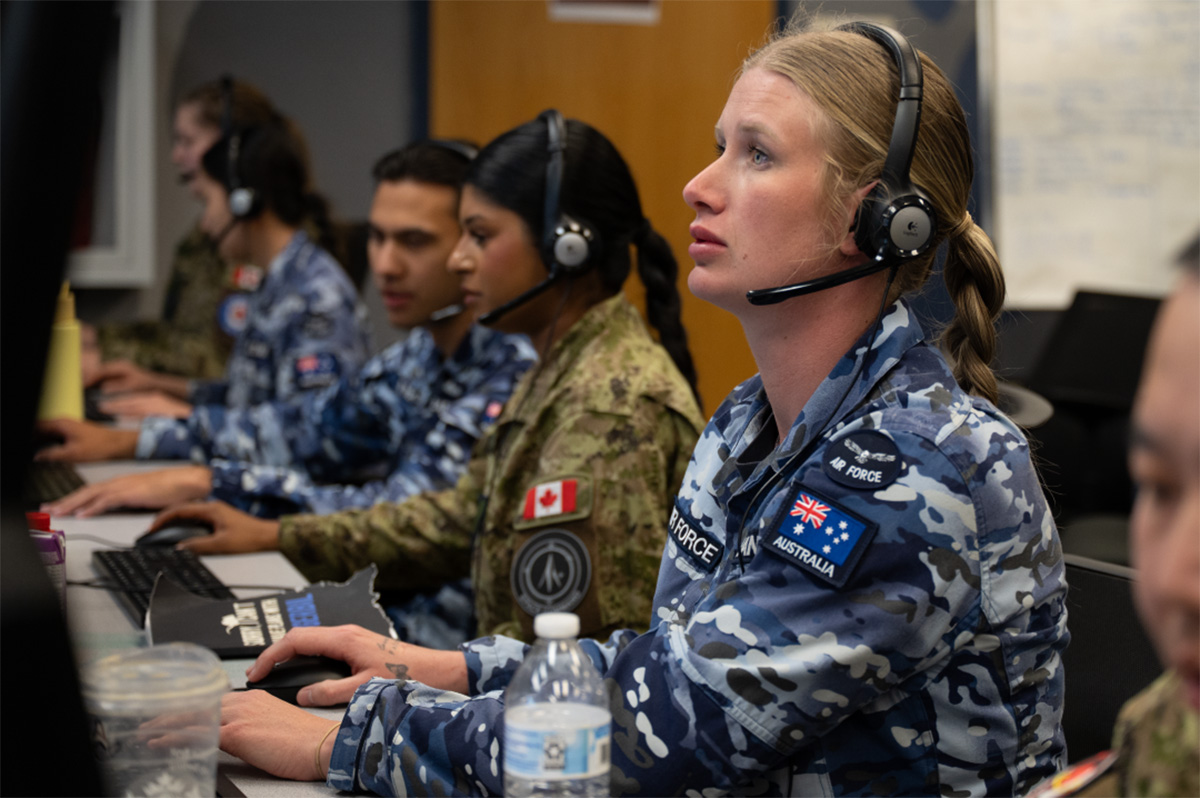
The U.S. Air Force said VFC 26-1 integrated personnel from the U.S. Air Force, U.S. Space Force, U.S. Navy, U.S. Army, Utah Army National Guard and U.S. Marine Corps, alongside international partners including the Royal Air Force, U.K. Space Command, Royal Australian Air Force, Australian Army, Royal Canadian Air Force and Royal Canadian Navy.
Lt. Col. David Jones, commander of the 705th CTS/DMOC, said the exercise supports mission command concepts intended to prepare forces for peer-level conflict.
“The U.S. Air Force has embraced mission command concepts like agile combat employment and decentralized execution because we have learned from experience that centralized C2 won’t work against a peer adversary,” he said. “VFC offers a great training opportunity to refine operational concepts and tactics with Air Force, joint, and coalition partners so we’re ready to fight together if deterrence fails.”
According to the U.S. Air Force, coalition and U.S. forces operated within a live, virtual and constructive training environment, using simulators and command-and-control nodes located across the United States, Canada, Australia and the United Kingdom. Constructive scenarios introduced computer-generated threats and environmental factors to simulate large-scale Indo-Pacific conditions.
Lt. Col. Abdullateef, director of operations for the 705th CTS/DMOC, said the exercise provides a venue for coalition forces to improve joint effectiveness.
“The core of VFC is about learning how to fight and win as a coalition,” he said. “This exercise provides a controlled environment to experiment, identify each other’s strengths, and improve our ability to operate together seamlessly under pressure. Such training is crucial as adversaries force us to work as a unified team across nations and domains.”
The exercise focused on refining distributed command-and-control systems in a contested environment, the service said, with scenarios requiring multinational forces to coordinate decision-making even when communications and intelligence were limited. Capt. Brian Boyce of the Royal Canadian Air Force Aerospace Warfare Centre said the training offered a valuable opportunity to improve coalition integration.
“The Canadian Armed Forces’ participation in VFC provided a strategically valuable opportunity to strengthen our ability to operate as an integrated, multi-domain partner within a coalition environment,” he said. “By training alongside our allies in the high-tempo synthetic battlespace that VFC provides, I witnessed CAF personnel improve C2 processes, further interoperability across air, land, maritime, space and cyber domains, and rehearse decision-making in complex, contested scenarios that mirror emerging operational challenges.”
Boyce added: “The exercise enhances the CAF’s capacity to share best practises regarding mission planning, information-sharing, targeting coordination, and synchronized effects across all domains. VFC meaningfully advances the CAF’s readiness and is always a pleasure to be a part of.”
Maj. Rikki Antaramian-Feightner, the VFC 26-1 exercise director, said multinational operations require continual practice to ensure systems and procedures integrate effectively.
“Each nation brings a unique set of tools, protocols, and decision-making processes to the table,” she said. “We saw firsthand how effective we can be when these diverse systems integrate seamlessly. But it takes practice. Exercises like VFC are crucial, allowing us to refine communication and interoperability in ways that live combat cannot.”
The U.S. Air Force said approximately 310 personnel completed 7,000 joint training tasks for 31 units using seven networks and 27 different systems connected at 16 distributed sites worldwide. The service said a significant addition to VFC 26-1 was the integration of the U.S. Air Force Nuclear Weapons Center, which provided input into simulated decision-making involving strategic assets.
Lt. Col. Abdullateef said the involvement of the Nuclear Weapons Center expanded the exercise’s scope. “The AFNWC’s participation was a game-changer in Virtual Flag: Coalition,” he said. “Not only did we test our interoperability with allied nations in conventional combat scenarios, but we also simulated higher-level decision-making that involved strategic assets.”
The inclusion of U.S. Marine Corps personnel also added further cross-domain integration, with Antaramian-Feightner stating that their participation reinforced the importance of joint operations. “Integrating Marine Corps capabilities into a primarily air-based exercise pushed us to think about mission command in a more integrated way,” she said.
Col. Terry Hjerpe, commander of the 505th Combat Training Group, described the exercise as a key part of coalition preparation for future conflict. “Virtual Flag: Coalition is more than just an exercise; it is a critical part of our strategy to ensure that the U.S. and our allies are ready to face any challenge,” he said.
During the exercise’s Distinguished Visitor Day, senior representatives from the United States, Canada and the United Kingdom attended briefings and demonstrations. RCAF Brigadier-General Leighton James said the event highlighted the direction of future readiness planning. “This Virtual Flag: Coalition is the context for where we need to go with readiness in the Canadian Air Force,” he said. “It offers a valuable opportunity to identify efficiencies and strengthen our integration with the DMOC and other coalition partners.”
Col. Ryan Hayde, commander of the 505th Command and Control Wing, said the exercise will remain central to coalition readiness as operational environments evolve. “As warfare evolves, we must continue refining our multinational operations,” he said. “The lessons from VFC are shaping the future of combat.”