

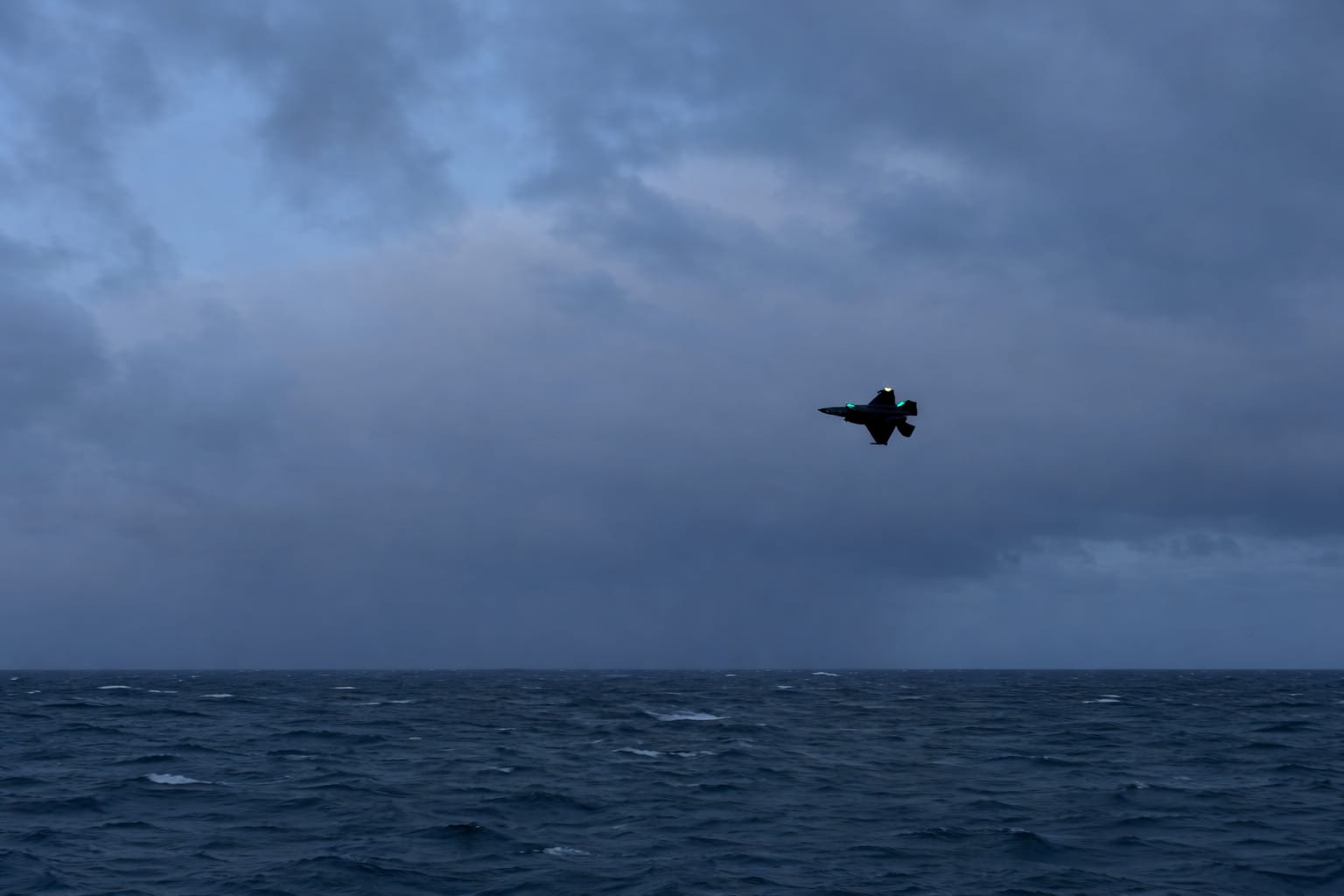
NATO warships operating in the High North have carried out joint air defence training with Norwegian F-35 fighter aircraft as part of a wider maritime deployment aimed at strengthening readiness in the region.
According to Allied Maritime Command, Standing NATO Maritime Group 1 (SNMG1) reinforced its operational presence in the High North during a recent deployment, conducting activities focused on enhancing readiness, cooperation and maritime situational awareness in what NATO describes as a strategically significant and demanding environment.
A central element of the deployment was SNMG1’s participation in the Royal Norwegian Navy exercise Arctic Advance, where the group supported the Norwegian Submarine Commanders Course. Operating in complex Arctic conditions, NATO said the activity provided realistic training focused on anti-submarine warfare and contributed to improving Allied interoperability.
As part of the deployment, SNMG1 also conducted patrols in the Norwegian Sea, with particular emphasis on maritime situational awareness around critical infrastructure. NATO stated that several Russian units were monitored during routine maritime operations, in close coordination with Norwegian authorities.
Footage released by NATO shows Norwegian Air Force F-35 aircraft conducting simulated attacks against the task group during an integrated air defence exercise. The training was designed to test coordination between air and maritime forces, allowing ship crews to practise air defence procedures in a high-tempo operational environment.
NATO said the exercises strengthened operational readiness and interoperability between Allied naval forces and fifth-generation combat aircraft, reflecting an increased focus on multi-domain operations in northern waters.
Commander of SNMG1, at the time, Royal Netherlands Navy Commodore Arjen Warnaar, said the deployment demonstrated the group’s ability to operate effectively under demanding High North conditions.
“Our crews have gained invaluable experience in anti-submarine warfare and air defence. Through vigilance and cooperation with our Norwegian Allies, we have enhanced NATO’s readiness and presence in this strategically important region,” he said.
The High North has become an increasing focus of NATO activity as Allied nations place greater emphasis on cold-weather operations, maritime security and freedom of navigation in northern waters. NATO has previously described the region as operationally challenging due to weather, distance, and the density of maritime and air activity.
Standing NATO Maritime Group 1 is one of NATO’s four permanent maritime task groups and operates under Allied Maritime Command, providing a continuous multinational naval presence that can respond rapidly to emerging security situations. The deployment and associated exercises form part of NATO’s routine training and assurance activity, aimed at maintaining readiness, improving integration between air and maritime forces, and ensuring Allied units can operate together effectively in complex environments.






“Our crews gained valuable experience in ASW and air-defence, against targets that have a very similar radar profile to American aircraft.”
They didn’t say that surely
American Submarine Aircraft ? lol.
Thunderbirds meets Stingray !
I’m just glad something, anything, is being done.
Can’t wait til we get some good news about our own F35s. I haven’t heard a thing about them for a long time and don’t even know what state they’re in at the moment, whether they’re even being flown.
They just participated in the largest ever deployment of F35B’s (24) 6 weeks ago as part of Neptune strike.
Thanks, that didn’t come up during my Google search, I got distracted by a story about short-termism in the procurement of the F35.
👍
Take a Trip up to RAF Marham and have a Ganders for yourself.
I would if I lived near it 🤣
Doh ! 🤦♂️
I guess the question is, would the US armed forces really be willing to use deadly force on fellow NATO members if ordered to by DT?
Yes the US armed forces will use deadly force against other NATO members.
They will obey any order given to them.
Despite the wistful fantasy of many Americans in the US political class, their forces wont hesitate to follow orders issued by Trump. I’m sure the Pentagon will drag its feet, would it even be possible to stage an operation in Greenland in January? I would image the death toll of US forces from the weather alone would be quite high.
Then there is the issue that the USA has very little in the way of assets in the Atlantic and everything is does have is sitting off the Caribbean coast. How many US forces are trained to operate in snow currently and available for deployment, probably none and if there are any they are probably in Norway at the moment.
Any operation in Greenland is likely to take months to plan and Congress would easily be able to pass resolutions to block it.
It’s still hard to see what an invasion of Greenland would actually look like given the US can already send any forces it likes there and only the Senate can add territory to the USA and not the president. Does he send some soldiers to Pituffik and call it a takeover. Pituffik is 1000km from the capital. It’s like sending soldiers to Shetland and saying you conquered the UK.
A single SAM battery based in NuuK is probably all that is required to defend Greenland from US forces, if there is a SAM battery in the area US forces will require SEAD operations and that would mean having to ship an aircraft carrier up there because Pituffik is not well set up to handle jet aircraft. Certainly nothing capable of over coming the Danish airforce and decent surface to air battery. The US has no EA capable aircraft that can easily get there without an aircraft carrier.
US amphibious forces especially Marines are not well suited for Arctic warfare and won’t be able to get there until May.
Such a Commitment will require Congressional funding so the military can probably be stopped that way.
Perhaps Trump wouldn’t use the US military, but could use a team of private military contractors, in a deniable ‘little green men’ style operation. Who would then be lauded by the White House as patriots .
True but are they likely to be artic trained? Danish and NATO troops would have no restrictions on wiping them out either if they were deniable assets!
Well they would be former US military so I expect that they would be Arctic and cold weather trained. They really only need to arrive via helicopter or boat into the capital and ‘claim’ it for the US. Plant a flag and seize government offices, they don’t need to stage an offensive across many miles.
True, being deniable assets the Danes could easily counter assault them and inflict casualties, but that need be just the ‘ provocation ‘ Trump will look for , ie American patriots being killed by Europeans…..
Shane Denmark doesn’t have any submarines
Remember how many people voted Trump. And how many still support him when he’s threatening to invade allies. He’s currently on the verge of ordering troops into Minnesota to crush protests.
We’re in the age of the tyrant (I won’t say strongman as that gives entirely the wrong impression of these people, they’re picking on the weak) and “just following orders/just doing what I’m told” is the excuse of those who follow them.
The day Trump fires on NATO and sends his forces into the Atlantic region and does the unthinkable and goes to war with the European powers is the start of the clock for China to launch a full scale attack on U.S. forces in the western pacific..it would be the single most stunning stupid act of self destruction in the history of Geopoliticals and warfare.. making hitlers attack on Russian seem a sound and sensible move… the USN would die in detail scattered across the globe fighting 2 enemy power blocks on different sides of the planet..
The worst part is the Chineses are a very very clever bunch ( it’s their political warfare that has sent the US down the rabbit hole ) they will wait until Europe has sucked in as much of the USN as possible letting the western democracies harm each other as much as possible.. before killing everything the USN has in the western pacific.. At that point the US and Europe would both be dead as world powers and china would bestride the world..
It would even be beyond the worst case geopolitical shit show I though would happen in which the US and Europe split into two neutral power blocks.. very much with the same sort of relationship India has with Europe..cordial but not allies.. this would even beyond WW1 level organic warfare chaos.. and the world we knew would die completely.
if you have an increasingly mad president and a cabinet of sycophants unwilling to enact the 26th amendment what’s to stop him glassing the place.
China would loose very quickly in a nuclear exchange with the USA. I think China would do nothing content to let the west destroy itself.
I see a war with Europe over Greenland having crippling economic effects on the US because European NATO countries hold by far the largest amounts of US treasuries. America is a nation of debt monkeys acting wealthy and a tanking of the US dollar and cutting off uncle Sam’s credit card is probably the worst action anyone could take Against the USA. The US may become ungovernable and split.
Deutsche bank has a report out on this today(Europes credit dominance) . People might think that rare earth minerals controlled by China are the most potent weapons in international trade but Europe and especially the UK control over international credit is far far more potent.
The only problem with such a weapon (as China will soon find out with rare earths) is you can only really use it once.
However in the fallout from the end if the dollar world its probable that a more united EU emerges and the Euro takes over form the dollar as the international reserve currency of choice.
The US could not win a nuclear exchange against china.. both nations would be dead… and then most of the rest of humanity would starve to death over the next few years ( a 1000 warhead exchange would end agriculture everywhere for 5-10 years). So I don’t think the U.S. even under a madman would not do that unless china was threatening to destroy it completely.
China has very limited secondary strike capability primarily as its SSBN’s are of very limited use and have to stay close to the Chinese coast to survive.
Everyone works under the assumption of the US never carrying out a first strike especially by surprise however if the US changed that policy I don’t doubt it’s Trident weapons have the capability to target most if Chinas ICBM’s on the ground. That won’t be the case for much longer at the rate China is building.
The US would certainly take hits however it’s a big country. As for nuclear winter it’s unlikely that the kind of exchanges possible with current deployed nuclear weapons could generate a nuclear winter.
I don’t think anyone should underestimate just how deadly the Trident D5 is as a weapon system especially with the new fuses they are deploying now.
Hi Jim it’s not a nuclear winter per say it’s our crops and how susceptible they are to black soot in the atmosphere.. there is a very good article in a scientific journal on the modelling.. they modelled a 100 warhead exchange in the tactical range and black soot generation ( basically the exchange they modelled was the most likely India Pakistan exchange ) against modern crop modelling and basically those 100 tactical warheads exploded in cites and causing firestorms.. removed 10% of the world’s food production for 5-10 years… so essentially a 1000 strategic warhead exchange kills civilisation through starvation.. by black soot production.
Also it really would not take that much to functional kill a modern nation.. they are profoundly lacking in resilience.. everything is concentrated in a small number of cities.. you destroy those you destroy the nation.. even geographically huge nations like the US and Russia essentially have almost their entire national infrastructure in a few tens of cities..
It is so true. Trump knows very well that he need 30% of world savings to sustain it’s economy. Seizing Greenland would mean loosing access to the Mediteranean see the end of access to Ramstein and Napoly bases. It is serious for all parties involved. And of Trump ever bet he could count on the far right of France, Germany or Italy… Well, he is simply out of his mind. Nobody will want to openly believe or agree with what they say.
The question is do we think Dementia Donny can grasp that reality?
That is the deadly question, how far has he gone.
Gosh, I don’t think I’ll sleep tonight having read this!
I think the US could realistically take control of Greenland and move towards annexation, with minimal shots fired, if any TBH.
It starts at Pituffik. The US reinforces its existing presence, increasing personnel, aircraft, and supporting assets, all justified openly as securing strategic interests in the High North (using the threat of Russia and China). This alone shifts the military balance quickly without crossing any obvious red lines.
The next step is control of access rather than territory. The US does not need to occupy Greenland to dominate it. By controlling airspace and maritime approaches, the US effectively decides who can operate there militarily. Denmark retains sovereignty on paper, but in practice cannot contest US activity without escalating directly against American forces.
Control of access is achieved through air and maritime dominance rather than ground occupation. From Pituffik and forward-deployed air assets, the US can enforce de facto control of Greenlandic airspace through continuous surveillance, air policing, and the implicit threat of interception. Maritime access is controlled by the USN. Any military or state linked movement into Greenland would be visible, trackable, and only possible with US acquiescence.
Once air and sea control are established, the US also controls everything moving in and out of Greenland. That includes people, fuel, food, medical supplies, spare parts, and commercial traffic. Greenland is almost entirely dependent on external supply lines, and those supply lines run through airfields and ports. Controlling access means controlling sustainment, even without setting foot in population centres.
From there, the US consolidates with a limited boots on the ground presence around the sites that actually matter. That means long-runway airfields for strategic airlift, port infrastructure capable of resupply, and locations tied to space surveillance, missile warning, and undersea sensor and cable networks. These are the assets that give Greenland its real strategic value. There is no need to move inland, seize Nuuk, or deploy large ground formations.
At that point the military situation is fixed. Denmark can protest politically and legally, but changing the reality on the ground requires a direct confrontation with US forces.
Annexation then becomes a political process backed by an existing military fact. The US already controls Greenland’s strategic functions, security environment, and access to the outside world, so any settlement happens under that pressure, with the military groundwork already laid.
The key point is that Greenland would not be taken through large-scale combat. Control comes from dominating access, sustainment, and critical strategic infrastructure, letting the political outcome follow.
Militarily, for the world’s only superpower, this is pretty straightforward. The difficulty is not in the military execution but in the fallout—political, legal, diplomatic, and alliance-wide. That is where I see the real cost for Trump and the US sits, not on the military side of the equation.
Oh if it gets much hotter Denmark/ Greenland says close your base and be gone by tomorrow!The US is there by invitation not by right!
Dern has said much the same for all US bases across Europe. If it did kick off they stand to have 80k either held captive or used as a bargaining chip the closer it gets to the edge!
Jacko pal, you have to start thinking outside the box. All sides will have considered how best to play this for a long time.
If Denmark and Greenland genuinely believed the US would simply pack up and leave, they would have threatened this already. They have not, because they know it would play straight into Trump’s hand and give him an excuse to deploy troops and the USN. It’s not fair, but we don’t live in a fair world. We are going back to a world of great power competition (what we used to call empires), and they believe—where there’s might, there’s the right.
And if you actually believe individual European countries would start taking US soldiers hostage, I honestly don’t know what to say. It simply isn’t going to happen.
If the US were to take Greenland, of course some countries would tell Washington to remove its troops while others would not. But there will be no US soldiers held captive.
Righto so basically IF Denmark triggers A5 against the US we are going to ignore that and leave armed pockets of what would be enemy troops in place all through NATO countries? That will work out fine I’m sure👍
I don’t think you understand how NATO and Article 5 work, Jacko. Anyway, let’s just agree to disagree on this 👍
I have a feeling if that plays out, the Danish Jaeger’s will make an appearance!
It sounds attractive, and they would no doubt inflict some serious damage, but I think it would ultimately escalate the situation, shifting the focus onto Denmark itself.
It would need to be resolved in any way other than through military action.
Not too worry,Scott Bessent has said in an interview on Fox News the pesky European leaders will see Trumps vision and bend the knee eventually🙄
I think it’s very different this time, politically everyone in Europe and the UK is ready for the fight. People seen trump back down over China, even Nigel Farage has come out against Trump over this and he is probably just about to loose his tariff powers from the Supreme Court ruling.
He is also just about to run into the mid terms so he is increasingly politically weak.
Fascinating comments from everyone, thank you.
Hopefully a political/economic compromise can be cobbled together. Trump has been known to waters down his initial, maximalist demands once he’s ‘persuaded’ the other party to come to the table.