

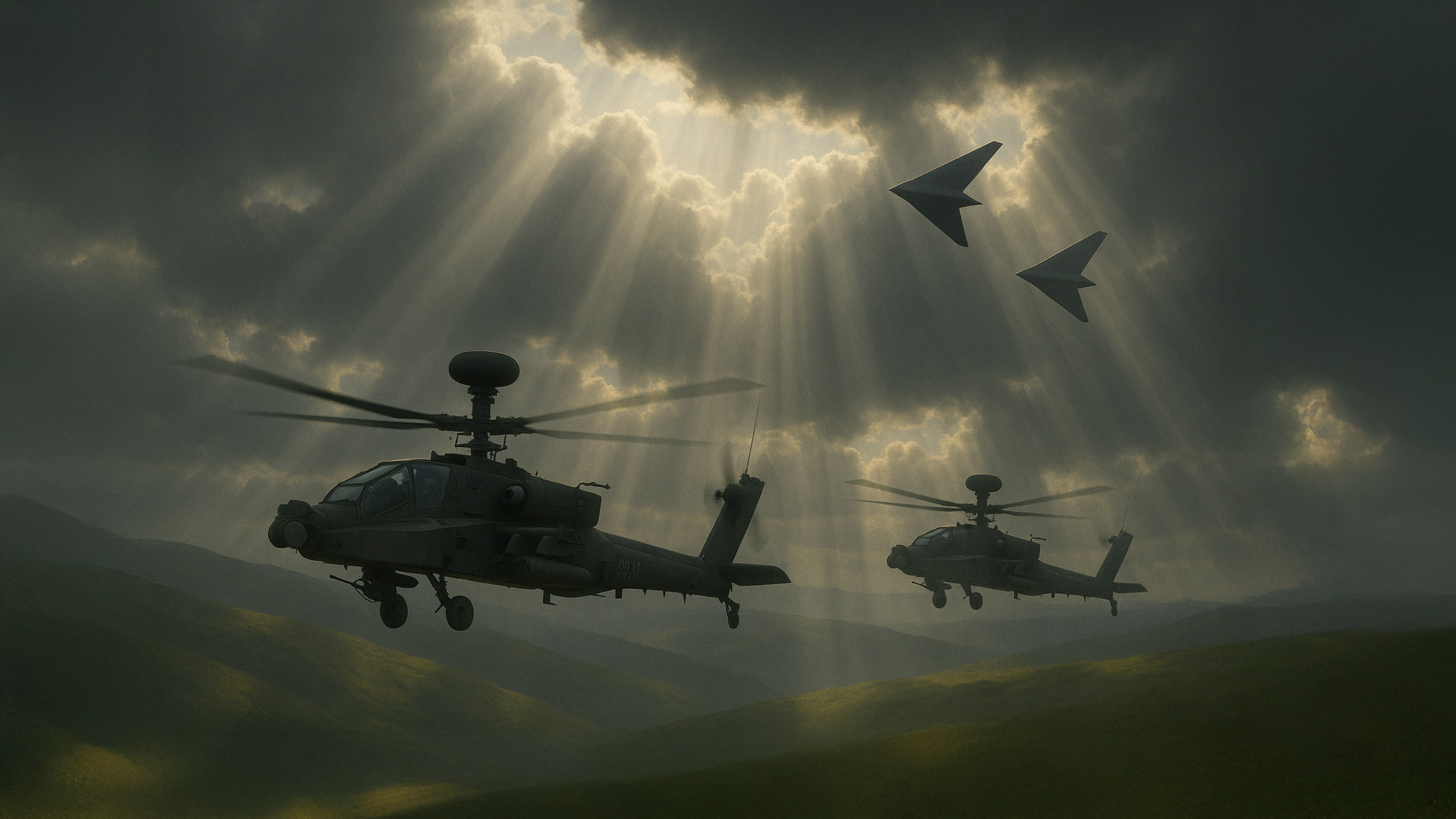
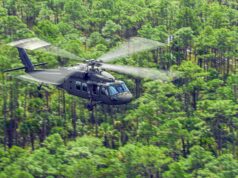
Seven defence companies have been shortlisted to develop prototype uncrewed aircraft intended to operate alongside British Army Apache attack helicopters, as the Ministry of Defence advances its Project NYX programme.
The initiative aims to develop so called loyal wingman drones that can support crewed helicopters on future operations, carrying out tasks including reconnaissance, surveillance, target acquisition, strike support and electronic warfare in contested environments.
According to the Ministry of Defence, Project NYX is intended to shape how uncrewed air systems are integrated into frontline aviation, with drones operating on a command rather than control model. This would allow aircraft to use artificial intelligence to adapt to battlefield conditions within predefined mission parameters, reducing risk to aircrew while increasing operational reach and tempo. The programme is being positioned as part of the Strategic Defence Review’s emphasis on autonomy, mass and new ways of fighting, with uncrewed systems expected to complement conventional platforms such as attack helicopters, armour and artillery.
Defence Readiness and Industry Minister Luke Pollard said the programme marked a shift in how the Army prepares for future conflict.
“These drones of the future will make the British Army more effective and lethal by enhancing our ability to strike, survive and win on the battlefield,” he said. “Project NYX represents the cutting edge of the Defence Industrial Strategy, working with leading British industry partners to ensure the UK remains at the forefront of autonomous military technology.”
The seven companies invited to submit prototype designs are Anduril, BAE Systems, Leonardo, Lockheed Martin UK, Syos, Tekever and Thales. The selection follows a pre qualification phase completed in late 2025.
In March 2026, the shortlist is expected to be reduced to four suppliers, which will be offered research and development contracts to produce concept demonstrators. Initial operational capability for the system is currently targeted for 2030. The Ministry of Defence said the programme is intended to strengthen collaboration with industry while accelerating the development of autonomous air systems capable of operating alongside crewed combat aircraft in high threat environments.



No Elbit UK?
Why not?
Labour being anti Israeli again
Israel has already threatened to withhold support and parts for countries voting against them. It’s even threatening to withdraw support for F35 if Turkey gets it. Israel is not a UK treaty ally, we should not be importing any equipment from non treaty allies.
Even though Elbit UK is a UK company with UK workers and all manufacturing is done in the UK?
It has just purchased UTACS from Thales
It is a subsidiary of Elbit Israel.
Your assumptions are false
Why should we not import kit from non teaty countires? even if the kit is better than others offer? i am just asking the logic behind your statement. Buy more USA kit, so they can rob us blind and decide when we are allowed to up grade it ie the F35 sofeware up dates to use non USA weapons issues?
Indeed let’s get real, we easily forget that Russia was second only to the US as Israel’s most important ally at the beginning of the Ukraine war and has gone out of its way not to upset them even since, or help Ukraine despite Russias overt anti-semitism only more overtly demonstrated during the war. Why? Well in part because a large number of its population are from Russia or surrounds and keeping friendly with them is deemed strategically important. A lot of their thuggish ‘security forces’ terrorising Arabs in the West Bank if you ever get a chance to listen to them have distinctly Russian and east European accents and make ICE look like kindergarten teachers. To my mind we should source nothing from Israel beyond what we have to, in terms of European policy they not only have that Russian influence with a lot of Russian skulduggery and agents filtered through the Country (bit like human money laundering) but of course they are now very much beholden to Trump and will do pretty much what they are told if Trump decides to focus his wrath on us, we see it starting now as an increasing disinformation and threat campaign for internal politicking and no doubt setting the scene for eventual NATO pull out. Indeed much of their technology has cross fertilised with the US so adds potential complications whatever the present availability. Totally unreliable in any future conflict I would say where we would be in opposition to Russia and/or without overt US involvement. Probably much of the future inherent risks for the West minus one in present circumstances I would say. So best to sideline the anti semitism campaign in this case.
Are they still relevant? ‘ “The AH-64D … is not a war-winning capability that we can fight with and win today.” Lt Gen Ryan also said that both Russian and Ukrainian attack helicopters have demonstrated “extremely limited” effectiveness in the Ukraine war.” ‘
The AH64 is now seen as a maneuver asset design to fight a deep battle at corps level rather than its previous fire support role. It’s still very relevant in this role although it requires significant SEAD a capability which neither Russia or Ukraine possess.
The deep battle role is what it has actually ended up doing in the two major wars in fought in Iraq 1991 and 2003.
‘…manoeuvre asset design to fight a deep battle at corps level…’
Must admit that sounds like a hand down to Winston Smith to rewrite historical documents for the Ministry of Truth to me, though I’m sure it has some meaning for those in the know. So therefore I will simply say whatever the value put upon these assets upon ordering them certainly we all know now from Ukraine as sophisticated as they are, they just wouldn’t last a month carrying out their original role now so as we are, for good or bad stuck with them, a new role has indeed clearly necessarily been proscribed as that double speak at least demonstrates even in its therwise unfathomable word spaghetti. Whether it will be that much better, effective or survivable I have no idea, though can’t be worse than the original expectations, but one thing I do know and know enough to comprehend is that for it to have any chance of succeeding it will indeed take very capable intelligent drones to substantially take away much of the inherent risk and expand Apache’s sensor parameters and much reduce its vulnerability envelope in time and space to allow it to exploit its true lethal strike potential. So I do hope these drones can offer that and do so asap so as to at least extend the helicopter’s useful service life and give crews some decent hope of survivability as well as useful capability that we will need. Got enough expensive unusable hi tech junk to deal with already along with the black holes in usable kit.
Their role and doctrine has quietly changed. Drones will carry out a lot of general anti armour work spread out over the whole of the front line, or that’s the plan when the drones finally get bought in sufficient numbers. Apaches will be used in a more focused concentrated force, punching a hole through lines, part of a larger deep strike maneuver element, again with supporting drones, and again when finally bought in sufficient numbers.
The change in doctrine makes sense as drone and anti air tech develops, it’s the fact it is dependant on the drones it needs actually escaping prototype and study group stage that’s the elephant in the room…
The attack helicopter fits now into the same role the tank destroyer did during WW2. Mobile fast response to enemy breakthroughs, but not leading or supporting breakthroughs themselves. Have we forgotten how lethal they were during the second Ukrainian summer offensive, the deployment of attack helicopters was almost certainly the reason the assault failed to meet the scale of the previous years.
Much like the tank we will never see them dissappear, there simply isn’t a reliable analogue to a heavily armed loitering asset that can rapidly change its location.
Yes let’s spend millions on more demonstration programs when they actually need to buy some kit. The entire defence spend uplift swallowed by housing nuclear and inflation.
Pointless program to throw cash away
Well they are near useless without them and the sort of drones required will have to be good enough to be effective in their own right and greatly expand the helicopter’s effectiveness and keep them survivable too, so inevitably that will take time and effort and testing to achieve and even determine what roles the drones are best focused upon. To send these guys into battle with ineffective equipment would be unforgivable. We don’t need any more charges of the Light Brigade where the Russians are involved.
Yet before spending millions redeveloping something we could buy off allies when they develop in the near future while our military is missing all the basics and needs £7billion just to fill the gaps to stay where we are.
We need to actually pay for what we have already committed too before doing more “jobs for the boys” and development that goes no where.
In ten years they spent billions on programs that go no where
Are these one way drones? Haven’t they got to be able to keep up and even go faster and further than the Apache itself? Thats a big ask. Hope they’re agile as and designed not to get in the way and jepodise helo safety.
Project this, shortlist that, blah blah blah more waffle with no action or honest intentions to actually put in an order! This is actually an effective force multiplier for the remaining Apaches we have, ensuring they can remain a little less close and vulnerable, while operating close to the FEBA. Will these be expendable or returnable? This needs to get off the ground as a matter of importance and unlike the vast majority of projects and promises by these clowns, it needs to be funded and pushed through fast!
Q, not sure why my post is a reply to you, it should have been a post in its own right, apologies.
2030 is the watch word here Airborne, I.e, the current bunch of clowns are no better than the last, pushing our defence problems onto the next government to sort out.
Everything they do is blah, blah, blah 2030…
They simply will not fund defence at the required levels, so nothing will happen, it will still in limbo for another 3 1/2 years.
They will sign GCAP and AUKUS contacts, because they cant stall those, but the lions share of the funding needed will be left to the next government to figure out.
Anything they can stall until 2029, they will.
Agreed, they are all the same, talk the talk then kick the big projects can down the road into someone else’s parliament! When I grip these clowns we have at the moment dues not in any way mean I supported the useless nob jockies who were in charge previously. They all see defence as a source of political funding to buy power to spend on those ideological attached support groups! Defence should be run by an elected all party group who are independent while in that post! 👍
Totally agree mate…
All good. Liking your posts.
Well my feeling is that helicopters racing through the countryside except where reasonably safe is not going to be a common sight, it’s when they are most vulnerable and where they have failed in Ukraine. I would see them best used as a stiletto strike from cover using the drones to expand their sensor coverage discover targets maybe use even as strike them assets while using the Apaches as flexible command centres and only exposing themselves when deemed safe and for much less time having gained intelligence and targeting information from the drones so increasing lethality while reducing risk. Others may disagree but can’t see other scenarios except in desperate circumstances.
Love the headline wording !!!
For a split second, I thought we might just have finally, ordered some kit but probably another ten years before all the meetings (swarms of meetings that drone on and on !) are over and then We’ll just start all over again.
Beem me up Scotty !
This government seem hell bent on Drones has if it’s the answer to everything on the Battlefield . Yes drones have their place no question about it .But like another poster has stated more kit is needed, for me it’s HMG cutting cost , Most battlefield drones are one way do there damage and don’t return meaning no maintains and less manpower needed , goes without saying paying or feeding them. 💰🍽 🙄
They are only talking about drones though. Not actually ordering any. It’s just a way of keeping thousands of civil servants in jobs for the May elections. Oh, that can’t be right. They’ve cancelled them.!
Interestingly, of all the Drone programmes we have ongoing, this one I believe has the most funding behind it, which makes me hopeful it’ll get somewhere.
Needs to too, a pretty new highly expensive asset is reduced to marginal usefulness without them I fear. This capability really is more than urgent. Whether the Govt truly understands that is anybody’s guess however or is it simply more cover for delay. From third to twelfth NATO biggest spenders in 3 years is pitiful and can’t be covered much longer.
Agree with Jim, we shouldn’t really be ordering anything from Israel while they remain in breach of so many UN resolutions and international laws.
We are a bit spineless here, scared of upsetting the USA and its AIPAC lobby. With luck, Elbit won’t win the contract. We have just wasted a stack of money on the Israeli Watchkeeper drones, which are being pulled from service prematurely because they don’t work very well at all.
Disagree on your post regarding working with Israel. As for Watchkeeper, the reason it’s been pulled is through the Armies inability to use it correctly, arm it, or even update its capabilities. A lot of the RA drone “pilots” would crash them on a regular basis, both in training and on ops and had to have civvy company drone pilots on hand to use and land them. The Watchkeeper was a shit choice and only half heartedly used by the Army. It was a generation behind when it come into service in 2010 and it took the Army 8 years to get FOC. Cheers mate.
Disagree. The Watchkeeper was based on a proven Elbit Hermes 450. The lead was Thales.
A proven bit of kit that after the MOD got it’s hands on it moved to a non working bit of kit
MOD and the Army to blame. As per AJAX
Still Israel grrrrrrrr
lol still Israel grrrrrrrr 🤣 Fair one! As for the WK as I said, ruined by the MOD, Army drone pilots were half trained due to not getting enough hours, and the kit itself was a toothless clunking tube chugging about the sky with some shite ISTAR on. A missed opportunity which we spunked over a billion quid on! 👍
100% agree
Good to see the idea being taken forward, Helicoptors are great assits but more open to threats than before,
How are Anduril and LM British companies? These American companies, are subject to US laws and congress.
Given the US is pivoting to cancellation of the mid term elections, the introduction of Martial Law and an Authoritarian dictatorship. Surely HMG should only be engaging with Independent UK companies?
We risk being controlled by an authoritarian power that is fascist in Nature and does not share our democratic society
Precisely! How could HMG look itself in the mirror if it awarded contracts to foreign defence companies whose government may (or may not) cancel midterm elections – it might interfere with their own policy of cancelling English county coucil elections in May whilst colluding with the Official Opposition and clamping down on free speech and gaoling those who disagree with it 🙄