

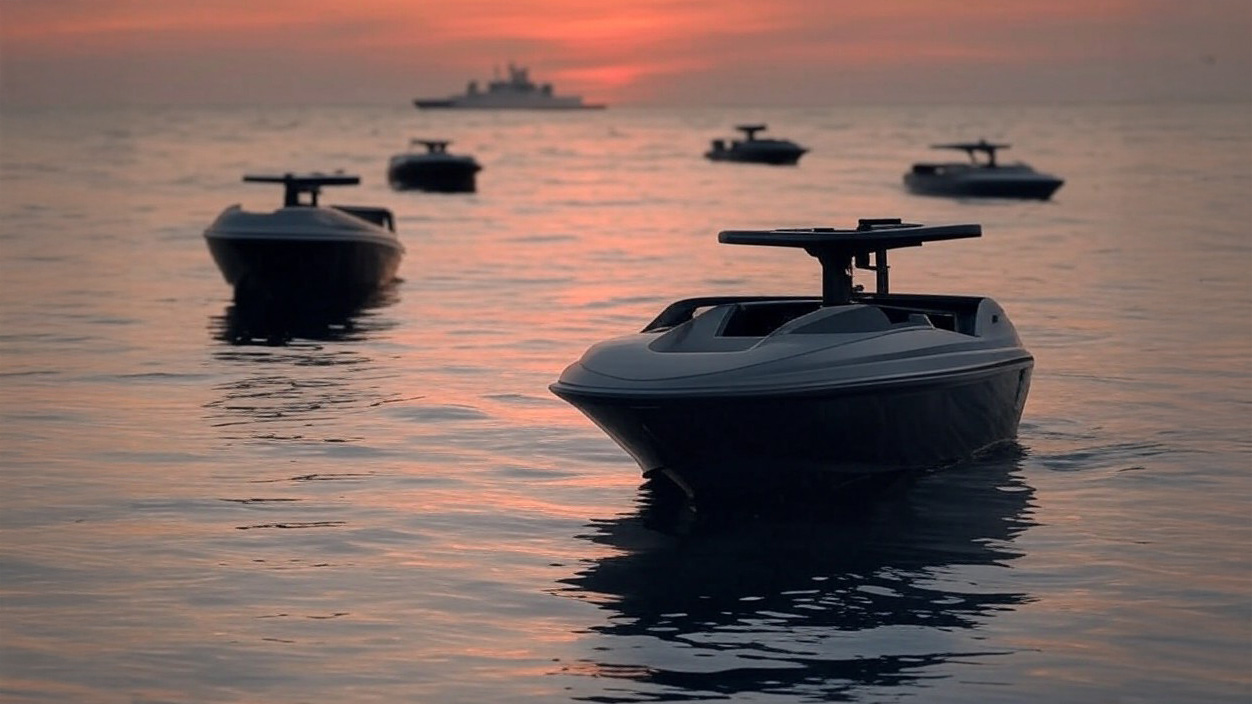
NATO is moving to expand the use of unmanned systems in the Baltic Sea, after senior Alliance officials described the deployment of a large drone fleet in 2025 as a major proof of concept for rapidly fielding commercially available technology to protect critical undersea infrastructure.
The next phase of the initiative, Task Force X Baltic, will be formalised through a new letter of intent signed by eight participating Allies, with NATO arguing the programme represents a practical shift from innovation testing towards real operational adoption.
Speaking at NATO Headquarters in Brussels, Nikolaos Loutas, Director in NATO’s Defence Industry, Innovation and Armaments Division, told myself and other journalists that the effort is tied directly to the Alliance’s wider post-2025 Summit drive to accelerate the pace of technology integration. “At the 2025 NATO Summit, Allied governments agreed a substantial increase in our defence spending to deliver on a new ambitious set of defence targets,” he said, adding that they also endorsed “a rapid adoption action plan to accelerate the pace of technology adoption to deliver on those targets.” He described the action plan as a mechanism to embed innovation into defence planning, aimed at addressing what he called the urgent operational need for effective new technology. “The action plan mainstreams NATO’s innovation efforts into defence planning and capability development to address our Armed Forces’ urgent need for innovative and effective technological products,” Loutas said.
He said Allies had committed to measures designed to accelerate procurement and integration, including shared best practice, new adoption pathways, and greater experimentation to reduce risk for new products. “They committed to de-risk new products through providing more testing and experimentation opportunities to innovators,” he said, pointing to Task Force X Baltic as one of the practical mechanisms enabling this. Loutas said the initiative is now reaching a significant milestone, with NATO preparing to launch the second phase. “One measure in this direction is the Task Force X framework, which is reaching a second milestone today, a very important one, with the signing of a letter of intent for the second phase of Task Force X Baltic,” he told reporters.
Loutas said the first phase of Task Force X Baltic was launched in support of NATO’s Baltic Sentry activity in 2025 and was intended to show that Allied forces could integrate new technology at speed alongside conventional capabilities. “Task Force X supports Allies rapidly acquiring, integrating and deploying new technological products alongside our conventional forces,” he said. He added that the project demonstrated how close collaboration between militaries and industry could deliver persistent surveillance at scale, covering multiple domains. “The first phase of Task Force X Baltic demonstrated that allied navies and army forces, when collaborating closely with industry, can deliver persistent intelligence, surveillance and reconnaissance from sea floor to space at speed, at scale and more affordably,” he said. NATO officials said the second phase will see eight Allies reaffirm cooperation on rapidly acquiring technology-enabled, multi-domain capabilities for naval operations: Denmark, Estonia, Finland, Germany, Latvia, Lithuania, Poland and Sweden. “At today’s signing ceremony… eight participating Allies… reaffirmed their readiness to cooperate on rapidly acquiring new technology enabled multi domain capabilities for naval operations,” Loutas said, adding that the work supports NATO’s broader Digital Ocean concept endorsed by Defence Ministers. “This will contribute to the implementation of the Digital Ocean vision,” he said.
Alongside Task Force X Baltic, Loutas said several other multinational initiatives were progressing, including cooperation on military airworthiness in crisis or conflict, ballistic missile defence capability development, a deep precision strike initiative involving drone technology, and Sweden’s entry into an existing NATO air mission memorandum. “All these initiatives demonstrate concrete actions taken by Allies to meet their capability targets,” he said, framing them as part of the Alliance’s wider effort to strengthen deterrence and defence. He added that Task Force X Baltic in particular is intended to translate experimentation into deployment, with a focus on rapid acquisition of commercial systems and real-world testing in operational conditions. “We will see commercially available drones and systems be acquired quickly and deployed in operational conditions in the Baltic Sea,” he said. “By integrating those innovative solutions alongside our conventional forces Allies will be able to test real time interoperability and command and control integration,” with lessons then captured in a playbook that can be scaled. “Lessons learned… will be summarised [in] a playbook which will allow NATO to scale and quickly establish further Task Force instantiations in the future,” he said.
NATO’s Supreme Allied Commander Transformation, Admiral Pierre Vandier, linked the origins of Task Force X Baltic directly to the cable-cutting incidents in the region, saying NATO seized the moment to demonstrate rapid response and capability deployment. “Remember, in December one year ago, we got the cables that were cut in the Baltic,” he said. “I seized the opportunity [to] demonstrate that NATO was able to take that into account, and probably more rapidly than [people expected].” Vandier said the first vessels deployed quickly, with NATO able to show the presence of an unmanned fleet within a month. “The first two ships that were able to sail… was only 30 days after the cables were cut,” he said. He added that the effort expanded sharply in the following weeks, reaching 50 boats before the NATO Summit. “During the following month, we demonstrate that we were able to operate a fleet of 50 boats before the summit,” Vandier said, claiming the United States later increased the size of the force by providing additional platforms. “The US… provided 20 boats more,” he said.
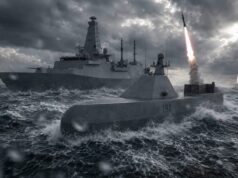
Vandier described the activity as unprecedented in scale, stating: “We have operated during one month the biggest unmanned fleet… on this earth.” He said the aim now is to move beyond experimentation and into multinational adoption, arguing that NATO is pushing towards a new era of integrated operations between traditional platforms and unmanned systems. “Now we are in a state where… we have the nations to adopt,” he said. “We are on the way to make nations cooperate on this and open a new era of cohabitation between legacy platforms and unmanned platforms.” According to Vandier, such integration would increase operational dilemmas for adversaries, while also improving cost efficiency. “[It] will create more dilemmas for the enemy… and a better use of the money,” he said.
The Admiral repeatedly framed the case for unmanned systems as a response to both mass and affordability problems, contrasting the cost of major surface combatants with the need for persistent presence and surveillance. “When you just look at… a frigate… [the] price per day at sea is 5 million,” he said. “It’s something you can’t afford.” He linked this to broader lessons from Ukraine, arguing that the challenge of countering mass drone threats has forced militaries to think differently about sustainable capability.
“As we see… where we need to… kill these drones with affordable munitions, it’s exactly the same with [unmanned surface vessels],” he said, describing them as a way to apply technology to achieve effects that would otherwise require prohibitively expensive force structures.
When asked how NATO intends to prevent further cable sabotage, Vandier acknowledged that physical prevention is difficult but argued that persistent surveillance and attribution are achievable through sensor networks and unmanned monitoring. “You can’t prevent a ship to drag its anchors on the sea bed and cutting the legs,” he said. “But today… we have sensors that hear the heat of the anchor on the sea bed.” He said such systems can detect the act of dragging and identify responsible vessels. “You hear the drag, and then, with persistence, surveillance fixed, you can identify who is the ship which is trying to do that,” he said, comparing it to criminal deterrence through monitoring. “It’s exactly as robbers… if you have video surveillance in your city, you will get them caught,” Vandier said.
Pressed on how large a future unmanned fleet could become, Vandier said size decisions would remain with participating nations, depending on funding and contract structures. “The size of the fleet is nations’ business,” he said. “It depends on the money and the type of contract.” However, he suggested that if Baltic states each fielded around 20 platforms, the region could see a fleet approaching 100 unmanned vessels, which he argued would be sufficient for monitoring the Baltic Sea. “If each of the Baltic country has… 20 ships, we’ll see a fleet of less than 100 which is worth enough to monitor the Baltic Sea and for a very limited amount of money,” he said.
A key theme of the briefing was the exploration of new procurement and support models, including leasing or hiring platforms rather than traditional ownership. Vandier said NATO’s early work demonstrated that commercial capability could be brought into service rapidly through such approaches, with multiple companies offering solutions. “We demonstrate that we were able to hire something,” he said. “You have today a bunch of companies… you have some US, you have some French, you have some Danish, you have a lot of offers.”
Loutas reinforced that Task Force X is partly intended to explore how defence acquisition must adapt to rapidly evolving systems that blur the line between hardware and software. “It’s also an important exercise for us to understand and explore different ways of developing capabilities,” he said. “In some cases, might make sense to acquire. In other case might make sense to lease,” he added, arguing that the Alliance must understand which business models deliver the best results under modern conditions.
Vandier warned that rapid technological change means long-term procurement assumptions are increasingly risky, particularly as artificial intelligence, miniaturisation and commercial communications technologies drive fast obsolescence cycles. “The speed of obsolescence is very, very high,” he said. “If you think that you will buy a ship that will be in your inventory for the next 10 years, you are making a great mistake.” He argued that future fleets will need regular refresh cycles for sensors, command-and-control and effectors.
“Each year… two years, you will have to refresh your C2, your effectors, [your] sensors,” he said. Vandier also indicated that while ISR is a core requirement, some tested systems may have additional roles, including interception. “Some of the… [systems] we tested are also interceptors,” he said. “They can be weaponised.”
The briefing also suggested NATO is already considering how the Task Force X model could be expanded beyond the Baltic. Asked whether it could be duplicated for Arctic Sentry or Eastern Sentry operations, Vandier said a project is already under way to replicate the approach in the Arctic environment. “We’ve launched… [a] project… replicating this in the weather conditions… of the Arctic,” he said, noting that cold temperatures, battery limitations and rough seas present distinct challenges.
He said similar work is also being pursued in support of Eastern Sentry. “We also launched something similar for Eastern Sentry,” Vandier said, adding that the first operational exercise in that context had already taken place in Finland last year. Looking ahead, he said NATO’s transformation command plans a large-scale exercise in Romania intended to test emerging counter-drone concepts, with Ukraine involved to assess outcomes.
The Alliance sees unmanned systems as a central tool for achieving mass, persistence and affordability in contested maritime environments. With the second phase of Task Force X Baltic now being formalised, NATO is positioning the programme as a template for wider adoption, with lessons from the Baltic cable incidents driving a push to embed commercial unmanned capability into NATO capability.


Just fluff.