

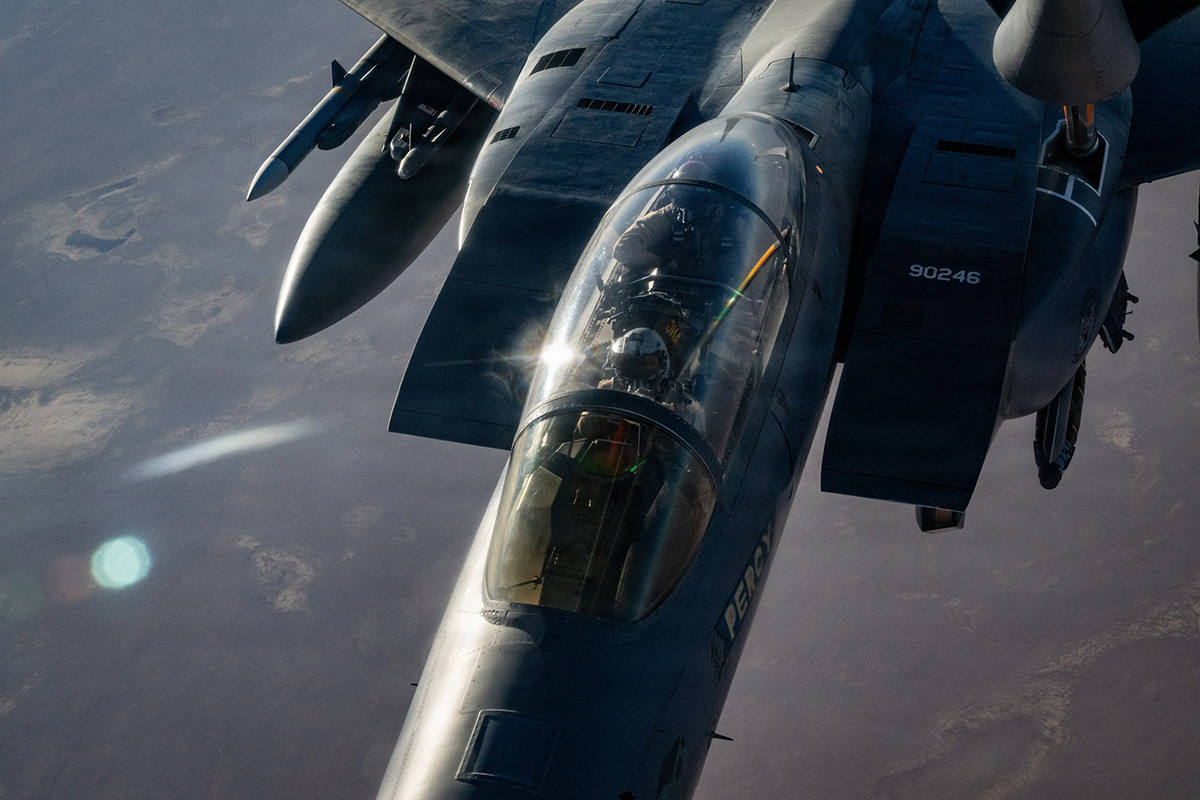
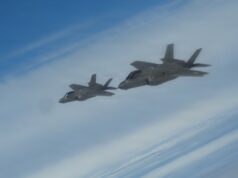
Three United States Air Force F-15E Strike Eagles have been shot down over Kuwait in what U.S. Central Command has described as an apparent friendly fire incident.
In a press release issued on 2 March, U.S. Central Command (USCENTCOM) said that at 11:03 p.m. Eastern Time the aircraft, which were flying in support of Operation Epic Fury, “went down over Kuwait due to an apparent friendly fire incident.”
According to the statement, the incident occurred during active combat operations that included attacks from Iranian aircraft, ballistic missiles and drones. USCENTCOM said the fighter jets were “mistakenly shot down by Kuwaiti air defenses” amid the engagement.
All six aircrew aboard the three aircraft ejected safely and have since been recovered. The statement confirmed they are in stable condition. CENTCOM added that Kuwait has acknowledged the incident and expressed gratitude for the efforts of Kuwaiti defence forces in supporting recovery operations.
“The cause of the incident is under investigation,” the statement said, noting that additional information will be released as it becomes available.
No further operational details have been provided.
The aircraft itself
The F-15 Eagle is an all-weather tactical fighter developed to establish and maintain air superiority. Designed with a high thrust-to-weight ratio and low wing loading, it offers strong acceleration and manoeuvrability, enabling tight turns without significant loss of airspeed. Its performance characteristics are supported by twin turbofan engines and a lightweight airframe optimised for air combat operations.
The aircraft integrates a multi-mission avionics suite that includes a head-up display, pulse-Doppler radar, inertial navigation system, electronic warfare systems and identification friend or foe capability. The radar is designed to detect and track targets at long range and at varying altitudes, including low-level targets in ground clutter. Information is fed into a central computer to assist with weapons delivery, while the head-up display allows the pilot to access critical flight and targeting data without looking down into the cockpit.
The F-15 can carry a range of air-to-air weapons, including AIM-120 AMRAAM and AIM-9 Sidewinder missiles, alongside an internally mounted 20mm M61A1 cannon. The F-15E Strike Eagle variant expands the platform’s role to include deep interdiction and precision strike missions, with a two-seat configuration and enhanced avionics for all-weather, day and night operations. It is equipped with terrain-following capability and advanced radar systems to support low-altitude, high-speed penetration.
First flown in 1972, the F-15 entered service in the mid-1970s and has since undergone multiple upgrades through improvement programmes enhancing radar, computing power and electronic warfare systems. Variants of the aircraft have been deployed in numerous operations, including the 1991 Gulf War and subsequent campaigns in the Balkans, Afghanistan and Iraq. The F-15 remains in service with the United States Air Force and several international operators, fulfilling air superiority and strike roles within modern air forces.



Crikey in such a congested air space you would expect an occasional blue on blue but three?
You would think though patriot would have friend or foe identification software on it I thought that lesson was learnt in gulf war 1
Lot of trigger happy nervous air defence people along the Gulf coast.
Well that proves modern western air defences are good at destroying 4.5 generation aircraft..
Reminder to pilots; when re-entering friendly airspace, make sure you turn the IFF squwak box back on!
This, presuming the GBAD units know the USAF IFF codes.
Sounds like the responsibility of USAF mission planning to let their allies know before it starts…
Expensive mistake.
3 in one go, that is some going.
I assume Kuwait GBAD far exceeds ours?
Kuwait have Patriot and NASAMS.
Well there you go.
Where they’re located, over the last two decades they’ve needed it more than us, but it’s time our pathetic leaders got their arse in gear on this.
I have little real belief they will, by the way.
They live in a tuff neighbourhood u would hope so
Guess it makes a change from the Spams shooting down our aircraft
Amazing luck that all 6 aircrew survived. How is that possible?
Ejection seats. They are a great invention. Have you heard about them?
At ours don’t reject downwards
AAW missiles generally head for the tailpipe as it is the hottest thing on IR and gives the best radar return.
That way there is a very solid engine between the missile and the pilot.
Doesn’t say much for the F15 countermeasures or the training of the land battery operators who can distinguish a slow drone from an F15. This is semi trained people pushing buttons.
Fair point on turbine heat signature and mass, however the turbine disintegration is catastrophic so it’s just as well the pieces are ejected axially, behind the crew.
All the Kuwait ground to air defences are semi active radar homers with warheads ranging for 35kg to about 85kg and finally if they manage to get a PAC 3 missile working a Mach 4-5 hit to kill evaporator … essentially it’s pot luck where the blast frag would go off really.
I suspect they were engaged by the older lighter systems and not Patriot PAC 2 or 3.. because your not really walking away from those.
Any modern system can shape the blast and fragmentation pattern.
Yep but they don’t shape them to not kill the pilot, they shape them to transfer as much kinetic energy and chemical energy into the target as possible.
The object of the exercise is to mission kill the plane not the pilot per se.
No engine is a mission kill as the engine will unpack itself laterally.
True but let’s be honest they just want the blast to hit.. essentially most aircraft essentially fall down no matter where you hit them.. so it’s all random luck on the blast frag hitting the front fuselage, wing and control surfaces or rear fuselage and engine and control surfaces… plane still falls out of the sky… for the pilot it’s all a matter of how much of that kinetic energy went his way… after all it’s only a very few ground attack aircraft that have armoured cockpits.
That really isn’t the case at all.
The blast shape will be carefully calculated to make it most likely to take out the aircraft in such a way that is cannot be made serviceable again.
If it is a tail shot that is taking out the engines and letting them destroy most of the plane.
If it is a closing shot then you might be right.
I’m not sure a lot of the Kuwait munitions are that clever.. it’s anti air breathing stuff is all pretty old ( AIM-7 based system and MIM-23 I-HAWK)
and patriot is essentially the equivalent of exploding a 250ib bomb next to the aircraft.. it’s going to be in pieces..
Their latest generation anti air breathing system is not on line yet because they massively focused on ABMs.
I sense lots of guessing going on here. Here is mine, perhaps they know they had been targeted and got out early. That is what Radar Warners Receivers are designed to do.
As for guessing that the rear of the aircraft was targeted, that is very sensitive to the engagement geometry. Missiles only curve to intercept aircraft from behind in films.
Hmme
If a missile is using IR it will head towards the IR signature…..which is the tail pipe….
You are guessing again, who said heat seeking? PAC 2 & 3 certainly are not.
NASAM, often AMRAAM likewise i.e. Radar Homing, unless IRIS-T or Sidewinder. Heat seekers / IR imagers are generally small and short range Sidewinder & ASRAAM. They certainly do not have the energy to curve around and attack from behind. Images will aim for the aircraft not the efflux.
Guessing is fun, but achieves little and you do not know when you are wrong.
Kuwait air defence certainly doing better than Iran it appears.
I am very well aware of what is on the front of most of the AAW missile systems.
If you look up the thread we were discussing heat seeking – which a lot of the older generations of missile are in terminal phase. We had discussed that they had a mixed bag of systems.
As a broad generalisation the middling generations used IR in the terminal phase: simply as it was simpler and used less power. It was conceptually the developmental middle step between semi active and fully active.
They have a real mixed bag of stuff from Patriot/NASAM right the way through to some real old stuff that UK certainly wouldn’t consider retaining.
It could be, as you say, that the crews punched out as a response to the threat warning receiver. We won’t know that detail unless or until a US board of enquiry finding is published. But there could be other reasons.
and if the cockpit happens to be between the missile and the tailpipe at the moment of kaboom?
Agreed – the objective is a mission kill.
It depends what shot them down really
Kuwait has three manybe four options
MIM-23 I-HAWK, Meduim altitude missile.. very very old big semi active Homer with a big old blast frag warhead ( 54kg) not accurate and would be using bug frag radius to get a kill.. it’s luck as where and if it get close to any part of the aircraft..
Amoun’ low-level air-defence systems, this would fire an Aspide missile, semi active, another semi active homers with a big blast frag 35kgs again its Luke where it hits or how far way it is..or it fires Raytheon AIM-7 which is another semi active homer and not much different to Aspide.
Patriot PAC 2, massive semi active Homer with a huge blast frag.. 85kg.. not sure there would be that much left of a f15 or the pilot to be honest as it’s designed to destroy a ballistic missile warhead that is hardened for re entry stress… it would probably evaporate an airbreather
Final option Patriot PAC 3.. this is a Mach 4-5 hit to kill missile.. weighing 650ibs.. it’s going to create the same sort of kinetic energy levels as being hit by an intercity 125… but concentrated into a very small area… evaporation of the f15 essentially.
So really I would imagine.. 1 they were not engaged by Patriots.. 2) for all 6 to be alive is just a matter of maybe maybe not.. ( luck).
how they shot them down at present Kuwait has patriot and some very old short range missiles.. Air breathing aircraft are essentially pretty fragile they make the cockpit less so.. a blast frag that causes catastrophic damage to an airframe May not be close enough to cause significant damage to the cockpit.. a
American s? Combat, friendly fire incident nothing surprises anymore
Interested to know who actually Shot them down,and by what means ?.
I don’t know what’s worse. being shot down by friendlies OR being shot down full stop, especially as these aircraft aren’t exactly missing anything for defensive purposes.
I agree it doesn’t say much for the DAS that the F15’s were fitted with.
Glad the aircrew got out. Imagine if the Arabs start flying sorties….
LOL.
Just reading that Qatar has shot down 2 Iranian SU-24s
And Iran is also using Yak 130 trainers above Tehran for anti-drone defence.
Nice to see others getting in on the downsizing of the Iranian military.
At least Qatar knows the difference between Iranian and American jets 🙂
Indeed, but it’s difficult to get a clear picture of what effects the strikes
have had or are having on Iran’s military capabilities right now.
I guess we will know more in a few days.
Whatever limited coordination and control there was will have been taken out.
What is left now is doing stuff to lists on sealed order which is why missiles are loosing off all over the place and annoying people who were not involved to start with. This is not rational strategy but last gasp lashing out in all directions.
I do wonder how long this will go on for one the drone factories and stockpiles have been blow up…as well as every launch site receiving a HE present by return. Yes, there will be those few who really are fanatical but that will be outweighed by those who appeared fanatical for the purposes of survival or promotion.
The only downside is that Iran is a huge country and any warehouse anywhere could hold a stockpile of cheap drones. The other side of that is that they are very trackable with NATO tech so it is one launch from one location and the location is toast.
I suppose it depends on how many nutters there are and if any none nutters can get organised enough and get control of the guns needed to kill all the nutters.. in my simple way that is why I think this was less than well thought out.. I would have made sure the none nutters had plenty of guns and a well planned insurrection before I blew up all the nutters command and control… but maybe I just overthink things..
I think what will probably happen now is a not so slow slide into failed state and Islamic warlords that will need constant bombing to stop then from attacking western alliance in the region..
The Iranians probably overestimated their resilience having seen the effects of their cheapo drones on UKR and assumed they could just keep making and throwing them ad infinitum.
The overestimation of their abilities was also encouraged by China and Russia who see Iran as useful if slightly toxic idiots. Both are quite happy to see the pot being stirred constantly as a distraction from their own antics and to tie down bandwidth and resources.
The regime’s domesday letters will be to wreak havoc on the enemies of the Iranian regime with little distinction between anyone as I doubt the clerics really realised how puny the resources were if fired over the huge areas they are trying to bomb into submission.
I think it’s important not to underplay the massive levels of anti ballistic Missile defences the gulf states had.. they all knew Iran would go tonto if attacked
Saudi has:
16 THAAD Fire Control and Communications Mobile Tactical Station Groups, seven TPY-2 THAAD radars, 44 THAAD launchers
seven PATRIOT fire units, 48 launchers, six MPQ-53 radars, six engagement control centres,
MIM-23B I-HAWK medium-range system, 16 batteries and a total of 126 launchers
And all the rest are essentially scaled down but at the same level..
I believe most of the worlds THAADs sit in the Middle East.
Why Kuwait? Somebody there has some questions to answer.
20 minutes in on BBC News at 6, still waiting for any detail or even admittance that RAF Akrotiri was hit.
A brief mention by Myree that 2 Drones were intercepted headed towards Cyprus is all we’ve had so far.
Yippee! As I’m watching, 25 minutes in, Akrotiri gets a mention. At last.
Nice of the BBC to acknowledge that Brit territory has been hit amongst all the anti Trump, anti Israel, and girls schools being hit bias which is standard.
And, that was the last part of the report! British side of things
Last.
I assume the BBC don’t wish to harden the public view so don’t highlight it first
Yes but if the public actually clicked onto the fact the UK had be attacked without provocation.. then they may demand HMG actually defend the nation by doing violence to others… scratch that the public really did not click that Russia actually attacked Salisbury with enough Novichok nerve agent To kill thousands and that if it had been picked up and crushed in a bin van it probably would have been spread throughout the city… personally I think we should have triggered article 5 for that.. ever since Russia has seen us as it weak and feeble nemesis..
Pretty much confirms the agenda I am suggesting. We need to grow a pair. I remain to be convinced that this government are able to, pity Maggie is no longer around, now THERE was a leader.
I did not agree with a lot of her domestic policies around infrastructure ( never privatise a Monopoly ).. but geostrategically she was a serious statesperson.. Gorbachev alway made it clear that what really screwed the USSR was the realisation that one European nuclear power was still essentially nutty as a fruitcake when it came to its willingness to face aggression with uncompromising force.
Couldn’t agree more D!
@Jonathan I’m reading a book called “From Russia with Blood” which pretty much opens with a statement about Russian agents and other Russian crooks being allowed to act with impunity in the UK – to the horror of everyone else – because they were pouring billions into the UK economy. Hence why so many serious incidents were swept under the carpet, or dropped for “lack of evidence” etc.
I recently read a book called “Failures of State”, where Johnson and Sunak were heavily implied to be a “let the bodies pile up in their thousands” tag-team whose needless delays and contradictory diktats were designed to lead to herd immunity and knowingly caused tens of thousands of excess deaths. The predicted covid death toll would have doubled if their plans hadn’t eventually been reigned in. The book specifically mentions how Sunak’s eyes would glaze over if anyone raised national defence to him while he was PM.
These are examples of leaders of our nation with absolutely no thought for defending the realm under any circumstances. Not when it would have cost a few quid to do so. And now we have Starmer who is actively turning the country into a 3rd world hotspot of crime and racial tension.
The Yanks talk about the “almighty dollar” but those with their eyes on the ball will also be thinking about the pound and the ruble.
You’ve hit on the core “secret” of television news, the Headlines at 1800 are the hook, but they aren’t necessarily the definitive record.
In the industry, the 1800 headlines are often referred to as the ‘Menu.’ They tell you what is being presented, but the essential details of the reporting is saved for the slots where the most people are seated at the table.
The reporting on the RAF Akrotiri strike offers a clear look at how news priority shifts throughout a single day. While the attack happened at midnight local time, the Ministry of Defence issued its first formal statement at approximately 0145 on March 2. The BBC announced it at 0212 in the early hours of the morning, just half an hour after the hit, via a ‘Breaking News’ alert.
By 0600, the story had become a lead headline for the morning cycle on BBC Breakfast and Radio 4. However, the reason the detailed coverage appeared to be ‘pushed back’ to 0622 wasn’t because it was considered unimportant; it was actually the biggest story of the morning. The 0600 slot is traditionally a top of the hour reset reserved for the most significant developments of the last 24 hours. At that time, the Lead Story was the broader Middle East crisis and Prime Minister Keir Starmer’s major policy shift regarding US use of UK bases. The Akrotiri strike was reported within that 0600 package as a ‘Breaking Development,’ but it was held for the 0622 Deep Dive to allow a Defence Correspondent to provide technical analysis. It was in this 0622 slot that the BBC confirmed the drone was likely a Shahed-type and, crucially, that it had been launched before the Prime Minister’s speech, even though it landed after.
This pattern of holding specific details continued into the evening. On the BBC News at Six, the strike was notably absent from the very top of the hour, only appearing in the 1825 slot. This is because the BBC treats the 1800 opening as a summary of the global and political state of play, focusing on the government’s strategic response and the risk of wider war. They reserved the 1825 slot—the ‘Gold’ position just before the handover to local news—for the definitive ‘boots on the ground’ report from Cyprus.
Because editors know the audience is at its LARGEST at 1825, data from BARB shows that the audience for the News at Six doesn’t start at its highest point; it builds. While the program might start with 3.8 million viewers at 1800, it often peaks at over 5 million by 1825. This isn’t because people are ‘aiming’ for that specific slot, but because of the regional news at 1830. They often place their most ‘substantiated’ or original reporting there. If they led with the Akrotiri deep-dive at 1800, they would miss the millions of ‘stragglers’ who haven’t yet made to sit infront of their telly. By placing it at 1825, they ensure the highest number of eyeballs see their most verified version of the truth before the national show ends.
This ties directly back to the BBC’s legal mandate. They are required to inform as many people as possible with accurate information. If they only reported the ‘What’ at 1800, when fewer people are watching, and ignored the ‘Why’ during the peak at 1825, they wouldn’t be fulfilling that duty as effectively. So, while you might just be a ‘straggler’ trying to catch the local news, the BBC is using that habit to make sure you get the most verified version of the day’s biggest story. It turns the 1825 slot into a bridge between the global politics of 1800 and the local reality of 1830.
In contrast, Sky News which is also regulated by Ofcom, but as a commercial entity, its “mandate” is to be first and keep viewers watching. They can report “reports of an explosion” much more freely. Sky led with the strike at 1800, emphasizing the immediate shock and the fact that ‘British soil’ had been hit. Sky is often the choice for viewers who want ‘fragmented updates’ quickly, as they prioritize the ‘What’; the sirens, smoke, and immediate quotes. While the BBC’s legal mandate ensures they prioritize the ‘Why.’
Their caution ensured they had the data to prove the drone was already in flight before the PM spoke, showing that a viewer needs the patience to wait for the analysis rather than just the shock alert.
Great post that, M. Really interesting.
One can find it so frustrating, but if there’s a rationale behind it, fair one.
there was a BBC reporter at RAF Akrotiri for the ten oclock news, who so they said had just got there. There also seemed to a bit of disagreement about midnight on Sunday ( live news on the internet) over drones hitting RAF Akrotiri, with the UK saying they did and both Presidents of Cyprus ( Cyprus and North Cyprus) saying no. That had gone by the morning of the next day.
👍
Has a sky sabre system been send to Cyprus ? Also I hear that the Greek government are sending aircraft and a couple of surface vessels .Is this to help us Brits out has we are on over stretch and don’t have GBAD .
F 15 war planes cost nearly 100 million. And war always have risks and costs. The Pres gave the Pentagon a 1.5 trillion budget, lots of $$$ to go around. …. For the MIC
Things like this happen in wartime, usually centring on the US military, although it’s usually them doing the blue on blue.
Still, this is incredibly embarrassing. Maybe the US strategy is to make China and Russia think they’re rubbish, then if WW3 breaks out, surprise! They’re suddenly brilliant.
No such thing as ” Friendly Fire”