

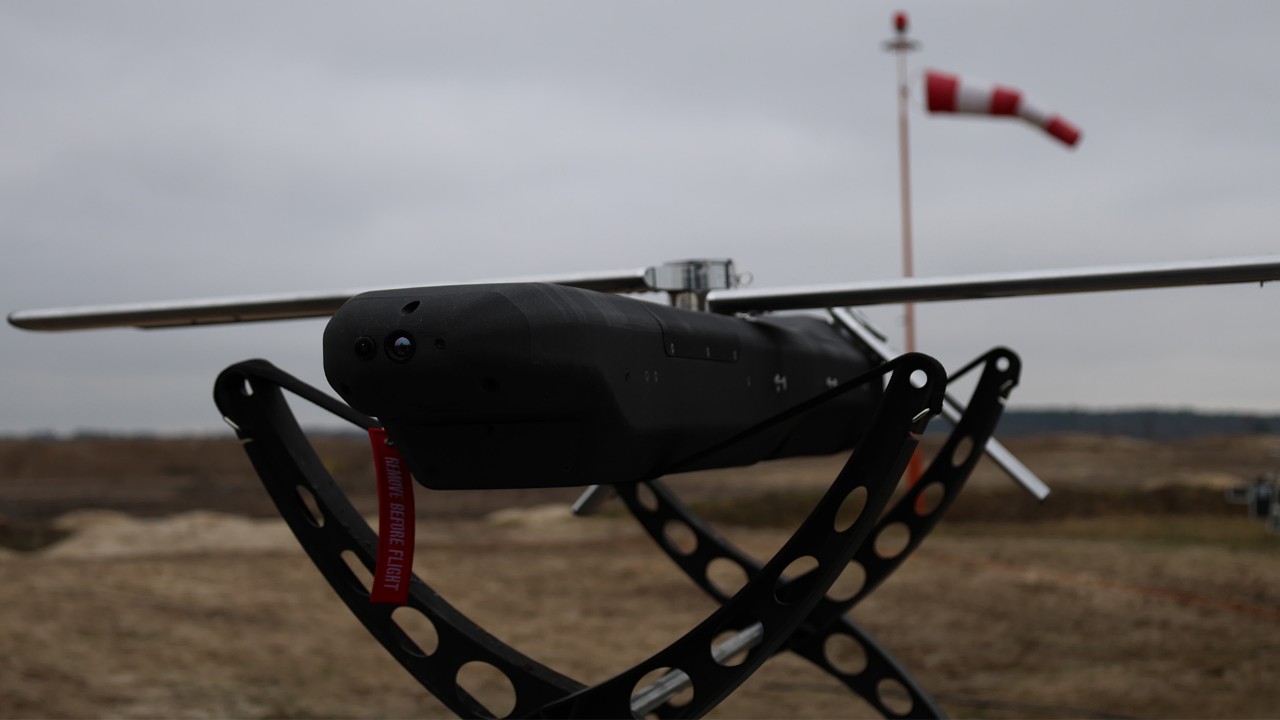
The UK is set to procure a new interceptor missile designed to counter drone threats, with a British start-up expected to supply systems to both UK forces and Gulf partners, according to the Ministry of Defence.
Defence Secretary John Healey announced that Cambridge Aerospace will provide the “Skyhammer” interceptor and associated launchers, with initial deliveries expected as early as May, subject to contract.
The missile is intended to counter threats such as Iranian-designed Shahed drones and reflects a wider push to field lower-cost air defence systems at pace, according to the government.
The system has a reported range of around 30km and a top speed of approximately 700km/h, according to the company. The first tranche of missiles and launchers is expected within weeks, with further deliveries planned over the following six months.
The announcement was made at the London Defence Conference and forms part of a broader effort to accelerate procurement from smaller, innovative firms and apply lessons from conflicts in Ukraine and the Middle East.
“We are accelerating contracts with the most innovative British businesses to rapidly expand support to Gulf partners and equip our own forces with anti-drone tech,” Healey said.
The Ministry of Defence said the deal is expected to support more than 175 jobs at Cambridge Aerospace, including the creation of around 50 new roles.
According to the company, the system is designed to provide an “affordable mass” approach to air defence, prioritising cost-effective interception against large volumes of low-cost drones.
“Skyhammer was designed to do exactly that – bringing affordable mass to protect our skies,” said CEO Steven Barrett.
The contract is expected to include integration, technical support and training, according to the Ministry of Defence. The procurement remains subject to final agreement.








Any idea of cost per unit?
Please ignore. I don’t think there’s much information along those lines.
Its estimated at cost of £20-£30,000, see breakdown below
That figure is based on industry reports and analyst projections circulating around the DSEI 2025 defense exhibition and recent procurement discussions in 2026.
While Cambridge Aerospace CEO Steven Barrett has officially stated that their interceptors will cost in the “tens of thousands” of dollars (to compete with the price of a Shahed drone), specific industry breakdowns from defense forums and journals like the UK Defence Journal and EDR Magazine have pinpointed the targets for each system:
The Price Breakdown
• Skyhammer (~£20,000 – £30,000): This is the high-subsonic, turbojet-powered model. Because it is designed to take down slower drones, it uses a slightly less expensive propulsion system, leading to that lower £20k-£30k entry point.
• Starhammer (~£30,000 – £40,000): You likely saw the £20k figure as a baseline for the company’s technology generally, but the Starhammer specifically is more expensive. It is a supersonic, rocket-powered interceptor designed for higher-speed targets (Mach 2+). The increased cost comes from the Nightstar solid rocket motor and the more robust airframe required for supersonic flight.
Where these numbers come from:
1. DSEI 2025 Briefings: During the product unveiling, the company emphasized a price point that is “a fraction” of existing systems like the LMM (Martlet) or CAMM.
2. Comparative Analysis: Analysts derived these figures by looking at the cost of the internal components—specifically the X-band radar seeker and the in-house manufactured motors—which Cambridge Aerospace produces vertically to bypass the typical 300% markup of traditional defense prime contractors.
3. Government Backing: Recent 2026 reports regarding UK government interest in “affordable mass” for air defense have frequently cited the £30k–£40k range for Starhammer as the target price for the MOD to achieve a sustainable “cost-exchange” ratio.
Clarification: If you see a £20,000 figure, it is almost certainly referring to the Skyhammer (the subsonic drone-killer) or the company’s early “target cost” for their base platform before rocket propulsion is added.
Starhammer’s probably more than that. It only has to achieve cost parity with cruise missiles so I’d estimate £70-100k and solid rocket motors are more expensive too. CA have said a lot about what they want to be able to sell for but that won’t be achieved for a long while yet.
Starhammer….Starmer….almost a missile namesake.
We had the Iron Lady now we have the Star Hammer
Good post, Jim.
👍
I believe Starhammer was also reported as having a counter-ballistic capability initially, though whether that has since been walked back is unclear.
They’ve changed it to that they want to upgrade to ballistic missiles eventually, it’s a stated aim of the company to be able to protect the UK against the full range of weapons. Star is smaller than CAMM though, so I think we will see a next evolution closer to Aster size.
drone warfare is constantly adapting, seems to be the experience in ukraine, this will need to continually evolve.
Even if we knew the cost, we don’t know what the total expenditure is and so have no idea if the order is for 10 or a thousand. You would hope tends of thousands of they are good but expect realistically sub 100.
That’s too expensive! Ukraine are knocking Russian drones out of the sky using drones it manufactures for less than £500 per unit. I have seen them. Shoulder/vehicle/container launched, they can fly at up to 380 km/h, cannot be jammed. They have a small charge the size of a grenade that can be activated by the user once in the kill radius.
Spending £20K+ per unit, is extremely wasteful and will cost us a fortune. Labour/MOD must do better. Because before long, entire drone divisions could be used to swamp NATO forces in a Baltic country. Not only would that mean the loss of trained troops, but also the loss of their expensive, slow-to-replace equipment.
1) The UK must move from a symbolic presence to a combat-ready force posture
The British Army’s current structure is not configured for immediate high-intensity conflict. Brigade-level readiness is inconsistent, equipment availability is uneven, and deployment timelines remain too slow. NATO expectations now require forces that can fight on arrival, not months later. That means fully manned, fully equipped brigades held at high readiness, with pre-positioned kit in Eastern Europe. Rotational deployments are not enough. The UK needs credible mass and readiness simultaneously, which it does not currently have.
2) Defence industrial capacity must be treated as a warfighting function
The UK cannot sustain modern conflict with its current stockpiles or production rates. Artillery ammunition, precision munitions, and air defence interceptors would be depleted quickly in a Ukraine-style conflict. The shift required is structural, not incremental. Long-term government contracts must underwrite expanded production lines, and supply chains need to be secured domestically or through trusted partners. Defence manufacturing has to be treated as strategic infrastructure. Without that, UK forces become combat ineffective through shortage, not defeat.
3) The UK must plan to operate without guaranteed US support
British defence planning still assumes deep integration with US capabilities, particularly intelligence, airlift, missile defence, and long-range strike. That assumption is now a risk. The UK needs to build greater sovereign capability in ISR, logistics, and deep fires. This does not mean replacing the US; it means removing single points of failure. European NATO members, including the UK, must be able to hold the line independently if required. At present, that threshold has not been met.
4) Air and missile defence of the UK homeland is inadequate
The UK is not properly defended against a sustained missile and drone attack. Current air defence is limited, fragmented, and not scaled for persistent threats to infrastructure or population centres. The RAF and Army need a layered system covering ballistic, cruise, and drone threats, integrated across military and civilian infrastructure. This includes protecting energy, communications, and transport nodes. The assumption that geography provides security is outdated. The UK homeland is part of the battlefield.
5) Decision-making and command structures must be faster and more autonomous
UK forces remain tied to political and bureaucratic decision cycles that are too slow for modern conflict. High-intensity warfare requires pre-authorised responses, clear rules of engagement, and delegated authority to commanders. Waiting for central approval in fast-moving scenarios creates vulnerability. The UK needs to align its command structure with NATO’s requirement for speed, which means accepting greater operational autonomy at lower levels. Without that, capability exists on paper but cannot be used effectively.
The UK still fields professional, capable forces, but it’s not structured for the kind of war NATO now expects. The gap sits in readiness, scale, industrial backing, and speed of action. Closing that gap requires political commitment, sustained funding, and a shift away from peacetime assumptions. Labour isnt doing that. At least Chamberline started rearmament when he was the Chancellor in 1936. Our current Chancellor is more interested in finding money to give to benefit recipients. We are heading for a disaster.
martlet has a range of 3.7 miles might it be easier to employ those?
This is good news and seems to be happening at quite a “pace”. Can it be placed on ships? Destroyers, frigates, RFAs especially those going onto the Gulf zone? Well done 🇬🇧 . Hopefully some exports will come from this.
This is how we should be doing procurement for new technologies like drones. Buy batches of them, test them out, be prepared for stuffs that’s doesn’t work and be ready to ship it off to Ukraine.
No clever classical Greek acronyms, endless committees, over paid MIC contractors or endless gravy train’s required.
This system seems ideal to tackle a range of emerging threats and at £20,000 – £30,000 a piece it is very affordable. That fact we can make something jet powered and radar guided for that price is amazing and a real testimony to British industry.
There’s a big shake-up going on with regard to defence procurement from SMEs.
I wouldn’t hold your breath. D.I.P. is now NOT gauranteed for June as promised and the Defence Readiness Bill has now gone altogether this year. Now probably nexy spring.
and yet even without the DIP you can see procurement from SMEs actually taking place.
Wonder why they can’t even release a Draft DIP nowish as an overview and then a final DIP after maybe some more constructive input?
I think they’re afraid of putting anything in writing because thet don’t knpow waht to do.
Also, Trump
Very true. 👍
Thats not very brave of them is it? Need some leadership here. Why not present what you’ve got and back it? Modify later if you have to. The longer it goes on the worse it looks unless its going to be a very fine masterpiece.
Starmer and Co. could never be accused of being brave, my friend. As for leadership we only have to look at the fourteen U turns (to date) to see where we are with that. As for the report an interim report, subject to change , is quite common in the business sector. The trouble these days is that very, very few of our politicians have ever been in business and the vast majority of civil servants have no knowledge at all.
The issue seems to be that the government promised to implement the full SDR and the thinking was the announced budget increases (2.5% this parliament etc )which were advised to the people carrying out the SDR were thought to be sufficient. That no longer appears the case and the cost of implementing the full SDR is much higher than initially thought. Add to that a £6 billion pound army acquisition project that was thought to be on a fixed and paid for budget suddenly may need to be completely scrapped and you can see the problem. The government doesn’t want to come out with a Draft DIP then an aspirational wish list. This is what Philip Hammond did before and it didn’t work. However coming out with a “fully funded” ten year DIP is probably an impossible task. There are too many unknowns and the service culture around procurement does not facilitate a culture of sensible procurement.
The government has tried to set up the National Armaments Directory and the service chiefs are currently in a battle to have Royal put in the title. The head of the new agency was only put in place in November after a year of vetting. Does anyo think that it’s labour politicians delaying things to get Royal in the title?
The problem is the British officer class, senior officers are completely unqualified to do procurement. How can someone spend a single year at sandhurst and be expected to make any meaningful contribution to a multi billion pound complex engineering program. Especially if the main qualification that person had to get the job in the first place was their willingness to jump out of an air plane. Forces need to be involved in equipment programs but not running them and the opinions that matter are generally the NCO’s actually using it.
The issue is the upper uniformed military have been playing this game for a long time and they know they can wait out any civilian government and the revolving door of defence sectaries all while blaming politicians for not giving them enough money. The US has the exact same problem it’s just worse. They spend $1 trillion a year and they can’t keep two aircraft carriers in station in the gulf.
The US has deployed the biggest force it can in the region and tiny Israel is almost matching the number of combat sorties the entire US military is doing.
I might be wrong but IIRC, is the head of the new organisation now the Braid that oversaw the disaster that is Ajax? If so, truly rewarding failure.
Rupert Pearce is the head of NAD, apparently he is quite a knowledgeable guy but has little military industry experience although he did run a satellite company.
He can’t do any worse than the current four star wasters.
I was thinking of this turkey:
Lieutenant General Simon Hamilton, CBE
Sounds like a turkey 😀
I imagine the failure of Ajax has thrown the budget in the air – prior to the initial release Ajax was supposedly fixed and ready to go – now we don’t know if we need to pay more or scrap it and start again
Alan Clark (that Alan Clark etc.,) wrote something similar last century. You are wasted here Jim.
The fact must now have dawned on most that we have glided over into a new era of defence and weaponry as historically does happen rapidly. It is ‘men in sheds’ time again.
While good news, I’m prepared to bet that this procurement is being funded by the Gulf states and that next to nothing is being purchased to protect the UK. If there was a significant UK buy, surely the money would have to come from that elusive, mythical creature the Defence Investment Plan.
Healey said today the DIP delay is not delaying decisions. Let’s hope this at least is one example that he can point to.
Mmmm did his lips actually move?
It’s not, although it is bringing them down to the wire. GCAP, AW149, SSN A, Atlantic Bastion and RCH 155 have all had initial funding provided to stop delay from the DIP affecting program delivery
I’m not trying to defend what goes on, it’s pissing me off as much as anyone but I can understand what’s happening and I do support the broader aims of what is trying to be achieved although I remain sceptical they can achieve what they want to.
I agree with their broader aims too. This isn’t lethargic non-action. At least with their aims.
I assure you that have a wobbly partner (to put it lightly) is contributing
That guy wakes up and breaks standards and norms that are required for Buisiness and any kind of long term planning
It’s not an excuse for them, but on this… I get it
So keen to throw away your money 🤷🏻♂️
Well unless Denmark or Belgium has a pop at us, we are safe from Iranian drones, or Russian.
Define drone? There’s the first problem – is a Kinsal not a drone?
And then, those non-Latvian, born in Latvia, estranged from Latvia, of Soviet parents, lorry drivers who regularly receive visas on the nod to travel in HGVs through the United Kingdom… and you know what the Ukrainians did to the Russian airbases in short time.
Irregular or asymmetric warfare just took a turn with the inability of the UK to truly defend it’s Borders, Home Office visa complacency and Service nonchalance.
Define inability to defend our borders? desperate immigrants in a dingy or MI5/6 preventing mass terrorist attacks and UK air defence. NATO wide intelligence sharing and capabilities me and you are not aware of. The threats are real. But we are well equipped to deal with them.
Dishing out visas willy-nilly to alienated Russian speaking, Latvian born HGV drivers is one area… there are more, Serbians with Residency Status in Slovenia get the same treatment. Bulgarians, Hungarians and Slovakians equally praise the good lord Putin.
It’s not hard, Robert.
As to refugees, we should never have left the EU – almost as if Farage, as in garage, had a master stroke of destroying the Dublin Accord that then allowed him to sow dissent amongst the English against immigration; strange that, I wonder who has funded this campaign.
Make sure they are container/NavyPODS-compatible, stick them on the back of as many trucks and XV Patrick Blackett-type/HMS Stirling Castle-type as possible*. At the very least this starts to give us some more options against UAVs and cruise missiles at a reasonable scale to protect bases, critical infrastructure, convoys, and naval task groups.
Now that just leaves ballistic missile defence… not sure that’s something that small start-ups can handle unless I’m wrong, so might have to go to MBDA with a big bag of money. Would make sense in terms of European-allied economies of scale.
*Not the 100% gold-plate solution but something that starts to deliver, then we can iterate.
We could be integrating SAMP/T NG with Aster 30 Block 1 NT, as the missile (Block 1 and Block 1 NT) is already planned on the Type 45’s.
We are, according to OCCAR. It wasn’t published on here, but the recent OCCAR report had a line stating Aster-30 B1NT for T45.
ESSI covers ballistic missiles.
Ah fair point, forgot about that. I’d say that needs some progress but that goes for just about everything!
I’d love to hear more about the progress of ESSI, particularly in light of lessons learned with Iran – or the rapid expenditure of Arrow and THAAD missile stocks. It needs to be a system that can defend a prolonged attack not just the first couple of weeks.
Some good news for once! We need to order thousands of these.
My thoughts exactly.
Now, who operates them?
I’d be forming a Civil AD Corps along the lines that J suggested weeks ago, seeded with military.
Good idea, If they raise the minimum age to 50 + to join a civil AD corps then there may be a lot of volunteers.
Yep, I would join Jim, I could even bring a rifle or five…
As long as I’m the Captain of course!
This would make sense, and you’d get a fair amount of sign-up interest (whether or not that would be CAPITAlised on – see what I did there – is the next question).
I would sign up, as long as I don’t have to be involved with CRAPITA
😀
This is good as CA are the standout startup in the UK for air defence. I could see a combination of Starhammer and Skyhammer, given a good sensor system and mounting, being able to do a lot of the Naval counter-drone PODS stuff that has been advertised and perhaps even a vehicle based role too (talk to Moog). It’s also good to have another missile manufacturer in the UK to have a bit of a stick to beat Thales and MBDA with to bring down their prices too.
Well done for predicting this mate!
I was quite chuffed this morning when the news came through, a rare good decision!
Though personally speaking I was planning to email CA this week about getting a placement for next year, now it’ll look like I’m just jumping on the bandwagon.
If it’s what you really want, jump anyway.
Oh, I will
Just waiting until next week, it’s not urgent
Yes, go for it TJ! Isn’t the ex Defence Minister involved with CA?
You absolutely should!
What sort of radar system is this paired with? Is it agnostic? Could it work with Giraffe or paired with Rapid Sentry/Sky Sabre?
I heard somewhere that we’ve just bought some new Giraffe 1Xs, so that might be linked to this or it might be for Rapid Sentry. CA say that they will also develop the surveillance systems for their own interceptors but I doubt they have the expertise to build air defence radar and the jobs they offer on their website suggest they aren’t planning to for a while.
It’s fire and forget, onboard X-band radar seeker.
Does it work?
They test fly drones weekly by running off their initial huge investment, if it didn’t by now they would be terrible engineers.
I meant if they were sent to Ukraine and/or other combat zone to be battle tested.
IIRC Barrett has said that he didn’t want to give the Ukrainians a half-baked weapon system before CA knew it was finished, so no it hasn’t been battle tested. It’s not hard to get a target drone to mimic a Shahed though, they don’t evade at all.
It will be interesting where they find the soldiers to operate them if there is no growth in the army. Some units being re rolled I assume.
Any/everyone, almost a personal weapon.
For those who don’t know what Skyhammer is, especially as the picture above doesn’t really give enough detail.
Cambridge Aerospace have two surface to air weapons, the Skyhammer is a subsonic surface to air “missile”. It is turbojet powered, has a take-off mass of around 18 kg, and is less than 1 metre long, with a 1.3 metres wingspan. It has a range of up to 30 km and a speed of up to 700 km/h. Skyhammer is tube-launched, the interceptor has two wings that fold forward and an inversed-V tail plane, whose surfaces fold forward from along the fuselage body. Skyhammer uses an active X-band radar seeker to give it better all weather capability. Skyhammer has completed a number of successful drone interception trials.
The second product, which I don’t believe has been trialled yet is called the Starhammer. This is a supersonic rocket powered missile. It is also tube-launched, and fitted with a radar seeker, where it can reach a speed of around Mach 2, and has a range of 20 km and an envelope of 10 km in altitude. Its take-off mass is around 90 kg, and its length is estimated at around 3 metres. The outer profile has a close resemblance to the Martlet missile, but sidewise is similar to CAMM.
Cambridge Aerospace is quite a new company that was founded in 2024, with Skyhammer concepting starting in January 2025.
Overall there is very little information about the two products publicly. For example what is the launching mechanism to throw it out of the tube and get the turbojet up to speed? As it is likely not powerful enough to accelerate the missile from zero airspeed. Secondly there is next to no information on how it initially finds a target to lock on to. Clearly it will have some form of lock on before launch (LOBL), but will it have target up dates once its left the launcher, thereby implying it uses a data-link?
Thanks for the summary DB. One thing I have noticed is that in the marketing images from today Skyhammer it has a pair of cameras in the nose rather than the original round radar seeker. It’s been suggested to me on other forums that there might still be a small AESA radar in the bulge under the chin (forwards-facing square panel) making it a dual seeker. If so that’s useful for IFF as IIRC the target discrimination for active seekers is terrible.
The spec on Starhammer says 3 metres long ,99 kg, radar seeker, tube launched , 20km range and 10km altitude.
One article suggests they think it could deal with ballistic missiles..
So within the CAMM spec but cheaper?
Similar to Tamir in iron dome.
Interesting that a private company can do something that complex.
“ Interesting that a private company can do something that complex.”
Is it that complex?
These things were being done in the 1970’s when Sea Dart was being developed. It is just that the solid fuels, guidance and software are now comparatively trivial.
Isn’t the radar seeker and data link the complex bit to develop in house, unless it’s an OTS purchase.
The difference is 700kmh speed vs Mach 3.
Starhammer is M2 though, but it is in the same footprint as CAMM so the difference between what CA and MBDA can do seems to be M2->M3 and 10km->30km though at the much higher cost.
Don’t forget high g manuovers CAMM has a 60g+ manoeuvre capability… starhammer is not going to come close… but CAMM is a 1 million pound a shot missile..
Starhammer is probably going to be more around the 20G mark..
To be honest you need to look at the effector you’re trying to destroy, what its target is and how many can the enemy keep firing at you.. the simple true is firing CAMMs at a cruise missiles costing 2 million a pop and only come in low numbers is worth it… it’s simply not worth the risk of using an inferior defence…. But for a 20,000 pound drone that will be thrown at you in the hundreds you want a low cost high volume option…
So not sure there is at present a market for starhammer.. what’s its target ? Because you don’t want to throw an inferior missile at the manouvering cruise missile with a 500lb warheads heading to your irreplaceable infrastructure…
I don’t expect Starhammer to ever get that cheap. Skyhammer maybe but Starhammer will stay in the £100-150k range IMO for the reasons you describe. It’s not worth dropping the pK from 80% down to 60% to save that little money in the grand scheme of things though I think you overestimate the difficulty of shooting down the cruise missiles Russia tends to use- they’re not as smart as e.g. Stratus LO is going to be.
Where the cost might come in handy however is in stockpiles and prepositioning. To give 30 sites 16 missiles each with Starhammer at £150k would cost £24M. To do the same with CAMM would cost about three times as much.
Good see some orders and the right thing to do, low coat ish drone defence. Plus selling it to Gulf countrys always good to see exports and jobs. Any idea how many base systems or even what a base system is ie tracker/command/launchers?
Look at whos involved and then tell me its not jobs for the boys
They seem to be the best people for the job, what’s the problem? I also don’t see how Shapps being an ex Tory minister and Barrett being treasurer of the Conservative expat organisation would help them win a contract from this government.
Im sitting here hoping the army gets this, could explain the recent order of G1X aswell.
Starhammer bares a close resembles to Edge’s Skyknight!
Looks like an anti-drone drone. Interesting to see whether this can be integrated onto a real world platform e.g. a ship, or is this solely for the land domain being truck mounted. Certainly if it performs it will be a shock to the ‘legacy’ complex weapons suppliers.
So at present this company can only produce a few hundred a year, its wants to scale to a 1000 a year…Russia can produce 5000 long range attack drones a month…
This is a part of the puzzle not the answer, the answer is thousands of anti drone effectors a month and our own long range cheap conventional strike effector that we can throw back in the same numbers.. not sure how we achieve the answer but Russia has now asked the question.. what will you do when I throw 1000s of long range drones at you each month.
How many are we, the British Armed Forces getting? That’s the question.
Spartan, Well, we’ve only got 6 SkySabre launchers, so don’t expect too many Skyhammers.
Apparently we’re spending about £70M on them (£250M with the Gulf orders) so that is 2000 interceptors if there was nothing else included. Because it includes launchers, training and support say 1000 interceptors?
Let’s not get excited, concept and planning, production initially great, but in reality let’s see what is actually produced over the next 12 months! Let’s not forget that Starmer and Healey don’t actually give a shit, and are in fact slaves to the back benches and PLP and to the majority of these types defence spending is low down in their socialist agenda! Smoke and mirrors, smoke and mirrors!
Wunderwaffe! Wunderwaffe!
A subsonic, 30km-range interceptor is a ‘Wunderwaffe’?
It wasn’t that long ago that I realised the RAF Regiment is back in the GBAD business with Rapid Sentry, based on LMM teamed with Giraffe radar, famously now deployed at Akrotiri.
So who is going to operate Skyhammer? – Rockapes or the Army’s ‘Gunners’?
Just hope that each airfield has more than one launcher as each has only 4 shots!