

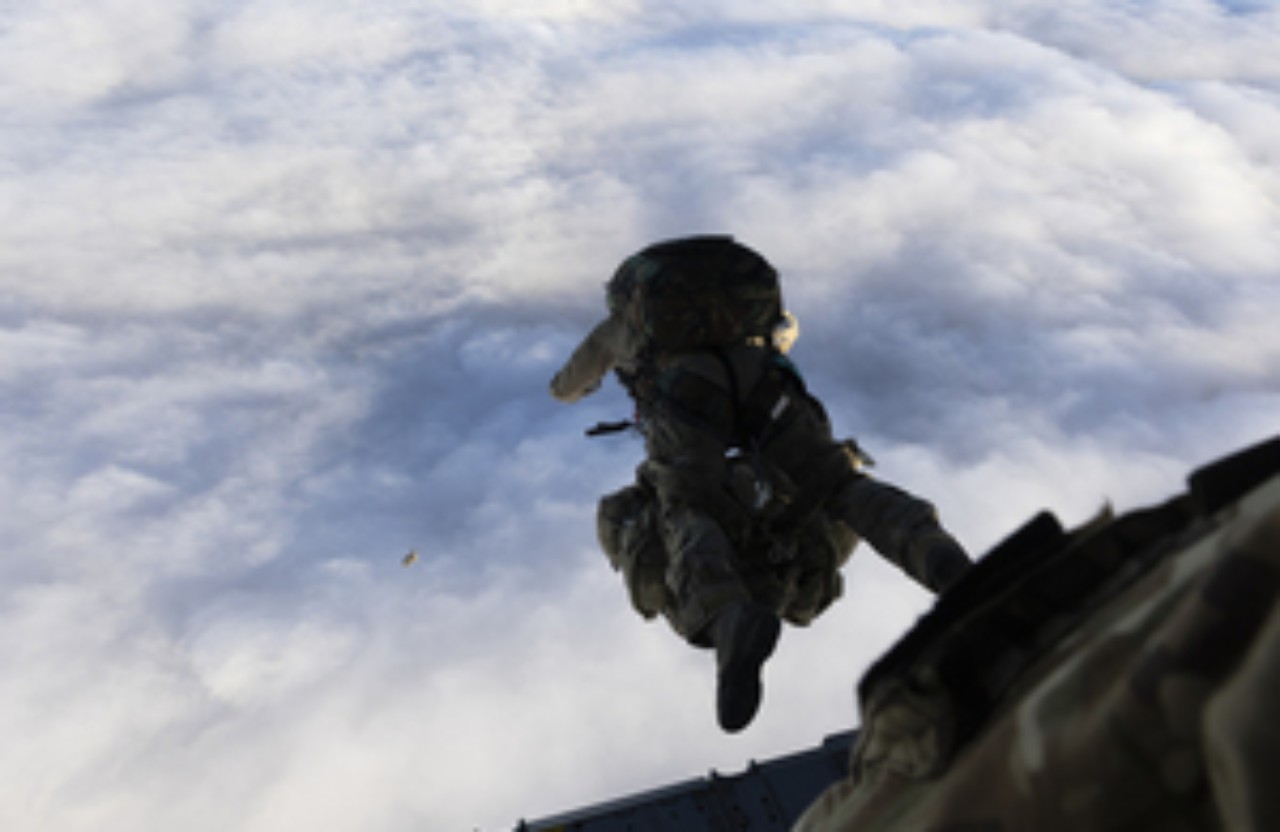
A specialist British Army team has parachuted onto Tristan da Cunha to deliver emergency medical support after a British national on the remote South Atlantic island was suspected of contracting Hantavirus, the UK Defence Journal understands.
The team of six paratroopers and two military clinicians, all from 16 Air Assault Brigade, jumped from an RAF A400M transport aircraft while oxygen supplies and other medical equipment were airdropped onto the island almost simultaneously. It marks the first time the UK military has inserted medical personnel to provide humanitarian support via parachute.
Tristan da Cunha is Britain’s most remote inhabited overseas territory, located deep in the South Atlantic with a population of 221. The island has no airstrip and is normally accessible only by boat, making an airdrop the only viable method of delivering urgent care in time. With oxygen supplies on the island at a critical level, speed was essential.
The aircraft departed RAF Brize Norton and flew 6,788 kilometres to Ascension Island before continuing a further 3,000 kilometres to Tristan da Cunha. An RAF Voyager tanker aircraft supported the operation by refuelling the A400M in-flight. Weather conditions at the island presented additional difficulty, with average wind speeds frequently exceeding 25mph.
Foreign Secretary Yvette Cooper said the operation reflected the government’s commitment to British nationals wherever they are. “I am deeply grateful to the personnel across the Armed Forces and the RAF who acted at pace to get urgent medical support to Tristan da Cunha. This extraordinary operation reflects our unwavering commitment to the people of our Overseas Territories and to British nationals, wherever they are. The safety and well-being of all members of the British family is our number one priority.”
“We will continue to work closely with international authorities and the Tristan da Cunha administration, keeping those affected informed and ensuring the right support is in place in the UK and across the Overseas Territories,” she added.
Minister for the Armed Forces Al Carns paid tribute to those who carried out the mission. “This was an extraordinary operation in incredibly challenging circumstances to get vital help to our citizens on Tristan da Cunha. I want to pay a huge tribute to our brave personnel for carrying out their task with the utmost professionalism and composure under pressure. This is a real cross-government effort showing our determination to support our overseas territories and British nationals affected by the Hantavirus outbreak.”
Brigadier Ed Cartwright, Officer Commanding 16 Air Assault Brigade, said the operation demonstrated the breadth of what parachuting can deliver. “This was a joint effort with the Royal Air Force and highlights the speed, reach and utility of parachuting. The arrival of paratroopers, medical personnel and medical supplies from the sky has hopefully reassured the people of Tristan da Cunha.”
The mission forms part of a broader government response to a Hantavirus outbreak linked to the MV Hondius cruise ship. British nationals are being repatriated from the vessel to the UK via a chartered flight, with all British passengers and crew subject to a 45-day isolation period on return. None of those being repatriated had reported symptoms at the time of the announcement, though the UK Health Security Agency, which confirmed the suspected case on Tristan da Cunha on 9 May, is closely monitoring all individuals concerned. Follow-up is also underway for people who may have been in contact with confirmed cases and have since returned to the UK or are in British Overseas Territories.
The MoD worked with UKHSA to deliver diagnostic supplies including PCR tests to Ascension Island via military aircraft on 7 May. The government has stated that the risk to the general public remains very low.
Hantavirus is a zoonotic disease transmitted primarily through contact with infected rodents or their droppings. Severe cases can lead to Hantavirus Pulmonary Syndrome, a serious respiratory condition. While relatively rare, the disease has a significant mortality rate in severe cases, making early medical intervention critical.





If someone in such an isolated location can catch this. how was it transmitted and is anyone safe anywhere?
Cruise ship went there
I’ve gained $17,240 only within four weeks by comfortably working part-time from home. Immediately when I had lost my last business, I was very troubled and thankfully I’ve located this project now in this way I’m in a position to receive thousand USD directly from home. Each individual certainly can do this easy work & make more greenbacks online by visiting
following website—.,.,.,.,.—>>> JobatHome1.Com
Google is your friend !
No seriously, have a look at the details, you’ll find that a passenger who returned to Tristan (his home) developed symptoms a few days later.
I also recommend watching “Survivors” on Youtube, It’s about a Plague that wipes out a large proportion of the Worlds population (early 1980’s ish)
Also stock up on Bleach, I think that Resident Chump will soon Instruct JFK to extoll It’s Virus killing abilities.
I’m buying shares In Domestos !!!
Hope this all helps Colin.
Hw,
Ummm … er … does anyone else believe it may be time to contract for a mRNA vaccine for this Hantavirus variant from GSK/Moderna/Pfizer?
Plan Bravo will be utilizing copious amounts of bleach. 🤔😉
Hw,
BTW, RFK (Jr.) not JFK However, style points awarded for presenting a potential horror flick plot w/ an assassinated POTUS transforming into Sec. of HHS. Hollywood awaits this epic tale! 🤔😉😁👍.
He was a passenger on the cruise ship.
And returned home to his Island where he fell ill.
Everyone will be fine. A good exercise for the military. Just ensure this guyis alright with food and medicine plus extract to hospital if necessary. Provided everyone is kitted up and trained ok there is no risk.
F**k me that’s some medical intervention, hats off to the men and women of the RAF and 16AAB for pulling this off.
Balls of steel
🫡🇬🇧
Rather over dramatic Balls of steel my ar,,,,
It was a peace time jump, no ground fire coning up
Winds gusting to 25mph makes it a bit dicey. Still pretty cool in my book. And good training, to boot.
Because of the wind speed they had to jump 5km from the island over the Atlantic Ocean with little chance of rescue if they didn’t land on the island.
Clearly you have a small brain in addition to the small piece in your trousers.
And a tandem jump with the non jump trained medics.
Video interview with the leader of the team, on BBC news. non jump trained medics., Consultant Doctor & ICU nurse. The Six Paratroopers are from Pathfinder Platoon!
Must be those red hats that give them special magik powers
They weren’t RMPs mate ;0)
Seems you’re also incoherent and can’t spell 🤷🏻♂️
Wot doo U meeen?
👏🏻 impressive!
Pity the anti-vaxxer, reform \ restore \ “patriot” idiots decided to hijack some of the threads on Twitter to spew out their nonsense!
A very well-planned operation to get help to a British Island and still proving that we can do it
You couldn’t simply state what a good response it was from the RAF and 16AAB without dragging it to the gutter and politicising it. Your hypocrisy shows that for you it’s just one rule for one person, one rule for another, criticising those who dare do the same as you. Heaven forbid anyone who might disagree with you!
Yet more proof, if ever needed, that some parts of society are on a path backwards along the evolutionary scale.
Russian propaganda bots are everywhere. There is a reason why I left twitter.
Yaaawn
If the patient was undiagnosed until 2 weeks after arrival, the whole island could be under doctors orders for 45 days now. Incredible effort by 16 AAB and RAF. Would expect more air drops unless a ship is also enroute with support.
Outstanding, good to see the military at its best and great publicity.
Awesome achievement by all
I hope someone points out to the orange tool in the White House that the UK military still does great stuff!
How can there be no airfield on Tristan ???????? WTF
Have a look on google maps and that will tell you why there is no airstrip…
Nah, you’d just have to do a China and dump millions of tonnes of concrete in the sea 😉
Ha, I’m guessing It would take a shit load of concrete !
The Chinese are building on shallow reefs and atolls to extend low lying land. Tristan is 6500 foot high active volcano with above 15 degree costal shelving dropping away to 10,00 ft depth.
How come you don’t know ? 😁
I have often wondered about the old lava field. Grind it up, mix it with some concrete & you get a simple airstrip, say 4800 ft long, the same as Guernsey. Nothing flash. Look at the simple airstrips other countries build on remote islands.
The one on St Helena cost 265 million to build and it’s iffy for large aircraft because of wind shear. There’s a reason why the A400M didn’t land there but operated from Ascension Island
It does not need to be as big or expensive as St Helena. Look at the simple short strip at Saba in the Caribbean.
An aircraft that is able to land on small shirt strip like Saba wont have the range to get to Tristan De Cunha not to mention have the range to divert if it cant land
A Dassault Falcon 2000LXS exec jet can fly 4000nm & operate from a 4000ft runway.
I started this as a simple side hustle, and last month I made a little over $6,137 just working a few hours a day from my phone. If you want to check out how it works, the website has all the details.
Here—>> http://www.giftpay7.vip