

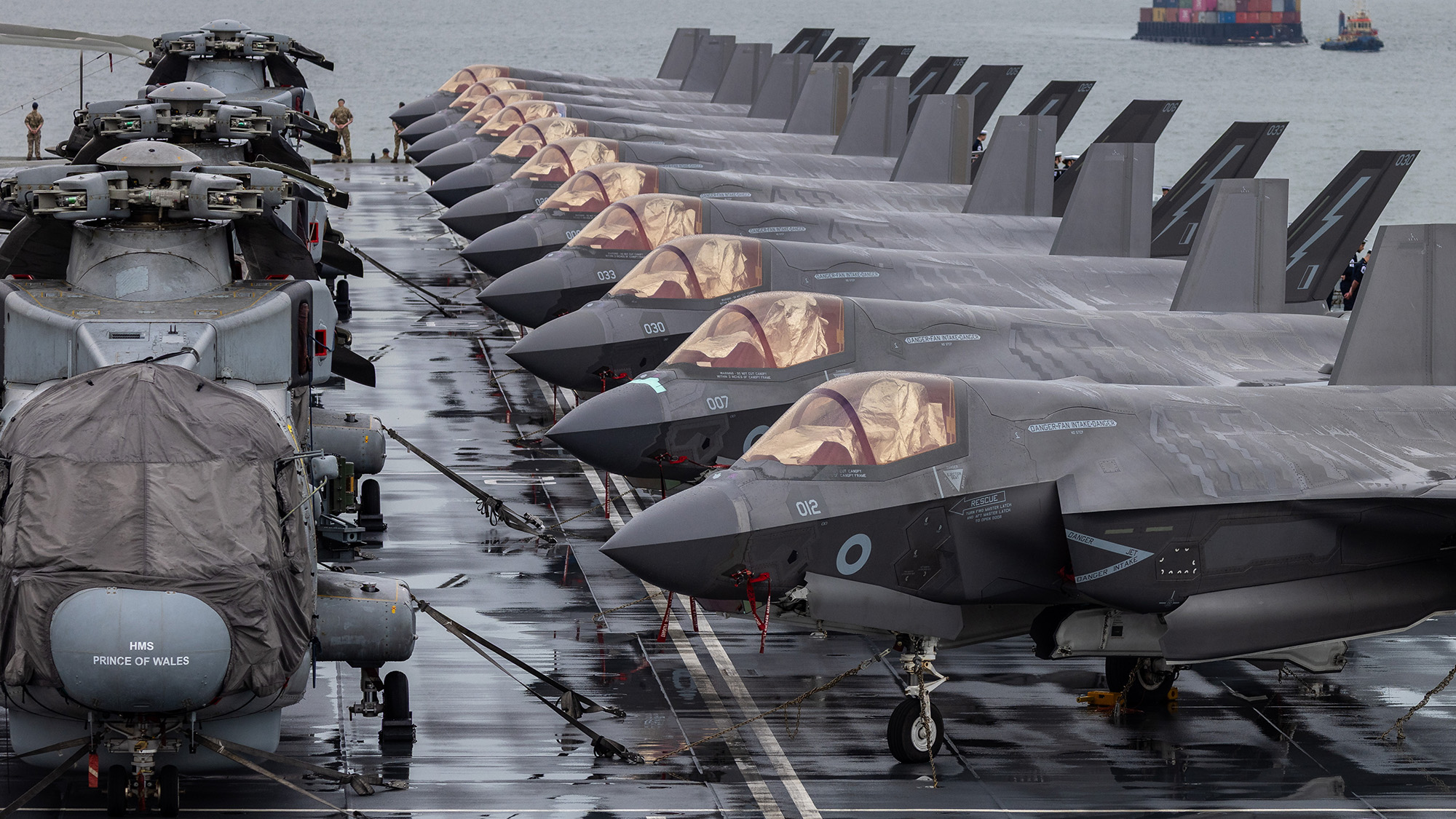
The Ministry of Defence has warned that F-35 availability will fall in the short term as it works through a backlog of corrosion-related maintenance, according to a letter from Permanent Secretary Jeremy Pocklington to the Public Accounts Committee.
Pocklington’s letter, dated 30 April 2026, describes corrosion worsened by maritime exposure as a growing concern that “impacts the availability of aircraft and will need constant management throughout the life of the programme.” While acknowledging the issue affects all F-35 nations, the letter states that “as maintenance activities intensify a short-term reduction is expected to clear the backlog.”
The MoD says it is addressing the problem through enhanced corrosion awareness and preventative practices at front line squadrons, deeper inspections conducted with UK and US industry partners, the development of more corrosion-resistant solutions within the wider F-35 programme, and by pushing the F-35 Joint Programme Office and industry to create what the letter describes as “rapid, agile and coordinated responses to corrosion occurrences.”
The admission of a forthcoming availability reduction is notable given that the PAC’s October 2025 report already found F-35 availability to be below both UK and global programme targets. The corrosion problem was exacerbated during Operation HIGHMAST, the carrier strike group deployment to the Middle East, with the letter noting that prolonged maritime deployment worsened corrosion issues and increased post-deployment recovery time. Those lessons have since informed planning for subsequent detachments including the early 2026 Cyprus deployment.
Corrosion is a challenge for carrier-based aviation more broadly, with salt air and humidity accelerating degradation of airframe components and coatings. For a stealth aircraft like the F-35, whose radar-absorbent surface treatments are critical to its low-observable characteristics, corrosion management carries operational as well as maintenance implications.





Wow. I thought availability was already low, now this on top.
Did older types like the Phantom, Bucc, Sea Harrier and SH FA2 have similar issues or is it a stealth coating RAM thing?
Any aircraft type or helicopter is exposed to greater corrosion when operating at sea. But stealth makes it more complicated to manage.
Ahh, just the man, had you in mind when I posted.
Ok.
Yep but most maritime airframes are built with that environment in mind.. seems a bit odd that they built what is meant to be a naval jet that’s designed to deal with that.
True. But other naval aircraft aren’t all aspect stealth fighters. Stealth is still a black art. And requires some additional attention instead of just regular wash downs at sea. Taking a stealth aircraft to sea for 6+ months still a pretty new thing.
Very true.
Thank goodness the F35b can be carrier qualified quickly so you don’t need to keep them at sea all the time…. I imagine it’s a nightmare for 35c squadrons.. maybe that is why the US are limiting themselves to 1 squadron per carrier.
It may be that outside of very limited times or in extremis the RN needs to operate its f35b from the hanger and not do as much deck storage… it may turn out to be even more fortuitous that the RN build big arse carriers that can store 20-24 F35s in its hanger.. if deck storage becomes an issue.
The hanger offers limited protection as there are many openings to the open air/sea.
Pity the USMC with their America-class…!
I’m surprised they didn’t mention it after they trialled the ‘Lightning Carrier’ idea a couple of years back…
It looked that way on last years deployment. Only aircraft that will fly that day are on deck. And that will be much easier on the QEs compared to the Invincibles. The Harriers had zero corrosive modifications to operate at sea. You literally just sprayed fresh water into the intake to help salt corrosion on the turbine blades, and the jets got a good wash down on flight safety stand down days. But the Harriers were never on board for that long. They never did 6 month + deployments with the jets onboard for 6 months in the Invincible days.
The 24 lined up were for the photo shoot.
Cobbled together with a degree of difficulty so I recall.
Robert, I’m pretty sure that Sea Harriers were “Marinized” to a degree.
The Sea Harrier did have some different materials and sealants compared to the RAFs GR3, but not much on the later GR7/9s. But they didn’t spend that long at sea.
👌
Interesting. The corrosion I understand but what is it about the stealth element? Coating?, materials?
I don’t know to be honest Geoff. But they have a cocktail of materials for the RAM coatings.
Okay, not to worry. Just a thought.
Taking stealth fighters to sea for 6+ months is still a relatively new thing. Lots of lessons will have been learnt.
Yep.Always things to learn, even when we used Coracles!
Stealth Coracles might just replace Frigates.
You never know !
i wonder if the fabric on the old Stringbags suffered in the same way?
“Dope”.
Not you, the process !
Hiya DM – I’d be interested in comparing Typhoon serviceability rates vs those of the F35- in general .
C’mon Keith Starmer -sign off another 40 Tranche 5 Typhoons , just before you are ousted. 😁
We will not be buying any more Typhoons. Between F-35A/B and GCAP, there will be no money for Typhoon.
The UK should arrange to share a squadron of F35A with Canada and pay for half of the costs 32 F35A. Canada has currently paid for 16 F35A and is supposed to purchase 88 in all, but in light of current relations with the USA, Canada is looking to take on the 16 they have paid for and spend the rest of their money on the GRIPEN or another Western fighter.
The UK shouldn’t be buying anymore F35s (except as replacements for lost or worn out B variant aircraft) because of the clear USA (Lockheed Martin) policy of ignoring all non-USAF or IAF (Israel) requirements. As I have stated on a number of times before, it is my view that this current iteration of the F35, especially the B variant, are dead ends. The upcoming “Mark 2” of the F35 that Lockheed has dubbed as the 5.5 gen is going to be focusing on the A and C variant, and I expect it to be a redesign on the lines of the F18E/F, slightly larger airframe with larger wings and greater internal fuel and stores capacity, achieved by removing the provision in the current design for the lift fan in the B variant.
The UK should just purchase additional Typhoons and share a F35A squadron with Canada (for the NATO nuclear strike role), while waiting for the Tempest to come into service.
I appreciate your thoughts but we are yet to see how much Tempest will run – and what the unit cost will be and therefore how many we will ultimately get.
I am a big fan of Typhoon – it is a fantastic 4.5 Gen aircraft but therein lies the problem – it will be just that while the rest of the world has moved on.
Scant funds need to be spent on 5/6 Gen aircraft in order for us to stay relevant.
I don’t disagree with you in what will happen, I just think it’s the wrong way to go for the UK.
In my view, F-35A should be the trainer for F-35B- which should be for carrier ops only. UK (and posessions) QRA plus any land-based expeditionary work should be Typhoon.
GCAP will not be carrier capable (neither V/STOL, STOBAR nor CATOBAR), so presumably the F-35B fleet will need to soldier on for quite some time into GCAP’s service before we find a replacement. If we fly the wings off our F-35s doing stuff other than the key thing we bought it for, then we’ll truly have carriers without aircraft sometime in the later 2040s. I don’t think adding more As helps us much either- as that gives greater cause for watering down/delaying GCAP aside from anything else.
What does drive GCAP forward (and possibly accelerates it) is telling the RAF that they have to “make do” with Typhoon until GCAP comes along. In reality, Typhoon can handle anything that Russia can put into the sky for the next 20 years, and will likely manage against their air defences reasonably well too with AESA Mk2 and suchlike. If we need to upgrade some of our remaining T2s to T3, or even T4 level to keep them flying (or add a few new airframes onto the back end of the Turkish order) then so be it.
But we’ve worked very hard to get carrier strike, it makes no sense to hobble it just because the RAF wants jam now and later (especially when Typhoon is also quite jammy!).
You reckon we’ll ever build that thing. Tempest. If we do it will such small numbers because we are a poor nation now.
We are currently the fastest growing economy in the G7. A little less gloom and misery is warranted.
I do wonder what the real thinking is behind the A decision. I don’t buy it’s about nuclear. The lack of air dropped nuclear options isn’t high up on the capability gaps. Cost is most obvious reason but I question if it’s really a major saving considering the low numbers and the extra maintance costs of having an additional different series. Maybe linked to issues with the internal bay size of the B.
If only mate.
There’s no money.
Even the 27 extra F35s are spread out over many years.
GCAP is what, 12 billion plus to develop?
But still, its “the biggest sustained increase in defence spending since to Cold War” according to HMG, so all is good!!
Anti corrosion coatings for exposed parts on motorbikes such as ACF 50 were based on Aircraft protection products. The roads In the UK get plastered In Salt at the merest hint of a chill most winters. That’s why most “Bikers” don’t ride their “Pride and Joy” in the winter months even after smothering their rides in ACF 50 type products.
You should see the state of my nuts !
Indeed – Bikers are well up to speed on these things – other Products are available ( of course) lol.
Ha, yes. It pays to also own a Winter Hack !
Didn’t you smother them with ACF50?
I do recall various other ‘commentators’ making fun of my comments on salt water corrosion on F35 and other platforms…..sadly it is true.
The issue, with F35, seems to be around how various metals are butted up against each other so it is galvanic in origin. I do find this unforgivable as there are simple table that you can look up the redux potential of just about every known aircraft alloy so that mitigations may be put in place. These are then tested in a climatic cabinet which throws warm salty spray at the items and you see what happens. In this day and age to say ‘F35 is complicated so corrosion happens’ doesn’t make a lot of sense. It is a bit of a BL excuse – you design problems out. Car makers have figured out how to make cars that don’t corrode to pieces and this was deemed ‘too hard or too expensive’ twenty years ago and it is mostly down to design and manufacturing discipline.
Not all car makers though. Chinese MG’s LDV’s and various others seem to be having those Issues now.
Everyone loves a bargain,
until It rusts away.
Which is one of the reasons why it would be in the interests of EU manufacturers to make the parts failure database publicly accessible again.
One of the reasons cars improved so dramatically was that EU law states that cars need to cover 120k without major component failure. This was backed up by publicly available data.
About 10 years ago the EU car industry said that ‘this was expensive to maintain’ so if was discontinued.
The level onus is still on the manufacturers but it is now very difficult to prove class faults.
Now it would be the best and most justifiable barrier to erect, bring it back, as it just keeps out the junk…Chinese manufacturers do cut corners all over the place.
Interesting, SB.
Thank you for that insight.
It’s not just the airframe which is the problem. A lot of issues are with electrical connectors. Gone are the days when you could coat them in cadmium. Which gave you a degree of protection, whereas today most are now nickel plated over the aluminium. This coating doesn’t have the same protective qualities as cadmium. So connectors are also generally sprayed with a coating of PX24. I remember seeing the back end of a Chinook whilst aboard Ark Royal, where all the connectors were a furry mess. Which was after daily fresh water washes. I’d imagine the F35 suffers from the same issues. Where it will need a outer panel strip to get access to clean electrical connectors.
Most of the naval MILSPEC connects I dealt with were gold plated on at least once side.
I’ll provide the traditional Lockeed answer: if availability is low, just buy more F35, problem will solve by itself easily… and in the meantime, you save flight hours that pilote can do on simulators. It is very inexpensive!
Otherways, you can do like India and buy Rafale instead. It works and availability rates are at 95% according to chief of maintenance staff. But the issue here as that pilotes tend to fly a lot, which somehow cost more, since your pilotes use the plane.
Oh dear oh dear oh dear… I glad we are out of that one, even if I would prefer the combat drone ready. We will have to make do until 2035, at that time UK should not be far from receiving Tempest, which will be a good plane hopefully.
British carrier aircraft were always made of salt water resistant material in the past. Regular fresh water washing and a liberal dose of WD40/PX24 used to keep them ok, a good Ardrox wash down was the first job after coming ashore done it many times. The Honey Monster.
During Highmast, the F-35B’s were constantly parked on the flight deck of POW to give a more impressive appearance. We are paying the price (literally) for that now. The F-35B also has the problem of being so frigging complex, just so many parts to inspect and maintain and keep corrosion free. The later F-35C design benefited hugely from lessons learnt from early F-35B sea trails, hence in part the very limited (20-25%) commonality.
The pictures published from the deployment made up just a tiny anoubt of the total deployment time and flying time/sorties.
Ha, So we now have “Lancia” B’s made with cheap Russian Steel that rusts away the whole plane over night.
Should have just bought “Marinized” Sea Typhoons all along. I bet the Rafales don’t rust like that.
Cat’s and Traps and Angled deck were the best option all along.
(please note, this Is not really a serious comment, It’s just random Halfwitted thoughts. No need to get all Warrior like.)😊
Its a good observation. The gin palaces were designed around the aircraft. Having two proper carriers would have allowed an aircraft model choice. I live near Marham….I hear stuff, and what I hear does not bode well for the F35. Over complexity being one main issue, we all know the weapons fiasco. Would love to see these things forward deployed like a GR7, in the woods…. be revenge on the fisheads for dragging airmen onto ships for months on end. ( Thats one of the issues for crabfats, or so l hear )
There is a big disparity in the force in T&Cs between light and dark blue too. The RAF has a 30 year career and the RN 22 from a structural point of view, so the RN engineers promote faster. Also, because of the Shore-basing policy of the RN, they have shorter times on the Sqn than the RAF AND the RN get Longer Separation Allowance (LSA) every day because they aren’t in one of the RN’s 3 base locations. By contrast, the RAF engineers only accrue LSA when deployed away from Marham…. So not only are the RN lot getting it all the time, they are also racing up the levels compared to the RAF.
The end result is you are likely to get RAF engineers spending more time at sea than the RN engineers, whilst being paid less and promoted more slowly. It’s a proper buggers muddle.
So transfer all the B’s to the Fleet Air Arm along with the engineers and ground crews and allow RN a section of Marham, call it HMS Compromise. Problem solved
The RAF guys, the majority I know, would not transfer. It was a stupid aircraft to buy, end of. Oh, I do not like fisheads one bit btw. Crabfats are ok most of the time…
It’s a stupid aircraft if you think of it as a Tornado replacement. If you consider that it is actually the harrier replacement and multiple governments have totally failed to procure an actual replacement for Tornado then it is a lot less stupid. The other thing is we simply don’t have enough. We need 48 front line aircraft for two squadrons of 12 at high readiness at any time to give the carriers just their standard peace time compliment. Since we know that at surge the carriers can actually carry around sixty I would expect that a part of that would be made up of USMC aircraft but being able to put 48 fighters aboard in an emergency is something that we should have as an absolute minimum.
On top of that the RAF need a proper replacement for the Tornado and this might well be the A variant but they need to commit to buying them in reasonable numbers by which I mean at least another four front line squadrons. Sadly it is never going to happen because politicians don’t care about us getting invaded, they only care about getting re-elected.
With the official maximum capacity of the carrier listed at 72 aircraft that makes is somewhere around 50 fighters that would be required on a full compliment, the other aircraft being AEW, ASW and transport.
AEW should be a massive priority, Crowsnest should have never even had to exist as we should have thought about a proper fixed wing solution.
BOOM.
See, I told you It was 72 !!!! 😁😁😁😁.
Aircraft model choice being the F35C. Super Hornet. Still very expensive but less capable. And no British workshare. Rafale. French, expensive and less capable. No British workshare. We build 15% of every single F35. Thats worth billions to the Treasury. As well as 5th gen industrial knowhow. Cats n traps carrier’s. Much more expensive. More maintenance. Need a larger deck crew. Longer refits. And a higher chance of incidents. And a bigger training burden. F35B with QE class is the best all round capability for our budget.
It was just Humour again I’m afraid Robert !
I was re-hashing all the old arguments !
I thought I’d replied to John. 😆
😁
The Rafale is less expensive than the Typhoon or the F-35 (whose long-term maintenance costs are very high compared to a 4.5-generation aircraft). As for the Rafale’s performance, the Indians have demonstrated that the French aircraft is highly resilient to jamming thanks to the Spectra system. Operation Sindoor shows that it successfully jammed most of the Chinese missiles. Only one aircraft was lost, even though the Indians had warned the Pakistanis of the operation to limit escalation of the conflict, and all targets were destroyed despite the air defense. The F-35 is still not fully operational, and the F-4 and F-5 versions of the Rafale are coming soon. Furthermore, when purchasing an aircraft, half the price goes toward weaponry. For the Rafale, that’s MBDA, so there’s a British component. The F-35 currently uses American weaponry.
Actually deploying hardware always puts more of a strain on it than keeping it in a cupboard.
My TVR is stored in a Vacuum Bag !
The government obviously knew about the corrosion issue and that’s why the f35b buy has been slow….so the carriers go to sea with a minimum compliment of aircraft in order to mitigate the issue!
Not.
AA
Yes, That’s why T32 is a non starter, they rust In salty water.
Hi. I have a stupid idea.
Why not bubble wrap them. It’s cheap and waterproof. Like a big sock.
Great thinking….. but It’ll never take off.
I’ve gained $17,240 only within four weeks by comfortably working part-time from home. Immediately when I had lost my last business, I was very troubled and thankfully I’ve located this project now in this way I’m in a position to receive thousand USD directly from home. Each individual certainly can do this easy work & make more greenbacks online by visiting
following website—.,.,.,.,.—>>> JobatHome1.Com
Should have been planned for. Seems rather reactive to be announcing delays in availability. Proper planning and forecasting prevents these kinds of capability gaps. MOD and the RAF/RN dropping the ball.