

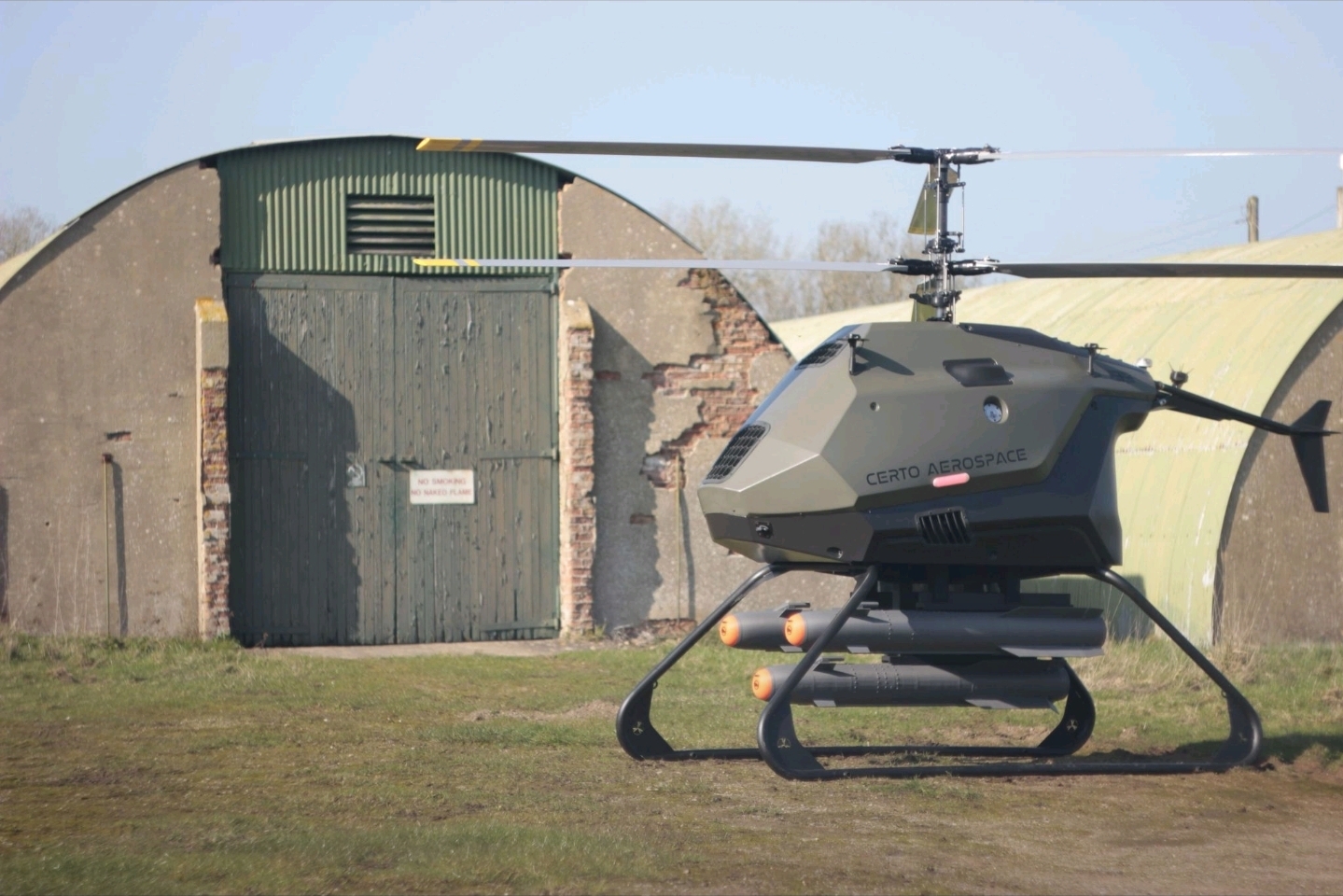
Images posted on LinkedIn by Certo Aerospace CEO Justin Tooth show the company’s CAPSTONE uncrewed helicopter undergoing ground trials with air-to-surface missile simulators, as the British SME prepares to compete for the British Army’s Project NYX loyal wingman requirement alongside BAE Systems.
The photographs show the coaxial CAPSTONE fitted with stub wing pylons carrying what appear to be Hellfire-class missile simulators, with a technician seen preparing the system for a trial.
The testing makes clear that Certo has been actively developing a weapons integration capability ahead of the Project NYX competition, which calls for uncrewed systems capable of operating alongside Apache attack helicopters across reconnaissance, target acquisition, electronic warfare, and precision strike missions.
The Apache’s primary air-to-ground weapon is the Hellfire missile, and a loyal wingman platform capable of carrying or cueing similar munitions is a pretty meaningful enhancement to Apache crews operating in contested environments, extending their reach and reducing the exposure of the crewed aircraft to threats.
BAE Systems Air announced the partnership with Certo via LinkedIn, describing the CAPSTONE as a sovereign UK solution ready to meet the Army’s needs. Certo Aerospace was founded in 2008, is UK veteran-led, and holds all intellectual property in the UK.
According to the company’s website, the CAPSTONE can carry payloads of up to 300 kilograms across a range of up to 300 miles with up to ten hours endurance. The airframe features a folding rotorhead and modular undercarriage, can be prepared for launch within minutes, fits inside an ISO container, and is operable from ships at sea. The platform has been in flight trials since 2017 and is now in its third year of testing, operating under both UK Civil Aviation Authority and US Department of Defense authorisations.
The BAE Systems and Certo pairing joins a competitive field for Project NYX. The MoD has confirmed four shortlisted partners, Anduril Industries, BAE Systems, Tekever, and Thales UK, with up to two selected for prototype development in autumn 2026 and an operational variant targeted for fielding by 2030. The £10 million programme is being delivered in conjunction with UK Defence Innovation.







But is this better than a drone equivalent that can be around in numbers and rotated for constant overwatch?
I suspect this has a higher ceiling but I’m surprised the payload is only 300kg?
Still a useful something that actually exists.
I thought 300kg was pretty impressive, and I don’t see why it couldn’t be available using rotations. If they are aiming it as Apache wingman, rather than an ISR drone, I don’t think it will get used that way by the Army, but I recall it was tested for the Navy earlier in the year on ASW, so a ship like a T31 could rotate a couple of them, if Proteus is thought too big.
Agree a payload of 300kg is very respectable. If a type 31 were to operate a few of these that’s a capable stand off weapons system. Seems like a viable design for loyal wingman, type 31, river batch 2s etc
I’ve gained $17,240 only within four weeks by comfortably working part-time from home. Immediately when I had lost my last business, I was very troubled and thankfully I’ve located this project now in this way I’m in a position to receive thousand USD directly from home. Each individual certainly can do this easy work & make more greenbacks online by visiting
following website—.,.,.,.,.—>>> JobatHome1.Com
This is a 600kg class drone, one step up from Peregrine, which is built on the S100 Camcopter. It closer to the S300, with a bit smaller MTOW and a larger advertised payload. That’s probably real due to the coaxial rotors that gives better lift. It’s a fair bit smaller than the 3 ton Proteus.
Is this just a case of spending even more money on loyal wing man drones to justify the existence of Apache. Hard to see how any of these assets are going to last more than a few days on a modern battlefield if they can even deploy into theatre in the first place due to air bases being gutted.
Satellite images are now showing the USA took a real pounding from Iran in the conflict with 18 bases severely damaged. It’s going to be tricky to even get attack helicopters into theatre in future.
If we keep the same number of apaches then spend a lot of money augmenting them with drones then we end up with a much larger and more powerful force but that force may be a waste of money compared to spade based assets and long range effectors and drones.
Very expensive short ranged aviation platforms seem to be bucking the trend of modern warfare.
Why does an Apache need to deploy to an air base?
Can it not operate in the field like the rest of the AAC and the RAF SHF?
Way I see it, if attack helicopters are still being procured by the USA, European allies, China, and Russia, then it’s another sad excuse to get rid l, like the supposed obsolete LPDs that Labour said “will not put to sea again” one of which is on it’s way to Brazil and which are operated by navies around the world.
We are far too eager to find reasons to dispose of assets.
On the survivability of manned rotary assets on the battlefield, I’ll listen to an expert from the AAC if we have one available, who will know how they operate.
It can forward deploy without an air base but it’s a complicated machine requiring specialists maintenance and support done at airbases. Ukraine has exploited this to great effect knocking out Russia helicopters hundreds of miles from the front.
Without such facilities it becomes difficult to deploy them especially in large numbers.
Fast jets can deploy from thousands of miles away using in flight refuelling , attack helicopters cannot.
Hmmm, maybe so. I’m honest, I’m not up to speed on exactly what 7 REMEs capabilities are in the field ( 7 REME is the aviation support element of the REME ) assumed they carried out level 1 and 2 support with deeper stuff back at base, at the Depth Support hub for Apache at Wattisham, lots of contractors, obviously not deployable.
On the AAR, no, course not, yet in an attack helis case they’d either lilypad across Europe to the front or, if need be, be put on a ship or inside a C17.
I assume C17 can take an Apache.
Whatever, I don’t write off battlefield manned aviation and I’m quite excited by this one, lots og money being put into it by the Army.
Graham is the man for this.
From my reading in the US army debate on the matter,
Apache is no longer a supporting fire platform. It’s now a deep maneuverer asset designed to allow a division sized force to fight a deep battle by passing throw the enemy front line on mass and then attacking undefended assets deep in the rear area.
But the trouble is that getting dozens of apaches into an area is a big logistical issue. Yes they can Lilly pad and they can be deployed by C17 but every step in those chains is massive added cost and logistics burden meaning your are giving up other assets like artillery, tanks and infantry to get those apaches to the fight.
Now you ask what am I getting for the massive cost and logistics burden. Basically you’re getting a camera and radar platform that can move relatively quickly and carry a fairly short ranged missile.
Then you ask well how many cameras and radars can I get into the enemies rear echelon with drones for the same financial and logistical footprint.
The answer is probably 12 Apaches deployed = thousands of drones or hundreds of long range missiles.
Due to the vast increase in MANPADS and GBAD the Apaches can no longer do the deep penetration job so now they require their own loyal wingmen drones to surround them and do the dangerous mission the Apache can no longer do which just further increases the cost and logistical footprint of the capability.
This is the reason a lot of countries are scrapping them
One difference is thst the US has the logistical resources to position so many for this deep manoeuvre.
I don’t know what our doctrine is, does anyone?
In the end this is one of the areas that may be hit by the drone saturated battlefield, as with classic combined arms. The questions are still there, what does combined arms look like on the drone saturated battlefield.
Crewed expensive small numbers of rotors are going to be one of those elements that need figuring out. Russia has lost a lot of rotors on the battlefields of Ukraine. Infact of the 440ish aircraft it’s lost 350 of them have been helicopters… essentially it’s would seem rotors are very vulnerable in the drone saturated battlefield.
Ukrainian forces are now downing rotors with anti drone drones.. the problem for the helicopter is that it can be killed by any system designed to engage drones and if armies are essentially gearing up to defend against thousands of drones in a day.. your squadron of 12 manned helicopters is going to be facing air defences on a scale nobody ever envisioned.
Rusi did a good article.. vertical lift is to important to abandon, but it’s now seriously context driven and especially attack helicopters are profoundly vulnerable.. essentially unless you can fully suppress air defences.. rotors are at risk.. which then raises the point if attack helicopters were profoundly context driven before and they are now even more so.. and can essentially be replaces by drones..the question becomes WHY…vertical lift yes.. drones hunters in your own airspace yes.. marine environment yes… but attack helicopters operating in contested airspace ?
Good job we only have 50, in a way, we can be selective where we use them.
We’ll have to be, with the scale of threat like that.
Yes I do think more and more we are moving to a world of very significant mass, with these exquisite capabilities essentially keep as forces in being to react to that rare opportunity that opens or to counter that rare time..
Sort of like the end of the age of the battleship.. you had to have them but the whole point become that they “existed” not that they were useful tools because they were to rare, expensive and there were so many dangers to them… the real war was fought with expendable masses of smaller ships and lesser capabilities.
What autonomous systems and drones are doing is bringing that concept back, that the exquisite will be overwhelmed by the dross and must be preserved not used.
rotors, jets, MBTs squadrons, frigates, subs ect are all to expensive and rare to throw against hundreds or thousands of disposable drones and lose so they will become “ battle fleets in being”…
It’s going to be a strange world for a while in which he who produces the most drones of all types and in all domains wins.
The US Army is going to have a problem in the next 5 years, when the MV-75 is introduced. Which has twice the speed and about 4 to 5 times the combat radius. Which means the MV75 can be fielded a lot further back from the front lines, whilst Apache has to be relatively close. Apache simply won’t be able to keep up with the MV-75 Cheyanne 2, even at max speed. There’s a 100 knot disparity between the MV-75 cruise speed and the Apache’s max speed. Therefore the US Army will have to rethink how it provides force protection for MV-75 “heli assaults”. Bell have shown the MV-75 kitted out similarly to the Blackhawk in this respect, so it will probably provide its own force protection.
Please do not paint all attack helicopters with the same brush. Around 80% of Russian helicopters at the start of the Ukraine War did not have any defensive counter measures. Those that did like the Mil-28 and Ka-50/52, were found to be pretty crap and ineffective. In comparison the Apache, has one of the best defensive countermeasure suites fitted to a helicopter. Both the Mil-28 and Ka-50/52 have had urgent updates to the defensive aids, though they still can’t counter HVM/Martlet and RBS70.
However, as Ukraine have clearly demonstrated, they can use drones to hunt down helicopters. As the drones they’ve been using have a 50 to 100 knots speed advantage over the helicopter. Additionally the drones are optically guided by the operator, have a very small heat signature, making it hard for a helicopter’s defensive aids to detect and warn the pilot there’s a threat coming. Something like the MV-75 in the current climate, would be able to accelerate away from a drone used in this manner.
Japan is replacing its Apaches with UAVs
defence-blog.com/japan-buys-drones-to-replace-apache-fleet
Hasnt the US binned it’s attack helicopter project as it has concerns about their viability.
I’ve no idea, Steve, have they?
I read they had terminated the project to replace the Apache and the manufacturers were now trying to sell their designs to other countries.
I suspect they are looking at Ukraine war and trying to figure out how to fight in a drone rich environment.
Hmmm, much as Jim and J say above.
Unless there is an increase in the size of the army, how are these systems going to be deployed? All sorts of loyal wingmen, OWE, cheap cruise missiles, drones, counter drone, GBAD.
Soldiers will need to deploy these from ISO containers, lug Hellfire missiles onto them and fuel, launch, recover and resupply.
The same air and ground crew that operate Apache could do it but that means it’s tied to the same operating bases, which would need to be withing 300km of the proposed targets and are likely to be targeted by drones, BM like Islander, MLRS etc.
If they are to be deployed closer to the frontline, to screen or blast a path for Apache, then that will require additional units of troops to operate?
It makes more sense from a ship perhaps but every week it looks like small buys of new toys but no uplift in troops.
Yes, one of my ongoing burning questions.
The stuffs being delivered, how it’s being fielded, who, what ratios, I’ve not been able to find out yet.
This is wear the efficiency savings come in. The MoD wants lots of new capabilities but like any institution it wants to keep what it’s got. It’s like sending horses along with tanks to France in 1939. The horses would ages found some use but if everyone was on horses then who was going to drive the tanks.
I think a major issue is that the people who are trialling these things are not the people who are supposed to be normalising them in the military. Despite the 40/40/20 aspiration, we still have a drone credibility gap throughout the services. I keep hearing seniors talking (at open source) about how we mustn’t buy or deploy very many cheap drones as they will be out of date in a few months and it would be a waste of money. So they say it’s better to make sure that we keep on top of upgrading the drones, particularly the software, then we can order them when we need them. I imagine this means that they are not being fully deployed or normalised into most Army exercises, just exceptionally inserted in specific ones needed to test drones.
I think, paradoxically, more expensive drones have more credibility, and therefore they are more likely to be adopted than the cheap throwaways we arguably need more.
We all agree about the necessity of continuity in ship building, but continuity in drone operation is also necessary for the same reasons. Just like saving money by pushing submarine manufacture several years to the right, pushing the full adoption of drones years to the right will have the same issue of boom and bust, increased costs, and skills death. Are we forever training new FAA and RA pilots only to lose them all during an evaluation pause? It’s now half a year since Lancaster stopped using Peregrine. When will we see it flying again? (After we’ve raised a requirement to the right level, created a contract for BAE to integrate it into a River CMS, waited for the ship to come back for maintenance, added the sensors/comms to the ship, got more pilots up to speed, and maybe persuaded the ship’s captain it would be a good idea to create yet another test on his ship.) As above, so below: we are currently evaluating Cetus XLUUV. Why haven’t we already ordered the next version? Evaluate the BAE Herne and incorporate the best ideas of both into the next gen, and get it ordered.
Yep, agree on all points.
Posse C will like this one if he reads this…”informing decisions my dear boy” which kicks the can another few years up the road.
We need to build up some institutional knowledge of their use in service, not just in endless trials.
Exactly, it’s the doom loop of endless trialling that is becoming tedious. Just purchase the drones, and establish and develop a force – wide doctrine. In the RN for example, the Peregrine UAV should be widespread throughout the fleet by now, including the Rivers and LPD’s.
Deeper understandings don’t make a force structure.
Peregrine wasn’t even supposed to be a trial. It was an UOC.
My understanding is the forces are running out of love with the XLUUV concept. Power and communications is a big limitation for a submarine and snorkelling is an increasingly risky technique. If I want a sonar sensor deployed in the ocean it’s often better by a large USV or a large array of cheap UUV’s like sea gliders. If I want to deploy a threat to a strait then I can now just send an automated torpedo to lie in wait with no submarine required.
A big and relatively expensive XL UUV may not be the best solution but this is what we are experimenting at the moment to find what works best.
I would counter the seniors view about being out of date with 4 points
1. We need to build the capability to manufacture and keep pace at scale – the only way to do this – erm,,, is to do it,
2. Our forces need to train with these assets – if they are cheap – great we can play, trash and move on.
3. We need to embed this speed of change into our culture – that won’t happen on its own
4. If we have a load spare – send them to Ukraine where they will get real world feedback
We are now miles behind on drones and I would say cheap missiles, fortunately we have Ukraine who are at the cutting edge and we should really be asking for their designs and setting up a factory in UK where we ship out to them whilst building what we need now.
Yes completely agree.. how do you perfect your doctrine and expertise if your not using them every day at all levels.. going out of date is not the issue, these are disposable assets, the army airforce and navy should be buying them and burning them… squadies should be in exercises all the time dodging drones, shooting them out the sky and driving them into stuff.. the navy and airforce should be doing the same but maybe not driving them into stuff as much as theirs will be a bit more expensive.
Thank you all for a very well thought out and informative discussion. I learned alot and appreciate you following the spirit of this site!