

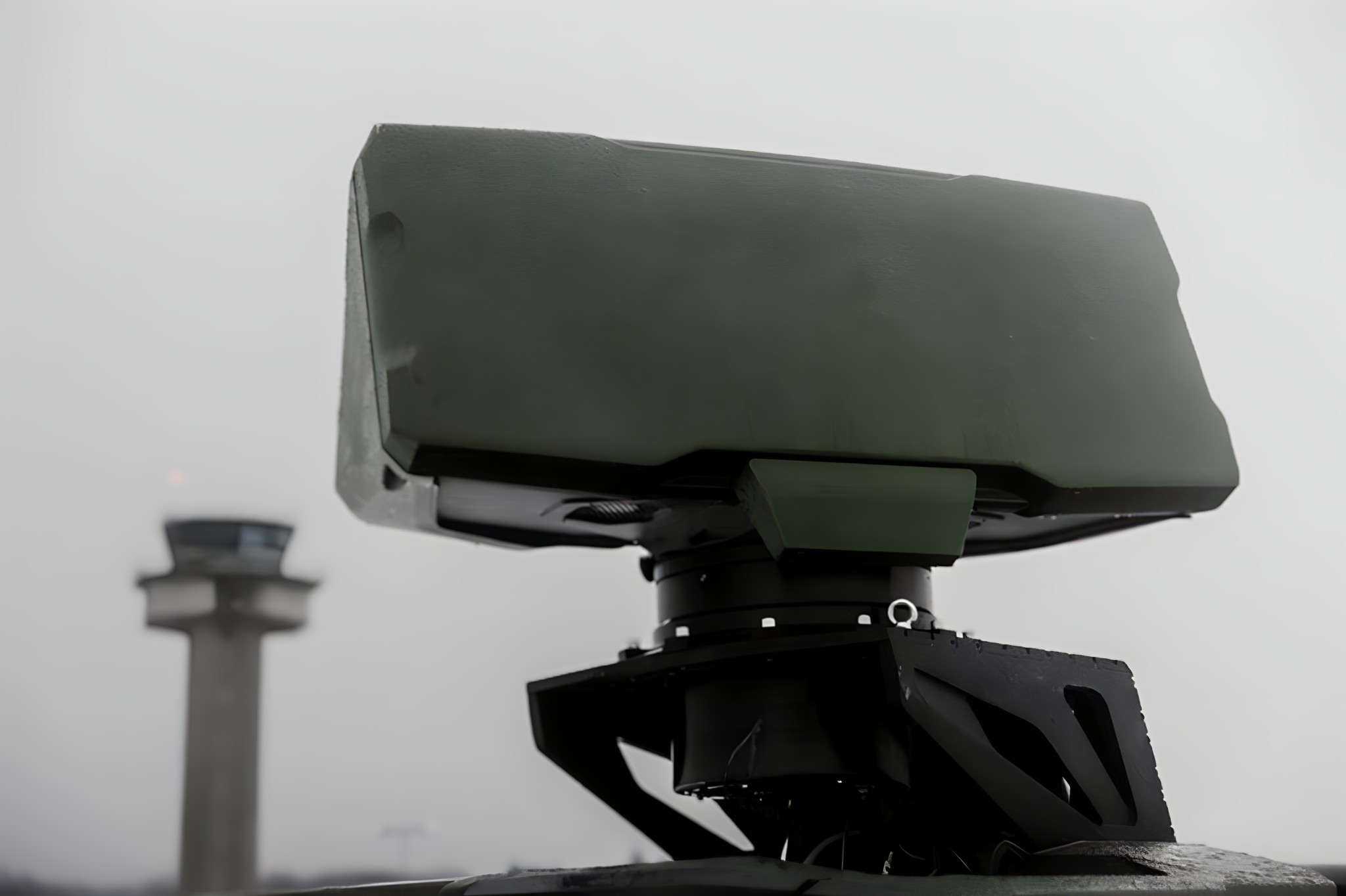
Saab UK, Aquark Technologies and the Royal Navy have run a trial in which a network of military radars continued to produce a single air picture without relying on GPS for timing, using quantum clocks instead, the company stated.
The trial paired Saab’s Giraffe 1X radar with Aquark’s AQlock quantum timing technology and is believed to be a world first for a distributed high-performance military radar network holding a coherent picture on independent quantum timing sources. QinetiQ also took part, and the work was run with the Royal Navy’s Disruptive Capabilities and Technologies Office.
The problem it addresses is not obvious from outside the field. Radars in a network do not simply pool their contacts; combining tracks from sensors in different places requires each to know the time to within billionths of a second, because an error in timing translates directly into an error in position. That timing has traditionally come from satellite navigation signals, which are weak by the time they reach the ground and straightforward to jam or spoof.
During the trial, several Giraffe 1X radars tracked live targets while running on separate AQlock clocks, after which the team introduced deliberate timing errors to reproduce the effects of GNSS spoofing and denial.
According to Saab, the radars operated successfully from separate locations on independent quantum timing, generated a single coherent air picture without satellite timing, degraded predictably when timing was disrupted, recovered quickly once synchronisation was restored, and kept working under conditions representative of both GNSS denial and GNSS spoofing.
Andy Fraser, group managing director at Saab UK, said: “This trial is a great example of how collaboration can accelerate innovation. By combining quantum timing technology with Saab’s advanced Giraffe 1X radar system, we have demonstrated a practical capability that could help customers continue to operate effectively when it matters most.”
Quantum clocks work by measuring the frequency of a transition in cold atoms, which is fixed by physics rather than by the properties of a manufactured component, and they hold accurate time for far longer than conventional oscillators without any external reference. Aquark, based in Southampton, has focused on making cold atom systems small and robust enough to leave the laboratory.
Interference with satellite navigation has moved from a theoretical concern to a daily one. Jamming and spoofing around the Baltic, the Black Sea and the eastern Mediterranean have affected civil aviation and shipping on a routine basis since 2022, with aircraft reporting position errors of hundreds of miles, and Finnish and Estonian authorities among those attributing the disruption to Russian sources. GPS-independent timing has consequently become a priority across NATO militaries.
The Giraffe 1X is the smallest radar in Saab’s Giraffe family, a lightweight three-dimensional set that can be mounted on a vehicle or a mast and is used for air surveillance, ground-based air defence and counter-battery work. Its size makes it a plausible candidate for the sort of distributed network the trial was testing, in which several cheap sensors cover an area that one large radar would otherwise be needed for.
Saab UK employs around 600 people across eight sites, including training and simulation in Wiltshire, Seaeye underwater robotics in Fareham, public safety work in Hull and a software technology centre in Farnborough. The company says more than 60 per cent of the Next-generation Light Anti-tank Weapon comes from the UK supply chain, along with 35 per cent of the Gripen fighter.









Excellent.
Excellent. Now put it to sea.
Great and relevant collaboration between UK engineering innovators. Space Vehicles for GNSS (satellites) are not the only application for atomic clocks where accurate time is required to determine position.
I’d definitely want my sensor network to share accurate time so enable big situational awareness for national Defence.
Chain Home radar did this first in WW2 to enable the Bentley Priory command and control centre to scramble RAF fighter squadrons and win the Battle of Britain.
Air Marshall Dowding made the right decisions for RADAR enabled C&C first. He saved lives in the air and on the ground, enabled by UK engineering innovation.
Sounds excellent. During the cold war i would have thought this kind of technology would have been classified for as long as possible . If the chinese and russians had not thought of this idea i am sure they will be working on the same technolgy asap .
Nothing fundamental in science is likely going to be kept secret these days, it’s the methods and technology to achieve a given target that hopefully can be kept away from prying eyes. Atomic clock have been around for decades and like the atom bomb to the hydrogen bomb the perfection of sub atomic concepts like quantum into usable devices is going to be universally explored. Getting there and how good the results are is the true competition.
As an aside Chinese students and researchers have been at the heart of US universities and research institutions and there is great doubt in present circumstances how that will continue. There is a strong move back to China and indeed other Countries and it reveals a dual edged sword. Having them in the US is greatly beneficial to the US economy especially in the hi tech and ai fields which are the only area where the US is still economically growing (hiding its overall decline) and according to Neil deGrasse Tyson at least their loss is going to be a serious hit to US research capabilities. However of course in helping the US research community, they are equally not only developing their own personal scientific proficiency and knowledge but gaining a great and wider knowledge of US and probably greater Western research (as it’s so interlinked) too which they can take back to their own Country and that’s before any considerations of espionage and illegality is considered. Somewhat between a rock and a hard place.
“.. the only area where the US is still economically growing (hiding its overall decline) .. ”
Gimme a break dude.