

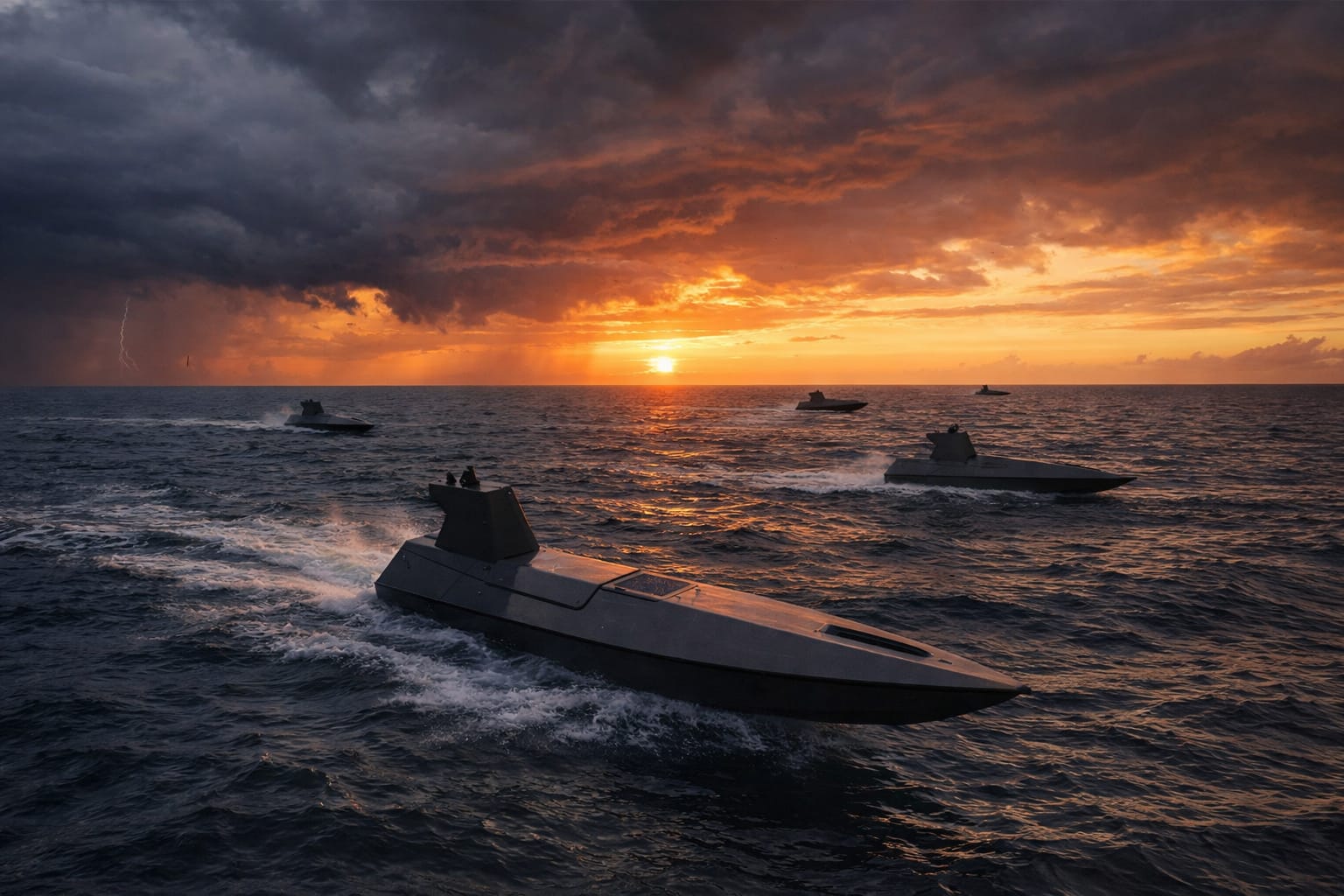
The Royal Navy is preparing to acquire a fleet of 20 uncrewed surface vessels under a programme known as Project Beehive, according to a newly published procurement notice.
The contract, valued at £10.25 million excluding VAT, is to be awarded to UK firm Kraken Works Ltd following a competitive tender process that drew bids from 12 companies, including BAE Systems, Kongsberg and L3Harris.
The vessels will form part of the Royal Navy’s Surface Flotilla (SURFLOT) and are intended to support training, tactics development, capability experimentation and operational activity in the UK area of responsibility and beyond.
According to the contract notice, the fleet will also play a role in testing technologies as the Royal Navy transitions toward a so-called “Hybrid Navy” combining crewed ships with autonomous platforms.
The vessels are expected to serve as experimental platforms as new capabilities are developed.
“The Royal Navy requires a fleet of 20 Uncrewed Surface Vessel or USVs for SURFLOT,” the notice states. “These platforms will be utilised for training, tactic development, warfare development, capability development, and operations in the UK area of responsibility and beyond.”
Project Beehive is structured as a spiral development programme, meaning the initial vessels will be designed with open architecture to allow future upgrades and experimentation.
“The Hybrid Navy transition will require development and testing of new technologies,” the document notes, adding that the vessels will act as “test beds to provide learning from experience.”
The first generation of vessels is expected to have technology readiness levels between TRL 4 and TRL 5, allowing the Navy to integrate and trial emerging autonomous systems and other capabilities as they mature.
The contract covers delivery between March 2026 and March 2027, with the vessels expected to support experimentation led by the Navy’s development and disruptive capabilities teams.
The procurement is one of several initiatives aimed at expanding the Royal Navy’s use of autonomous systems at sea as it explores how uncrewed vessels could complement traditional warships in future operations.



Hmmme
So these are not very big at that price point….so what sea states will they operate up to?
So this is another R&D study so that ‘important lessons can be learned’ before the idea is cancelled prior to another…..I can’t even be bothered to type out what we all know will happen.
But why 20 units – it actually seems quite a lot…..
But above all else the expenditure of an utterly trivial amount of money compared to the chasms that exist between force preparedness levels and the levels that are required.
Half a million pounds a unit…. You’re not going to get much for that….
Yes, but you can do a lot when things are cheap to buy and operate. Dinosaures were not able to survive in harsh transitions. Mice were.
We are through one of the biggest change of warefare we have seen in a long long time. Every expensive asset seem to be a target of choice for cheap solutions equiped with a large amount of explosives. Your « incompetent » sailors and Royal marines have achieved remarkable success in Ukraine with duck tape and imagination. They may not be engineers, but they are lord of war. Please don’t underestimate those who do and win wars. Creative thinking always look foolish until you see the results of gritt, fighting spirit and determination to win at play. I don’t know where these ideas come from, but please don’t kill from the gate go people like that. They ask you little and give you sometime benefits beyond imagination. The Ukrainian special ops against Tu 95 was a prime exemple of that.
Fair argument, only amplified by the fact the budget rich US forces have had to ask Ukraine to help them use their expertise to negate Iranian ‘crude’ drone attacks. For all Americas super weaponry Iran can still strike ships in the Straits of Hormuz with weaponry they are as yet unable to even identify.
you would have thought they know what they are doing by now given the amount of time they have been working on the mine countermeasures unmanned systems
very disappointing really as I was hoping these vessels would be similar to the Patrick Blackett ship purchased from Damen for sub £10m, even a CB90 at £1-2m would surely be ok for this kind of task.
As you say smacks of another £20m blown to make it look as if we are moving forward when the reality is we are not. Everything that is wrong with UK military on display here.
Hope we are all wrong, but unlikely I would say. Track record indicates its another show and tell that never gets anywhere
This is the first time we have operated drone warships. Its no surprise it’s going to take some significant design, test and evaluation just like loyal wingman to make it a reliable and capable force multiplier. It isn’t going to happen overnight.
They are not going to be warships, they are small boats… if they use the design kracken have that’s an 8 meter boat.
There are three designs in the K3 series. The ones tested so far are the 8m/300kg payload/650nm range type but there is a 12m/2500kg/1000nm and an 18m/10,000kg/2000nm version as well. All of the range values are at a transit speed of 25kts.
18m could be interesting as it supposedly retains 40kt sprint. As a FAC-M with a RWS and Sea Venom or even NSM it would be a good substitute for shadowing the Russians through the Channel.
We have been messing about with drone ships for years now (mine counter measures system 10+ yrs) we are also very important partners with Ukraine, so I expect us to be at an advanced stage of autonomy understanding now.
I really do hope I am wrong and am being too cynical, but we have all seen these “holding patterns” before, spending 10-20m on an extended proof of concept that goes nowhere, problem is all these 10-20m assessments add up
Look at systems deployed in Ukraine. 5Kg of explosives on a toy are enough to disturb infantry trench defenses. The same quantity of explosives on a ship are nightmares for Russian Black sea fleet. Tanks and ships are being hit left, right and center by very small devices. Perhaps have faith in your commanders…
I agree that for use in local and hyperlocal environments small drones can do the trick.
What I’m questioning is how this can do anything for Atlantic Bastion and the like?
I don’t see these as persistent effectors…z
To push it, no intent of trolling, what if you did not have anything to survey because critical part of an ennemy sub was struck in dry docks…
I didn’t think we could put any more submarines in dry dock…aren’t they all full?
I thought the issue was the Navale Group heat exchangers…..which need exchanging…..
SB,
Surely you would not wish to deprive the 1SL of the opportunity to proclaim that immortal line of dialogue from the movie Clash of the Titans (2010): “Release the Kraken”. 😉 (Sorry, occasionally bound to attempt to introduce humour into a uniformly bleak discussion.)
Humour is the only way forward.
I can’t take the situation seriously: Starmer and Healey sternly lecturing the world on the threat level and the need for spending to rise whilst pulling the usual Brownian tricks of double announcing and shuffling budgets to disguise a real terms cuts.
Whilst I am hugely supportive of RN the lack of any real Defence Investment never mind a plan with that title….as Sir Humphrey always said ‘get rid of the difficult bit in the title: it does less harm there than on the statute book.’
Did I hear Starmer in PMQs that we were build ships on the Clyde and Typhoons in the North of England to help keep Britain safe. If I did hear right then it pretty much summed up the smoke and mirrors (downright deception) being used to misrepresent the truth for while the ships are factual the new Typhoons (unless he is keeping it for the DIP) are for Turkey not the RAF but hey I guess the strategy is that other Countries are protecting us with their investments, so good on Poland and Germany then. No wonder they gave Starmer such a negative reaction to his lecturing speech a few weeks back ironically the day before he talked about advancing the defence spending targets…. which ironically hasn’t been mentioned since either.
The harsh fanatics that Labour haven’t made a single large equipment investment decision.
They are deliberately leaving it late so all of the overspend is pushed into the next parliament.
Pure. Utter. SCUM.
Shame on those who voted for them.
Always enjoyed Sir Humphrey’s wit. Amazingly timeless perspective of government bureaucracy. 😁👍
We need proper bishops not remote controlled btoys
Looking at what kraken have your looking at an 8 meter essentially autonomous speedboat.
I like the apparent flexible approach to the use of these vessels bringing together operational and experimentation. Given the awful situation the navy find itself in flexibility will be key to bringing new and disruptive technology into service quickly. According to a quick search on google these vessels have been ordered in under 6 months and the fact that they have to be capable of spiral development are good signs that the navy and MoD are pushing ahead with modernising the procurement system – something that is long over due. I also especially like the idea that a Small or Medium sized Enterprise (SME) beat off at least 3 big primes. SME are tend to be far more agile which will be a real boon in this sector given the rate of development.
Also its is nice to see some kit being ordered and all 20 to be delivered within a year! What is the world coming to?!
Cheers CR
Despite understandable cynicism on this announcement has to be said this is probably the right decision. Kraken is gaining great interest in their designs both established and in development, they are clearly innovative, focused and have great intent in this sphere shown by having acquired businesses to support it and signing cooperative agreements in the area of Ai to enhance their products, especially the Manta. Was it here or elsewhere we read a few months back that they are gaining interest in America for their designs? Seems their designs are very flexible annd imaginative while specialising in the Littoral environment.
Don’t get me wrong I think these are the perfect capability you want for a 21c major surface combatant.. but they are something you stick in the mission bay of a a frigate.. to allow it to undertake safe littoral work..
Essentially I see these as becoming as ubiquitous as a small ship flight is now..
But they are not autonomous warships.. they are an extra system you add to a warship.. miss selling on the headline I think.
I assume these are the k3 scouts?
I would guess so, maybe with a sprinkling of K4 for supply transfer etc?
They look cool but very inshore though which makes me wonder about their use.
Will the Admiralty naming committee get involved?
I enjoy the naming conventions.
Hmmm The ‘flat pack’ class perhaps mate
HMS IKEA
HMS B&Q
………
HMS Homebase sadly lost in inaction.
HMS MFI (More Frigates Immediatly)
I do wonder if they will get a name at all.. they will not be a HMS.. £500,000 a pop will buy you a 30 foot inshore boat of some descriptions, not a commissioned vessel.. even HMS magpie is 60foot.
They named the RNMBs doing the MCM work so so maybe some new names here.
HMS Future Decisions??
Sounds like they’re for FOST.
Probably more use to Captain Birdseye…
Come on George, we’re used to misleading headlines from MSM but for you to stay at the standard expected please cut the ‘tabloid headlines’ . The UK is not buying 20 drone ships.
Agreed.
Get a life dude.
They will be used to test out ships crew or emerging systems when being attacked by USV swarms, or maybe boghammers if in Persian gulf theatre.
or maybe mail delivery for ships in UK water save them coming into port and using a helo?
I don’t think the word “ship” is probably the correct term.. 10 million for 20 surface drones.
The Atlas Elektronik contract for 35 Vahana class ( Sea class ) work boats was 48 million.. so a 15 meter inshore basic workboat your paying 1.2 million. So not sure what the navy will be getting for £500,000 per vessel.. but it’s going to be a long long way from a ship.. more like a 10meters inshore boat of some description.
This is my problem with the whole concept of a hybrid fleet.. it’s BS.. yes drones make
1) a really nasty little sea denial capability for enclosed seas
2) an adjunct to a major warship..essentially like small ship flight.. great to stick in a mission bay.
They will not in any reasonable timescale replace major surface combatants or even crewed patrol vessels, they simply cannot do it.
Agreed, my position as well. These are training vessels I believe.
Got excited that finally this might be a contract for the sloops of war, armed with drones and PODS.
Nope just a load of tiny boats that may or may not prove useful.
So 20 RIBs with remote controls
Essentially that’s all your getting for that sort of money.. useful for training and maybe to pop in a frigate mission bay if your doing littoral work.. but nothing else.
Best to check their website methinks. My gut feeling is initially these will indeed be used for training of warship crews against Seababy like threats, their innate upgradeability will help there. That training will equally test the potential and capabilities of Kraken’s innovative designs in being used themselves proactively and how best to exploit and develop them. The worry would be that it looks good on paper to promote all this to give the impression of action, but leaves plenty of wiggle room for delaying doing much else thereafter. Time will tell.
For me these are simply adjuncts to add to a warship.. essentially every serious future warship will want a pair of these tucked away.. just like for that last 50 years all frigates and destoyers have had a small ship flight in a hanger..
My worry is the RN is pursuing these instead of major surface combatants instead of another system you add to a major surface combatants..
In the end the are a number of ways surface drones will go..
1) true warship: these will be big 2000+ tons with a many of the capabilities of a modern major surface combatant.. they will probably be optionally crewed… because many of days jobs of a 2000 ton naval ship require a crew..I think these are probably a decade away.
2) persistent area denial platforms.. 100-500+ ton fully autonomous vessels for essentially denying a specific area out to about 1000 miles from your coast.. the majority of these will be unarmed sensor platforms ( this is what a lot of work is on now.. we will probably see these in a few years )
3) ships companions.. something you can have in your mission bay, essentially 10meters range boats a major surface combanant can send of to do a risky task.. mine warfare, keep any eye on the littoral, attack a target, act as down threat axis sensor platform ( we have the first of these already deployed)
4) 10meters range.. one way attack platforms.. essentially one way killer drones to send into someone else’s seas to act as very advanced self deploying mobile smart mines. ( Ukraine has essentially matured these)
Worth remembering these are not intended to be operational ‘drone ships’. At Technology Readiness Level (TRL) 4–5, which in defence terms means prototype or early development systems rather than mature operational capability.
They are essentially experimental platforms used to trial sensors, autonomy software and tactics, and to help the Navy understand how uncrewed vessels might operate alongside crewed ships in the future.
Having a pool of relatively cheap platforms to experiment with allows sailors and engineers to build experience and refine concepts before moving to more capable systems later on. Until you actually have hardware in the water and sailors using it regularly, autonomy remains largely theoretical, so programmes like this are a reasonable first step.
The common sense post Greg, that’s exactly what this is and a very welcome one to help avoid the Black Sea experience. The great thing about Kraken is that they are clearly a very nimble and innovative company that can develop their ideas to fit and rapidly progress client requirements. Let’s hope the client in this case doesn’t cripple that capability by hesitation, U-turns and a preference for naming conventions over actual end product.
Well put Greg. Looking at the comments it seems very few actually read the article before commenting. 👍
I think the comments Robert were based on the very silly headline….
Britain to buy a fleet of 20 drones ships fir the RN…
You are probably right Jonathan.
In the 50s and 60s there were dozens and dozens of experimental aircraft being evaluated. It’s seems we’re going back to that because like the jet, it’s new technology unlike anything before. Those experimental types were not operational and had very specific purposes. Without the Avro 707, for instance, there would have been no Vulcan. NO Lightning with P1 and so on.
Got me on one of my favourite subjects there, the ones that never were built or flew in particular mind. Miles M52, Vickers Type 583, Bae P-1216, Bae 1233-1, Hawker Siddeley P1154, Fairey Delta 3, Saunders Roe SR-177, and perhaps my favourite the Avro Type 730. Them were the days when little seemed impossible. I do agree though there are going to be some weird and wonderful concepts being developed around drones, Kraken themselves have concepts like the Manta which either operate on foils or semi submerged, that is very much in the tradition of those 50s/60s aero projects.
Some heart warming names from the past… the P1154 was a particular miss. I shall have to look up a few of those!, though! Thanks! Some of those are too modern for me, they passed me by… great few minutes looking them up. Cheers! Saba would have given Aardvark a run for it’s money, I think!
Another complete waste of money. We need spend that on expediting completion of badly needed ships in build and give the 31’s some sonar and Mk41 vls with a half decent armament.
Yeah what’s the point in trying to build up the capabilities to defend themselves against sea drones it’s not like we will suffer like those useless Ruskies now trapped in their Black Sea ports eh. I mean let’s be honest it’s like thinking numpties like Hezbollah could hit a British hanger with a crude aerial drone isn’t it… oh hang on a minute. British arrogance personified.
One of my favorite book was the story of a British sailor in Napoleonic wars. Even though here and there, my French feelings are hurt, I remember a sequence of Captain Hornblower with a « galiote a bombe » (a small mortar boat. With this tiny ship, they were able to attack and destroy with little risks a French vessel in a natural harbor (in Sweeden), while the mighty cruiser was at large, safe. This was a creative thinking at play. Though fictional, this story look like real ones, like these small investment or previous creative assets of WW2 (I remember a fireworks wheel aimed to carry explosives on a beach. Unsuccesfull, but very imaginative for a single purpose; the german explosive cigars of WW1 were another one, the US explosive puppet in Normandy another one). I like this way to try things. They are not war winning ideas, but they can create battle surprise. Surprise mean initiative. Initiative give momentum and impose paranoïa in defense. It is good to have it on your side.
This is where I think the RN has got its major surface combatant design completely right.. in a few years these small drone surface vessels in the 10meters range will be very mature and useful for so many high risk operations and the ability to carry around a couple and easily deploy them from dedicated mission bays will be massive… monitor a littoral send in your drones.. make a kinetic attack,, send in a pair of drones,, monitor an enemy combatant .. us a drone.. send a sensor down the threat axis… send a drone..
But the RN must keep building its major surface combanant fleet because without a T31 or T26 or MRSS to deploy from these will simply be toys to float around your own EEZ… with the major surface combanant to deploy from they become a significant force multiplier.. if you multiply 0 by anything it’s still 0…