

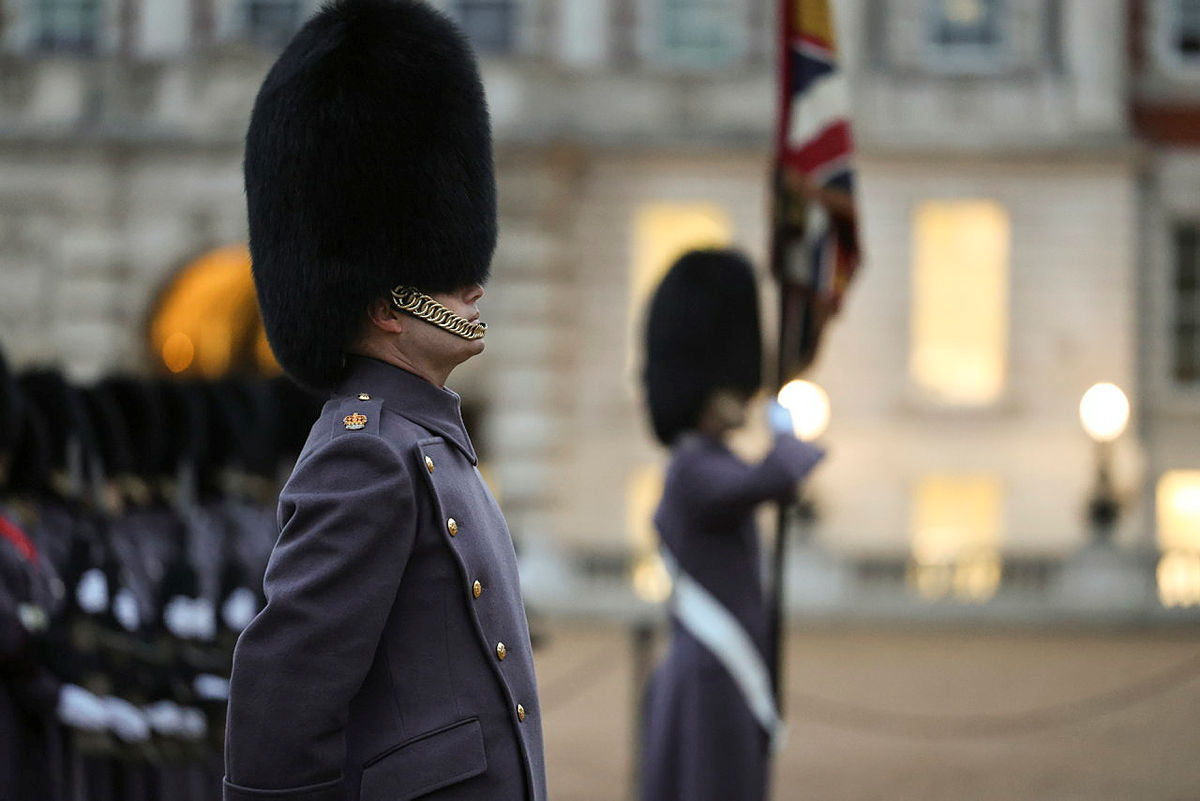
The Ministry of Defence is drawing on lessons from Ukraine to inform improvements to body armour, including feedback from female personnel, while continuing to face scrutiny over the use of real bearskin caps in ceremonial uniforms, the UK Defence Journal understands.
In response to a written parliamentary question from Conservative MP Richard Holden, ministers confirmed that UK procurement teams are working with personnel involved in Operation INTERFLEX to capture frontline insights from Ukrainian forces. This includes feedback on equipment fit and performance.
The Department said: “Procurement experts within the National Armaments Director group work closely with the Ministry of Defence’s Op INTERFLEX Handling and Processing team, which collates feedback from Armed Forces of Ukraine personnel.”
It added that, “This includes lessons from operational experience and female user feedback, which help to inform UK capability development.”
The work is linked to ongoing efforts to update protective equipment, including the Tactical Ballistic Plates project, aimed at improving body armour issued to UK personnel.
Separately, Liberal Democrat MP Manuela Perteghella raised questions over the continued use and cost of traditional bearskin caps worn by guards regiments. In response, Defence Minister Luke Pollard confirmed that each cap currently costs £2,460 including VAT and can last more than two decades depending on maintenance.
Pollard said: “The current cost of a bearskin cap is £2,460 including VAT. Whilst the longevity of caps varies depending on how they are maintained, this can be up to and in excess of 20 years.”
The Ministry of Defence has not yet identified a viable synthetic alternative that meets its requirements. Pollard noted: “The Department has not yet identified a synthetic alternative that meets the standards required to provide an effective replacement for bearskin ceremonial caps.”
However, the Department continues to assess potential options. “The Ministry of Defence remains committed to finding a synthetic alternative and continues to welcome submissions of test results… on synthetic alternatives that meet our criteria for a suitable, affordable and sustainable alternative,” he added.












Fitted for but not with fur.
F**king ridiculous,
What over promoted public school boy has us wearing £2000 real fur hats.
No doubt we will need a 2000 page document of requirements to find a synthetic alternative
The language they use to describe the replacement is how they describe real procurement😂😂, is it in the concept phase? We cling to much on our past, we need to move on. Rather see money go to 5 more t31 with sonar inset of pointless walking up and down.
Think the MOD are just upperclass Eaton twits that think they know politics. Rant over, cheers 👍
As US, the US Navy has absolutely crushed Iran. Which evidently is not important enough to note on this website. This is the s*** you post!
Crushed Iran – tell that to the mariners stuck in the gulf – the us military may have destroyed their navy airforce and schools but the regime are still giving you the bird. Trump has achieved nothing. Thankfully not all Americans are morons and no one voted for Trumps war.
Sniff test..yep another howler. Iran without the ability to manufacture instant rays of Sunshine is a winner. Clearly doesn’t fit your narrative. Laughable
I think you’re saying the US has destroyed Iran’s ability to make nuclear weapons and so Trump has achieved something – unfortunately I haven’t seen the evidence of this yet – remember Trump obliterated Iran’s nuclear program only a few months ago – only for it to miraculously rise from the ashes – the US had a non-proliferation deal that Trump abandoned – had supposedly positive talks that Trump abandoned – had a large proportion of the Iranian population that wanted to be free of the regime that Trump abandoned – at present this looks like a mess of Trumps making that making the the world poorer and more dangerous
This is an utterly trivial ‘issue’ to be wasting Parliamentary time on, considering the wider state of our defences.
With everything going on in the world, SMH. Typically dopey Liberal Democrats.
Hats are an absolute procurement priority in a rapidly changing drone environment. We need AI integration into all real fur hats. They will be a system of systems approach to the replacement. More details will be released in the100% upcoming DIP. (Which will have a dip in defence spending)
You’ve stolen my DIP joke!
Should go for the smooth hairless look nowadays.
😊
A freshly shawn bear resembles a huge scrotum, are you implying our forces look like d***heads on parade?
Bucking the trend, as a traditionalist I have no problem at all with the Guards Division having ceremonial dress, as befits their head of state which they represent at state occasions.
But, I agree that the cost of a traditional bear skin is daft, given the pressures on the budget, and I’m against them on wildlife welfare grounds anyway.
Hard to believe a suitable alternative is not available.
👍🏻
Personally from a wildlife welfare perspective I’d rather the fur from otherwise culled bears was put to use rather than wasting a finite resource on making plastic hats that spend more time in the landfill than in use.
Yes, if the Bear is being culled then make use of as much as possible.
My position was that I’d not want the Bear culled at all, certainly not just for it’s fur.
I’m not sure using the scalps of Russian Infantry as ceremonial headwear would be appropriate given the delicate sensibilities of the Royal Family (the young prince and princesslings are often in attendance). Even if the proposed Russian scalps are harvested from sustainable military sources at the market-busting price of a Ukrainian Stinger drone, the cost is at a similar price point to the original Beaver skin, thereby defeating the cost-saving exercise.
On the whole, the suggestion is in poor taste, a flagrant violation of the articles of war, and rather detracts from the exceptionally high standards of NATO and the British Army’s principles of sportsmanly behaviour at war.
Conceptual trials for synthetic scalps continue, at pace
; )
They come from the annual Canadian black bear cull.. a required population control undertaken ethically.. so no issue to be honest ( as a keen environmentalist I’m completely up on the need for large mammal culls as a part of balancing nature and human impact)
Totally agree.
A clear point that isn’t made clearly enough often enough.
Nature does need to be managed sensitively as otherwise it gets out of balance and can destroy its own ecosystems. A bit like wild deer populations as they eat and destroy every small sapling they can find- left alone = zero forestry which isn’t on any eco agenda!
They’d look far more stylish if the adopted the Mary Quant 60s Bob style and imagine the weight savings!
By the time they have a consultation and/or study that costs upwards of half a million quid they might as well just keep the skins
So with VAT about £500 goes back to the government with the hat being about £1,900 over 20 years. So about £95 a year per hat.
Tradition and culture is what makes a country, so I would be sad to see them go. Personally I think animals are partly for eating and clothing so have no issues about real fur.
Don’t go making sense, now Andrew. We need to have outrage over a flipping hat.
So the MOD buys about 20 of these a year so that is about £50,000 a year.
After on costs that buys you about 1 squaddie.. so by getting rid of the bear skins we could up the British army establishment by 1… it’s a bit of a none issue really, let them keep their bear skins… I bet seeing then has inspired more then one young lad.
I’ve gained $17,240 only within four weeks by comfortably working part-time from home. Immediately when I had lost my last business, I was very troubled and thankfully I’ve located this project now in this way I’m in a position to receive thousand USD directly from home. Each individual certainly can do this easy work & make more greenbacks online by visiting
following website—.,.,.,.,.—>>> JobatHome1.Com
The bearskin cap have been worn since 1815 (after Waterloo) when the Grenadier Guards first started wearing them.
It’s traditional.
Black bears are not an endangered species.
Canada does NOT cull black bears to provide the British Army with bearskins.
ALL military uniform and equipment is overpriced.
How poor we must look to our NATO allies that we wear cast off French headgear…
Nothing wrong with 🦫 , indeed, I’d feel really happy if I had my head stuffed into a 🦫. Let’s reintroduce 🦫!
Think of the morale boost that would give the chaps and possibly one or three chappesess!
tumbleweed… … .. .
Dental floss.
Belly button fluff…
Circa £120 a year. Next.
And these are the things you worry about…
Nicely twisted as “you” becomes the UK.
No. Read the article. A Liberal MP asked.
Most commentators think it a non issue.
You all go on about the cost, fine, what will we do with the money ‘saved’? Yes, you guessed it….
I get paid over 220 Dollars per hour working from home with 2 kids at home. i never thought i’d be able to do it but my best friend earns over 15k a month doing this and she kaz convinced me to try. it was all true and has totally changed my life. This is what I do, check it out by Visiting Following Website
HERE————— http://www.giftpay7.vip
We need to be making these from Grey Squirrels.
The black bear is culled for reasons down to apex predator control, the fur is still there whether the British Army buys the odd small batch or not. We cull deer also, so let’s switch from the bearskin to large stag antlers, now that would be a look. Aside that, really? With all the issues right now this Liberal Democrat MP Manuela Perteghella raised that as a question? An MP who wasn’t even a British Citizen until after 2016 and a former lecturer, now lecturing the Army.